


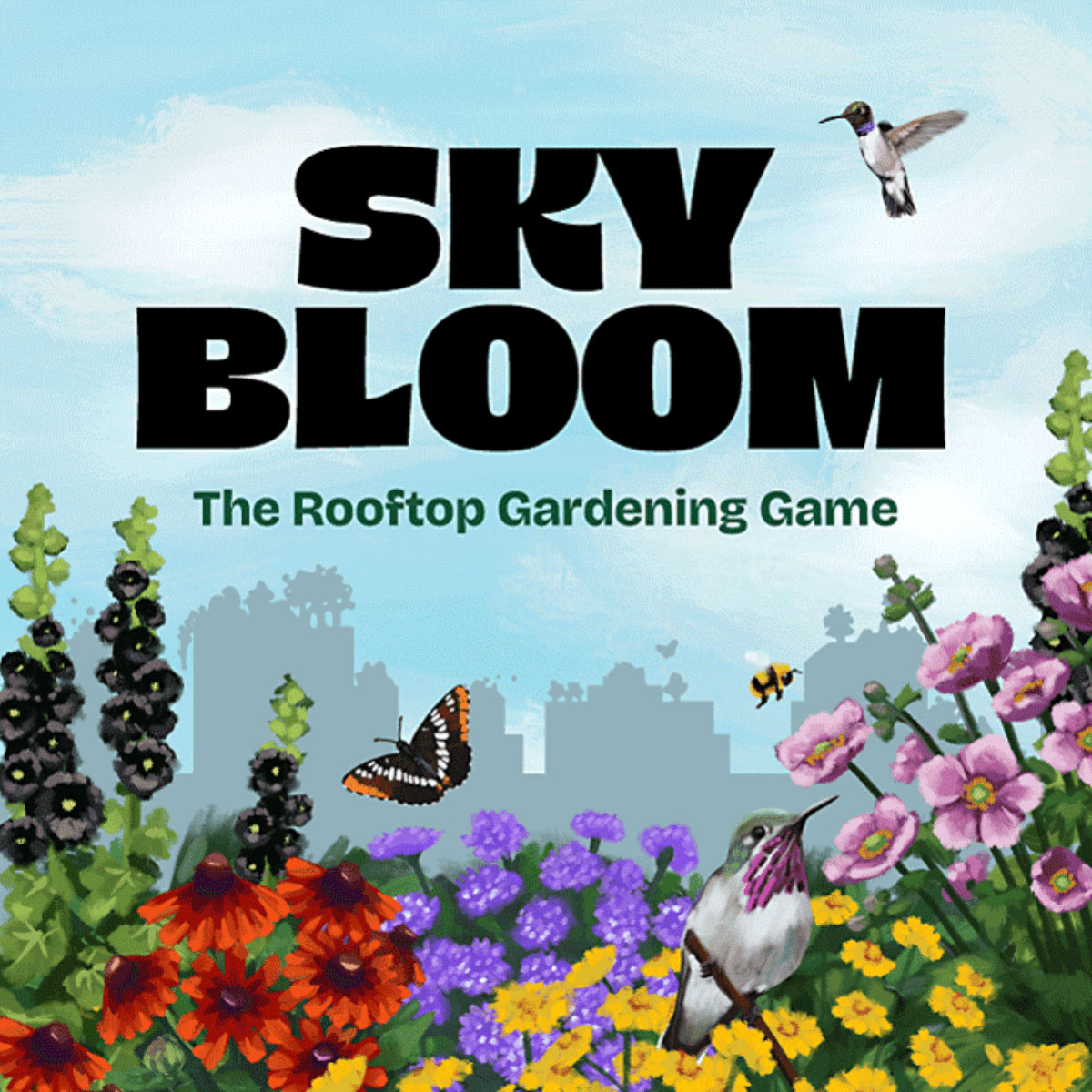
 Merchants of Play is a board gaming platform where users can play official implementations of popular titles such as My Little Scythe, Trailblazers, and Moytura. The CEO, Mack Flavelle, has also used the platform to launch and test his own designs, including Sky Bloom, which will be launching on Kickstarter on October 6th. We had a chance to play a prototype copy of the game, so let’s walk through it!
Gameplay Overview:
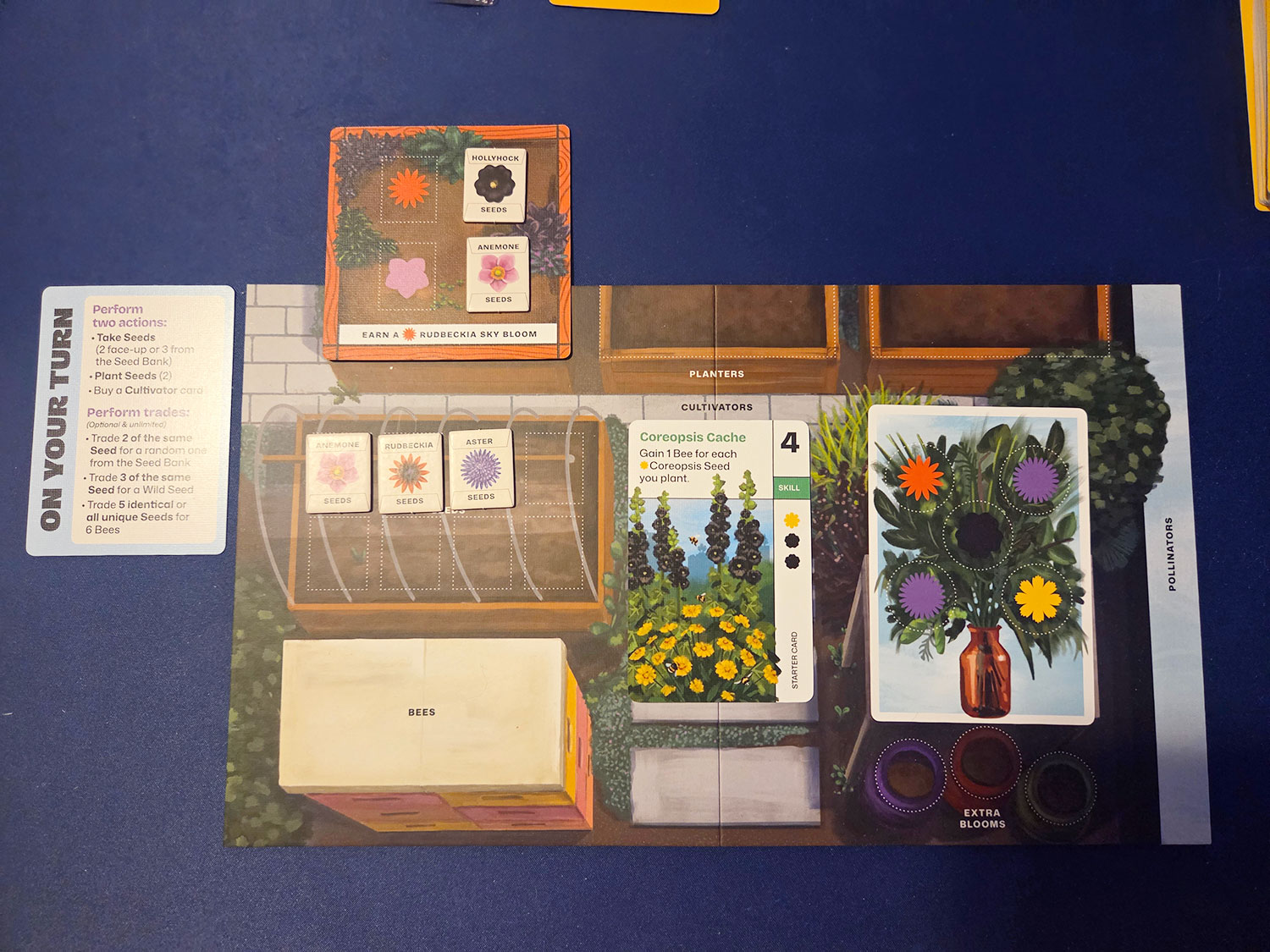
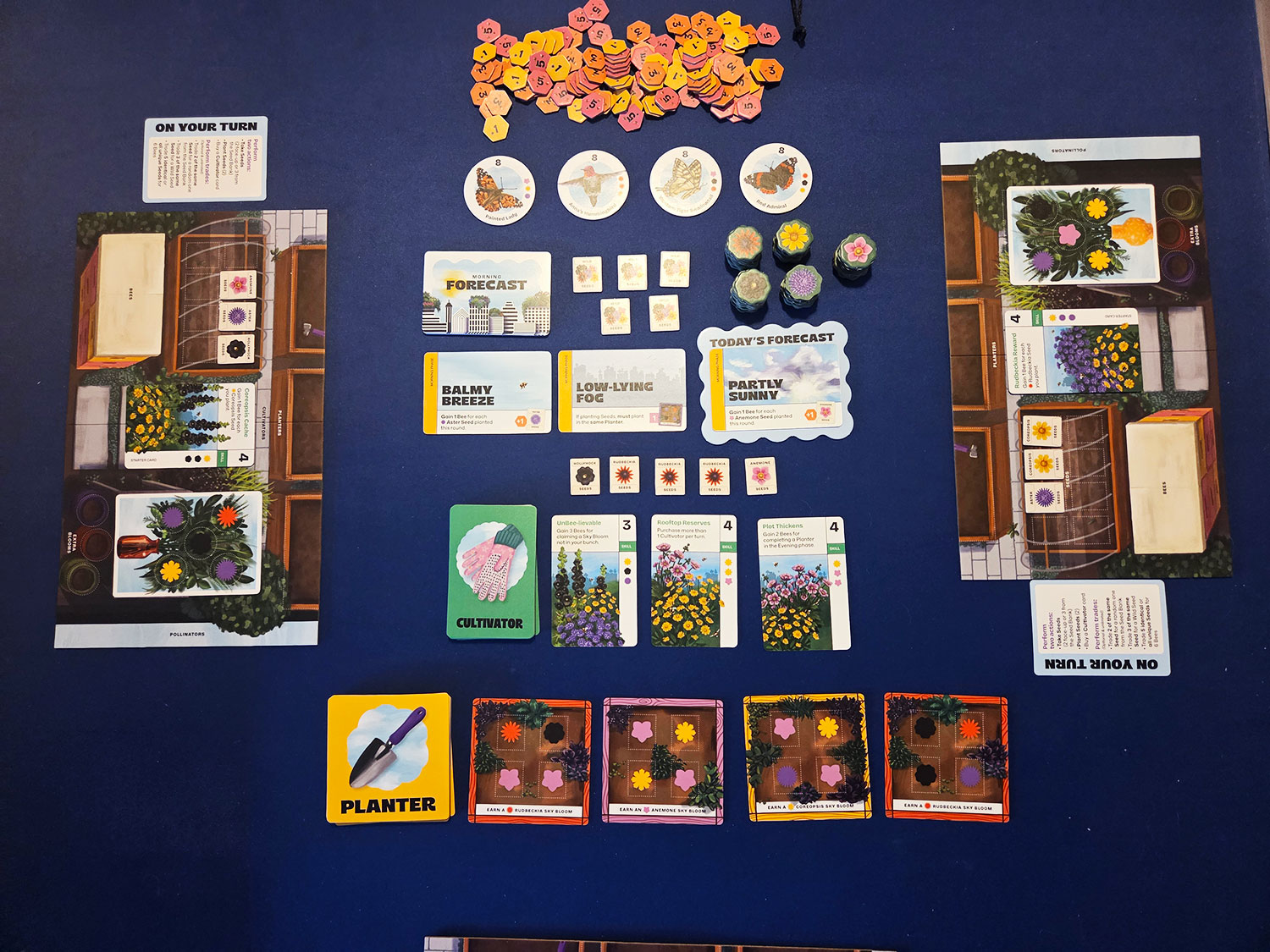
In Sky Bloom, 1-5 players will be taking on the role of a rooftop gardener, attempting to add life and vibrancy to the cold, drab cityscape. Each gardener will be given a Player Mat with room for seeds, bees, cultivators, bunches, blooms, planters, and pollinators. While this may seem like a lot to keep track of, each and every individual system in the game makes logical sense, matched to its real-life counterparts. Players will be acquiring Seeds, planting them in Planters, and getting a Bloom from the Seeds, just like we all learned about in elementary school.
On a player’s turn, they complete two actions from a pool of three possible actions. These actions can be repeated, or players can choose two different actions to complete. Players choose from the following: Take Seeds, Plant Seeds, and Buy a Cultivator.
When a player Takes Seeds, they may take any 2 of the 5 face-up seeds on the table, or draw 3 random seeds from the Seed Bank draw bag. Each player may only store a total of 8 seeds at a time, but may draw over 8 and discard unwanted seeds. In addition, players may make Seed Trades at any time, trading 2 identical seeds for a random seed; trading 3 identical seeds for 1 wild seed; or trading 5 identical (or 5 unique) seeds for 6 Bees (aka Victory Points).
When a player Plants Seeds, they place up to 2 seeds into up to 2 planters. When a player chooses this action, they may take a new planter card from the display. Each planter requires 4 seeds to gain the specific bloom, meaning that in order to get a Coreopsis, you can’t simply turn in 4 Coreopsis seeds, but rather follow the requirements on a planter card that will give a Coreopsis Bloom.
When a player Buys a Cultivator, they are either purchasing a Skill Cultivator, which will give them bonus Bees for completing certain actions; or they are buying a Risk Cultivator, which will give them more Bees at the end of the game for hitting the requirement, but is much trickier to complete. These Cultivator cards are purchased with seeds, but if a player has a bloom of a seed type on their board, that acts as a discount for the Cultivator, and they are not required to turn in that bloom to acquire the cultivator card.
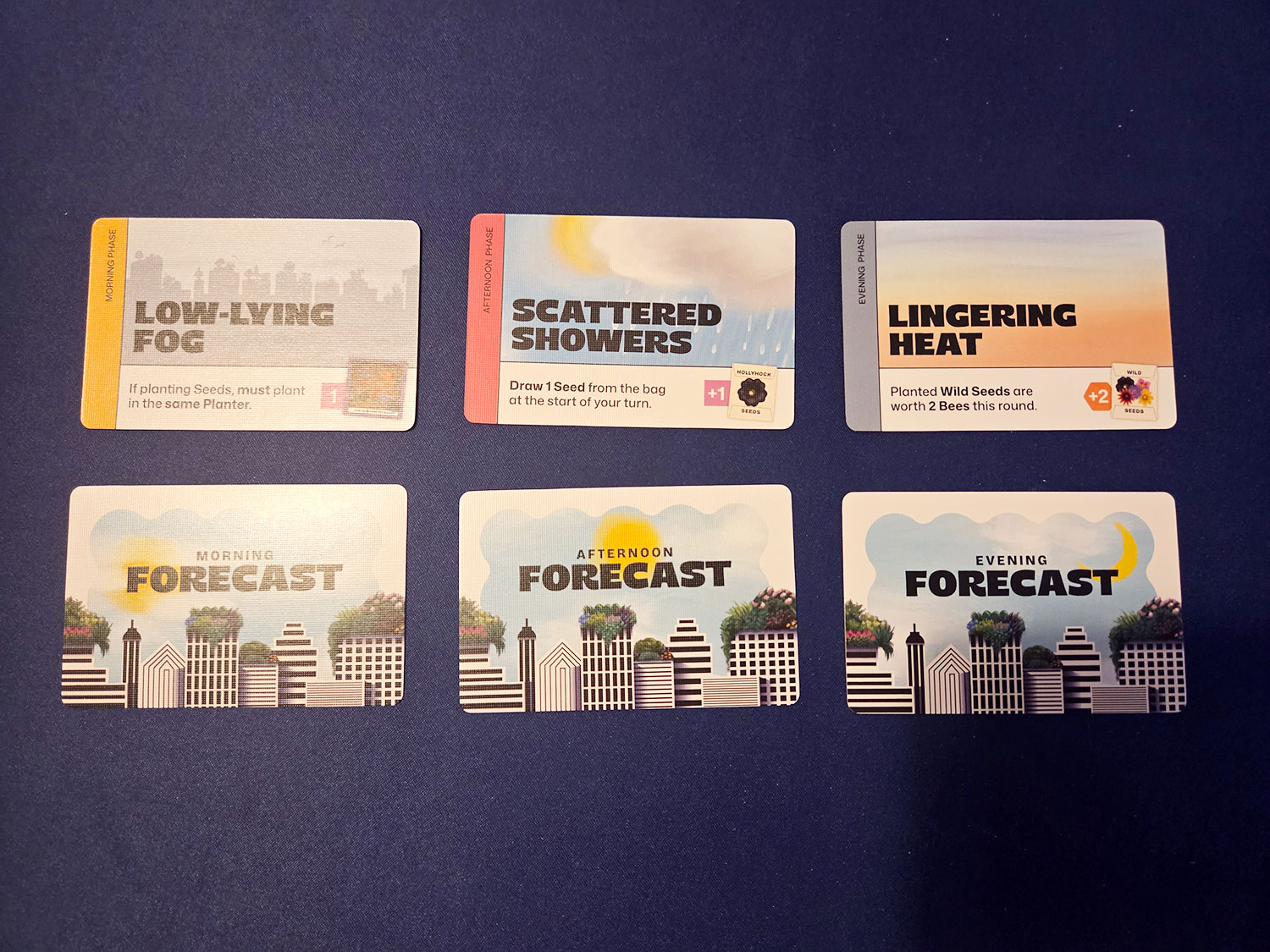
The other two main systems at play are Pollinators and Weather Cards. When a player has the blooms listed on a pollinator, they immediately acquire the pollinator, which will give that player 8 points at the end of the game. The Weather Cards are random event cards that change some rules throughout the course of the game. Some are as innocent as giving players Bees for completing actions in a given round, and some are as cruel as not allowing players to repeat an action type in that given round.
Sky Bloom can end in one of two ways. If a player completes their Bunch card before the Event Card “First Frost” is drawn, they immediately win the game. However, if no player completes their Bloom card before the “First Frost” Event Card, then players will add up their Bees (aka Victory Points) to see who wins the game.
Game Experience:
Sky Bloom feels like the type of game they don’t make anymore: rules light, thematic, and with some real bite to it. The first analog that came to my mind is Photosynthesis (and not because of the theme). If everyone around the table plays heads-down, it’s a thematic, relaxing game that rewards strategic play. If everyone is diligently watching everyone else around the table, it’s a tense game of blocking one another from completing their Bunch card and trying to sneak in as many victory points as possible.
While these two victory conditions don’t inherently fit hand-in-hand together, because racing to complete your Bunch card will not gain you a ton of victory points along the way, it is the push-and-pull between these two conditions that gives this game immense replay value. If a player waits until the last minute to try to collect victory points when they realize there’s no chance for them to complete their Bunch, they won’t have the points to win the game. Conversely, if a player neglects to grow their Blooms at all, not only does that lock them out from lucking into a clutch seed draw to win the game at the last minute, but by having no blooms, the cultivator cards are prohibitively expensive, leading to a shortage of victory points from these cards that seem to give 6-8 points on average.
Again, I can understand from the outside how frustrating this experience might sound, with basically taking big bets with your limited actions throughout the game, but what saves Sky Bloom is its densely packed playtime. I was able to get my plays down to 30 minutes apiece (the box lists the game at 45 minutes, to be clear), and with such a short playtime, this swing-and-a-miss penalty feels like a lesson for next time, not a crushing defeat that leads to never wanting to play it again.
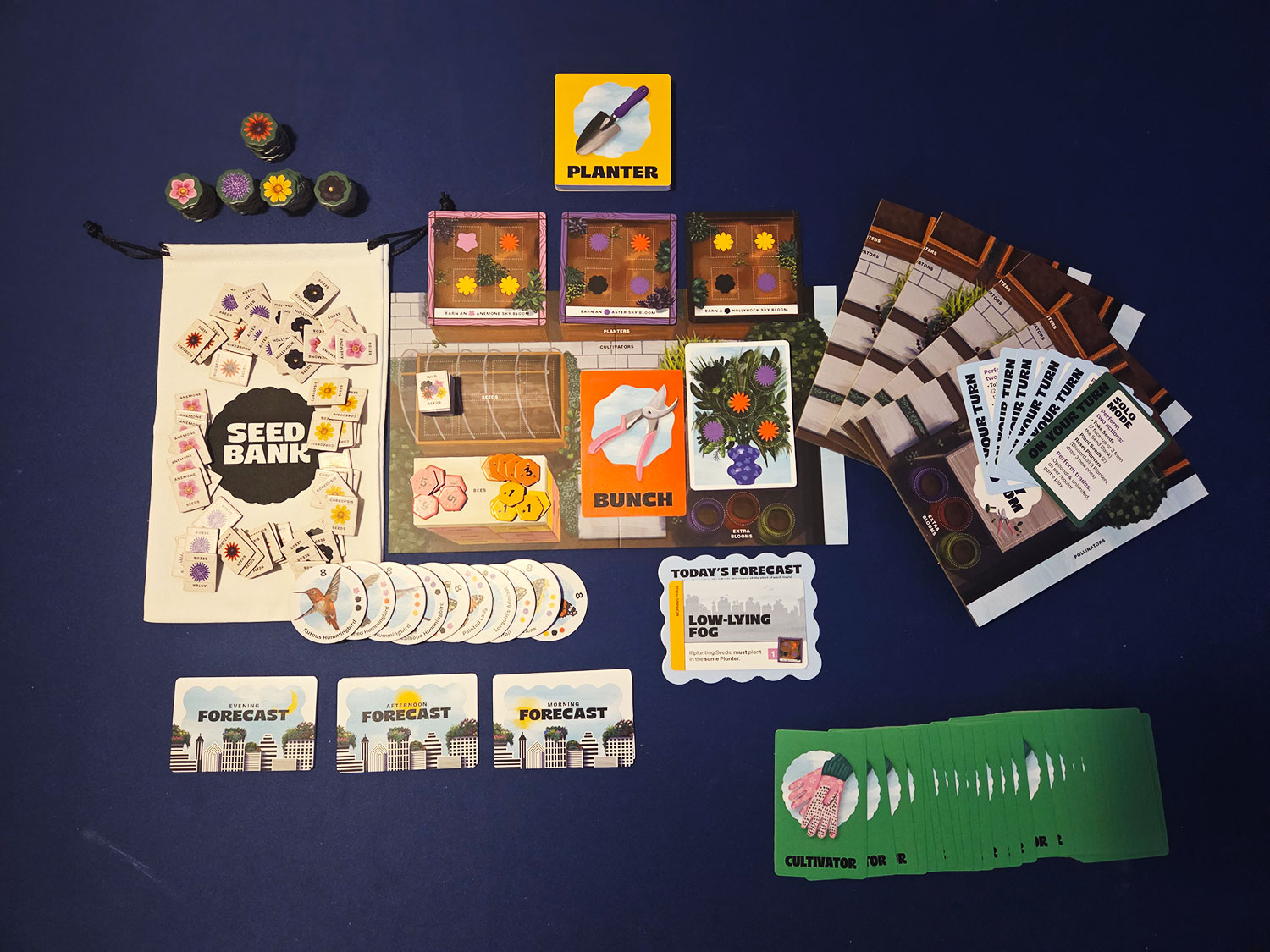
One final note I want to cover is player count. Because the actions are so simple, a player’s turn is often quite snappy. I’ve truly enjoyed this game from 2 all the way to 5 players. Each player count offers a different feel to the game, and I think that heads-down players and confrontational players will eventually find their own sweet spots for which player count they prefer. The real standout here, though, is the solo mode. This is not some substandard “beat your best score” Euro-style solo mode. While there are some major rule changes, like not having the Cultivator cards at all, each solo playthrough is an attempt to complete your Bunch before the game ends. Unlike other solo modes, it is both a great puzzle on its own, and it actually helps you get better at the multiplayer game.
Final Thoughts:
Sky Bloom gives me hope for the future of the Eurogaming space. It has shown that lessons from the late ’90s and early ’00s are not lost within the space, and that not every game will be a heads-down point collector. Sky Bloom has one of the most effective uses of theme I’ve seen in board gaming since Viticulture, and the rules of the game immediately make sense to anyone who has ever picked up a trowel. The game matches the playstyles and temperaments of all groups of all sizes, without compromising on its design. Sky Bloom will be my choice of a gateway game for new hobbyists moving forward, and I think everyone in the hobby should give it a shot.