
I don’t know about you, but I’m always rationalizing why I need to buy another board game. It’s even better when someone else does it for me, so I’m here to help you with that.
If you’re not familiar with the term STEM, it stands for Science, Technology, Engineering, and Mathematics. Every toy store has a STEM section now, governments are spending millions of dollars on STEM education, and the number of jobs being created in the STEM fields is outpacing the number of graduates in the STEM field!
So, to help you rationalize buying more board games, here’s a top ten list of STEM-infused games to help the child in you your life have a bright future.
Top 10 STEM Games for the Kids
 1. Battle Sheep
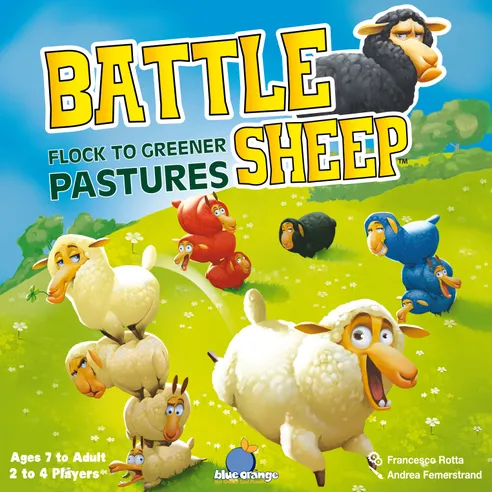
Battle Sheep takes simple rules and turns them into a quick game of spatial grid expansion and territory control. Players split tall stacks of plastic sheep and move them in straight lines across a modular board to trap their opponents and claim the most pasture. Underneath the funny sheep art is an exercise in spatial topology, area control, and mathematical foresight. Kids will learn how to optimize territory control—a crucial skill if they ever hope to manage global supply chains.
2-4 Players • Ages 6+ • 15 minutes • $19
 2. Blokus
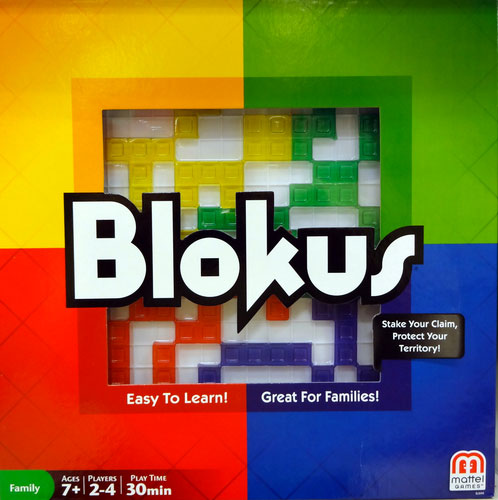
Blokus is a modern classic of spatial reasoning that takes seconds to learn but is full of tactical depth. Players take turns placing Tetris-like polyomino pieces on a board, with the only rule being that your pieces must touch corner-to-corner, never side-to-side. It forces kids to constantly analyze spatial geometry, pattern recognition, and area coverage as the board fills up. Kids get a mental workout while developing sharp, analytical minds.
2-4 Players • Ages 6+ • 30 minutes • $19
 3. Diced Veggies

A lot of kids don’t like eating their veggies, and a lot don’t like doing math either, but Diced Veggies somehow makes both fun. Players use a cardboard knife to separate dice out of a block of dice to complete recipe cards, introducing practical arithmetic, visual grid parsing, and mental addition. It’s light, fast-paced, and never outstays its welcome on the table. If a game can trick your kids into doing math and subliminally normalizes vegetables, it basically pays for itself in health and education.
2-4 Players • Ages 6+ • 30 minutes • $23
 4. Dr. Eureka

Dr. Eureka combines fine-motor dexterity with rapid logical reasoning as players race to pour colored “molecules” (balls) between scientific test tubes to match a goal card. You can’t touch the balls with your hands or drop them on the table, which requires careful planning, sequencing, and hand-eye coordination. It’s a real-time dexterity game that’s training kids in chemical lab safety protocols, set organization, and processing speed.
2-4 Players • Ages 6+ • 15 minutes • $21
 5. Jetpack Joyride

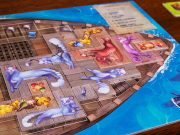
Jetpack Joyride takes the frantic, classic mobile game and turns it into a tile-placement puzzle. Players lay down polyomino shapes, dodging lasers and grabbing coins as they navigate through a laboratory layout. Mechanically, it forces kids to exercise spatial reasoning, pathfinding, and geometry. This is basically prerequisite training for future astronauts.
1-4 Players • Ages 8+ • 20 minutes • $30
 6. PitchCar

PitchCar is your modern-day Crokinole. Kids, seniors, and everyone in between love playing this game. In PitchCar, you get to flick wooden cars around custom-built racetracks. On the surface, it seems like it’s just a dexterity game, but it’s actually a hands-on physics laboratory. Kids are constantly adjusting vector trajectories, calculating kinetic energy, and testing the angle of reflection off the wooden rails. If you don’t help your kids master calculating force and surface friction on wooden racetracks now, how are they ever going to pass Physics class later?
2-8 Players • Ages 5+ • 30 minutes • $99
 7. Robot Turtles
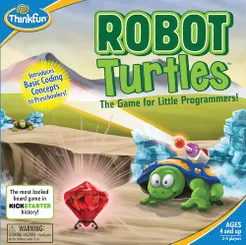
Robot Turtles might be the best introduction to programming for younger kids because it teaches the core logic of coding completely screen-free. Kids act as the “programmers,” playing card commands to move their turtles, while parents act as the “computer” executing their code and making funny turtle noises. It introduces command sequencing, functions, and debugging when a move goes wrong. Kids are learning JavaScript logic before they can even spell it.
2-5 Players • Ages 4+ • 13 minutes
 8. Rhino Hero Super Battle
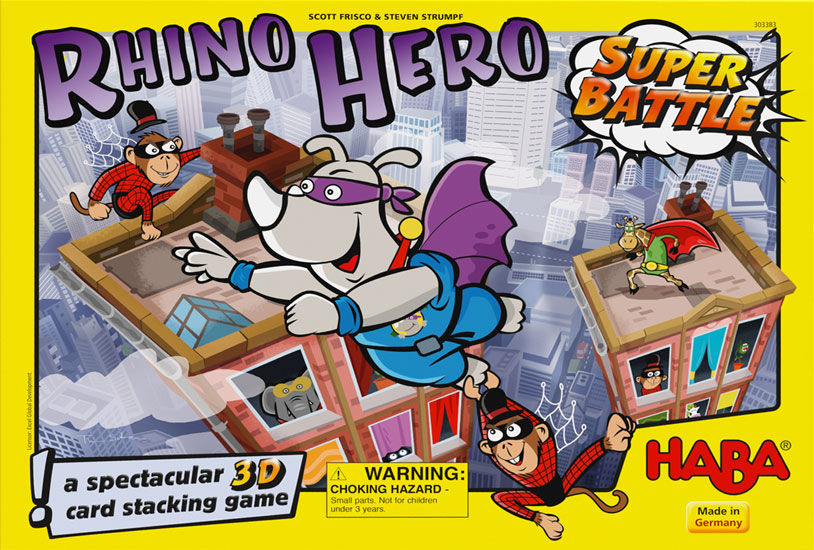
Kids naturally love building towering structures, and Rhino Hero Super Battle takes that love and puts it into a lighthearted tower-building game. As players construct a skyscraper out of folded card walls and roof tiles, they have to carefully balance a wooden rhino on the upper floors. It’s a course in structural engineering, balance, load-bearing walls, and center of gravity. You’re investing in your child’s future as a civil engineer.
2-4 Players • Ages 5+ • 15 minutes • $29
 9. Tuki

If you want an engineering game with some speed, Tuki is that game, and it’s super easy to pick up. Players race to build 3D colored structures out of wooden blocks based on a drawn card, using neutral snow blocks as temporary structural supports. It heavily tests spatial visual processing, 3D architecture, and rapid problem-solving under a clock. Kids are learning to be architects and surgeons without even realizing it.
2-4 Players • Ages 8+ • 30 minutes • $29
 10. Turing Machine

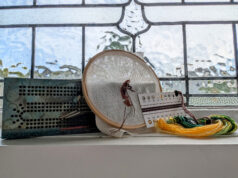
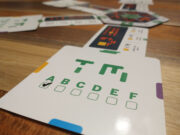
The Turing Machine is pretty much a mechanical computer that uses punched cards to solve complex logic puzzles. It turns math and binary deduction into a deeply satisfying, tactile detective puzzle where you try to outsmart an analog “computer”. It’s an incredible tool for teaching algorithmic thinking and step-by-step problem-solving without a screen. Coding bootcamps cost thousands of dollars. Buying an analog logic puzzle is practically saving your family thousands on a future computer science degree.
1-4 Players • Ages 12+ • 20 minutes • $39
Is there a game you need help rationalizing to buy? Let me know, and I’ll see if I can help!