 Castles of Burgundy is one of my favorite board games, and when I learned that Stefan Feld had a new game with a druidic theme, I was intrigued. The forest and its mysteries await; let’s journey in.
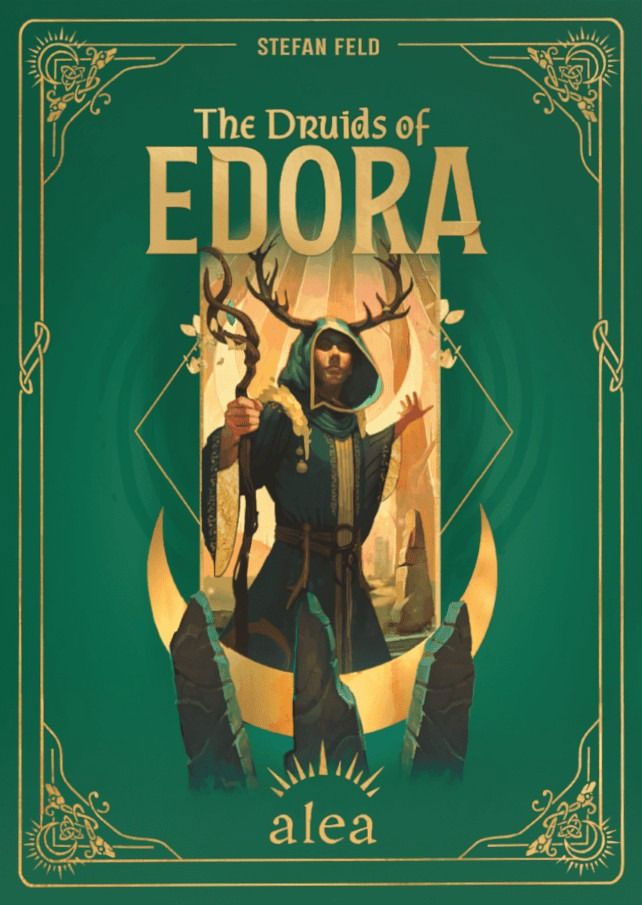
The Druids of Edora, published by Ravensburger, is a dice-rolling and worker placement board game. It plays over 13-15 rounds in about 90 minutes and rewards the resilient.
Game Play Overview:
Before the game begins, you set up a modular board based on player count, randomly arrange medicinal herbs along your medicinal herbs track, and roll all your dice. These actions let you take early control of the luck-driven side of the game. Like much of life, it’s what you make of luck that counts.
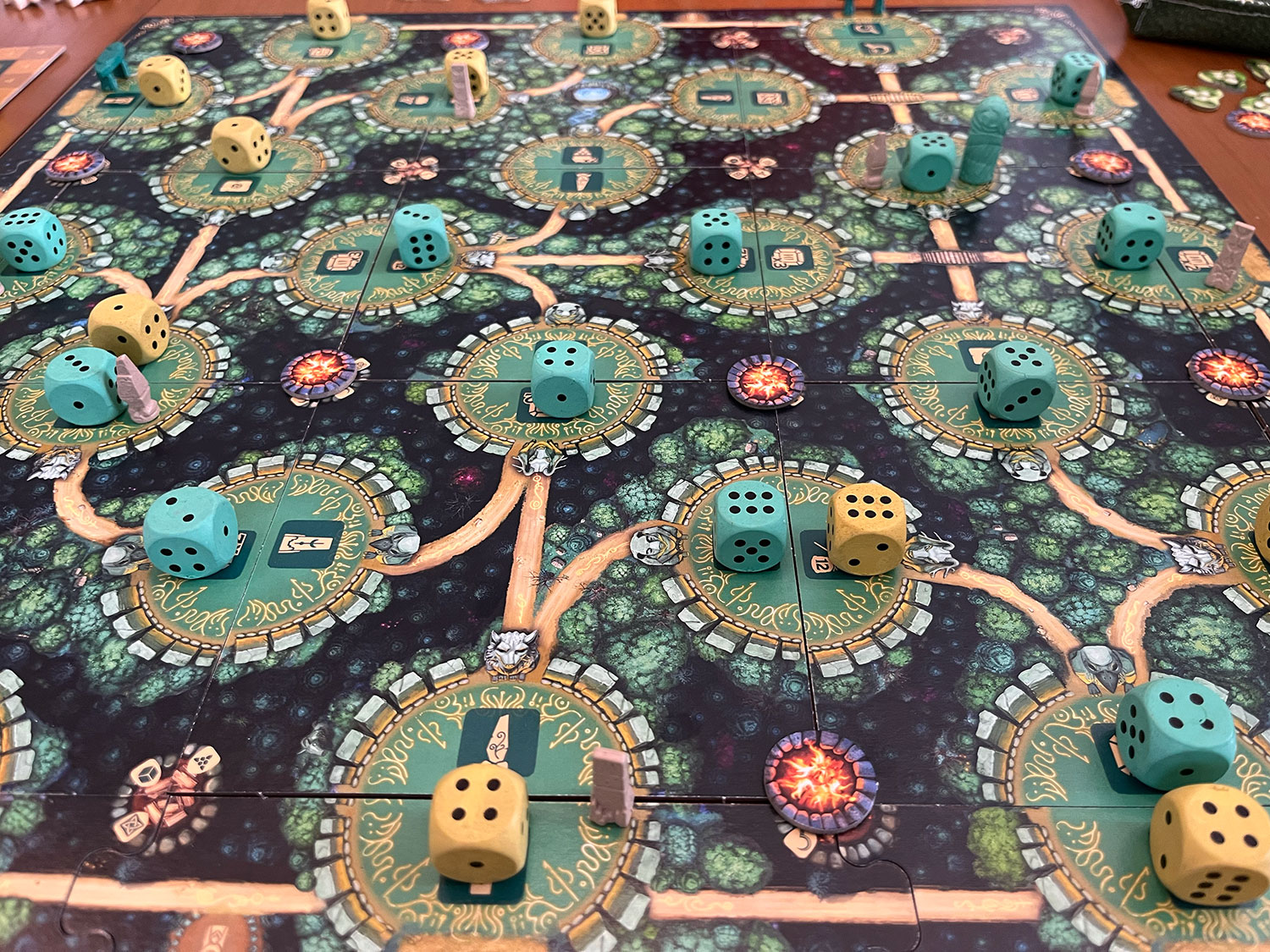
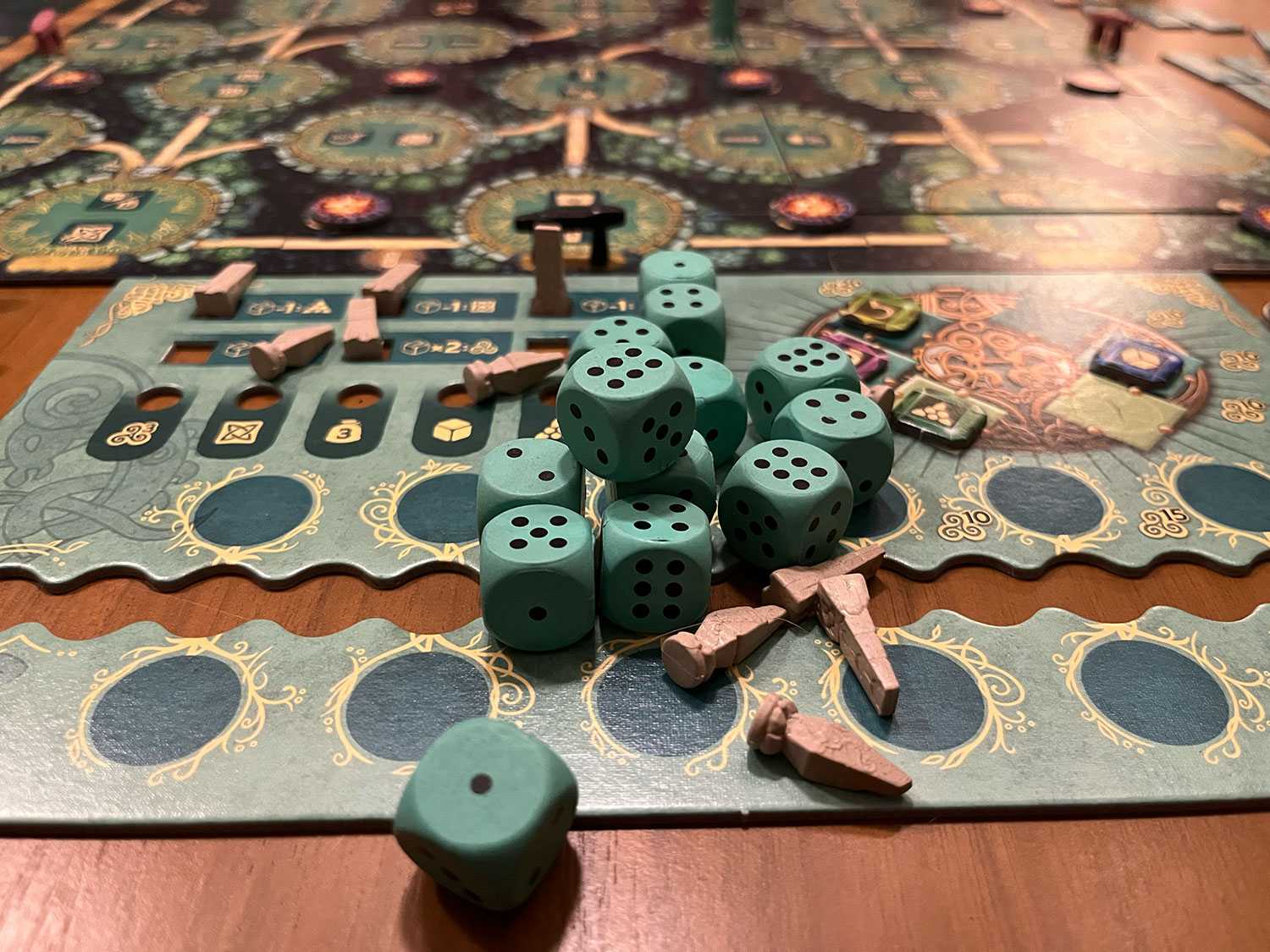
Each player begins with a druid, 13 dice (4 in hand, 9 in reserve), and 12 provisions to pay for movement and actions. Each round, you move along paths through the forests to reach shrines. There you place a die of your choice to ultimately:
- Collect provisions
- Draw dice from your reserve
- Place a standing stone or rune stone
- Collect a stone tablet
- Add a gem to an amulet
- Gain prestige (victory) points
- Take some mistletoe, buy a potion, and brew it
- Move along the energy or medicinal herbs track
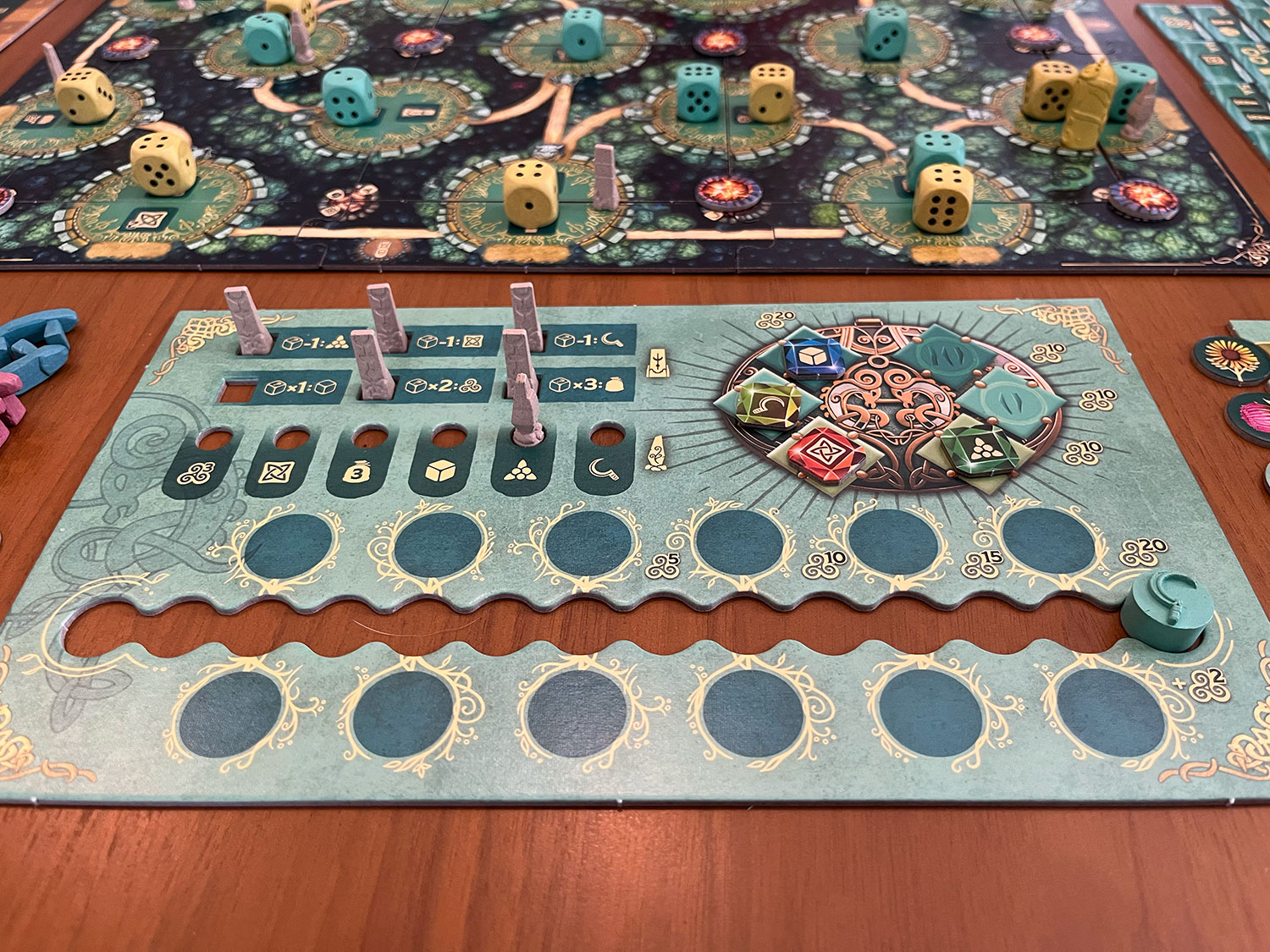
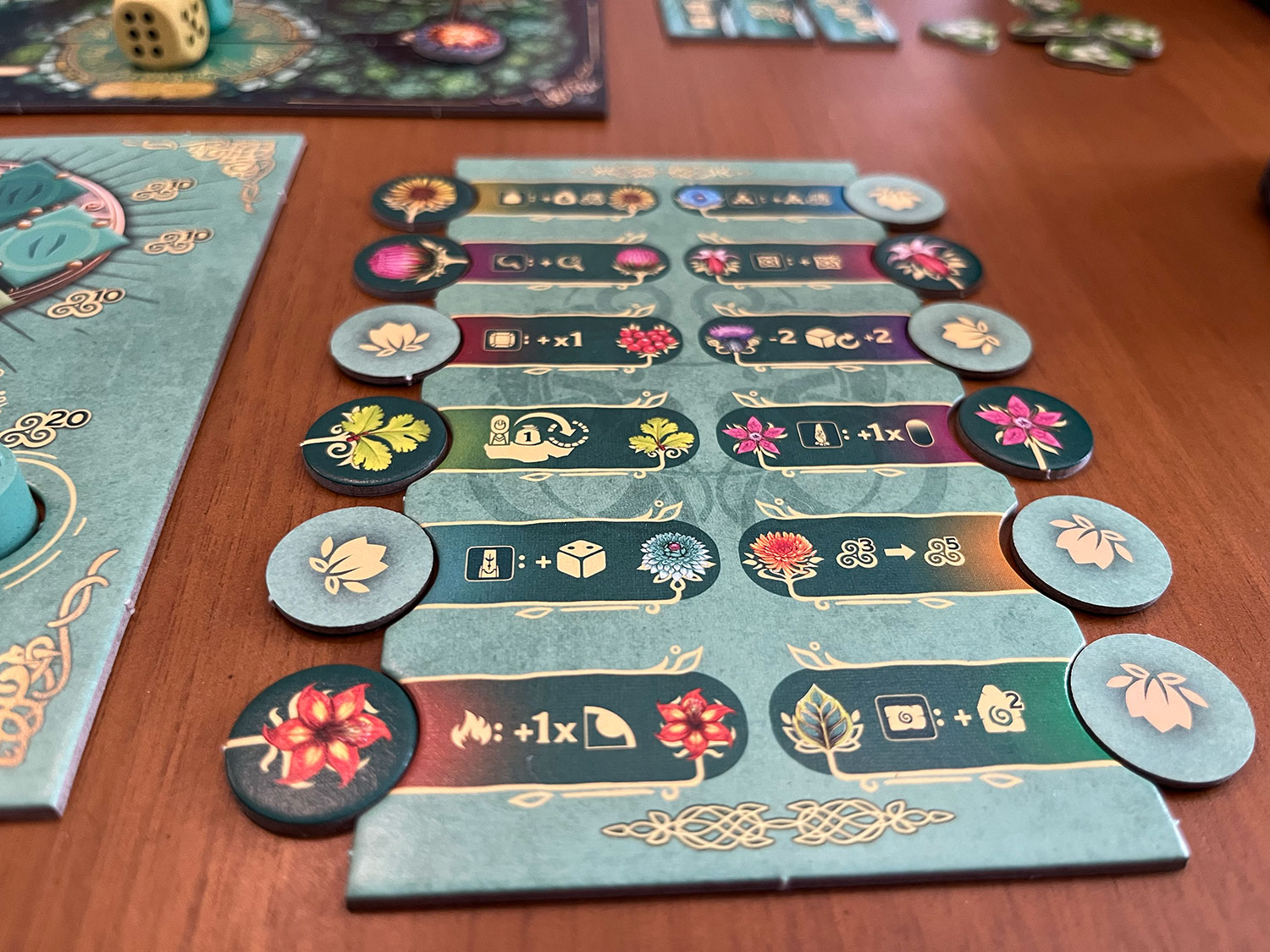
Phew! Many of those choices lead to end-game points. You’ll also compete for prestige points if there is more than one die at the shrine, with the winner claiming 2 prestige points. Now, perform the action based on your die placement. Moving along the medicinal herbs track unlocks botanicals, which earn passive points or other benefits throughout the game.
You may also surround a fire by occupying each shrine adjacent to the fire, which garners bonuses. You might create a connected path to the same colored dolmens, again, gaining points. And after evaluating those potential actions, you may have released medicinal herbs for placement on the small player board to unlock a potion or two, which will often have a passive effect for even more scoring.
Game Play Experience:
I really enjoy Druids of Edora. It arrived on a day when I badly wanted to pop cardboard, and there’s a satisfying amount of it to pop. (I regret not taking a picture.) The wooden dice are a nice touch and the art is highly thematic. Wooden dolmens and druids would have completed the set.
Setup is more intense than average, but everything is color-coded, and the iconography matches pieces to their spots on the four boards you’ll interact with. That sounds like a recipe for a table hog, and it isn’t. The rulebook lays out what you need, and early turns are straightforward, so teaching goes smoothly even with plenty of rules to track. The ruleset and its many tracks can be fiddly, but the rulebook keeps you moving.
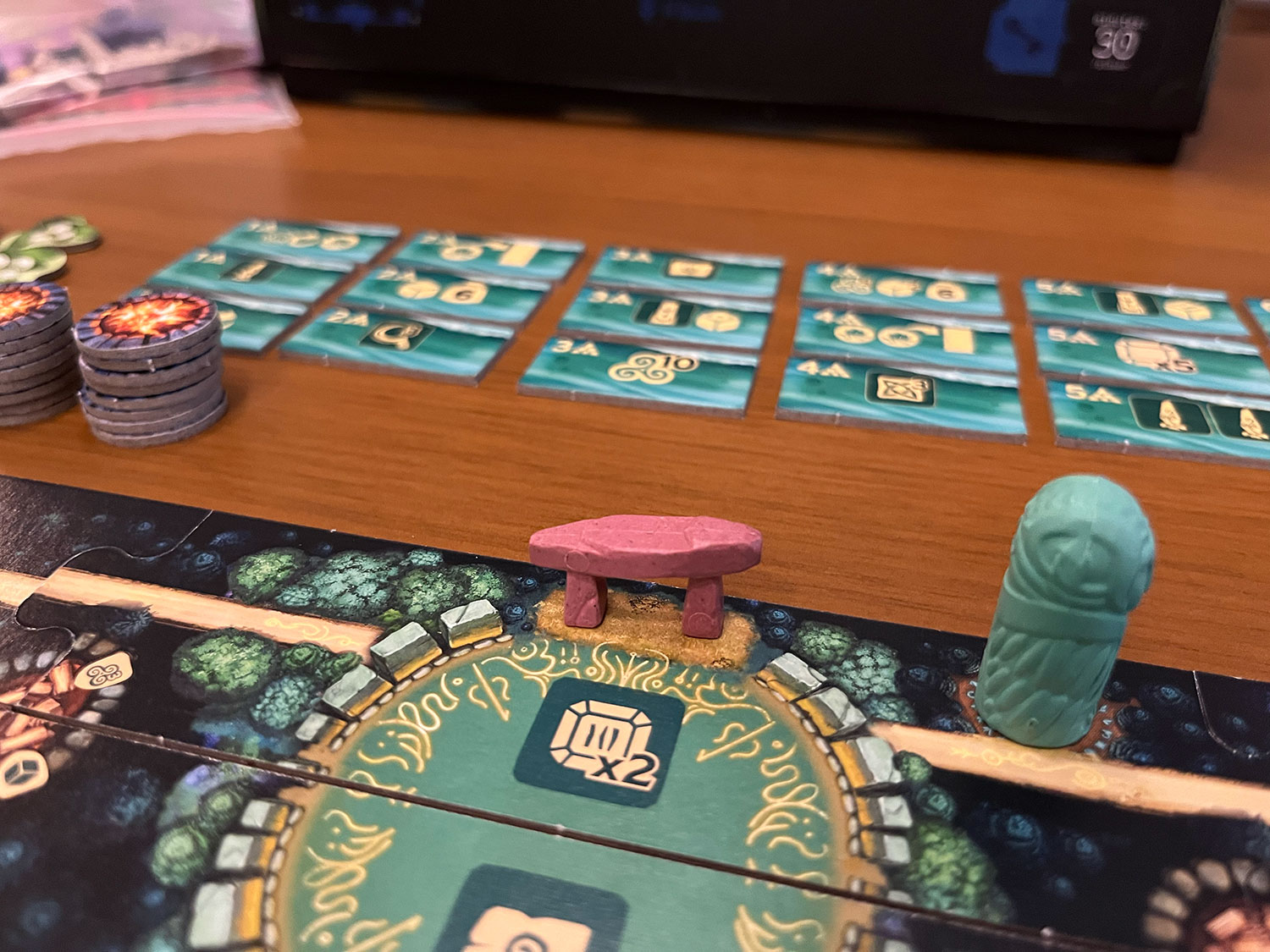
I wouldn’t ordinarily praise a game with multiple luck mechanisms, but the timing won me over. Everyone rolls up front, and the modular board and medicinal herbs are revealed at the same moment, so you can plan around your luck before the first move. The 13 dice also cap the rounds while constraining your strategy.
A low roll doesn’t knock you out, but it forces a choice: find other ways to win the shrine, or abandon that path to victory. In my game, a low roll sent me toward knowledge to multiply the shrines I could win, and toward maxing out points with potions. I stayed competitive, but I neglected the dolmens and had to settle for the consolation of a single one. I finished third out of four. Point stacking and passive rewards early can carry a low roller, especially at two players, where interaction can be nonexistent. But as I learned in my first 4-player game, you’ve got to compete at the shrines and with the dolmens.
The game runs on two interlocking mechanics. The first is resource management, which anchors every turn. You need a die and provisions each round to make a move, or you’re forced into a druid in distress turn. A druid in distress gains a die and provisions but forfeits movement, and thus the chance to claim a clearing and all its rewards. I’ll happily argue for managing your turns well enough to avoid it, though some might find some strategy in claiming distress. The tension is that gaining dice or provisions costs those same scarce resources, which trades off against activating the things that earn victory points.
The second mechanic is Druid movement and area control. You vie for clearings for end-game scoring and race to connect same-colored dolmens for serious in-game points. A player focused on dolmens can take the lead quickly.
Druids of Edora plays differently at 2 than at 3 or 4, and 3 or 4 is the sweet spot. At two, it’s less robust. Interaction feels superfluous, though end-game scoring can still swing the result, and you feel the tension of carving your own path to victory. At 3 or 4, the competition for clearings and dolmens is tough. The modular board helps throughout, scaling to player count and varying your victory paths from game to game.
What keeps me coming back is the abundance and the narrowing. The game offers many choices and demands that you commit, and those trade-offs make me want to get it back to the table. Feld fans will find the familiar feel: dice-driven movement, modularity, and multiple point tracks.
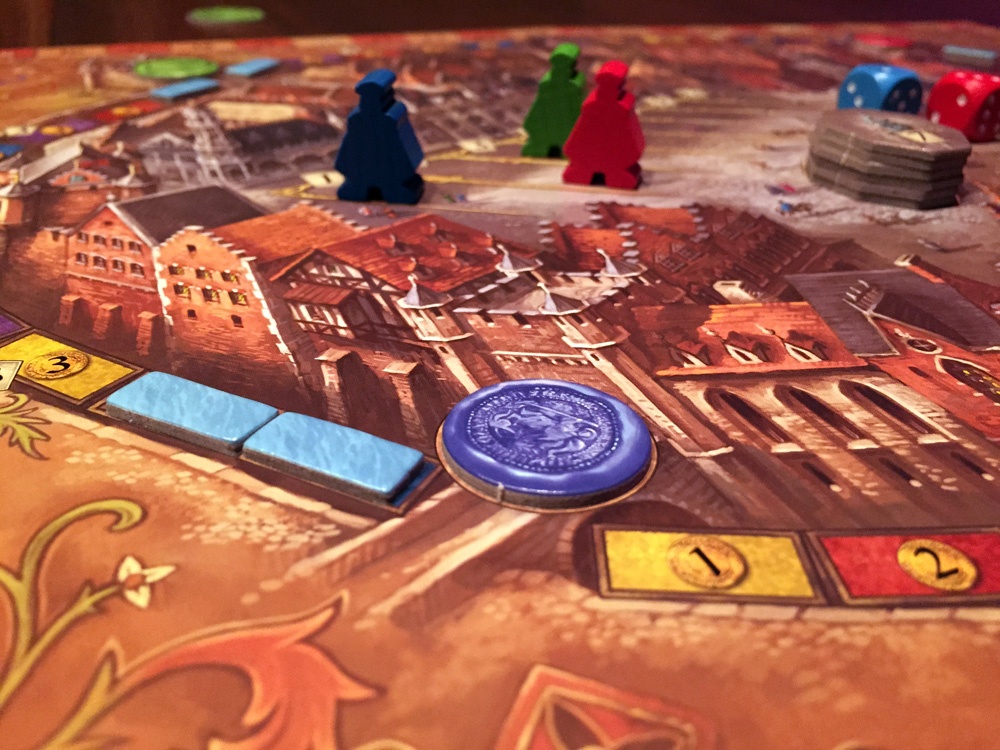
I suspect the theme causes me to see this game as less set up intensive than it is. There’s a gorgeous canvas of greens and golds with details, like the animal statuary at each of the shrines, that make putting the board together engaging. Studying the medicinal herbs and the small board they pair with feels like part of the learning I want to accomplish rather than a drudgery of small parts to put together. That I had to stop and examine my thoughts about how the art shaped my experience says something about how well the theme comes through. Do I feel like a druid or priestess honing my craft? No. Do I feel immersed in another place for 60-90 minutes? Yes.
Final Thoughts:
The Druids of Edora may cast a spell on euro fans who enjoy mid-weight games with multiple point tracks and the modularity of the setup that forces some fresh thinking on strategy, at least for a handful of plays. Dare I say that there’s something cozy about this brain-burn? There is for me, and it’s in the way the artist has executed the theme. There’s also plenty to keep mid-weight lovers thinking and plotting, especially in a 3 or 4-player game.
Final Score: 4 Stars–a solid mid-weight Euro with great art and theme and love that start-of-game dice roll
 Hits:
• Luck you can plan around. Luck becomes a puzzle instead of a surprise.
• The squeeze on dice and provisions.
• Many paths, forced narrowing: you can’t chase them all.
Misses:
• Interaction at two players feels superfluous
• Fiddliness. Setup is more intense than average, and the many tracks take effort to keep straight