
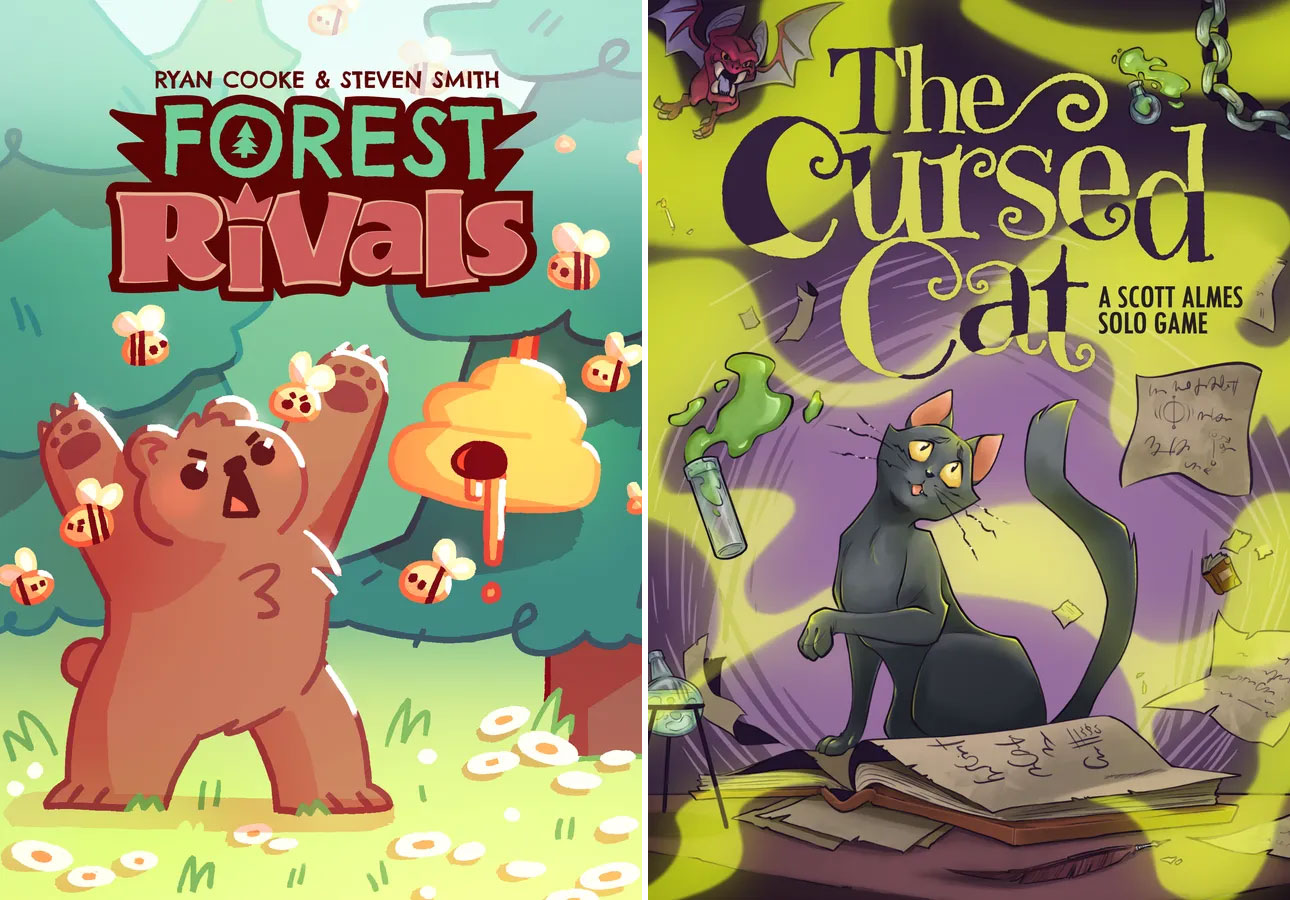
 What’s a better way to spice up your summer travel plans than packing new micro-games from Button Shy’s Summer 2026 collection. I’ll be giving a preview of two of the new titles, Forest Rivals (for 2-players), and The Cursed Cast (for solo play), both consisting of 18 cards and playing in around 10 minutes.
Forest Rivals
The first title, Forest Rivals, has an appropriately summery theme, if immersing yourself in the woods is your idea of a fun vacation. Designed by Prof. Ryan Cooke and Steven Smith, with art by Manon Mergnat, Forest Rivals has each player embodying a group of either bears or bees who are fighting for control over honey pots—which is great, since that must make them too busy to terrify the local campers and hikers!
Gameplay Overview:
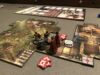
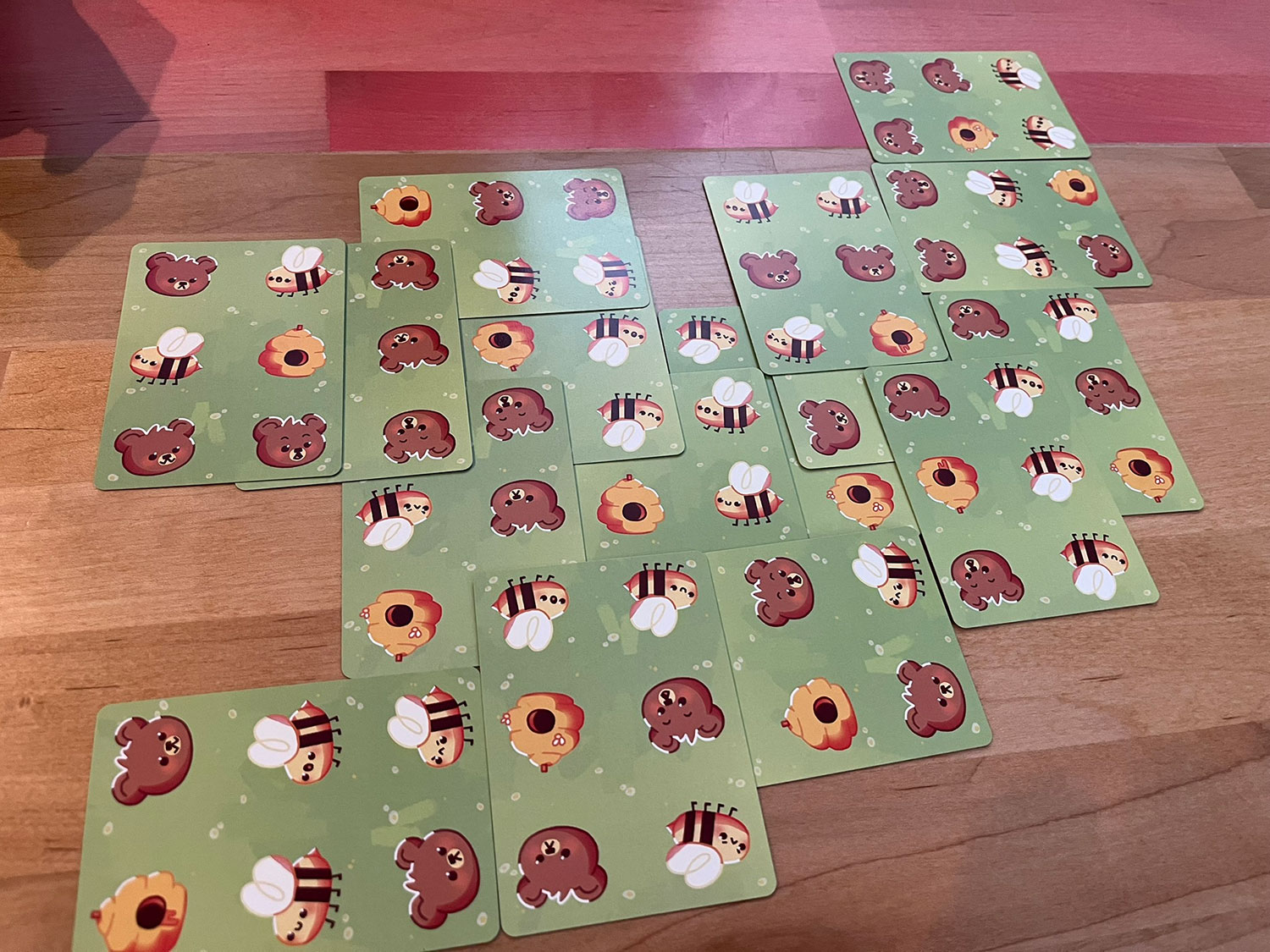
To start, each player will take their respective deck of bear or bee cards and shuffle. Every card contains 6 symbols arrayed as a 3×2 grid. For the bears, this will be some arrangement of 3 bears, 2 bees, and 1 honeypot. For the bees, this is some arrangement of 3 bees, 2 bears, and 1 honeypot. On a turn, a player will draw a card and play it to the common landscape being created by the two players. Cards can be rotated and placed such that they are covering a maximum of 3 already existing symbols. The key placement restriction is that every newly placed card must always be orthogonally adjacent to at least one matching symbol already in the landscape.
Players are attempting to earn points as follows:
- 1 point for each fully surrounded honeypot controlled by your character
- 1-3 points for the largest contiguous group of your character
Once the last card is played, points are summed to determine the winner.
Game Impressions:
Forest Rivals is an elegant design—simple enough to play with kids, but thinky enough for all levels of adult gamers. The random order in which the cards come out and the ever-expanding options for card placement as the game progresses means no two games will ever be the same. Replay value is truly excellent. For a game with 8 turns per player, it’s also impressive that there is such an arc to the gameplay. Early game, there may only be two area-control contests to ponder, but by late game there can be as many as 16. And just because a honeypot has already been fully surrounded doesn’t mean the contest result is locked; your opponent can swoop in and be a buzzkill by covering, say, bear symbols with bee symbols to tilt the contest in their favor.
Surrounding honeypots must also be balanced with building a relatively larger contiguous grouping of symbols than your opponent, and these two objectives do actually fight each other. If you’ve clustered all your densest grouping of bear symbols together, then you may not have sufficient area-majority numbers around the dispersed honeypots on the landscape; it can be a bear to prioritize both.
The layering nature of the cards feels similar to other Button Shy titles like Circle the Wagons and Sprawlopolis, except that the head-to-head dueling nature of the shared map puts players on both offense and defense when considering each placement. This is the type of game where players best have their claws (or stingers) ready to steal majorities and do what it takes to earn those sweet honey points.
I only have one hairy point to raise, which is that in my 8 test plays, the second player did seem to have a consistent advantage, even with the game’s built-in +1 point for the first player. Nonetheless, if you play two games back-to-back swapping first/second player, this can be evened out. Fortunately, the game is short and addicting enough to warrant multiple successive plays.
The Cursed Cat
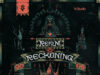
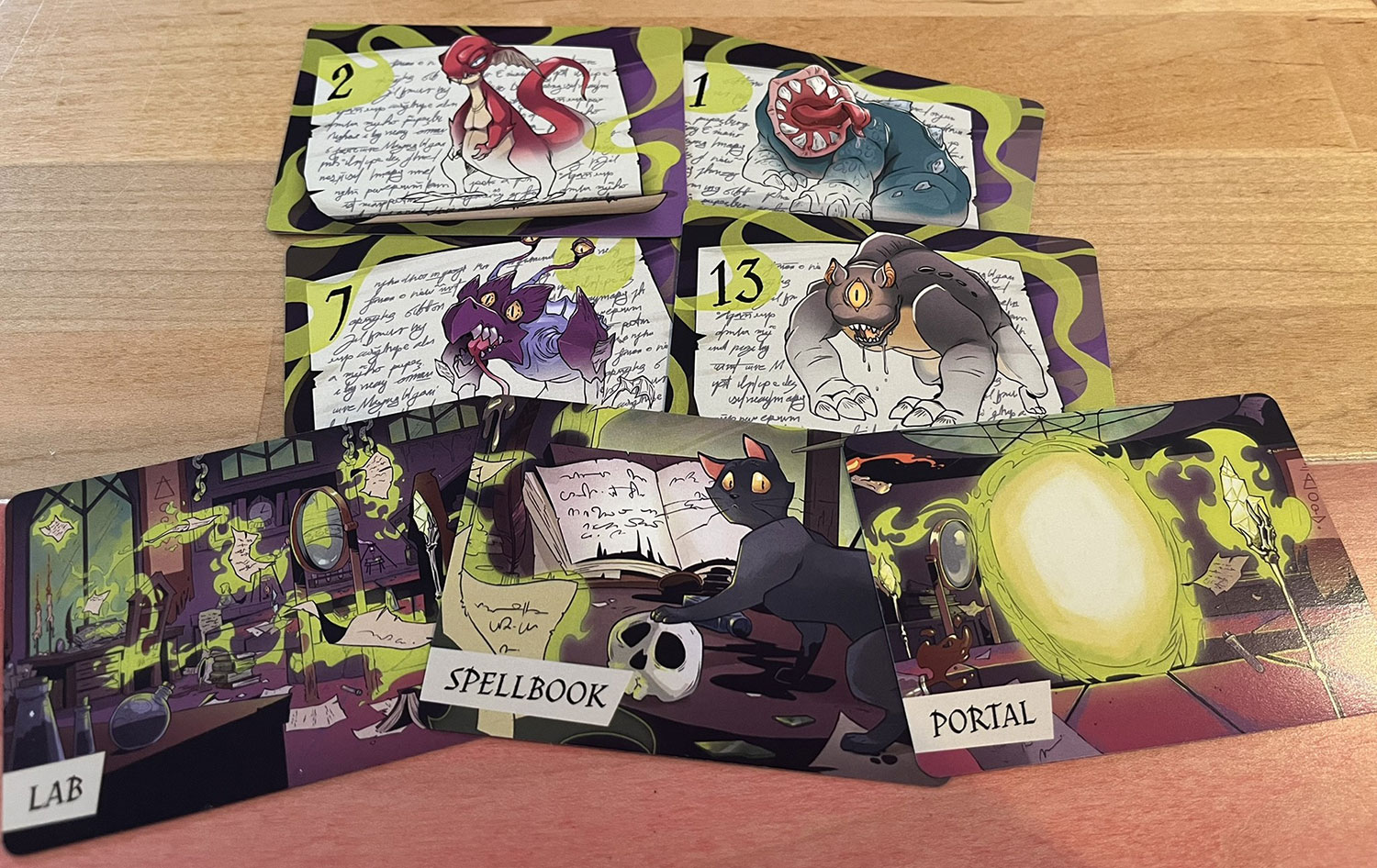
The Cursed Cat takes place in a laboratory—something I can relate to as a real-life scientist. Typical lab policy states no felines allowed, both because they won’t wear closed-toed shoes, and practically speaking, they’d be waiting for their chance to knock an Erlenmeyer flask off the bench. The premise of the Cursed Cat is that you’re a witch/wizard who has made the fatal flaw allowing your feline familiar into the lab space. This cat has hence wreaked havoc by summoning all sorts of mystical beings and monsters into the lab, of which it is now your task as the player to organize and banish via a portal.
Gameplay Overview:
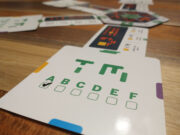
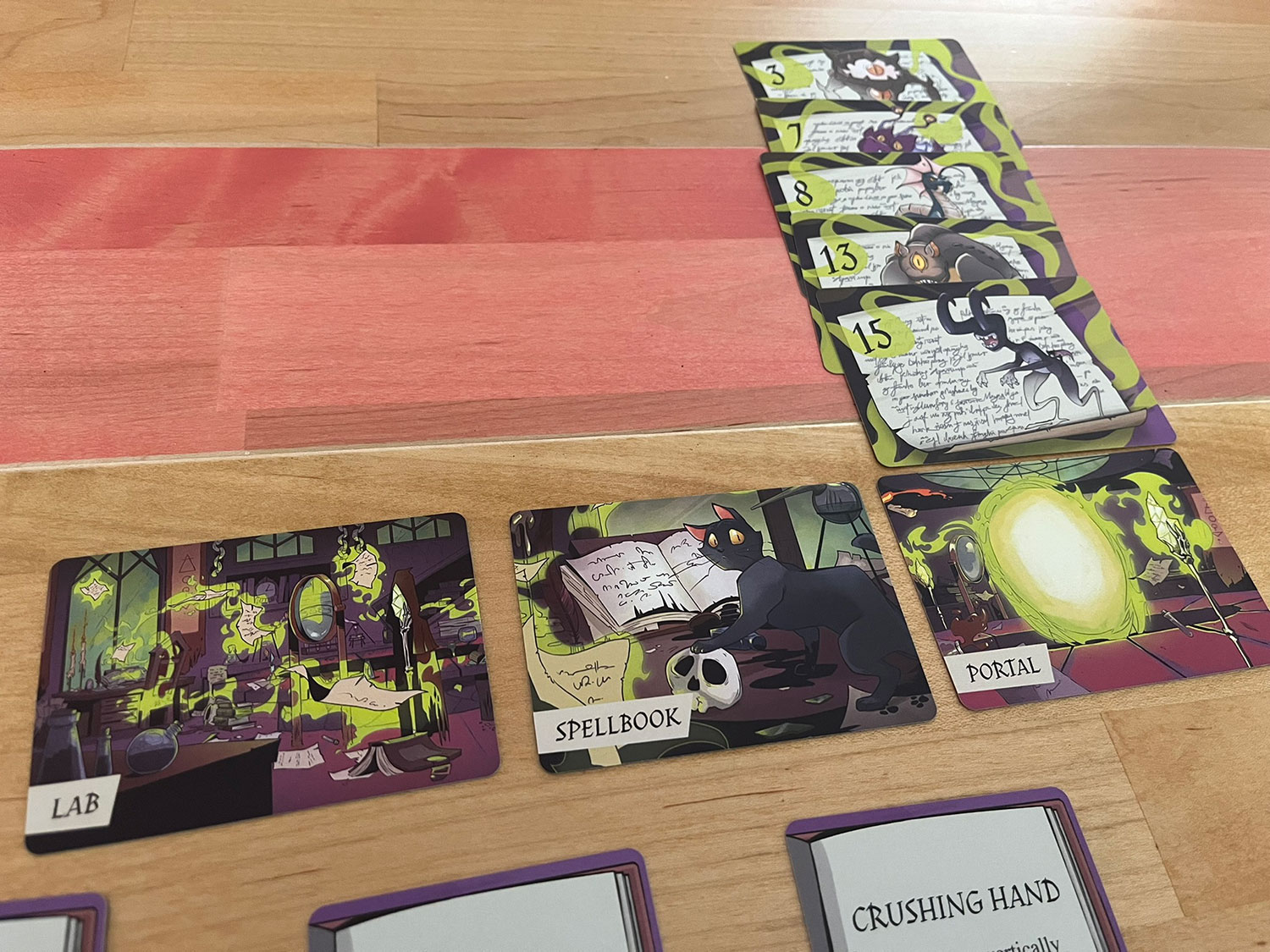
Set-up involves randomly stacking a certain number of monsters, each with a specific numbered value 1-15, above each of three zones: lab, spellbook, and portal. The precise layout is determined by whether you’re playing on easy, medium, or hard. Below the zones, three cards will be flipped spell-side up, and the remaining cards will form a deck spell-side up.
On a turn, you may move 1-2 monsters according to the following rules: (1) the monster being moved must currently be at the top of its stack, and (2) monsters may only be placed upon empty zones or atop monsters possessing a higher numerical value than themselves.
Following these moves, you MUST cast one of the 4 face-up spells, after which it will be discarded. Each spell possesses unique functions like banishing monsters, breaking rules, and monster rearrangements. If the spell is executed fully, your next turn carries out as normal (1-2 moves), but if you cannot or choose not to fully execute a spell, your next turn will be limited to 1 move.
The goal is to line up all remaining monsters in ascending order within the portal zone before you run out of spells.
Game Impressions:
Players familiar with Food Chain Island will definitely feel the design DNA from Scott Almes in this latest title, which is a similarly fun and puzzly solo experience. The core gameplay of moving cards left and right among 3 columns is reminiscent of a Ball Sort Puzzle with the colored balls in test tubes, which is fun enough. However, most setups of The Cursed Cat would be impossible to solve according to normal numerical ordering moves without use of spells. The tricky part is deciding which spells to use and in what order to achieve a win. Efficiency is key, as depending on difficulty, you will only get so many turns. I have had many a play at both medium and hard difficulties where the puzzle was imminently solvable, but I ran out of spells (and thus lost).
Whether this is a better game than Food Chain Island will depend on the gamer. Food Chain Island contains perfect information after the initial set-up, as well as the same 16 abilities in play with each game. Thus it’s more feasible to plan out every turn with minimal luck, as well as develop a meta over successive plays. The Cursed Cat plays out a bit more variably from game-to-game. Fifteen cards comprise the main game, with a numbered monster on one side, and a unique spell on the backside. If a monster is in-play inside the lab, its spell will not be available to you this game. Furthermore, the game starts with just 4 spells visible and available. Only the spells placed within the deck allow new spells to come into play after use, and there will be some level of mystery as to which spell will be available next. Even if you did memorize the deck, there will be some amount of push-your-luck with respect to the ordering of newly available spells.
For gamers who enjoy crunchy puzzles with ample forward-planning and a touch of luck, the Cursed Cat is a meaw-some solo experience.