

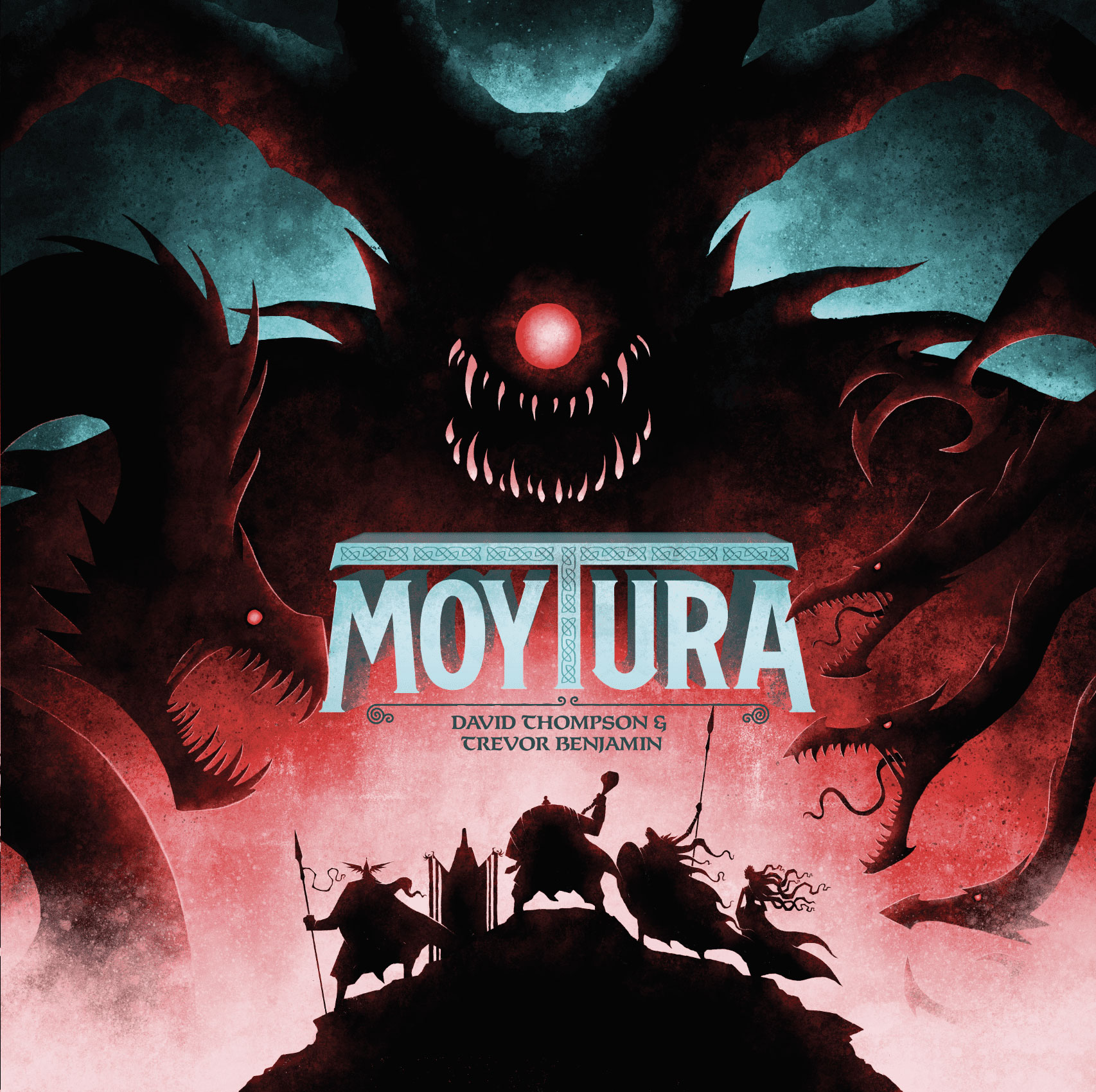
 Here are two facts you should know about me: I love area control games, and I often only get to play board games with two players. Sounds like a conundrum, right? Well! Moytura pitches itself as a two-player area control game with the feel of a five-player game, thanks to three bot players. But does this game live up to this premise? And does it actually create a two-player area control game with pizzazz?
Gameplay Overview:
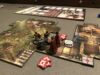
In Moytura, two players will be competing for regions across Ireland. However, it’s not so simple as defeating your opponent, because three other enemy factions roam and destroy the land. From one perspective, Moytura can feel like a 2 vs. 3 competition because the players cannot directly attack one another, and enemy factions don’t each get a turn every round; rather, there is an action deck that determines which enemy faction will act. But it’s not a 2 vs. 3 competition, because either one of the players will win the game, or the two players will both lose because they didn’t keep the enemy factions in check. So maybe it’s a 1 vs. 1 vs. 3 game?
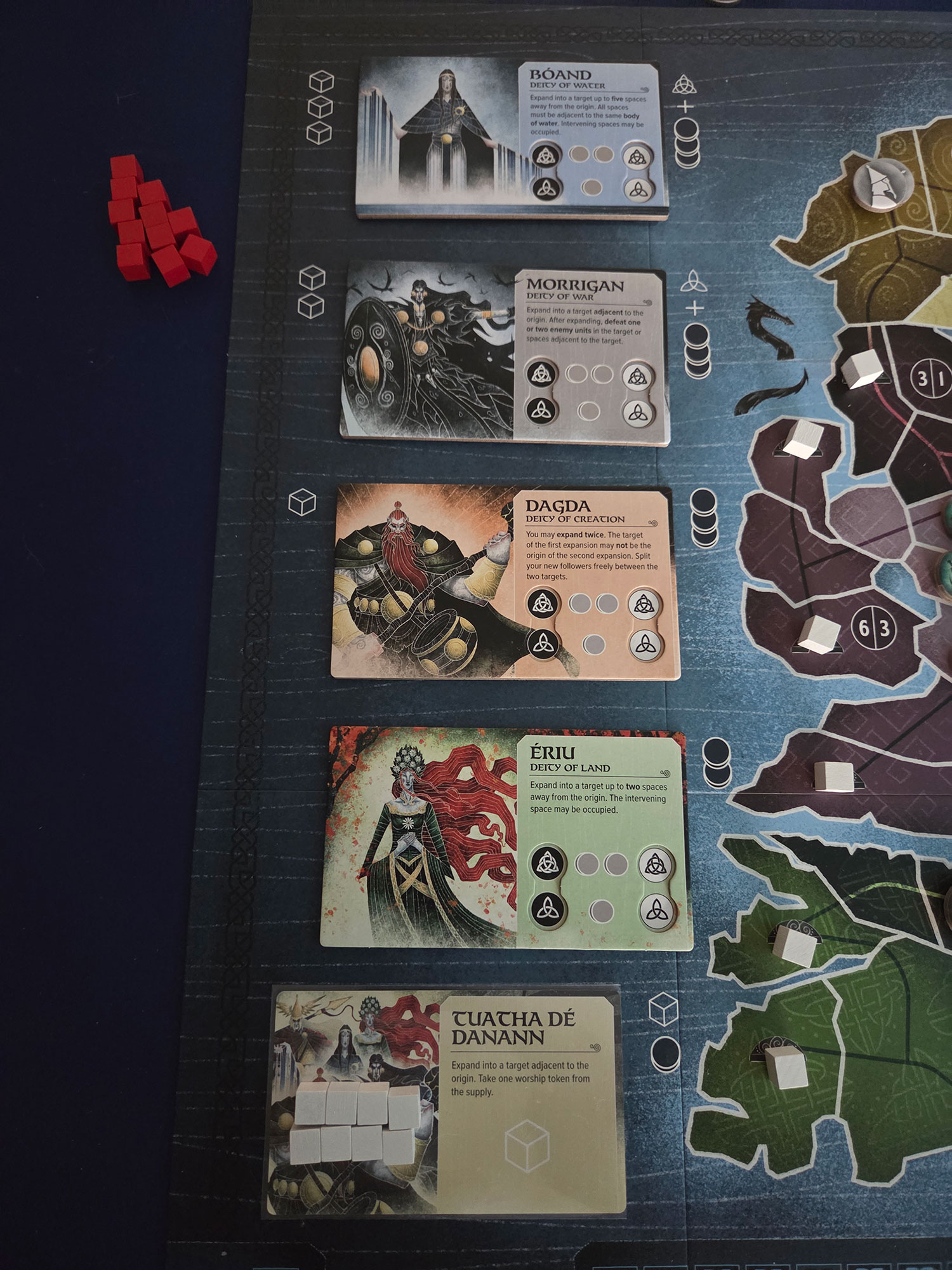
Either way, turns in Moytura are quite simple. The acting player will choose one of the five deity tiles on the board and do whatever the tile states. Often it’s as simple as placing down some of their troops onto the board, but each one has a wrinkle to how those troops are placed: maybe you split them over two regions, maybe you can sail the ocean and plop some down many regions away, etc. But it’s not as simple as choosing any deity a player wants: depending on their placement on the deity column, the cost to activate that deity will vary. But in a brilliant twist, more expensive deities aren’t inherently worse options.
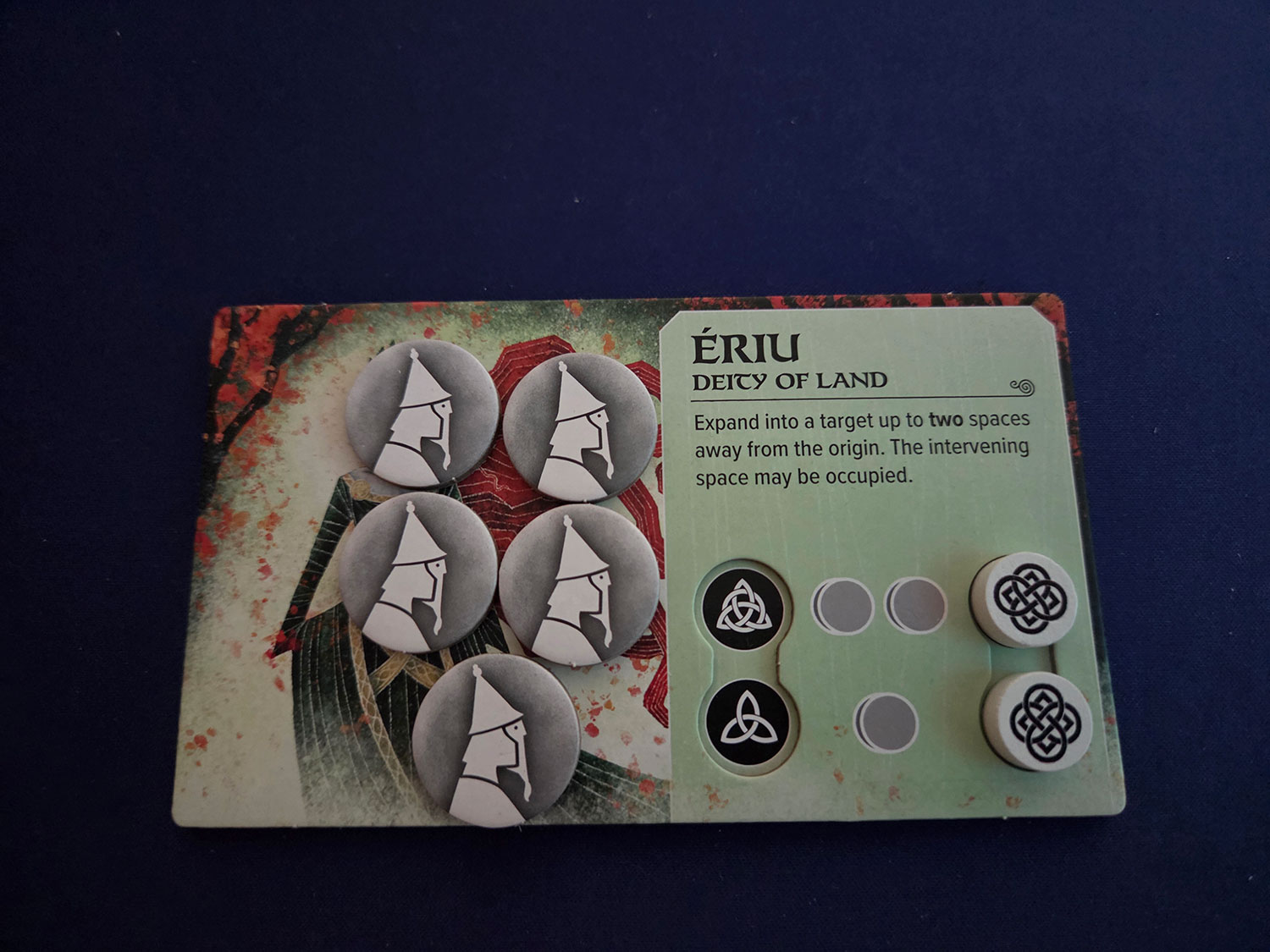
If a player chooses one of the two most expensive deities to activate on their turn, then they will get to upgrade that deity. Upgrades will allow that deity to provide additional troops for placement for that player, every activation moving forward. The currency with which to activate these deities is worship tokens. While there are some scattered across Ireland, players can pick up, there is always the option to choose the cheapest deity (which always remains at the bottom of the deity column) to gain more worship tokens at the expense of placing fewer troops onto the board.
Choose the optimal deity, spend your worship wisely, and combat against the enemy factions (but not the other player!) to claim the most territory and conquer Moytura.
Game Experience:
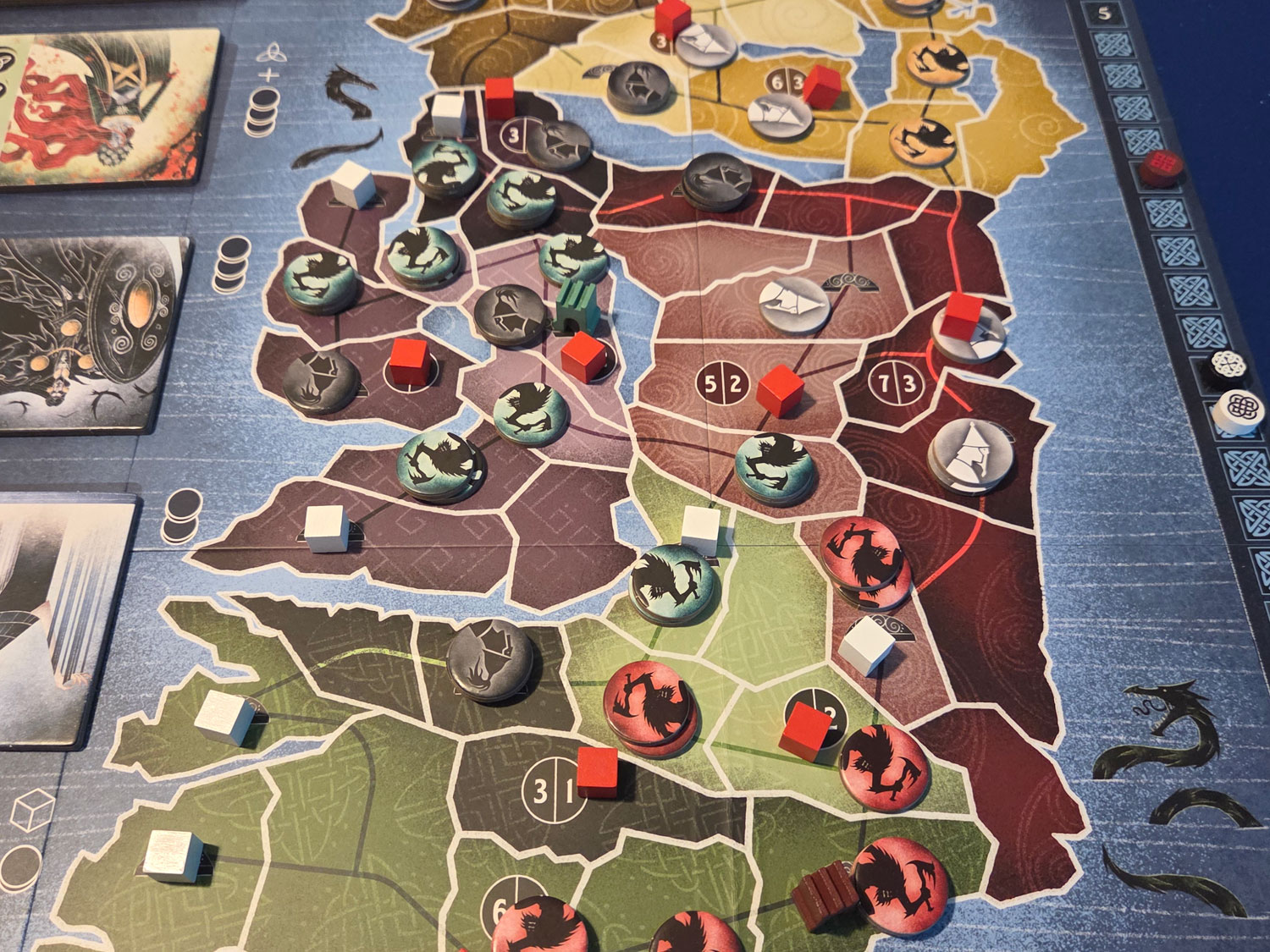
Moytura is a game that feels like it shouldn’t work. The enemy factions don’t really feel like other players at the table; rather, they feel like diseases spreading in Pandemic. Just like in Pandemic, though, these enemy factions cannot go unchecked, because each time one of the three is activated, they spread off of their largest cluster of troops, which can lead to them spreading into nearly a dozen different territories if left to fester on their own! This makes the game feel like a brain-versus-brawn situation, where the players spread slower but can be precise with their movements, and the enemy factions just dump troops all over the board.
Another game Moytura reminds me of is A War of Whispers, a brilliant game where players act more as spymasters rather than war generals, slowly manipulating the battlefield and attempting to be in the pockets of the most dominant factions. While I cannot attack the opposing player directly, I can place my troops in such a way as to hinder their progress. Or maybe I attack an enemy faction in a way that splits them in two so that when they spread, they are spreading from a cluster closer to my opponent’s units instead of my own. Understanding the overall flow and impact of every troop placement is critical in this game and really turns up the intensity of the game.
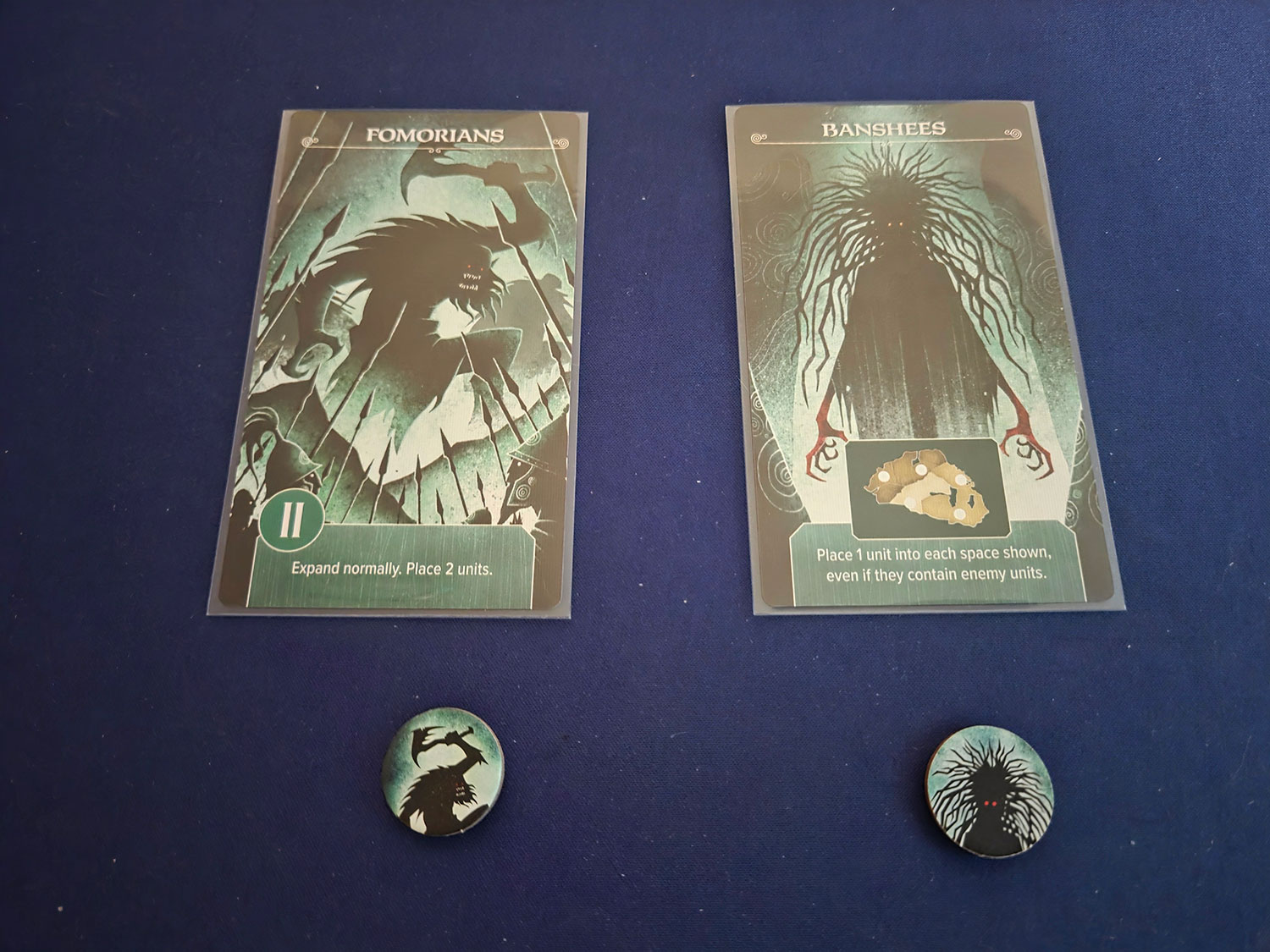
I do adore all of the systems and mechanics in place here, and I think the deity selection and upgrades add a necessary wrinkle to the equation. My only real gripe with the game is the enemy faction AI options. Each color of enemy troop comes with two options of cards: either the mechanically simple Fomorians, or mythical creatures like the Three-Headed Beast, the Sea Serpent, and the Banshees. While these mythical creatures have different placement rules for how they spread, I didn’t particularly find them any simpler or more difficult to compete against, no matter the ratio of Fomorians to mythical creatures. Unfortunately, I felt that all the mythical creatures added were more complexity to the AI turns, something I don’t think anyone really wants to deal with. This does make the options of this game feel smaller, and I think this hurts the overall replayability of the game.
Final Thoughts:
Moytura fills the lands of Ireland with enemies and asks you and another player to conquer them without battling one another. There are conniving, explosive maneuvers that fill each player with arrogance at their brilliance, and there are simpler, smaller moves that can have impacts that ripple out through the rest of the game. The deity selection mechanic drives the game forward and forces variety in some spectacular ways. However, I think the game overall falls a bit short of mimicking three other human players, and while the system can make up for the lack of intelligence, the simplicity of the AI, no matter the creatures in play, can make the game lose its luster within just a few plays.
Final Score: 3 Stars – I wanted more from Moytura.
 Hits:
Hits:
• Brings area control to two players
• Engaging conflicts between opponent and enemies
• Spectacular action selection system
Misses:
• Uninspired AI enemies
• No true variety in the AI
• Feels more shallow on more plays