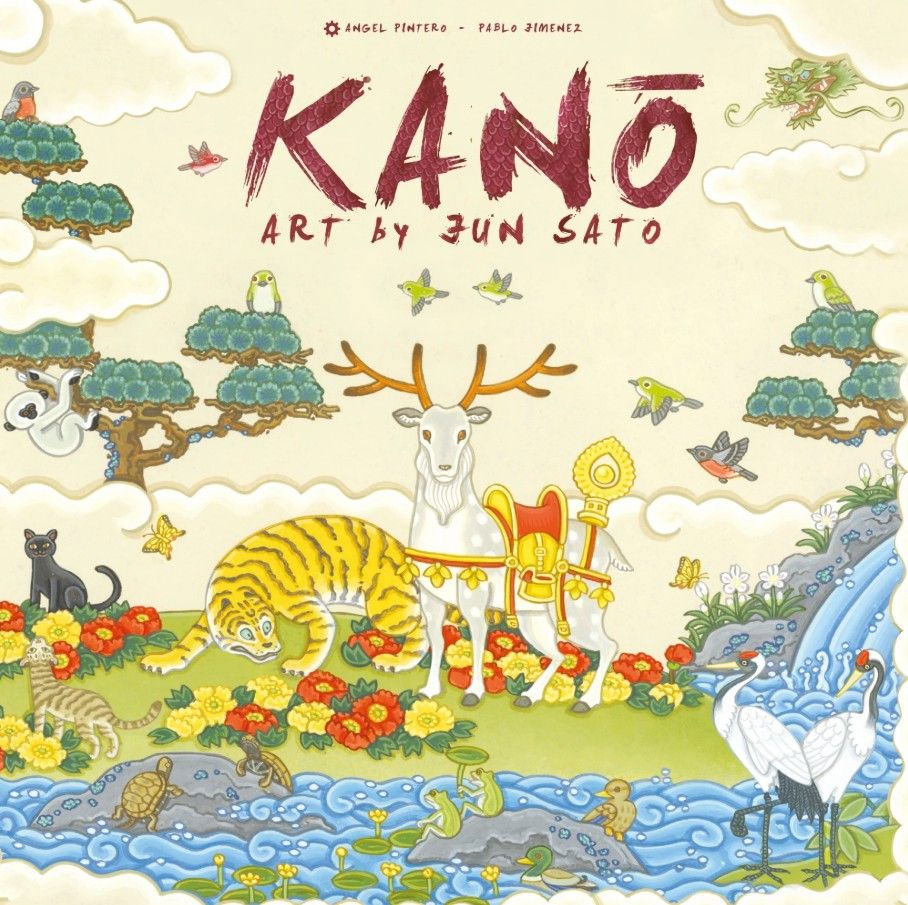
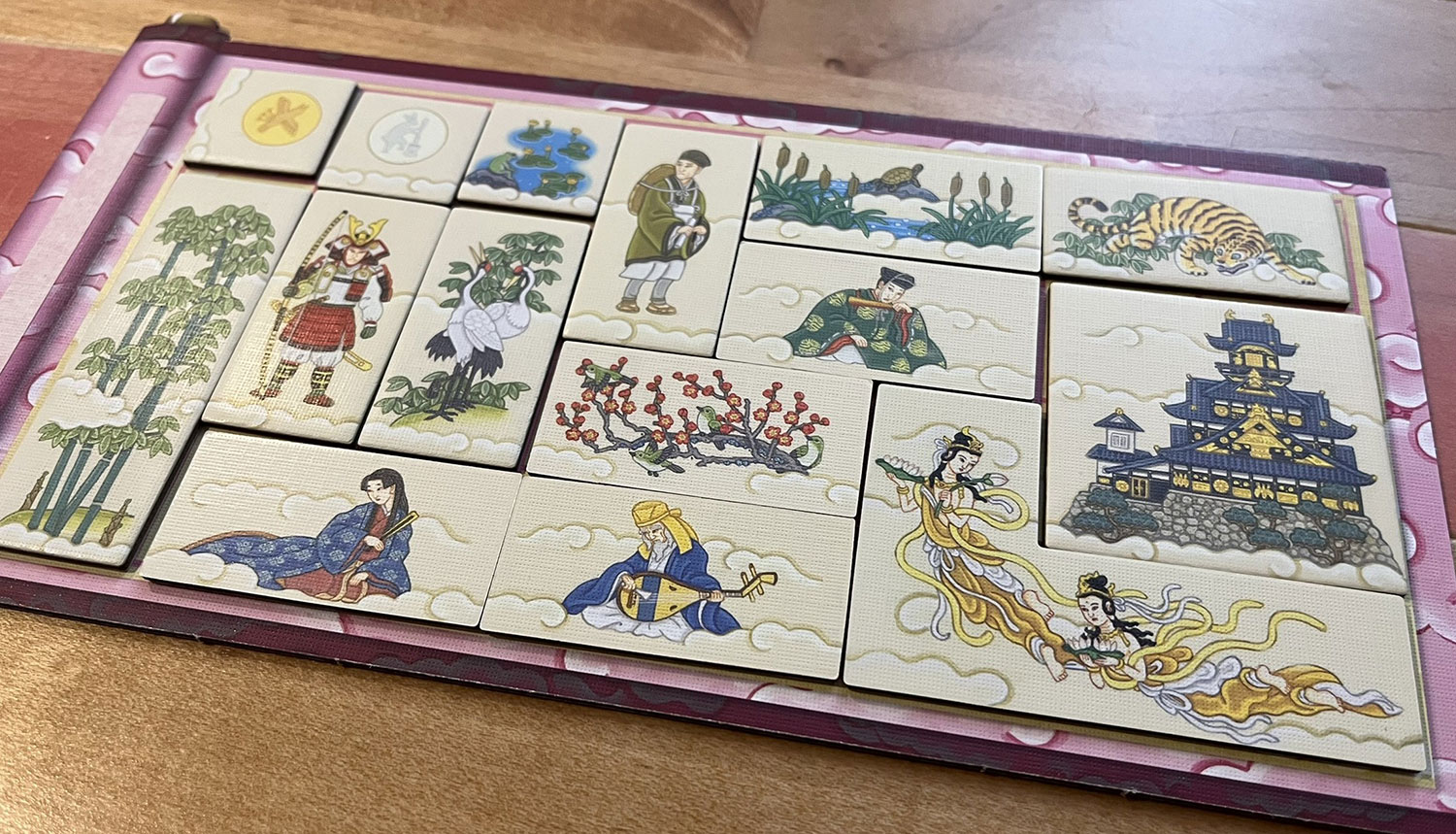
 With many board game designs, the mechanics come first, and the theme—for example, space or nature—is often “pasted on” afterwards. Not so with Kano, the recent release from Matogot. Here, it seems the beautiful art by traditional Japanese artist Jun Sato and its incorporation into Emakimonos came first and was followed by the tile-laying abstract gaming mechanics. Emakimonos are hand-painted Japanese scrolls up to 40 feet in length that unroll horizontally to tell a narrative story utilizing text and images. In Kano, 2-4 players competitively draft colorful paints that can be arranged to fulfill mini-recipes that translate into specific illustrated artistic tiles, all in an effort to complete the most impressive Emakimono. It’s a gorgeous production that plays in a sweet 30-40 minutes. Are the mechanics a match for the game’s artistry?
Gameplay Overview:
Players in Kano alternate taking turns until one player has completely filled their playerboard with tiles. A turn consists of 3 phases:
- Drafting paints
- Placing paints on your playerboard
- (Optional) Converting certain paints into artworks
Drafting:
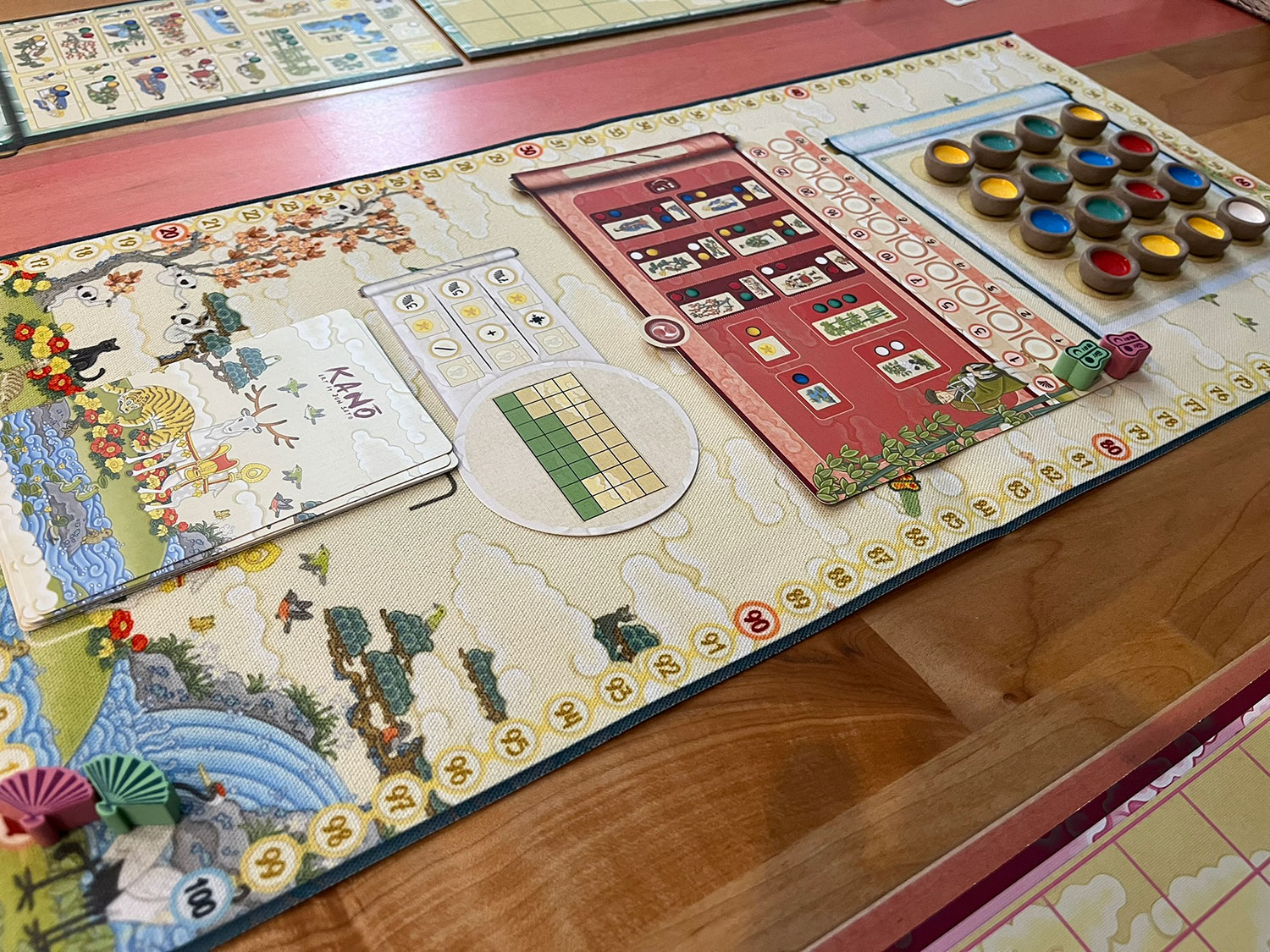
Paints of 5 unique colors are drafted from a shared 4×4 grid. Before drafting, you may optionally choose to swap any 2 orthogonally adjacent paints. You must then draft 1-4 paints of the same color in a vertically or horizontally contiguous straight line. Refill the paint grid with new paints from the bag immediately after drafting.
Placing Paints:
Newly acquired paints must all be immediately placed on your grid-like playerboard. The rule of gravity applies, so paints must drop to the bottom-most available space of the column to which they’re added. Paints may stack atop existing paints or tiles. They cannot be moved once placed
Convert Paints to Artwork (optional):
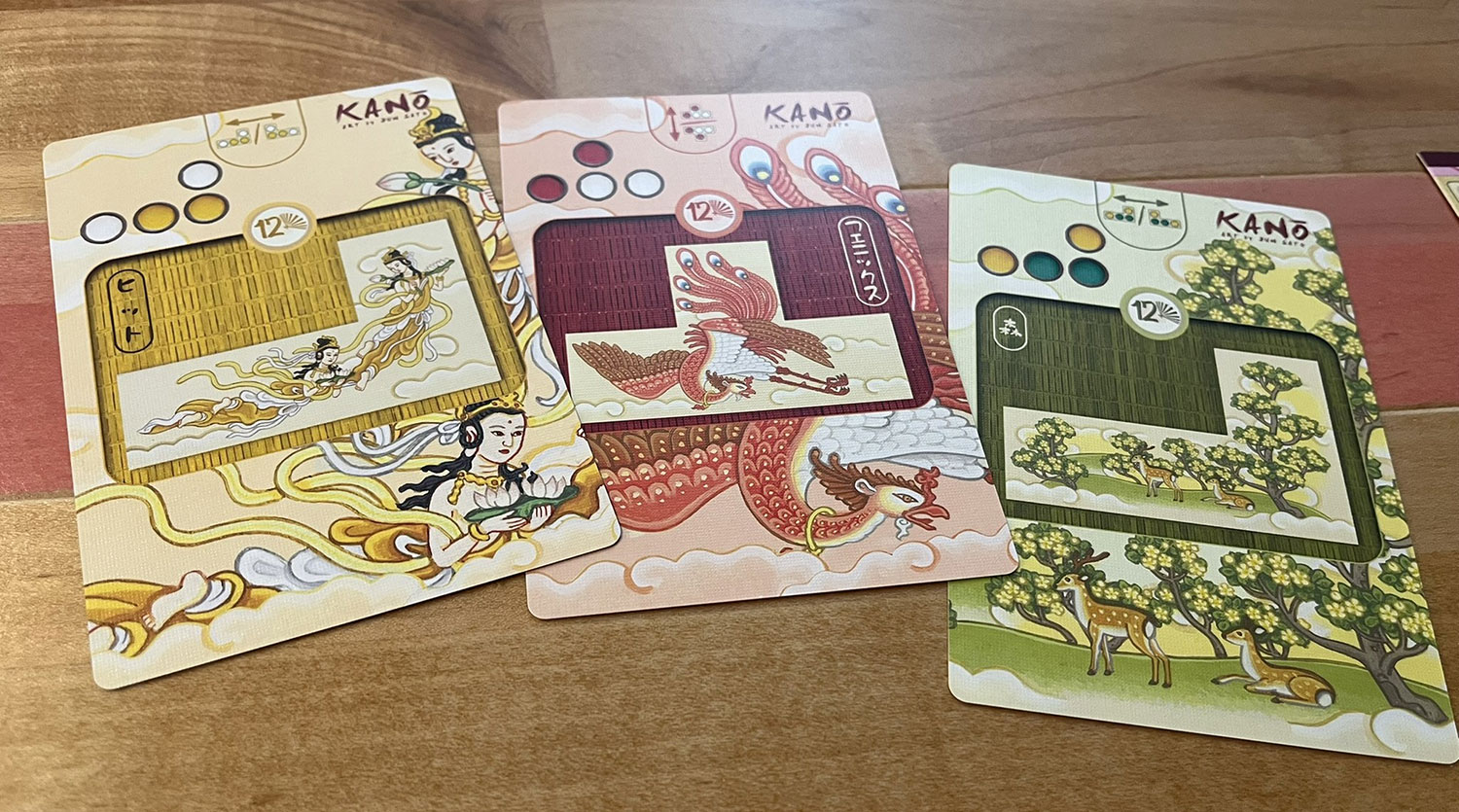
Consult your summary sheet and your personal (secret) masterpiece card for the “recipe” or particular arrangement of paint colors required to create various artworks. Each paint pot can only belong to a single artwork. Convert as many paints as you’d like into completed artworks by removing the paints from your playerboard and replacing them with the appropriate artwork tile.
Notably, if you have more than 4 paint pots remaining on your playerboard after this phase, they dry out, and the excess (beyond 4) automatically get converted to cloud paintings, which take up space but will not score.
At end game, points are tallied as follows:
- Points for tiles of certain sizes: 3-size-tiles = 7 points; 2-size tiles = 3 points; 1-size-tiles = 1 point
- 12 points for each completed masterpiece
- Points for level of completion of a common white goal (changes each game)
- Points for adherence to the red goal sheet (changes each game), which shows a selection of 10 unique artworks (among 21 possibilities). Points are awarded for completing a diverse selection of these artworks
The highest score wins.
Game Experience:
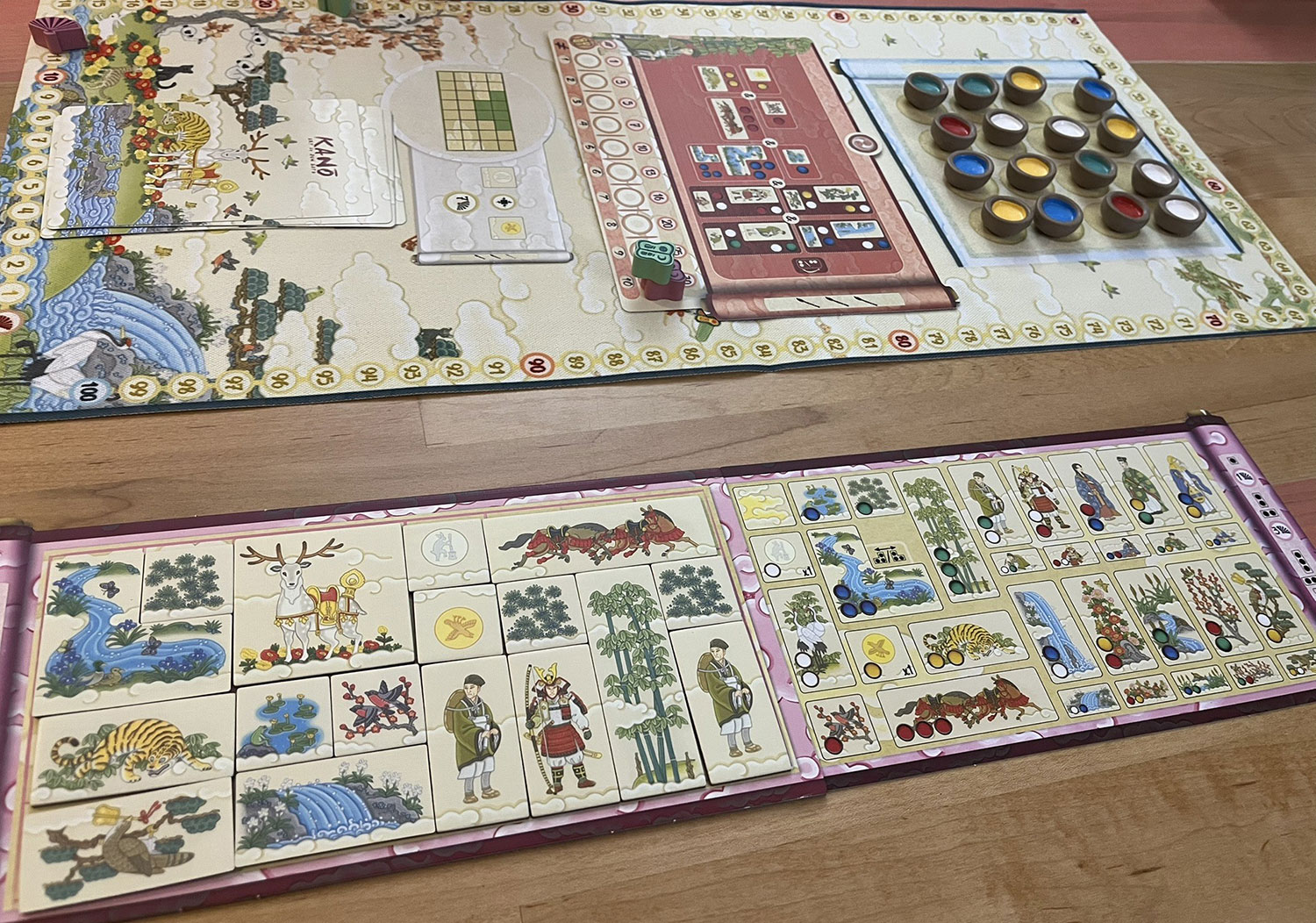
Kano presents a calm, family-weight abstract gaming experience to go along with the delicate and colorful Japanese artwork and deluxified chunky paint-pot components. The paint color combinations required for completing various artworks are mostly straightforward, consisting of anywhere from 1-3 paints (or 4 for a masterpiece) and only 1-2 different colors per artwork. Their shapes are predominantly squares and rectangles. While the fulfillment process feels a bit like Tiny Towns, this is the much more forgiving game, largely owing to a player board with twice the space and players having much more control over which colors get drafted and when. Sure, the threat of paints drying out sounds harsh, but it’s easily avoidable with minimal forward-planning and the ability to pivot if bad luck does strike; not once was a player forced to dry paints in any of my review plays.
The key source of variability game-to-game will be the red goal sheet, which dictates 10 specific diverse artworks to be completed for a maximal score. There are ten options available in easy, medium, and difficult varieties. While players are welcome to divert from these artworks and instead paint the other 11 artworks in the game or paint repeats of certain artworks, it will generally be to their detriment. Sure, every artwork will grant points, but unique artworks on the red goal sheet grant bonus points, allowing you to double-dip on scoring, and the more of these artworks you complete, the greater the marginal point returns.
To do well in the game, it’s not enough to merely paint high-scoring artworks, but to add them to your board efficiently. Game-end is triggered when the first player fills their player board with tiles, and players who are able to cram in more tiles in the same playtime are generally going to do better; thus, there is a bit of a race element. You generally want to be drafting at least 2, if not 3 or 4 paints in a given turn, rather than just 1, assuming you have a worthwhile plan for each of them. Note that there’s a bit of luck with this efficiency, based on paint availability on the shared grid during your turn. Maybe you need 3 greens to complete two different artworks with your existing paints, but there’s only 1 currently available for draft. You could take just the 1 to ensure completion of one of your planned artworks and prevent the paints from drying out, or you could draft a different color currently available in greater quantity, and turn the existing paints into different artworks from your original plan, which may or may not align with the red goal sheet.
There are plenty of interesting decisions such as these to be made early-game. By late-game, however, space on your playerboard is limited, and you might very well have to draft a single paint pot at a time to finish what you’ve started and which still aligns with the goal sheet. Following the red goal sheet is important, so in Kano, everyone is generally aiming to make the same 10 artworks in a given game in addition to maybe 1-3 unique masterpieces along the way, just in a different order. By late-game, opportunities to pivot dwindle, and decisions become less interesting in this reviewer’s opinion.
By comparison, in an abstract game like Cascadia or Harmonies, you usually still have interesting options on your last few turns, and throughout the game, different players are more likely to lean into different scoring specialties based on drafting opportunities that appear throughout the game. Kano is very much an abstract game on rails by comparison. This might be a favorable trait for gamers who don’t enjoy or aren’t skilled at coming up with their own strategic plans, but personally, I found the game overly restrictive in its viable strategic options.
Final Thoughts:
Kano is an absolutely wonderful production with chunky ink pots and beautifully illustrated, thick cardboard tiles, coming together to create an abstract game dripping with a Japanese emakimono theme. The gameplay has some interesting decisions and forward-planning but is generally fairly straightforward and very much family weight. The variable red scoring sheets give ample direction to players as to how to best build out their player boards in any given game, and some players may enjoy the efficiency puzzle contained within the bounds of these score sheets, especially considering the great artistic packaging. For players seeking out a more thinky abstract gaming experience with multiple routes to victory, and potentially more player interaction, however, there are better abstract games out there. Like the silk of an ancient emakimono, Kano is beautiful and smooth, but maybe not sharp enough for some abstract gamers.
Final Score: 3 stars — Beautiful artwork abounds, but the gameplay is only so colorful
 Hits:
• Fantastic artwork and production
• Theme ties into the gameplay well
• Decent replay value
Misses:
• Scoring paradigm limits strategic options
• Minimal purposeful player interaction