

 A lot of board gamers were the nerds in high school, the kids the jocks would stick in lockers for grins. As a result, there’s a decent amount of “I don’t like sportball” snobbery in the hobby, but despite that, there are a lot of board gamers who also like sports, and when the two come together in a sports-themed board game, there can be a lot to love.
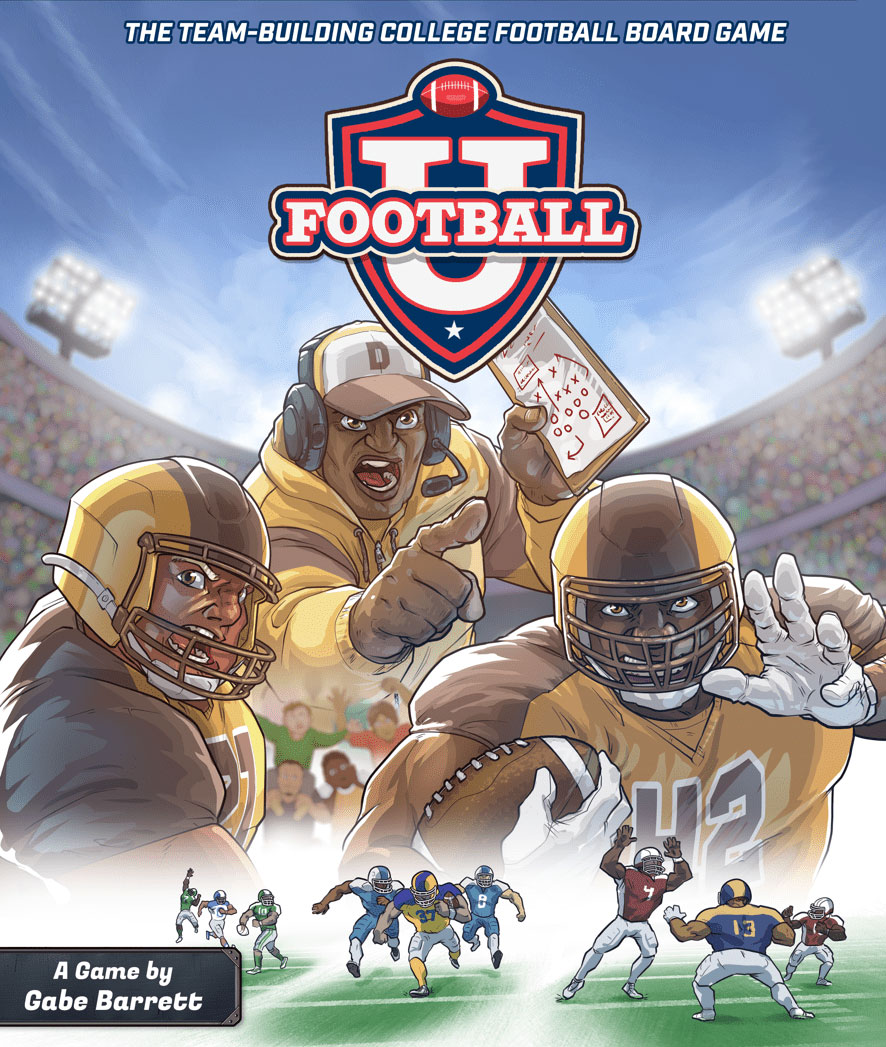
Football U, designed by Gabe Barret (with art by Ash Jackson and Alyssa McCarthy and graphic design by BGQ’s very own Tony Mastrangeli) and published by Scorelander Games, fuses a breezy dice-chucking game with a little hand-management and luck mitigation to tackle (see what we did there?) the theme of college football recruiting.
Note: This is a combo review from both James and Andy.
Gameplay Overview:
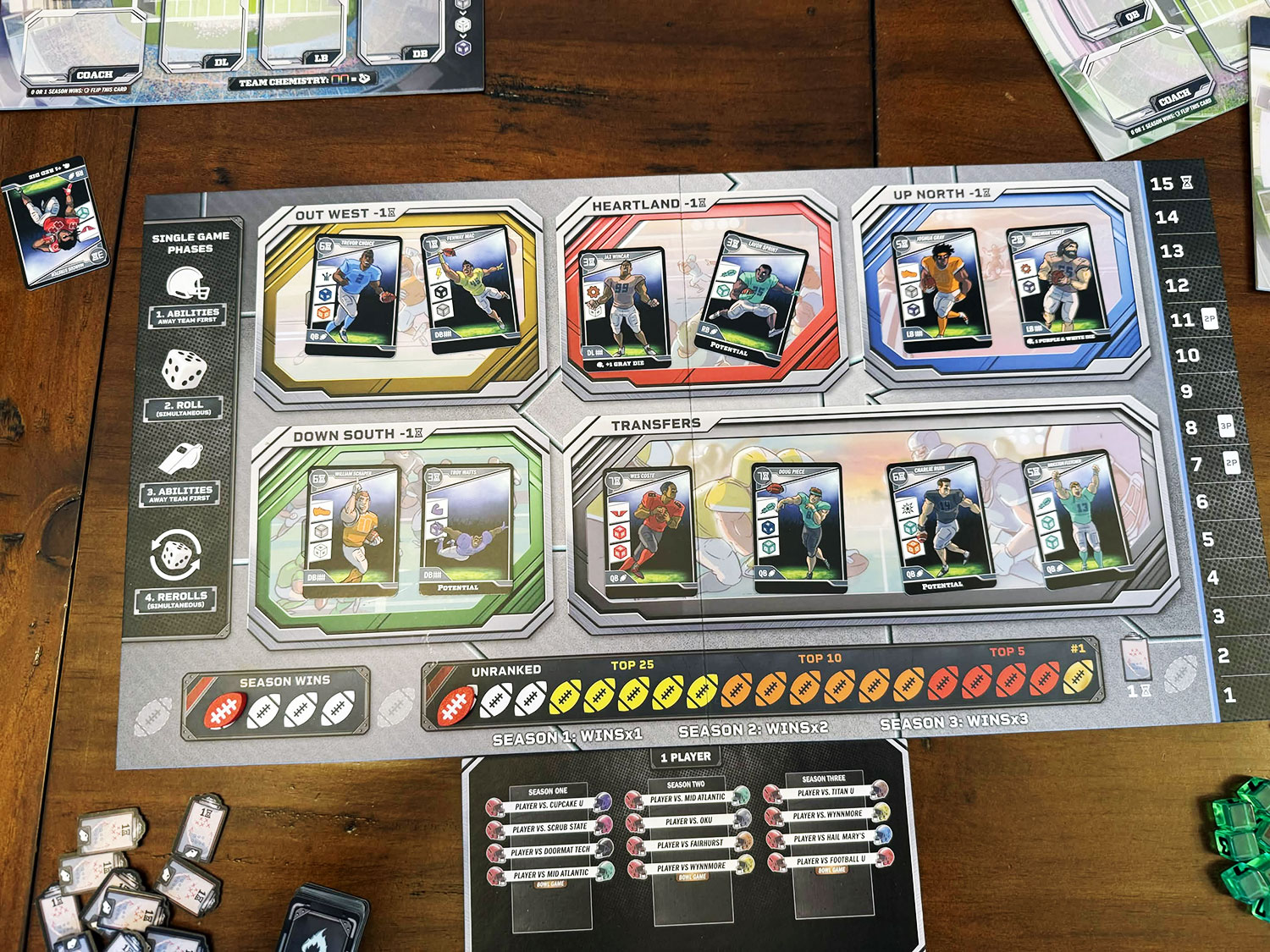
Football U is broken up into three rounds that are split between offseason and the regular season.
During the offseason, coaches select players from the board, spending time on each player to collect them. Players in one of the team’s regions cost one time less. The team that has spent the least time takes another turn, meaning that teams can take multiple small turns in a row. This time mechanic was first implemented in a modern board game by Peter Prinz in his game Thebes and may be best known from the 2-player game Patchwork (we reviewed the Patchwork app), but it’s reminiscent of other games we’ve reviewed at BGQ including Red November and Plutocracy, as well as others like Monster Baby Rescue and Firefly Adventures: Brigands and Browncoats.
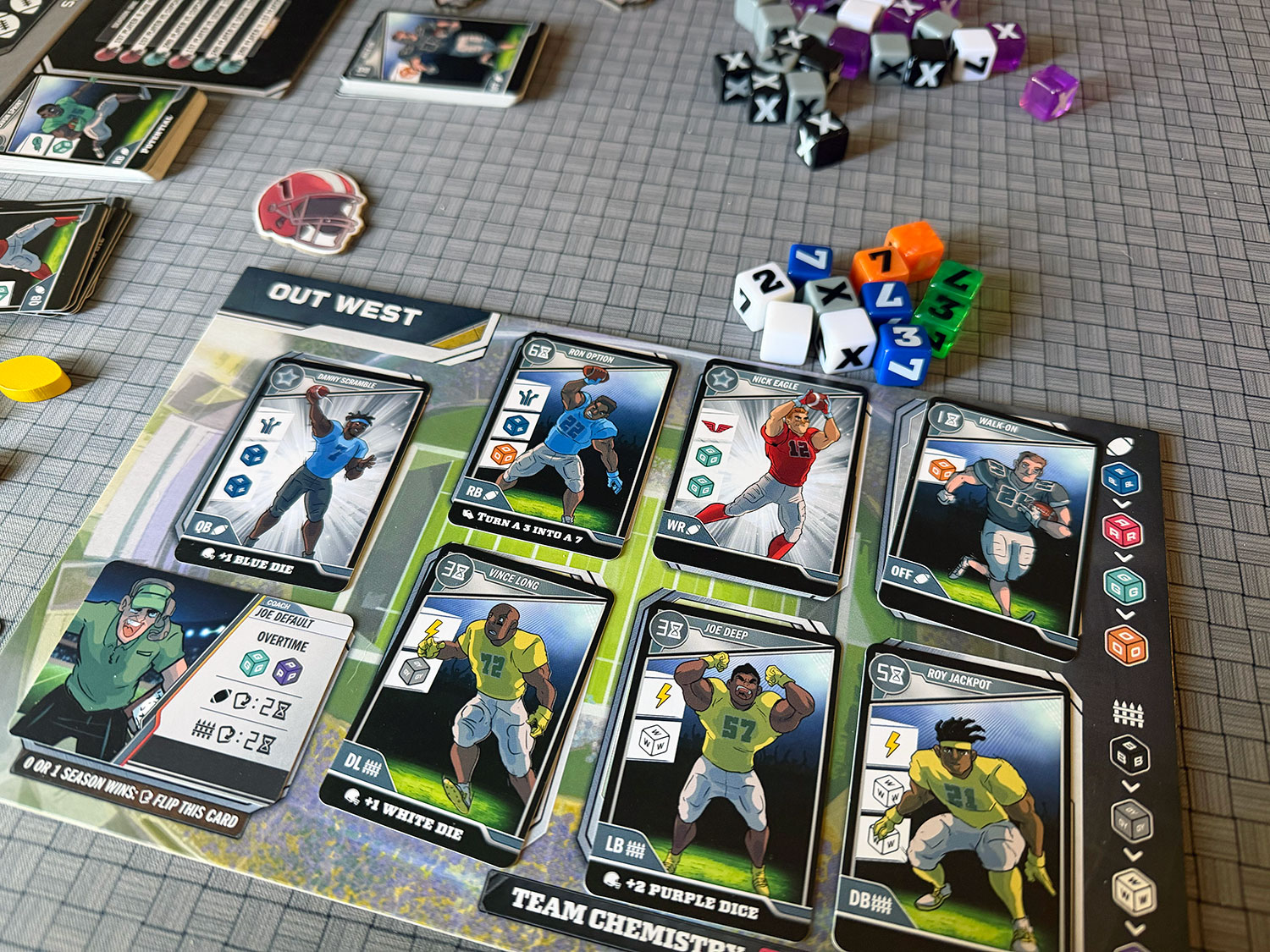
Time can also be spent to flip players over to an upgraded side—thematically, think of this as the coach taking time away from recruiting to actually coach his players, though oddly all improvements are lost between seasons. If a player has a symbol matching someone on the team, you’ll get a chemistry card, a one-time boost you can apply to your team’s on-the-field play whenever you think you most need it. Coaches can also spend time to develop a game plan, which earns tokens that grant rerolls during the season.
At higher player counts, players are removed from the neutral transfers area, simulating players being picked up by other teams.
Once all of the players have run out of time for further recruiting and training of their teams, the regular season begins. During the regular season, players face off against other players and/or automated opponents. Before each game, the visiting team and then the home team decide if they want to use a helmet ability, which often can grant extra dice.
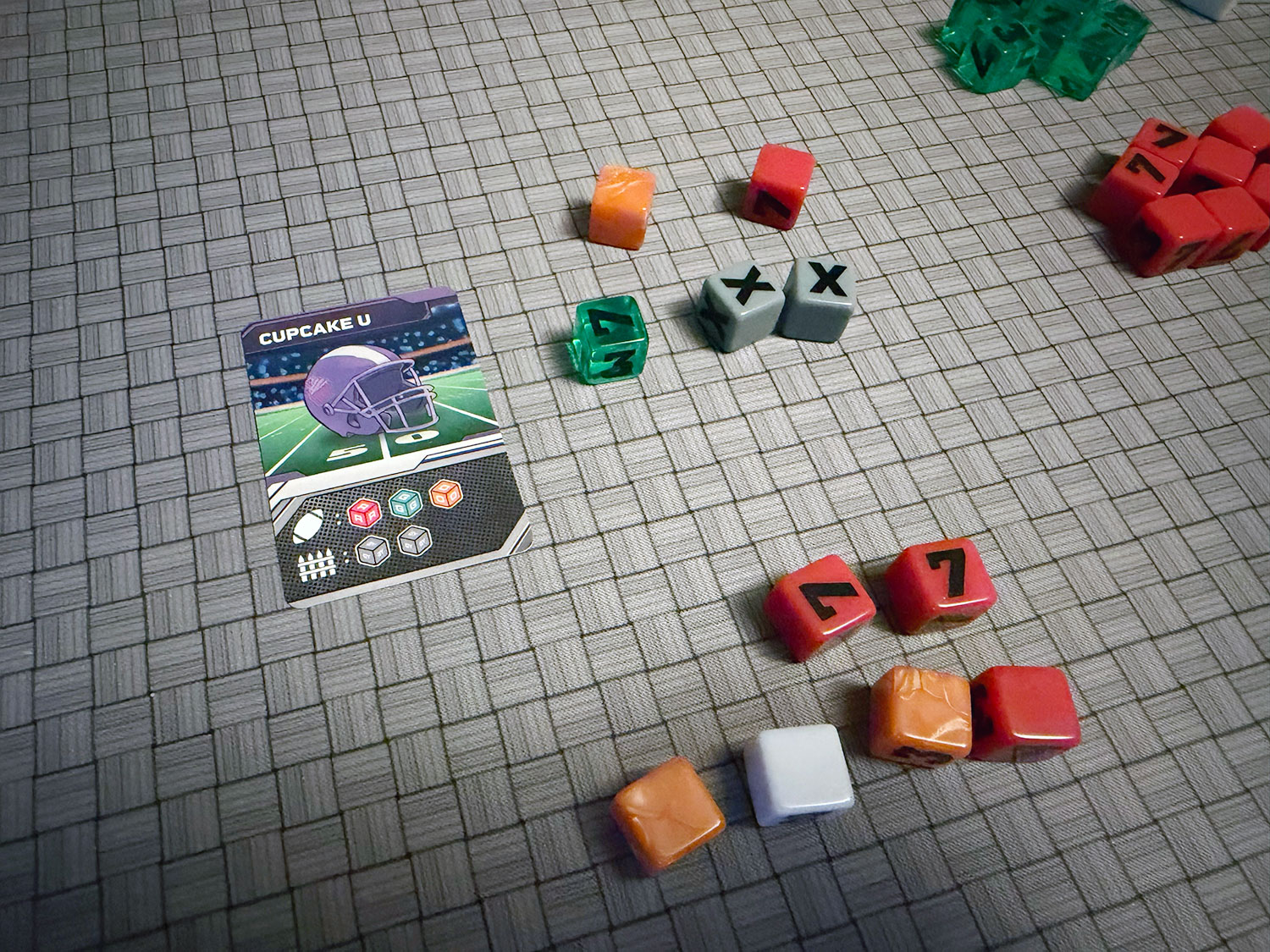
Then the football game itself begins, with both sides (or you for yourself and the AI) rolling dice based on the players you have representing offense and defense. X’s on defense knock out the opposition’s offensive scoring dice. Starting with the road team again, the player can opt to use whistle abilities and game plans, followed again by the home team. The whistle and helmet abilities can only be used once per season. The winner is the player (or AI) with the most points after all rerolls are spent and X’s have zapped opposing teams’ points.
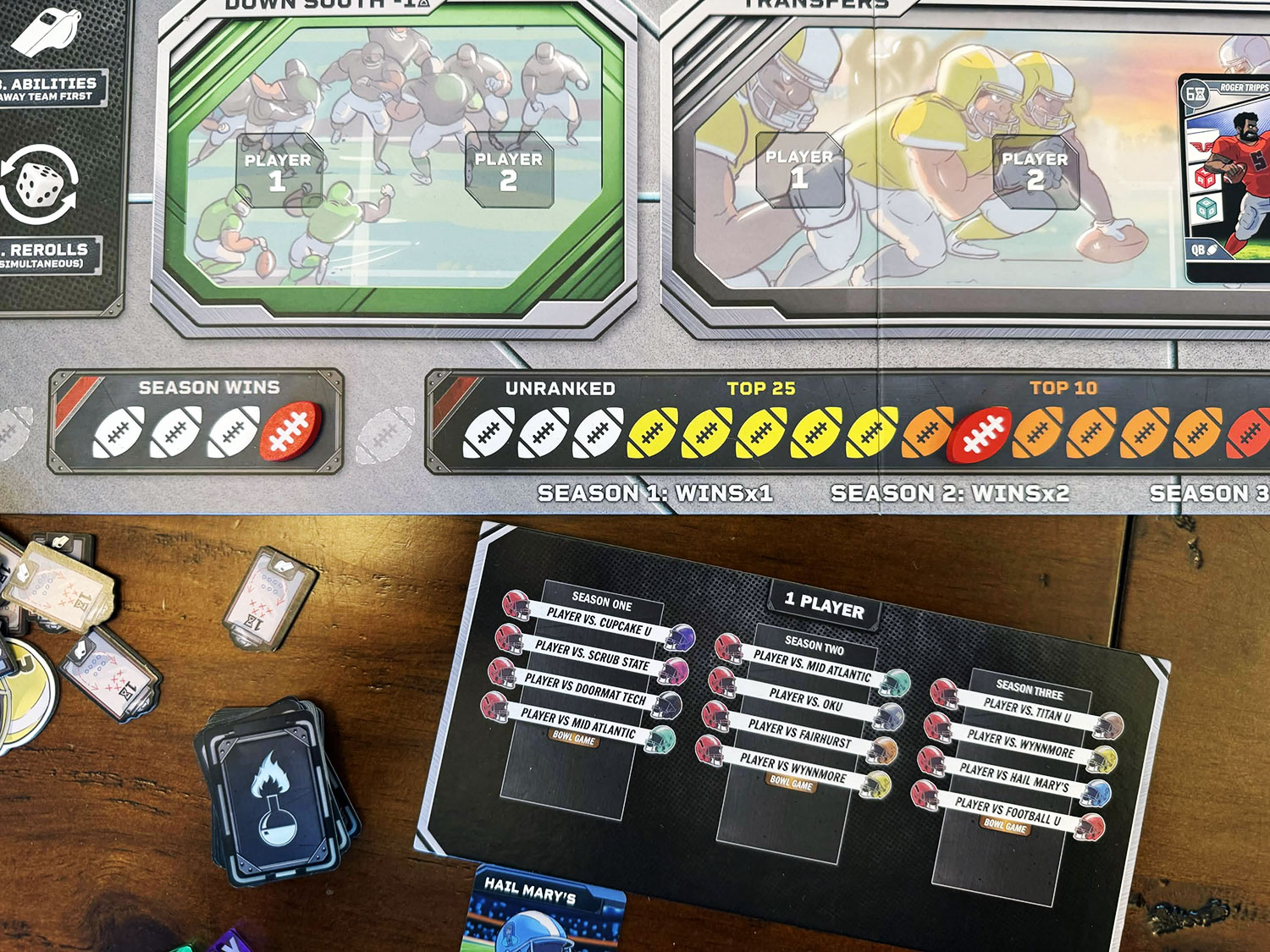
Each game won moves the team up the win track, and at the end of the season the number of wins improves the program’s ranking (with the number of spaces growing as the game progresses). A team that wins zero or one game can flip their coach over to their better side, generating a permanent upgrade. In contrast, all players that were upgraded forget everything their coach taught them, coming back for next year flipped back over to their starting sides, and a new offseason begins.
The player highest on the score track at the end of three seasons wins.
Game Experience:
This is not a complex Eurogame by any stretch. You’re doing a little hand management in terms of acquiring and upgrading cards to generate more dice, and buying a little bad-luck mitigation along the way, but for the most part, you and your opponent are going to be chucking a big handful of dice and hoping for good outcomes. So you need to know going in that this 90% what the game snobs call “Ameritrash” but it’s good fun for what it is.
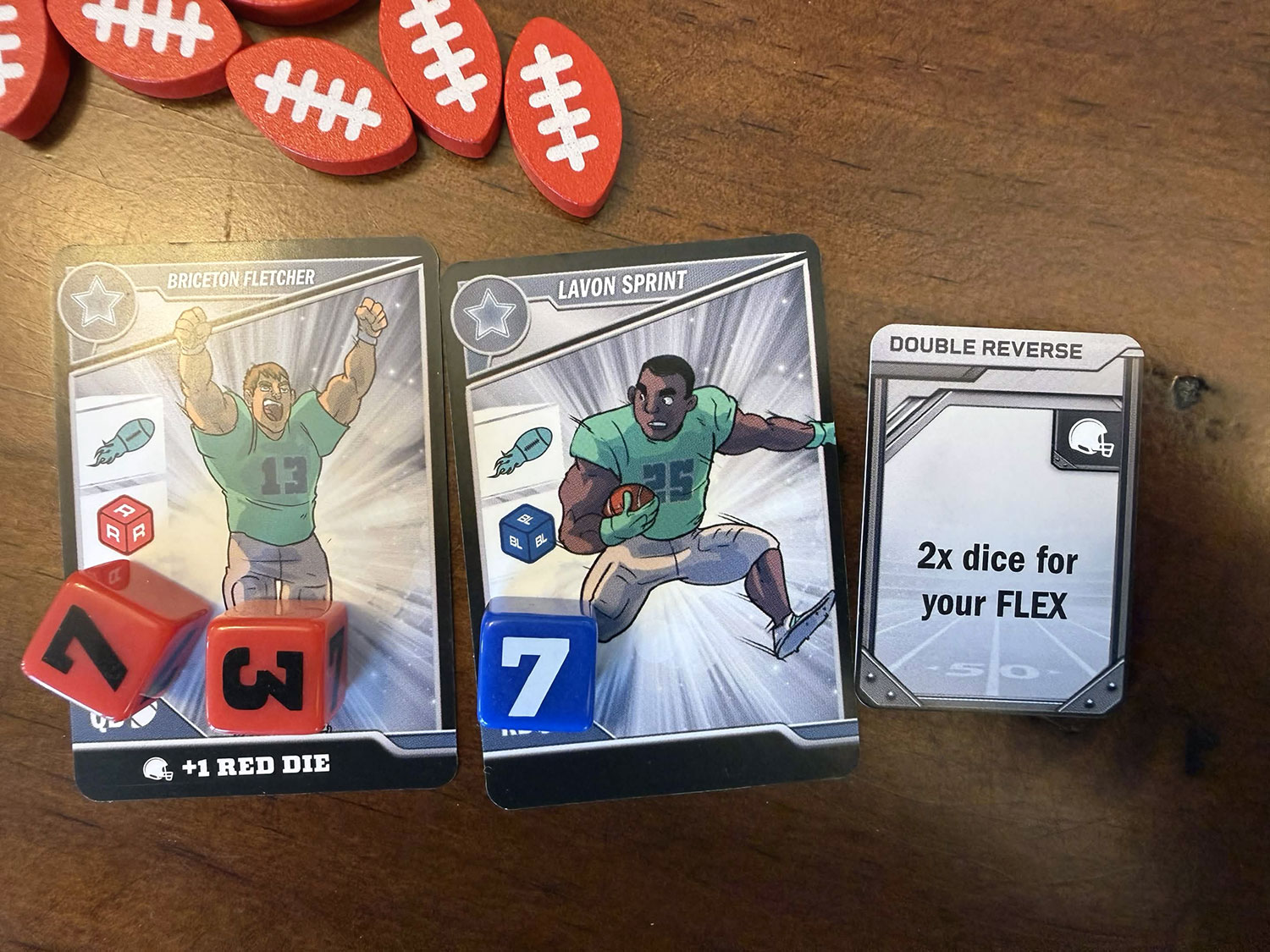
It’s not all blind luck, though. For example, the multiplayer game changes experience based on the number of players, as with two players you play other humans, with a bowl game being an extra game between the top two players. That extra game, which can move you up the Top 25 track one to three spaces, can end up really mattering.
Trying to time your moves so you can snag two players or get the player from transfers before they’re removed from the board mid-offseason also adds some tension to that portion of the game.
Is Football U deep? To put it in football terms: if a going deep is a heavy euro, this is west coast offense in pee-wee football. But that doesn’t stop it from being a ton of fun to build up a team and roll handfuls of dice. Game resolution is seconds long as you organize scores and X’s and end up with a final score. I’ve wanted to play with four players and write the scores down to facilitate extra trash talk between players about who gave up the most points to Cupcake U.
When played as a solo game, nonetheless, the urge to announce each game and celebrate wins and mourn losses to teams with dad-jokey names like Cupcake U and Wynnmore shone through, and even while realizing the game was sort of objectively dumb, it was also good, dumb fun.
Digression on the Theory of Games
One of the two authors of this review, Andy, spends his non-game life working on the economic issues of college sports and, as he insists on reminding everyone, designed a similar-themed game about putting together a college football roster called Envelopes of Cash (EoC). While the theme is identical, Football U and EoC bring very different game mechanics to the table. Football U is 2026’s version of a 1980s beer and pretzels dice-chucker with a little hand management and a smidge of mitigation available for bad luck. EoC is 2023’s version of an early 2000s Euro, where a large part of the game is strategizing how to mitigate luck and fulfill recipes efficiently.
But more importantly, the two games have very different takes on the business of college football recruiting. Football U essentially takes a “shut up and dribble” approach, with zero reference to how the sausage gets made. The only cost to recruit an athlete to your school’s team is the time it takes away from other activities. The system is neither good nor bad; it just is.
EoC is very much making a statement about a societal problem; athletes are being paid under the table because the system circa 2020 prohibited schools from compensating them openly. In EoC, the first player is chosen based on whoever last experienced wage theft, and even in the family rules, the game encourages parents to explain to their children that a system where the workers don’t get paid their market value is unjust.
Of course, you don’t need to care about whether the pre-2021 world of college football was exploitative or not (though it was!); you can just play EoC as a very straightforward pickup/deliver and set collection game in the style of a mid-2010s Stefan Feld game (Macao was a big inspiration for EoC). But if you think of a board game as “art you can play,” EoC has a message it wants to impart. Football U takes a more Cyndi Lauper approach and just wants to have fun.
Final Thoughts:
Different people will gravitate to one type of game or the other, and so if you love tossing a whole mess of dice in battles against your friends, Football U is going to be a fun choice, whether or not you like sports or want to ponder the societal issues behind your autumnal Saturday entertainment. While Envelopes of Cash might work better for the efficiency Euro crowd, if you adore college football in all its messy glory, you might be the kind of person who wants both in your collection.
As for us, James says: I’m an unabashed lover of dumb fun. Football U’s games are chaotic, with a 5-yard dash worth of mitigations to try. Meanwhile, I enjoy the drafting and trying to make the best team I can out of what’s in front of me. This is an accessible lightweight filler-ish game. But if you want the same theme with a bit more meat, I know a guy who, allegedly, designed a game.
And Andy says: Once I got off my high horse about my quixotic attitudes about college sports, Football U was a fun 20-minute game that could serve as an excellent filler or as an amuse bouche before a more serious game on your next sport-themed game night. Heck, even your friends who deride “sportsball” might get a kick out of rolling those dice and rooting for touchdowns.
Final Score: 3.5 Stars – Football U is the sports-game equivalent of taking basket weaving: it’s easy and fun without being really complicated.
 Hits:
• Good, dumb fun.
• Nice mix of drafting cards and rolling dice.
• Genuine excitement when it comes time to square off against your opponents.
Misses:
• Deep strategy this is not.
• Nor is it a profound statement about society

Disclosure: While fellow BGQ reviewer Tony did indeed do the graphic design for this game, he had no input on the content of this review (outside of removing 2 spaces after a period, come on guys!)