
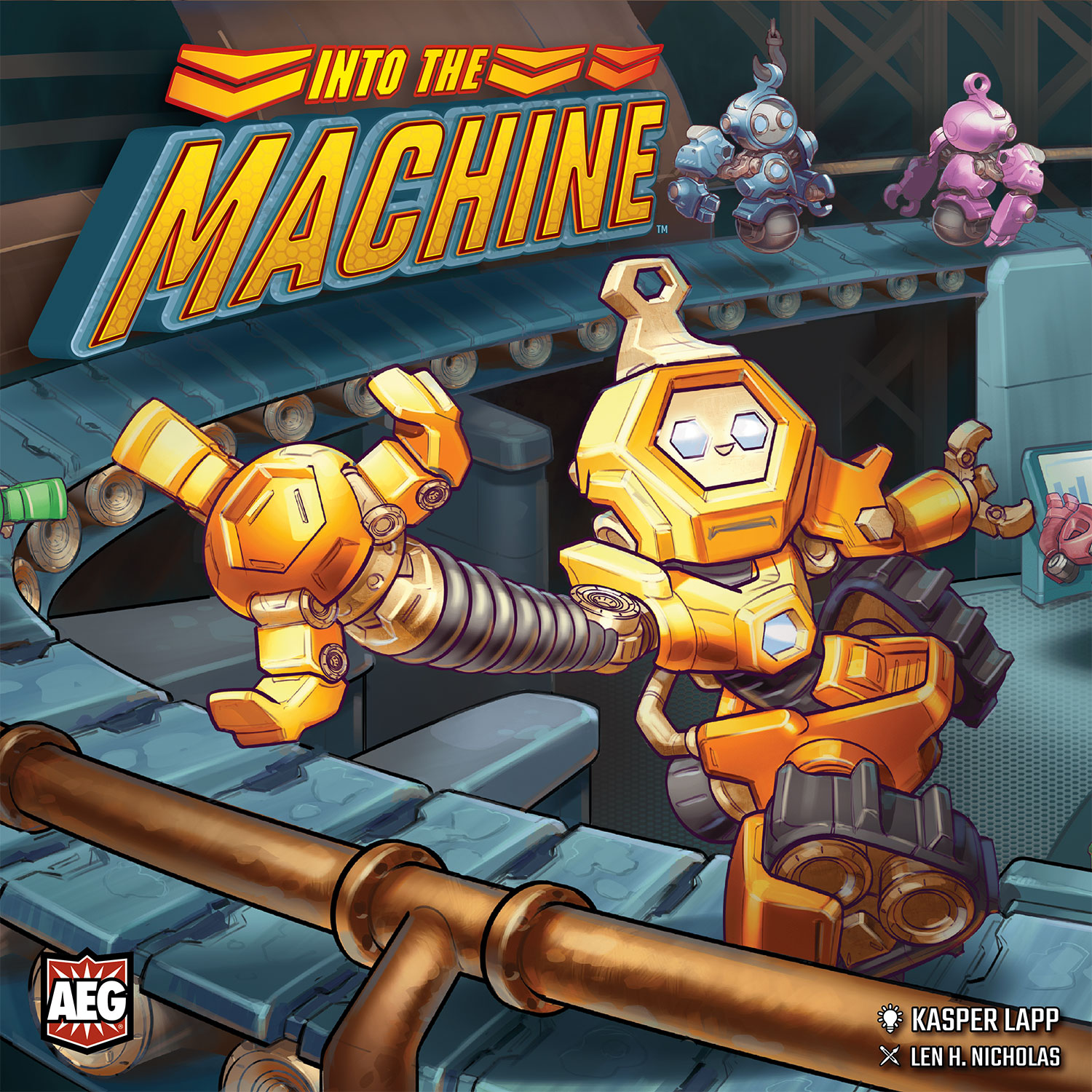
 AI is a hot topic nowadays, with discussions ranging from its capabilities to spur innovation to the danger of it escaping its sandbox and inciting the machine apocalypse. Thus, AEG’s 2026 release of Into the Machine, designed by Kasper Lapp, could not be more timely. Into the Machine humorously answers the question of what happens at a widget factory at the end of the day when the humans are gone, and the robots are left to their own devices: an epic robot relay race, of course!
Into the Machine sees 2-5 players compete over 45-60 minutes to manage a team of robots in a tactical relay race controlled by worker placement actions. Be prepared to gear up for some fun in this highly player-interactive medium-weight engine-building gaming experience.
Gameplay Overview:
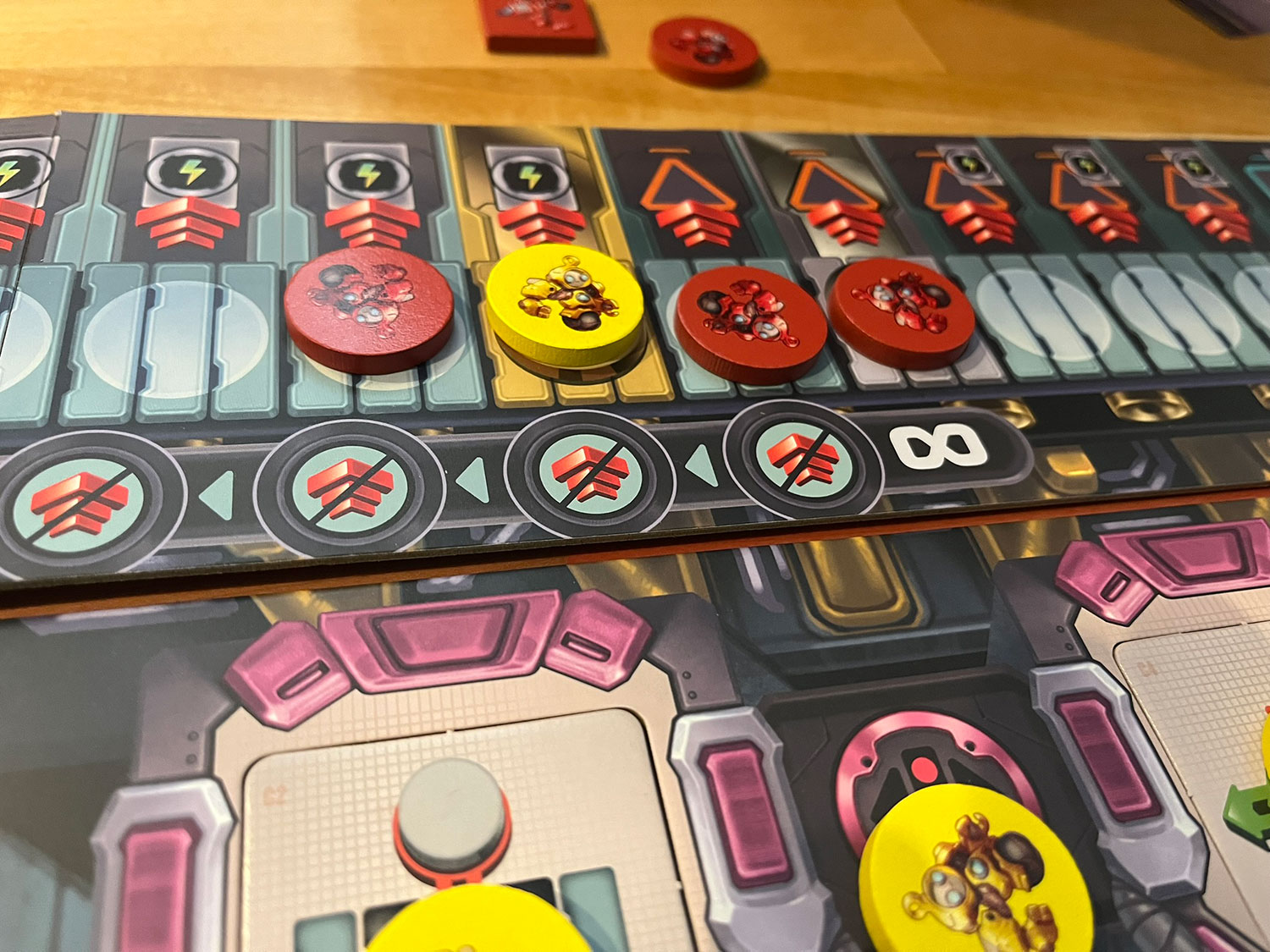
The goal of Into the Machine is to move 3 circle-bots across a conveyor belt, convert them into hex-bots, and then move those 3 hex-bots back across the conveyor belt and over the finish line.
Each player starts with one circle-bot on the conveyor belt.
On a turn, they will either deploy a non-racing robot to various worker placement spots on the board to influence the status of the race on the conveyor belt, or recall all their non-racing bots back to their supply.
On any given turn, players may also optionally play one power card which allows 1X bonus actions.
The worker placement actions allow players to:
- Move one or more racing circle-bots or hex-bots along the conveyor belt in varying manners (incrementally, hopping, sliding, etc.)
- Add new circle bots to the conveyor belt
- Acquire new circle bots to your supply
- Remove a circle-bot from the race-track and upgrade it to a more capable triangle-bot or square-bot. Some upgrade positions also grant power cards.
- Draw a power card
There are three key twists to the worker placement:
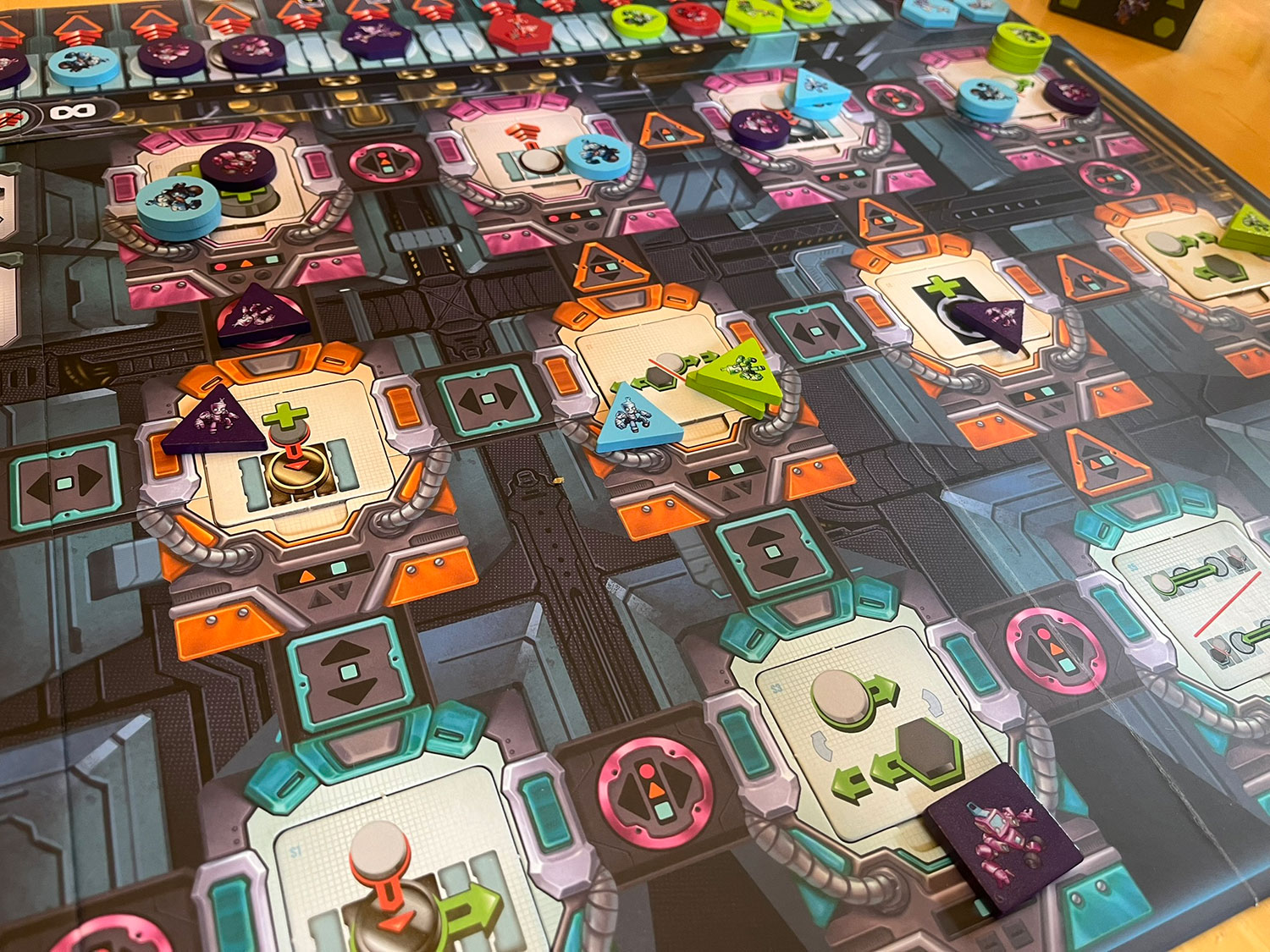
- There are three tiers of worker-placement spots: basic, intermediate, and advanced. Only square-bots can activate advanced spots. Only triangle-bots and square-bots can activate intermediate spots. All bots can activate the basic spots. You’ll need to upgrade circle bots into triangles and squares to access more of the better spots.
- There’s only partial worker-placement blocking. If a single bot is on a worker placement spot, two bots are required for its next activation, and then 3 and then 4, thereafter.
- All worker-placement spots are arranged in a grid, and if any player has bot presence on two orthogonally adjacent spots they may re-activate those two spots on a later turn by placing a single bot on a linkage space between the two spots.
Any player immediately wins if they:
- Move 2 hex-bots across the finish line before anyone else gets a single hex-bot across
- Move all 3 hex-bots across the finish line
Game Experience:
Into the Machine reminds me of the Quest for El Dorado in that it’s a relatively streamlined ruleset for an engine-building racing game—though notably, Into the Machine is the more player-interactive title. That’s largely because most “moves” of Into the Machine involve hopping over other player tokens until you reach the next available spot. Thus, a key strategic element of the game is taking advantage of large clusters of player tokens and/or attempting to create gaps so other players don’t get to leapfrog quite as far.
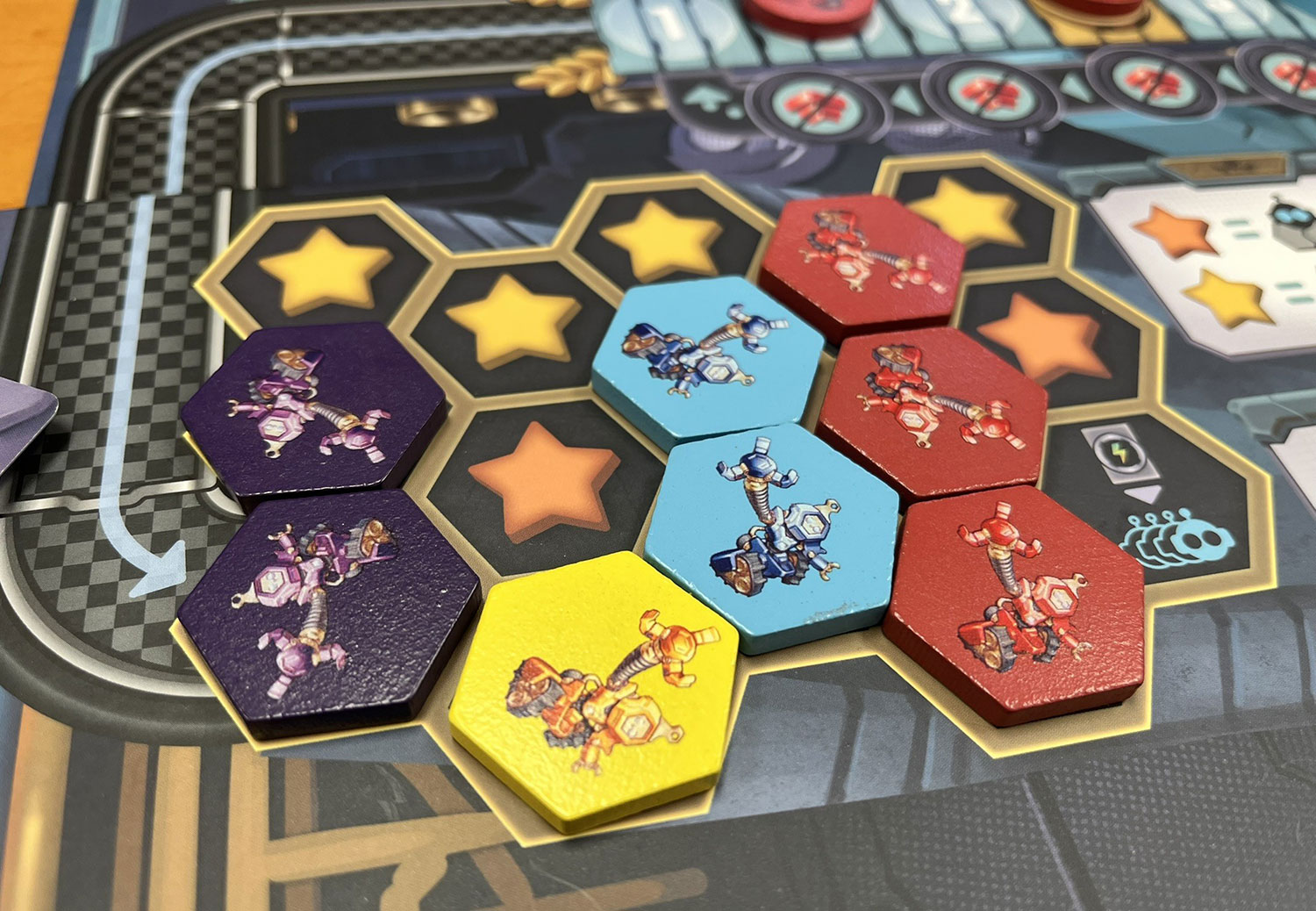
Another key element that separates this from most racing games is the bi-directional nature of the single track. At any given moment, each player may have multiple racers on the track, some of which are moving right, and some of which are moving left. There are typically several creative options for maneuvering multiple of your tokens in various directions to create new movement opportunities for yourself, whether that’s sliding through a large gap or hopping over a big cluster of tokens.
Balancing the speed of your racing with engine-building is another vital aspect of the game. Especially at higher player counts, the basic worker-placement actions get clogged with tokens quickly, such that they may cost you 3+ tokens for another activation. Thus, you’ll want to invest in at least a few upgraded triangle-bot and/or square-bot tokens, each of which necessitates removing a racer-bot from the track. Deciding how many of your bots to upgrade and when to upgrade them is an integral part of the game. Eventually you actually need to keep some bots on the track and move them towards the finish line, lest someone else wins.
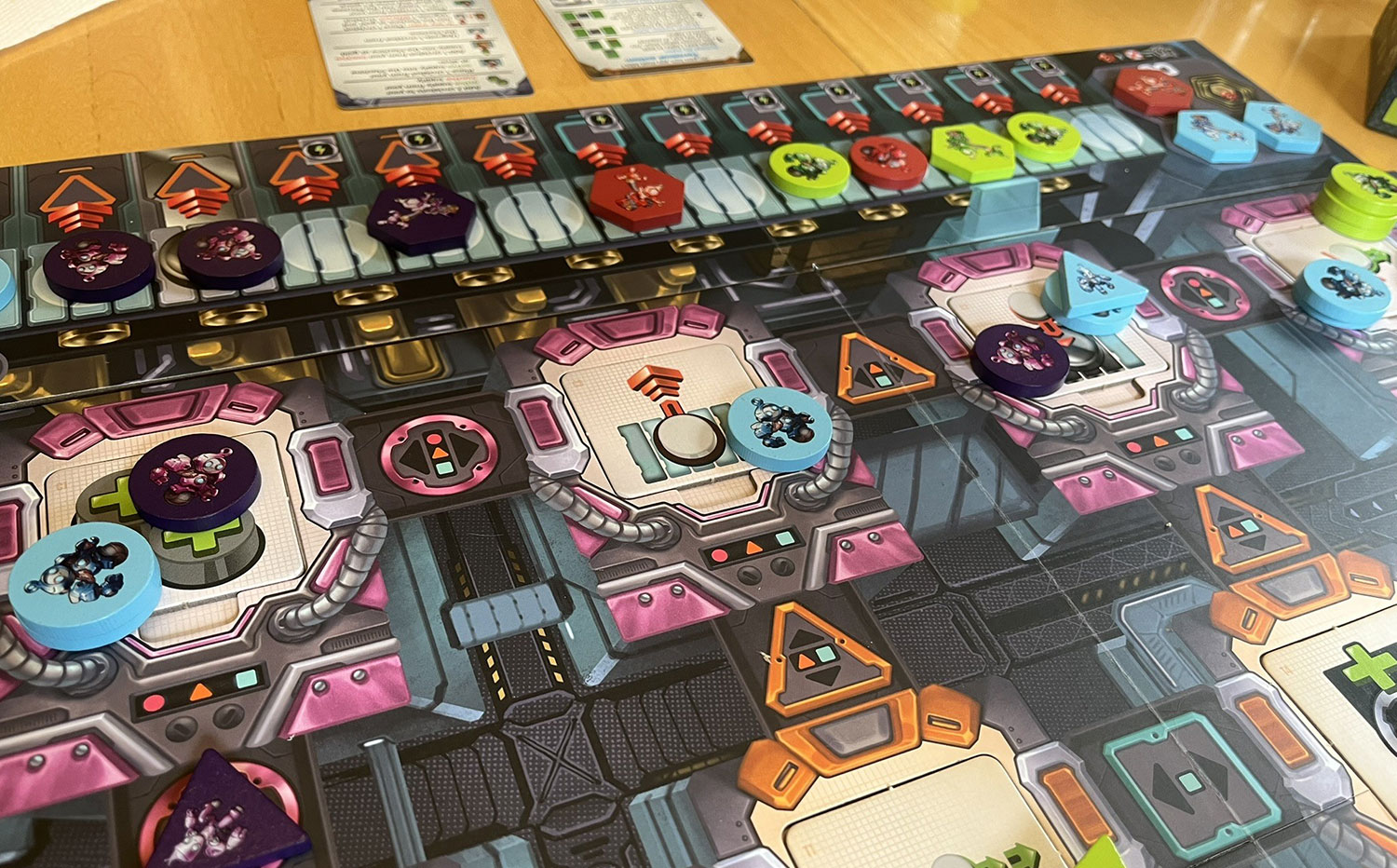
Possibly my favorite element of the game is the ability to link previously taken actions on future turns. At all player counts, getting to take two actions in a single turn can be a very powerful play. The fact that you are guaranteed to do so for a single token when most other spots on the board require 2+ tokens makes this a bargain to boot. Thus, players need to plan ahead and think about the spatial arrangements of the actions (which change each game) and determine which orthogonally adjacent actions they want to prioritize for repeat activation in each round.
Notably, as an interactive tactical racing game, Into the Machine does feel different at the various player counts. The track length adjusts according to the player count, but nonetheless, the overall number of tokens on the race track and how many times they change locations in between your turns will be different based on player count. At 4+ players, it can almost feel a bit chaotic; every move you make can potentially help or hurt specific players, and there can sometimes be a bit of a free-rider problem. At 2 players, you’re more incentivized to think equally about what’s best for you AND how to hinder your opponent—though notably, there are no direct “take-that” actions.
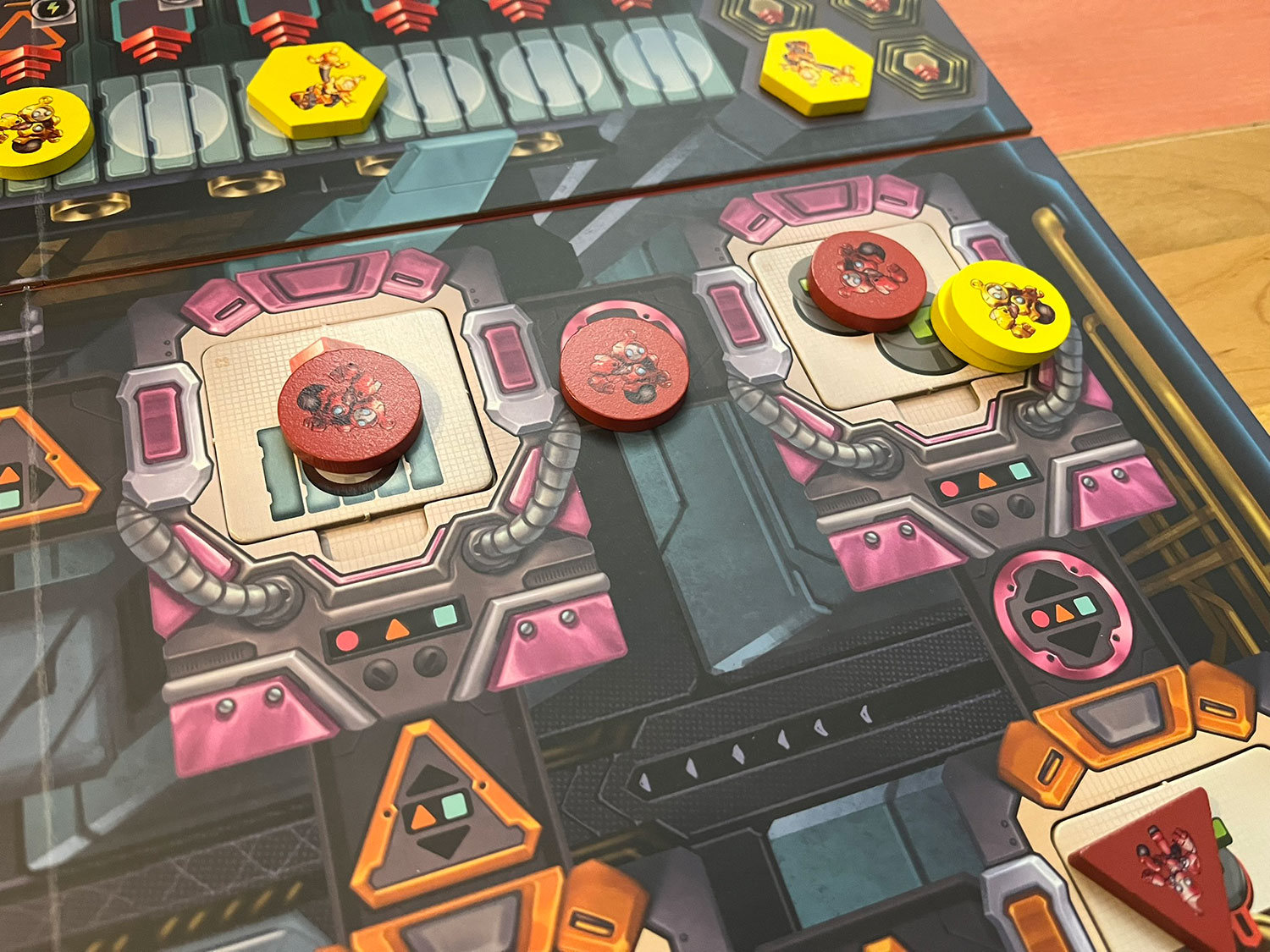
The biggest difference due to player count is the tightness of the worker placement board, which has the same number of spaces at all player counts. At 2 players, not nearly as much engine-building is required because the token costs for placement never get too high, though efficient use of the linkage mechanic still matters. The game truly shines at 3+ where it feels like you need a full armada of bots to gain access to the spaces you desire. Having to pivot because certain spaces are suddenly way too expensive—or alternatively super attractive because they just got cleared off—is a much more frequent part of the decision-space, and it can create a fun tension.
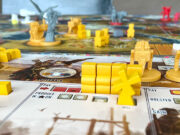
My main critiques are that (1) the chunky tokens can obscure visibility of the worker placement spots and (2) maybe there should have been inclusion of some “take-that” action spots, or power cards, possibly as an add-on module. Near end-game, it can sometimes be clear that one player is best-positioned for a win, and there’s not much the other players can do other than slow them down a tiny bit, if that. Your last few turns can thus feel a bit pointless if you’re not in a winning position.
Final Thoughts:
Into the Machine cranks the fun into high gear by combining a highly tactical and player-interactive racing experience with a fairly simple ruleset. The bi-directional track crowds racers together, creating dynamic opportunities to hop over other players or slide through gaps. These moves are triggered through a worker placement mechanic featuring asymmetric worker activation and geometric linkage of previously activated spots—i.e. it’s a puzzle unto itself requiring some engine building and good timing for maximal efficiency. This game shines at the player counts of 3+ and represents an excellent medium-weight racing game that’s as slick as a well-oiled machine.
Final Score: 4 Stars – Going into this machine is a pure joyride
 Hits:
• Highly player-interactive racing maneuvers
• Linking of worker placement spots is a cool mechanic
• Straightforward rules
• The opportunity to say “ding ding!” to players who take too long
Misses:
• Chunky player pieces can visually obscure the board
• End-game can be anticlimactic if you’re not close to a winning position