 It is the near future. Computer consciousness has burgeoned to become inescapable. Entire cities have surrendered to become automatons to be used by the Machines for their nefarious purposes.
In other words, Deckers is a 100% factual, serious work of documentary. I’m surprised that it wasn’t published by GMT.
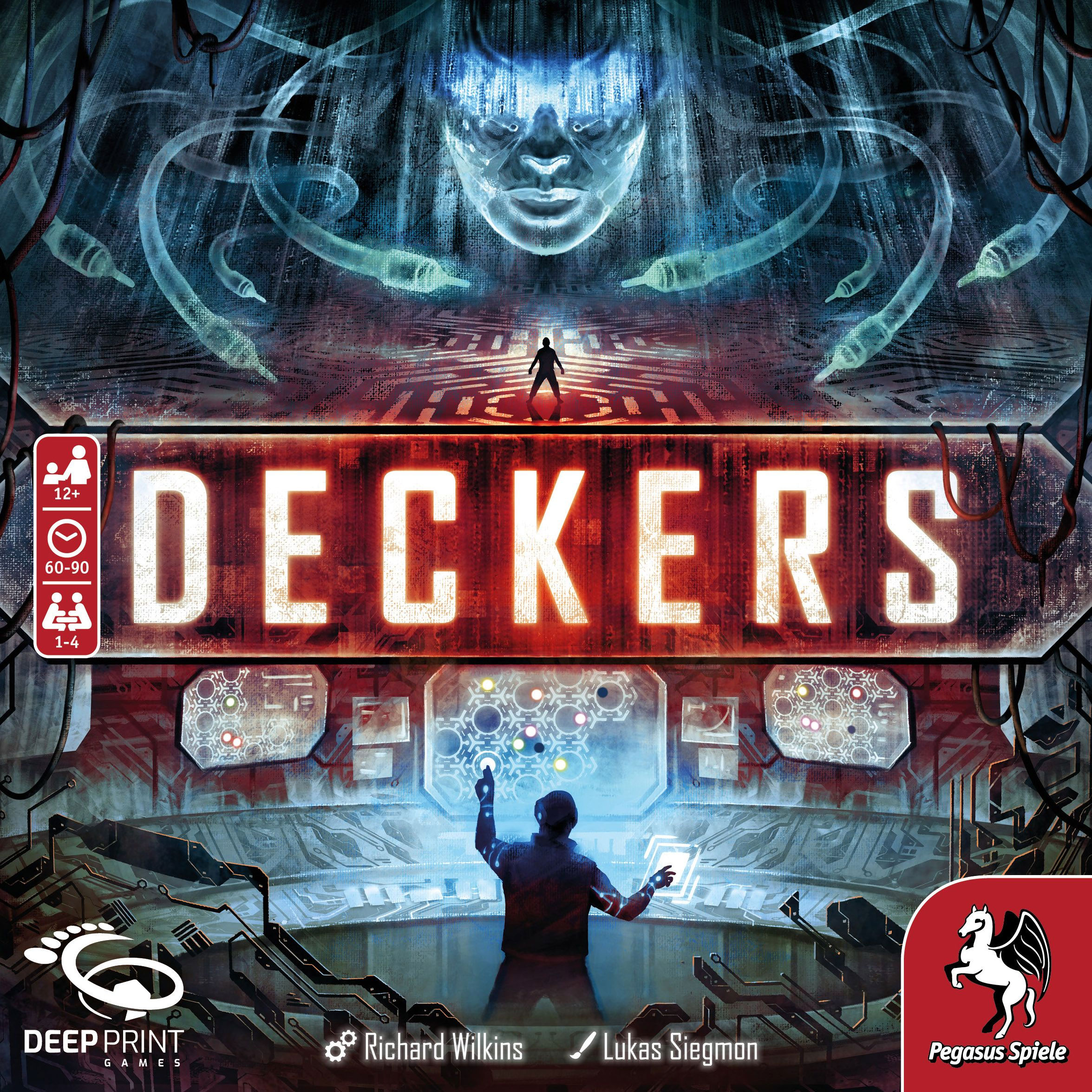
Deckers, from Richard Wilkins (AKA Ricky Royal on YouTube) and published by Deep Print Games and Pegasus Spiele, is a 1-4 player game that takes about two hours to play. Deckers is a V2 of Renegade, which was previously reviewed by Tahsin for BGQ back in 2018.
Gameplay Overview:
In Deckers, you and up to three friends play cooperatively as Deckers. Hackers who are trying to infiltrate and take down SMCs (super massive computers). You’ll start to see the enormous decision space during setup.
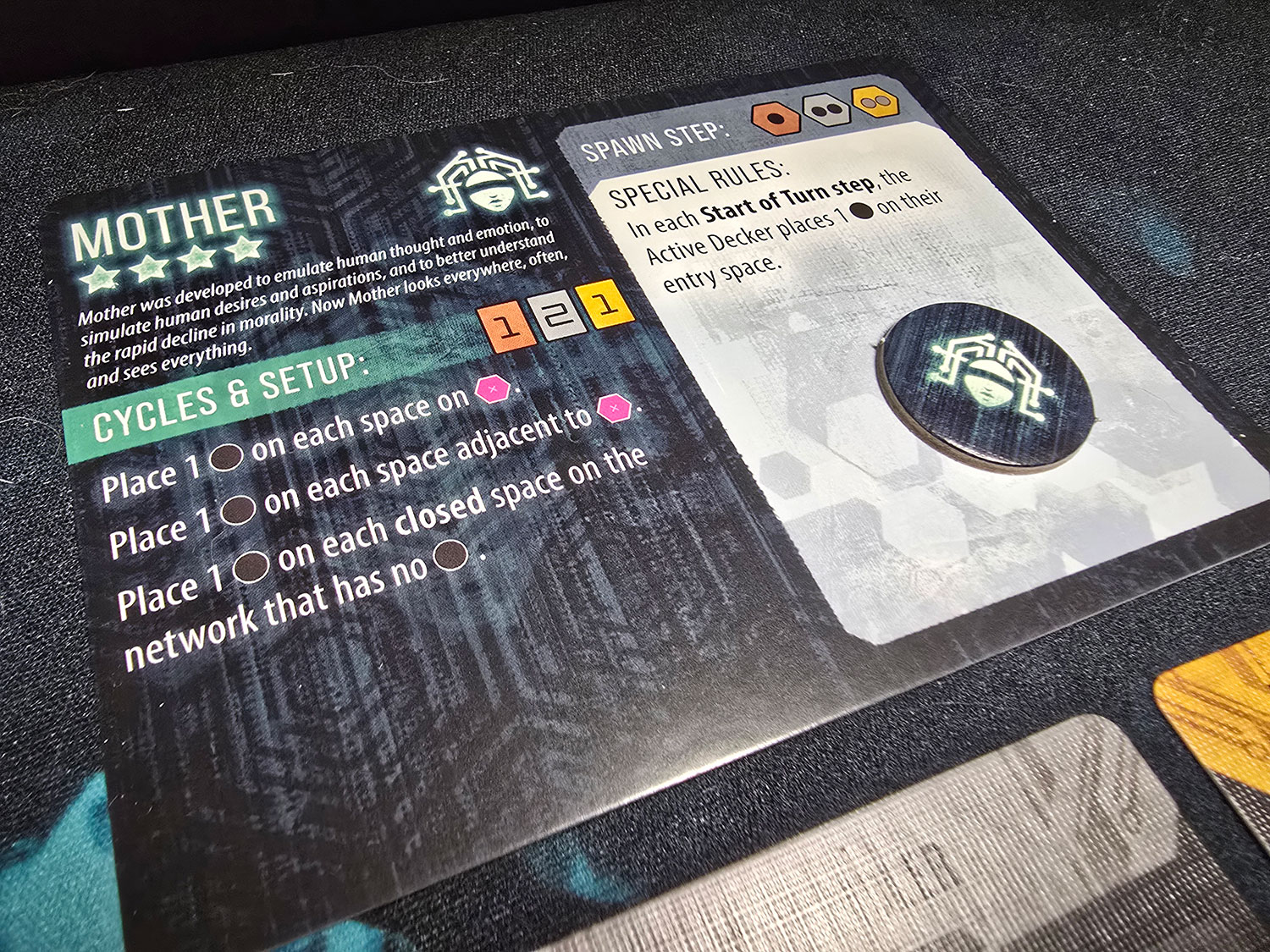
First, you choose one of 7 SMCs to play against. These are the Big Baddies. The mean AIs that the Deckers are fighting. Each one will actively work against you with unique abilities and difficulty scaling.
Then you choose objectives. These are your win conditions. Unique puzzles and problems. There are Copper, Silver, and Gold objectives (12 of each), and you only need to complete the Gold objective to win. But if you don’t complete the Copper or Silver objectives, your life will be that much more difficult.
Then you build the map. These are colored hexagonal tiles with spaces 1-6 on each. Each color is a server and represents various fields of battle for our Deckers.
Finally, each player chooses a Decker to play, of which there are 10 total (5 A-side and B-side, 1 per color). Deckers have unique abilities related to their color, which I’ll get into in the next section.
Once setup is complete, gameplay proceeds in Cycles (game rounds, of a variable number depending on SMC). Cycles consist of three Phases.
- Intel Phase
- Literally just read the cards on the table to remind you of rules specific to objectives and SMCs
- Action Phase (lots more to come on this in the next section)
- There are six sequential steps in this phase, where various effects may trigger, including new bad guy minions spawning.
- Each decker takes three turns, using their whole 15-card deck. Turns are not necessarily sequential.
- SMC Phase
- SMC pieces on the board attack
- Objectives are evaluated for resolution
- Sparks may move around the board
If the game is in its final cycle (against the Gold objective) and the Deckers have met that goal, you win! Easier said than done.
Game Experience:
You’ve set it up. You’ve read the rules. Or watched a video. Whatever. Now it’s time to go bonk the bad AI.
Except, uh…. Well. How?
On your turn, you play cards from your hand. You start with 5. Simple enough, right?
Wrong.
Because those cards are each a Rube Goldberg device made of Swiss Army Knives. You can play the card for its printed Effect. You can play the card for its command symbols.
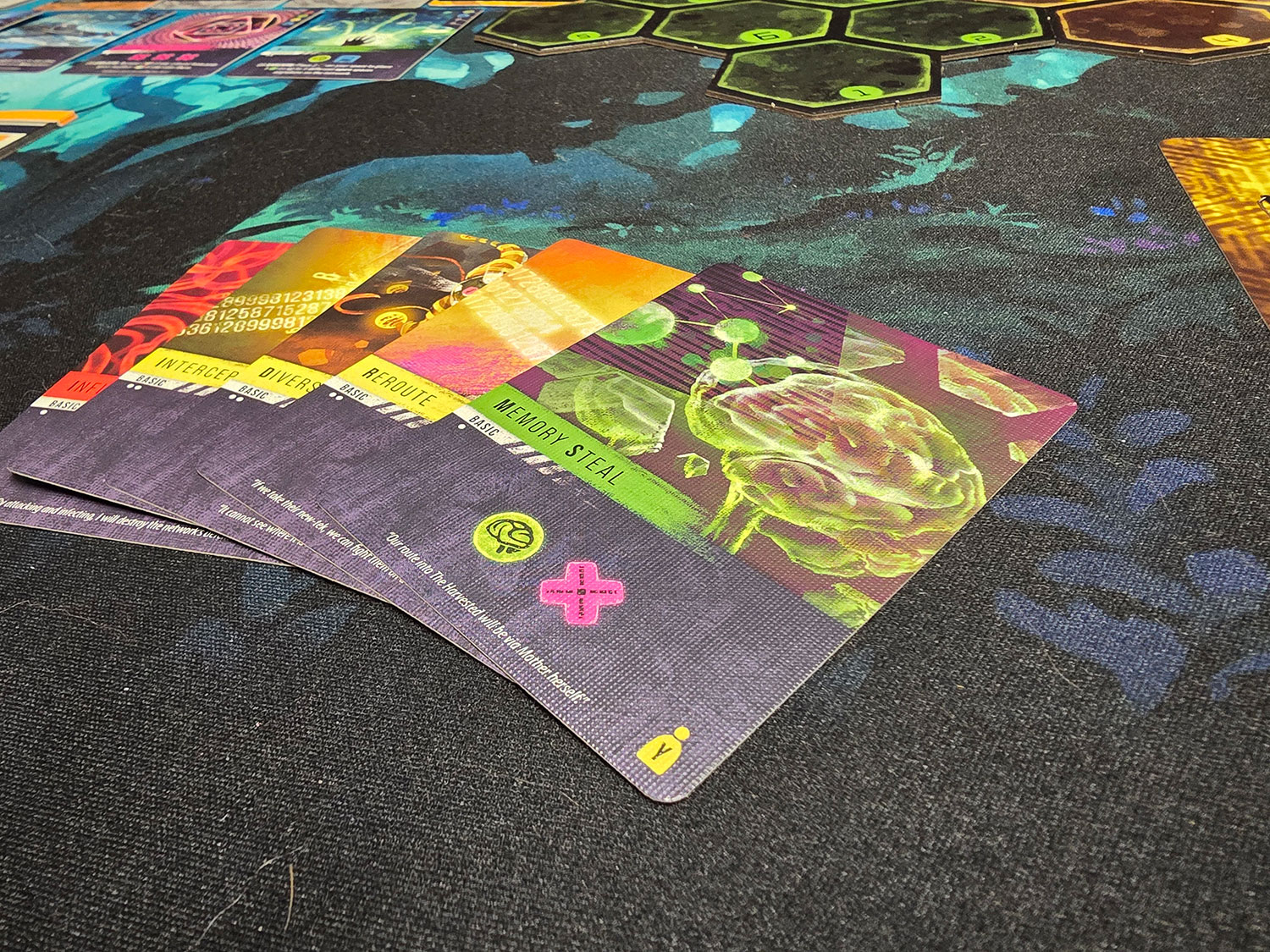
Oh, and you use those command symbols to
- Upgrade command cards
- Upload programs (small bits of map presence that facilitate actions)
- Convert programs to installations (permanent structures that make actions more powerful)
- Perform a color-specific action like moving yourself, shifting, modifying, or infecting other pieces on the board
See, you’ve got options.
Obviously there is the immediate problem of the sparks (and maybe Guardians) on the board. Those minions will all get in your way and eat up your programs if you don’t crowd control them. Easy, just spend some reds to throw down a program and infect.
But wait, there’s also that objective that you’re working towards. And maybe that card in the market would really help on the way. Except you’ve got the wrong color cards to buy it, damnit.
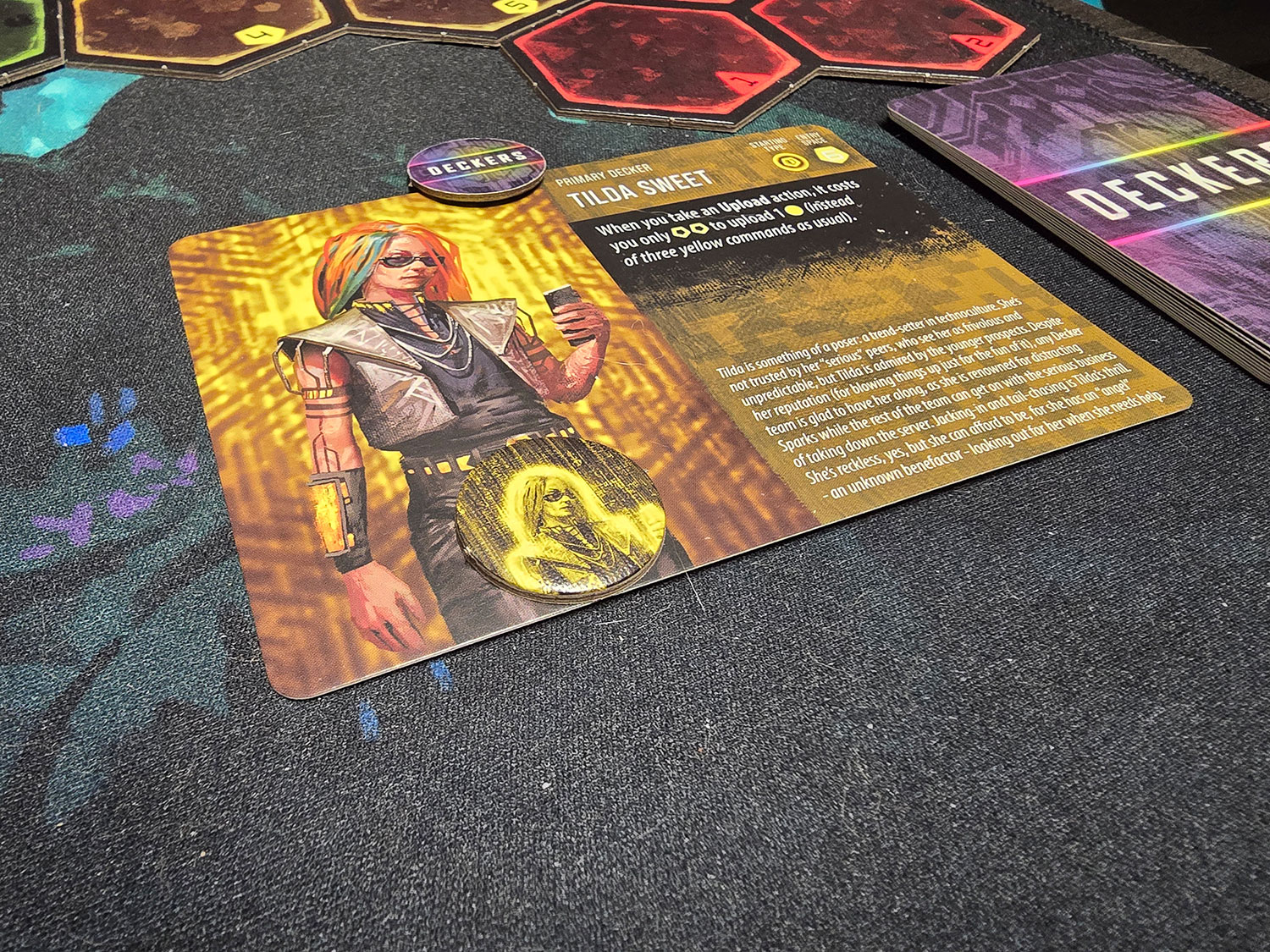
OK, instead of that, maybe I’ll play off my Decker’s ability to pocket some programs and move (shoutout Hettie) to another spot on the board where they can stack
And you make these kinds of choices 15 times per cycle. That can be overwhelming.
Each action in and of itself is straightforward. Pay a blue command for 1 movement point. Easy! It’s the choice pathways that give this game complexity. Because you can also use that blue to pay for a card upgrade. Or with other blues to pay for a new program. Or with other command colors to become a wild (purple).
The most challenging aspect of the game is that its puzzles often require rules-breaking thinking in order to beat them. The AIs write the rules. You, the Decker, have to break them to beat it.
For example, the Gold objective suggested for your first game, HackMan, instructs you to destroy the HackMan, except you aren’t allowed to move into HackMan’s space. What?!
Finding a way to do that is both confounding and immensely satisfying.
Similar to other open pathway, multi-use card games, you can find yourself slowed at the beginning while you plan. Then the Cycle will rapidly resolve as your plan unfolds and turns will flow quickly.
For you Euro purists out there, there are dice in the game. And they dictate combat. There’s a deterministic element, but a dice roll can still go against you and bork your plans. When an Infect action is taken, you calculate the value of red programs and command icons played, plus some adjacencies, and then roll d6 dice to determine combat values. So if the SMC blasts you with a 6 to your 1, you could lose if you don’t have enough support.
The Sparks will move around and turn into Guardians (like your Installations, permanent, and a permanent pain in your digital tuchus). Sometimes sparks will pile up and cause an Explosion, where they cascade-populate across the board. A lot of times that’s an instant loss. Too bad, so sad. Git gud, Decker dweeb!
Upgrading cards is satisfying. It almost feels like stealing free turns. The upgraded card comes right into your hand for use that turn. And you can pay more than one card for the upgrade, but only need to ditch one card to take the new one. So you can use the same card(s) multiple times as long as upgrades are available.
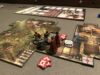
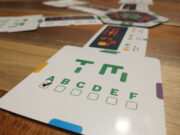
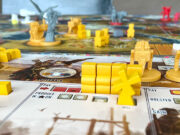
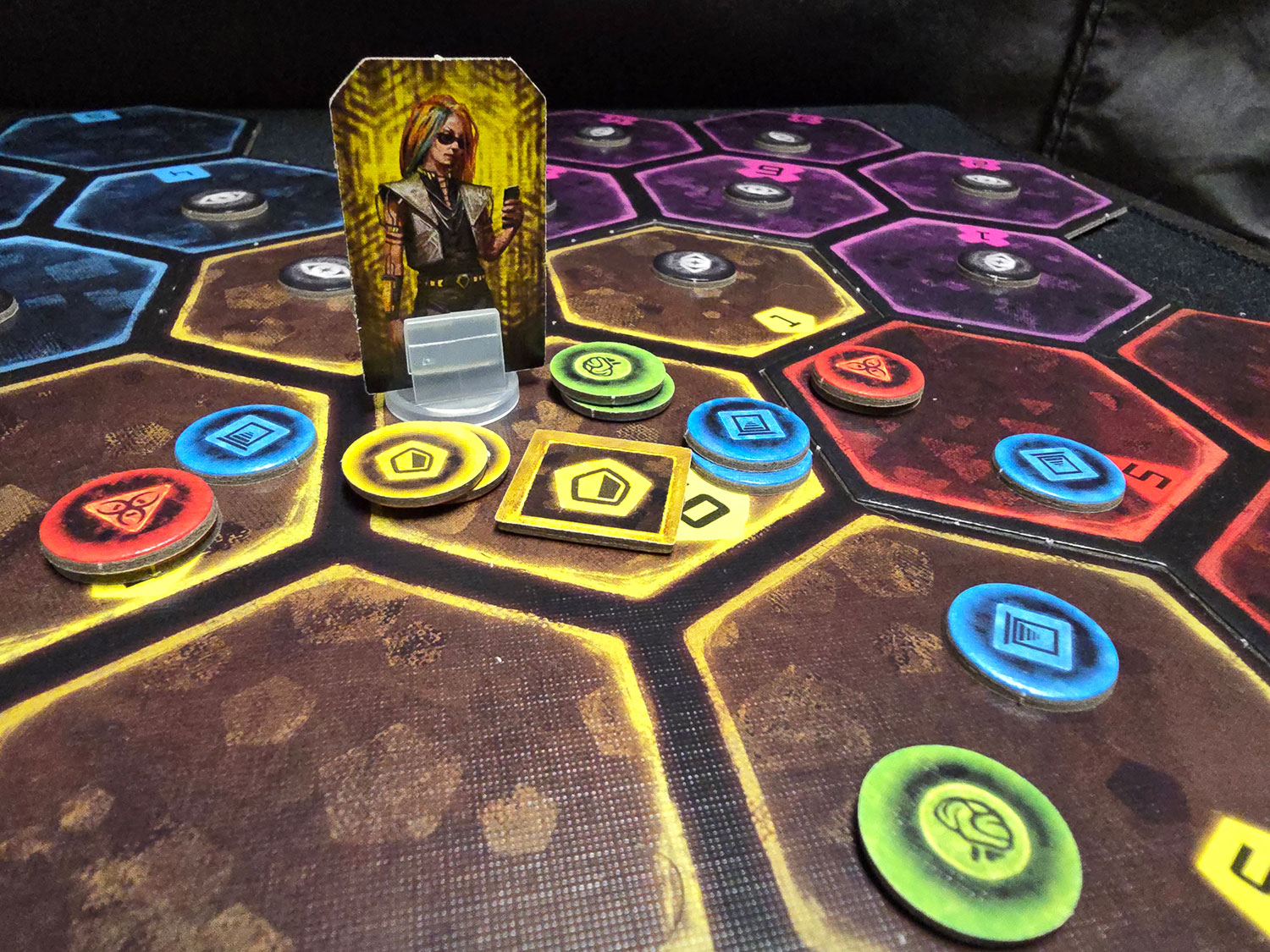
Table presence is nicely compact. I’ve heard some rumblings that it doesn’t look nice on the table because the most prominent thing is a featureless rainbow colored map. That’s simply not the case. The card art is wonderfully thematic, and the map fills quickly with tokens that would be hard to parse if it were a busier board.
In keeping with other Pegasus/Deep Print games, it comes with included cardboard boxes for storage. They are lovely and improve setup/teardown time immensely.
Final Thoughts:
Playing Deckers is sort of like opening your junk drawer and landing in a Costcome Depot Super Center. Have a beehive to get rid of? Sure we’ve got that pansy spray that goes 25 feet in the air, but have you tried our artisanal flame throwers? How about a psyop against the queen bee? Of course we have those.
The wondrous tool kit can be overwhelming at first. Expect game 1 to be a brain-bending drubbing.
As you familiarize yourself with the action set, ways to game your deck, and how the AIs will play, the game finds a rhythm.
That’s the thing with Deckers. The game has a rock-solid foundation with immense modular flexibility layered on top. The various Deckers, SMCs, Objectives, map orientations, and all that comes with that variance make for a fresh (and occasionally frustrating!) experience every time you play.
And if this box isn’t enough for ya, there’s an expansion releasing soon: Deckers: Duplicity.
Final Score: 4 Stars – Deckers provides a ridiculously variable (and sometimes overwhelming) toolkit for players to Force Quit some Asshole AIs.
 Hits:
• Phenomenal open play system
• Fairly simple rule set for a very deep game
• Ridiculously replayable
• Included storage solution
• Small tabletop footprint
Misses:
• Some of the flavor text is, uh, weird
• The flexibility can be overwhelming at times
• With more than 2 players, it feels long.