


 We’ve all had this happen. You pack up a bag full of games after careful thought about which ones would really excite you at the game meetup, but when you get there, everyone’s already set up, and there’s one seat for a game you’ve heard a lot of buzz about. So you put your carefully curated choices to the side and play the new hotness, only to find it entirely pedestrian. Why is everyone so psyched about this game? What am I missing? Maybe I know nothing about games after all?
So you find a chance to play it again. And still nothing. And then the game is so popular, they make it into an app, so you figure, heck, this is my chance to play it by myself and figure out the magic I’ve been missing. But then it still just seems entirely blah. Not bad, not good, a little bit of fluff to occupy your brain while stuck in line waiting, but not something you’d ever ask to play. You know that sort of game, right?
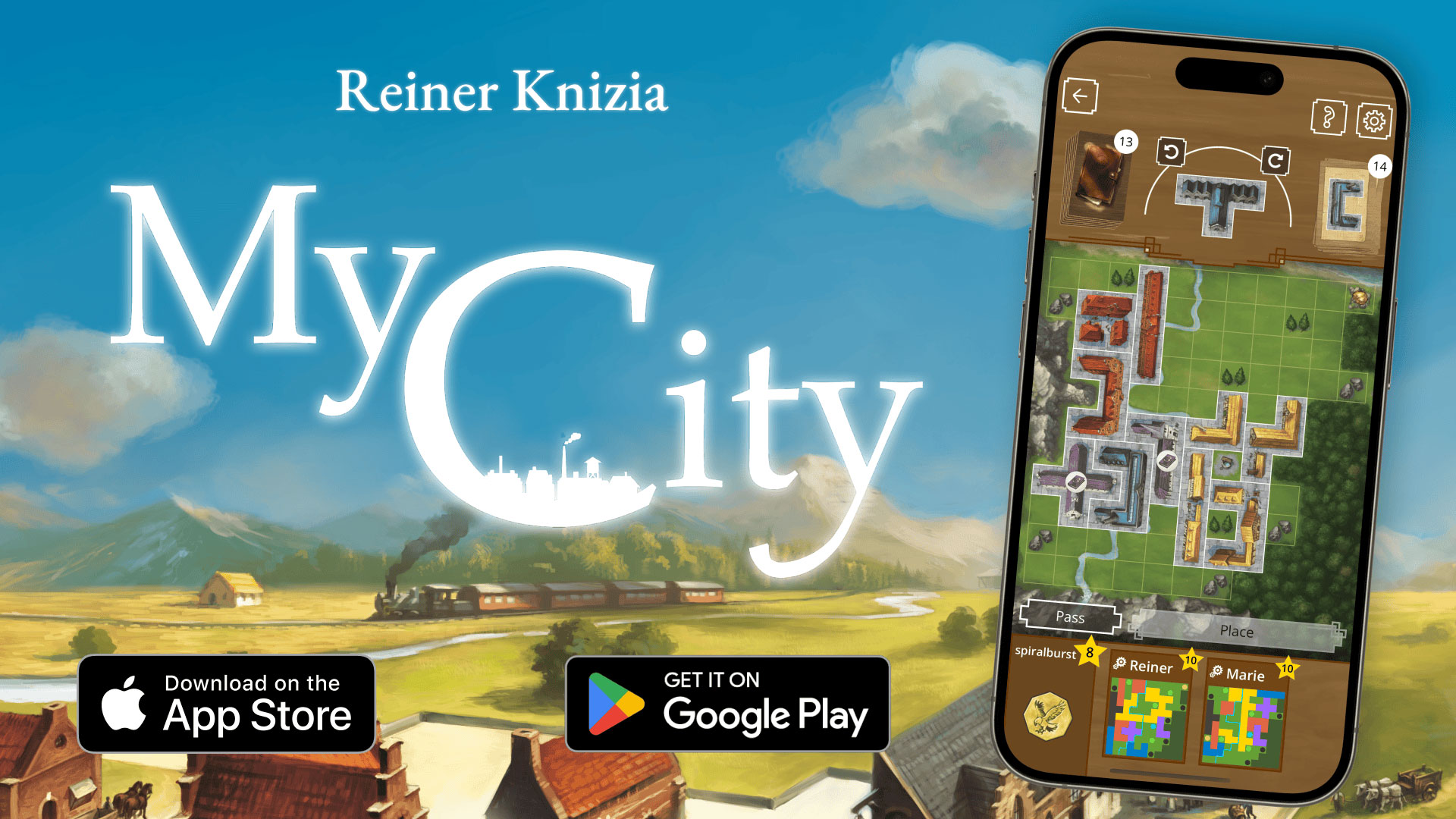
Ladies and Gentlemen and other gamers, let’s give a warm round of applause to welcome Reiner Knizia’s “My City” (Digital version) to the Meh Club. The “My City” board game is published by Kosmos Games with art by Michael Menzel. I tested out the game on the newly published app (available for iOS and Android) published by Spiralburst Studio, LLC.
Gameplay Overview:
My City is a polyomino tile-laying game, so basically flat, slow Tetris. I like some games in this genre—Uwe Rosenberg’s “Patchwork” is quite fun, as is Phil Walker-Harding’s “Bärenpark.” These games involve laying typical Tetris-style tiles onto a grid to make a quilt or a bear-oriented zoo, respectively. They offer interesting ways to draft your tiles and, in the case of patchwork, a tactical puzzle about timing.
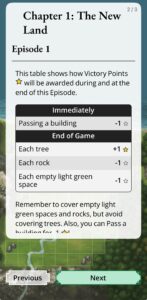
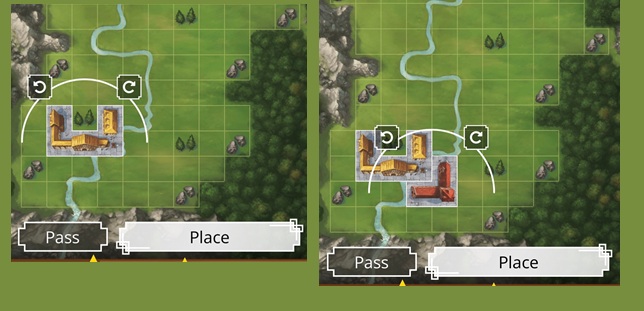
My City is also a game in this genre, but it simplifies a lot of the decision-making by having the tile draw be random but shared, so that the only choice the players have is where to place their tile. In this sense, the game is more like Tetris than the others in this genre because the next tile is not in the players’ control. In a video game, this adds to the fun, but for my taste, it detracts from a board game, or even a board game app.
The hook for “My City” is that it is a campaign game, where the rules for how you score points change from turn to turn, with new restrictions and new bonuses becoming available as the game plays through its 24 (yeesh!) episodes. In some games, you get bonus points for making clusters of the same color tile. In others, you get bonus points for surrounding one color of tiles with one of each of the other colors. Sometimes you feel like a nut, sometimes you don’t.
Down the middle of the board is a river. Thou shalt not place a single tile such that it crosses the river, ever. It’s a 24-episode pain in the butt.
Game Experience:
Let’s talk first about the game itself, and then the Spiralburst’s implementation of the game as an app. Game-wise, the rules are pretty simple. Every episode, you are told the scoring conditions for that round, with an emphasis on what has changed from round to round. The game features clusters of trees, which you generally don’t want to cover with tiles, and clusters of rocks, which generally you do want to cover up. There are also larger swathes of forest, which sometimes you can cut down to make space for tiles, and sometimes you cannot. There are other elements added that I don’t want to spoil, but they are all of the generic sort of “now try to touch every space on the bottom of the board” or “cover the top right and bottom left corner of the board” sort of challenges.
As the game progresses, you can see the tiles that have not yet been drawn, so you can play a little bit strategically—if you know there is still a T-tile available, then leaving a T-space gap for later can be wise. In some episodes, you can pass on a tile that ruins your plans, at the cost of -1 point. In other episodes, passing even once ends your round, allowing the other player(s) to keep on drawing tiles until everyone passes or the tiles run out. But basically, it’s 24 Groundhog Days’ worth of the same mediocre game over and over with rule tweaks to make it “interesting.”
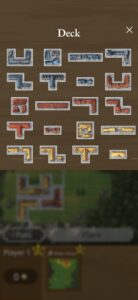
With that said, the app does a nice job of making it clear what’s going on from episode to episode. I had played a few episodes of the game once or twice before I got the app, so I had a vague sense of the rules, but I was able to dive right into a full campaign with an online friend without reading any rules, and the nature of the campaign was such that I learned as I went. It’s easy to tap to see which tiles are still in the random queue, and also to check on the specific rules of each scenario. So, in terms of turning a cardboard experience into a digital one, I give high marks to the team at Spiralburst.
I have a few minor quibbles with the quality of life elements of the app, though. These all revolve around what happens when it’s your turn. If you left the game while waiting for your opponent to take a turn and the phone locks up, the app can act like you’re still waiting for their move when it’s actually your turn. This is true if you are in the app or doing something else on your phone. The game gives you an alert (at least on iOS, I did not test the Android version), but it does not put that little red 1 in a circle next to the app icon, so if you miss the notification when it gets sent, you won’t know it’s your turn just by looking at your screen of apps.
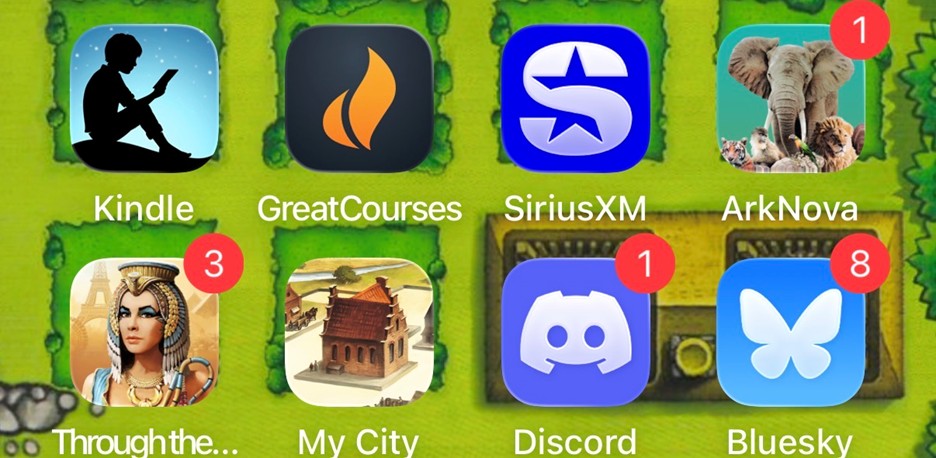
In truth, the app is generally pretty good, and the AI opponent was difficult enough that playing the game offline was a smooth and generally pleasant experience. In other words, if I had to play a game of My City from start to finish, all 24 episodes, I would definitely prefer to play a game on the app against the AI, rather than asynchronously against someone else via the app or over a series of in-person sessions.
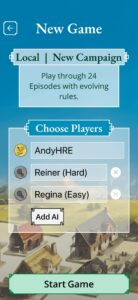
But all that to say is that, as slick as any app can be, the full experience can only be as pleasurable as the underlying game allows. And boy howdy, I just don’t find My City to be all that much fun. The best I can summon up for praise is that in spots where I have been stuck killing time, like when my wife was getting hip replacement surgery and I was cooling my heels in the waiting room, the game can be a diverting distraction from the boredom of nothing to do. When all of my BGA games were waiting for other players to taske their turns and I’d done my Ark Nova and Through the Ages app turns, I sat and battled Regina the Easy AI player in My City (the “Easy” players’ names are randomized, the first “Hard” player is always “Reiner” and random after that) and about 45 minutes sped by much faster than otherwise would be the case.
Final Thoughts
In general, I am a big fan of Reiner Knizia as a designer. I have about a dozen of his games, and some of them I consider home-runs. And so when people I respect like, Quinns at Shut Up & Sit Down were raving about how Reiner Knizia’s My City had basically obsoleted all other polyomino games, I bought into the hype and was very excited to get it played.
The hype was unwarranted. This is a so-so game. I mean, it’s fine. It’s a little like how Colin Farrell’s character in the classic movie In Bruges tries to explain how some people might find Bruges pretty cool if they are from a rural background and of low intelligence, but because he’s a smart Dubliner, he’s not at all impressed [be aware, this link uses offensive language for humorous effect]. It’s the board game embodiment of the concept of So-So.
But if you did grow up on a farm, etc., or if you are a fan of My City already, then the My City app is probably right up your alley. It has a few notification kinks that will hopefully get worked out as patches are released, but overall, it is a very good implementation of a game I just don’t happen to love, or even really like all that much.
Final Score: 4 Stars – 4 for the app, devotees of the genre, 2 for the underlying game.
 Hits:
Hits:
• The AI is sharp and speedy
• The app does a good job of helping you remember which rules are in force and where you are in the overall campaign
• It helps pass the time when stuck in a lobby or a line
Misses:
• The underlying game itself is just not that fun
• 24 episodes is too many. 8 would be fine.
• This is by the same guy who designed Tigris & Euphrates, Botswana, and Ra?












Nice review Andy, way to not pull any punches!
Also nice playing HiS with you last weekend 😉
was a pleasure! let’s find a way to play something again soon!