

 I’ve organized my fair share of group theater excursions, and I’ve always selected a block of seats either in a single row or back-to-back across two rows. How basic of me. Of course, I’ve never had to worry about packing a theater for a world premiere, ensuring celebrities are surrounded by enthusiastic fans, and convincing ticket-buyers to sit in undesirable locations such as along the far edges and behind sight-restricting pillars. That is the situation in Take a Seat, a competitive “share-and-write” filler game for 1-6 players. Over 25 minutes, players will try to optimally fill in various regions of a theater with polyomino-shaped seat blocks, in a manner that best satisfies the various capricious tastes of management. So come along and listen to this theater-themed review.
Gameplay Overview:
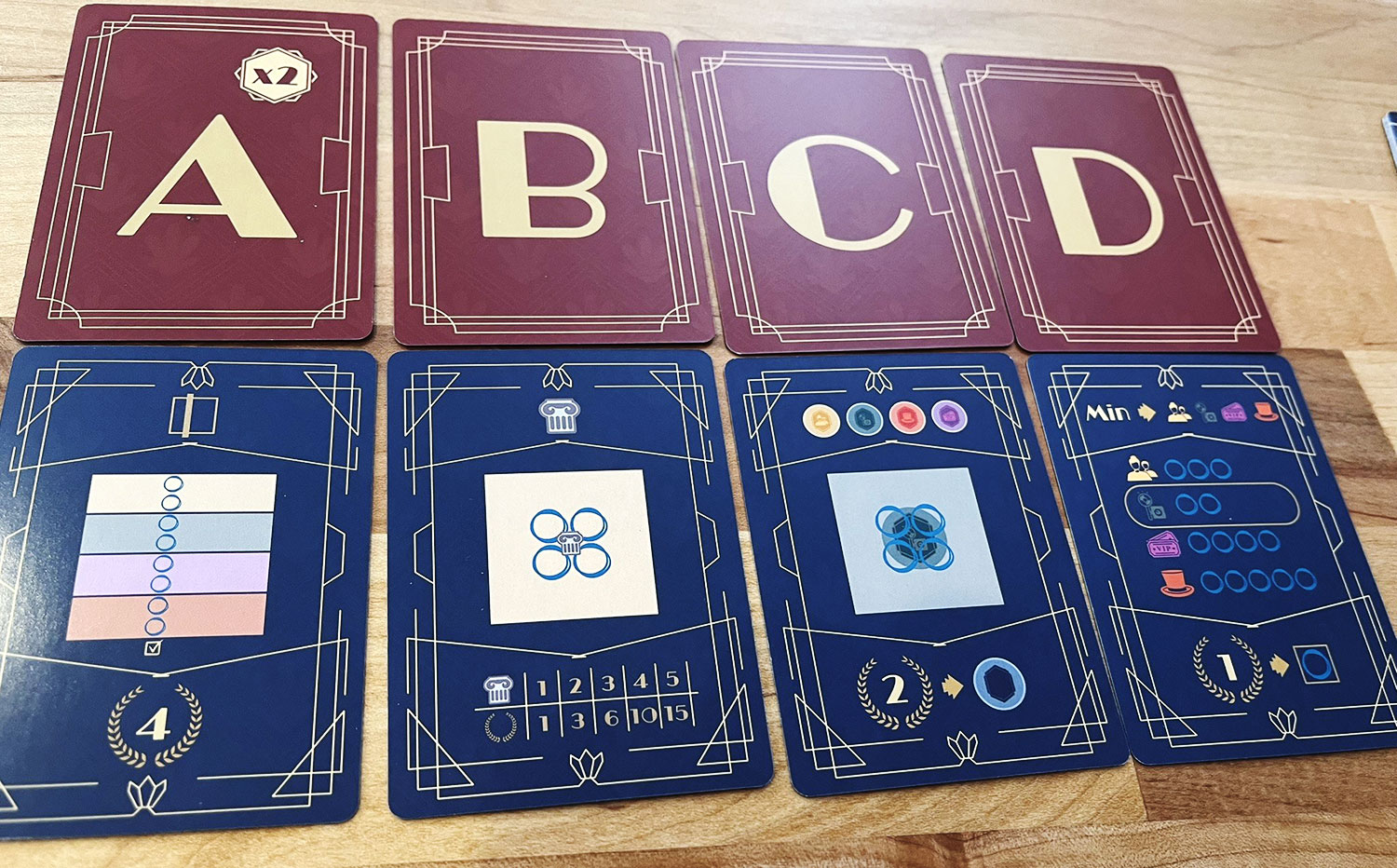
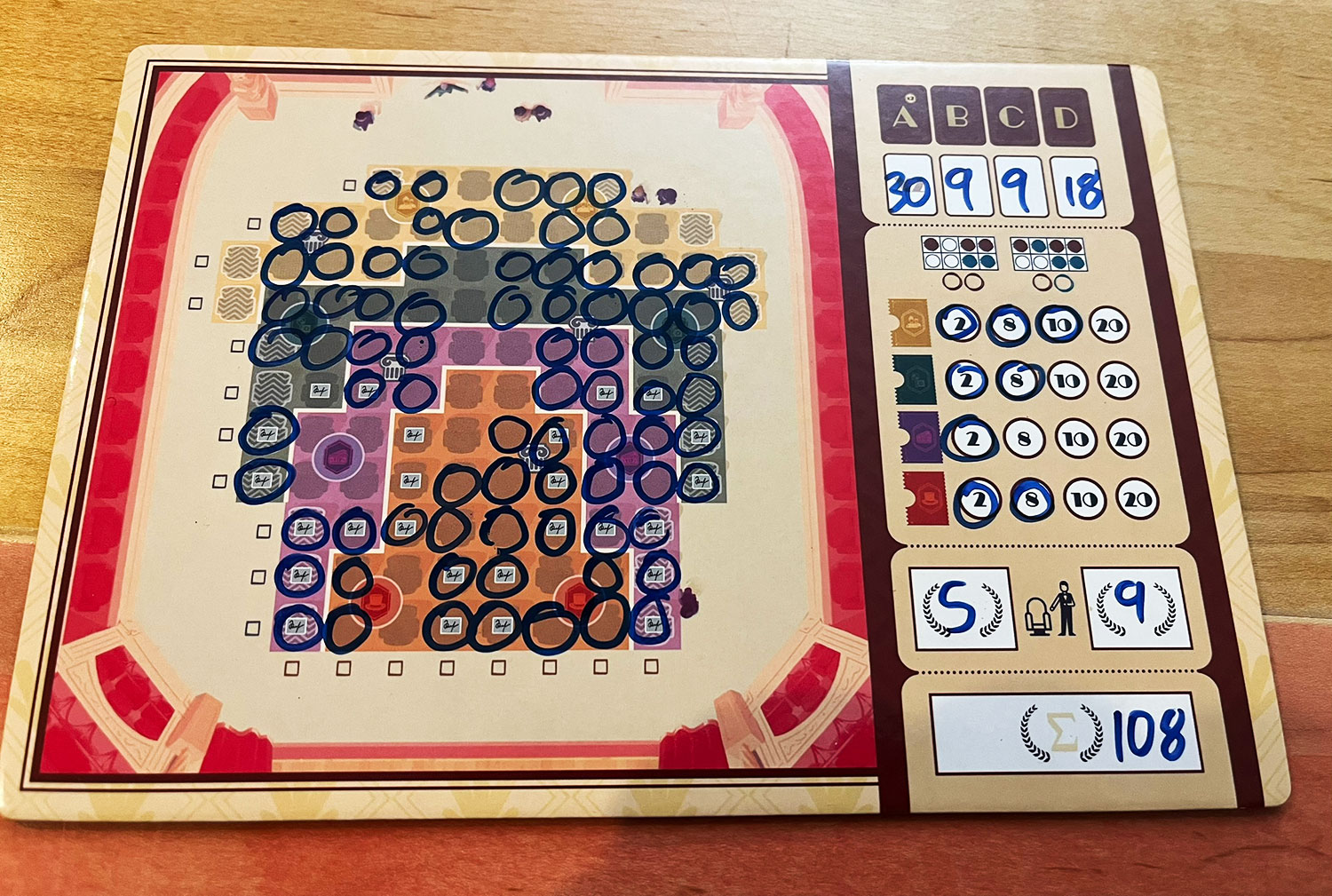
For setup, four random objectives will be selected among three levels of difficulty. These will determine the desired seat-filling patterns for earning points. Each player receives their own dry-erase theater board showing available seats. They will also have a dry-erase reservation board to the left and right, to be passed back and forth and shared with their neighbors.
On a turn, each player must simultaneously punch a ticket on a reservation board corresponding to one of 4 different colored seating sections. Each ticket is a polyomino subdivided into 8 seats. The “punched” seat is eliminated, and the remaining polyomino shape is what will be filled in on your theater board, being placed at least partly in the matching-colored section.
Players may additionally choose to alter this polyomino in some way, by rotating it, changing its assigned color, or by slightly modifying its shape if they choose to use an usher’s ability. Each reservation board has 8 total usher abilities of 5 varying types, each linked to a certain point value, and each being single-use. If you utilize an usher’s ability, you must cross out the associated points, and if you use the polyomino shape without modification, you must eliminate an usher’s ability and claim its points for end-game.
Players continue marking alternate reservation boards for a total of 14 turns. They will then compare the majority of ticket punches in each of the four colored sections with each of their neighbors.
Points are summed from area majority contests, unused usher abilities, and extent of completion for each of the 4 objectives. Highest score wins!
Game Experience:
Leapin’ lizards! This game sure has me whistling a happy tune. When selecting any filler game, a few of my favorite things to seek out are (1) little downtime, (2) interesting decisions, (3) meaningful player interactions, and (4) a flexible player count. In Take a Seat, all those boxes are checked; everything’s coming up roses, if you will.
The setup and rules are fairly straightforward; you don’t have to be too carefully taught. We go together, taking our turns; play is truly simultaneous with minimal downtime other than waiting for a player with occasional AP to finish up. And the actions of your opponents really do matter, both in terms of area majority as well as what polyomino shape options they’ll be leaving you with. There’s ample flexibility for player count as well. Take a Seat is excellent with two players side by side, though the area majority feels more balanced, so player counts 3+ are even better.
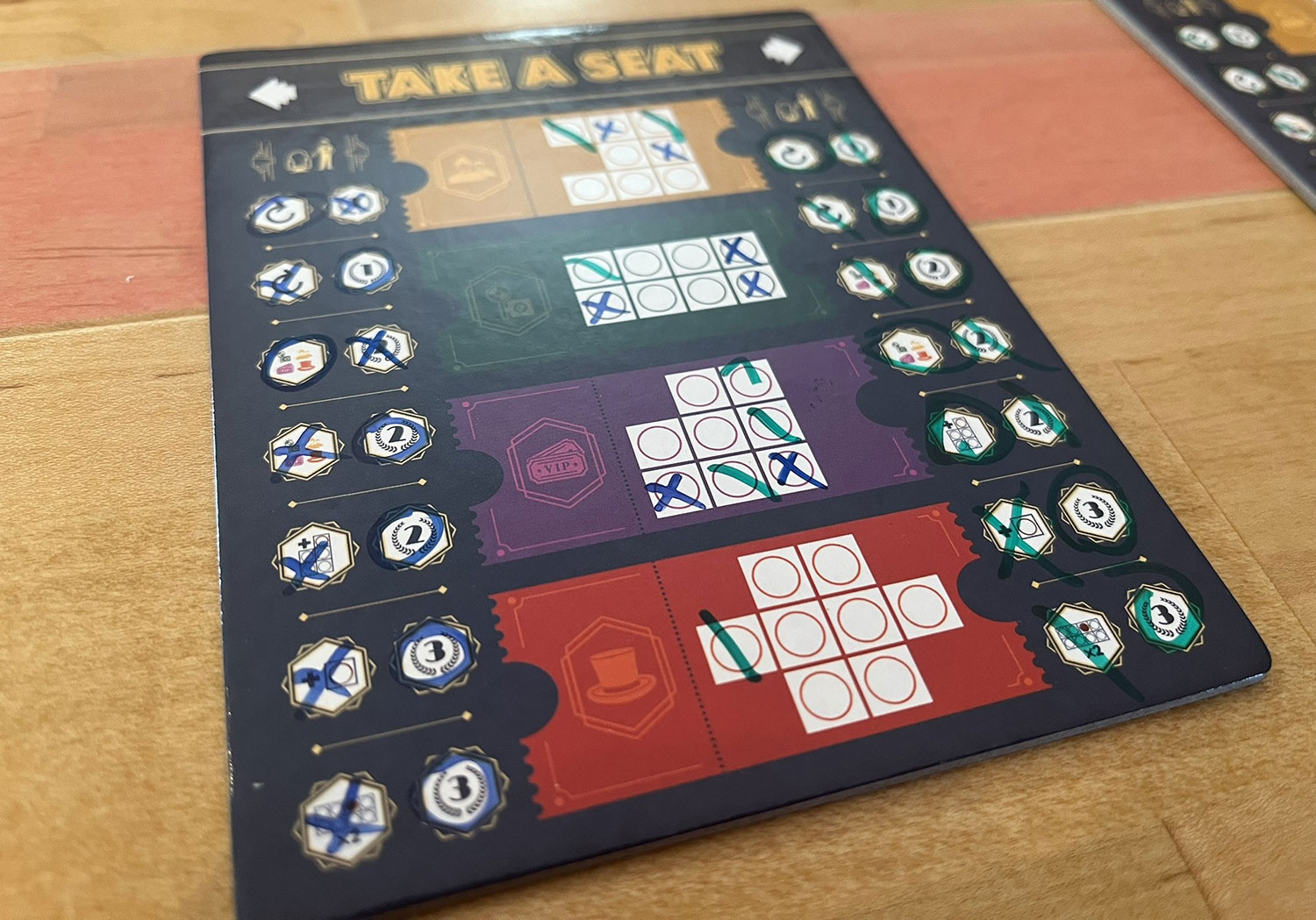
Then there are the interesting decisions. At any given moment, you’ll be trying to optimally fill seats such that they satisfy up to four different objectives, avoid using an usher ability (which means giving up points), and keep you competitive in important area control regions. Balancing all these factors is often an impossible dream. Completely filling the theater is magic to do, given the limited number of ticket spots available, and certain objectives contradict the others, such as filling in the edges versus filling in around pillars, which are more central. Finally, every single turn, whether you use an usher ability or not, you will be permanently eliminating an ability from future use, past the point of no return, and you have to try to predict which abilities are best saved for late game when the theater map gets tighter.
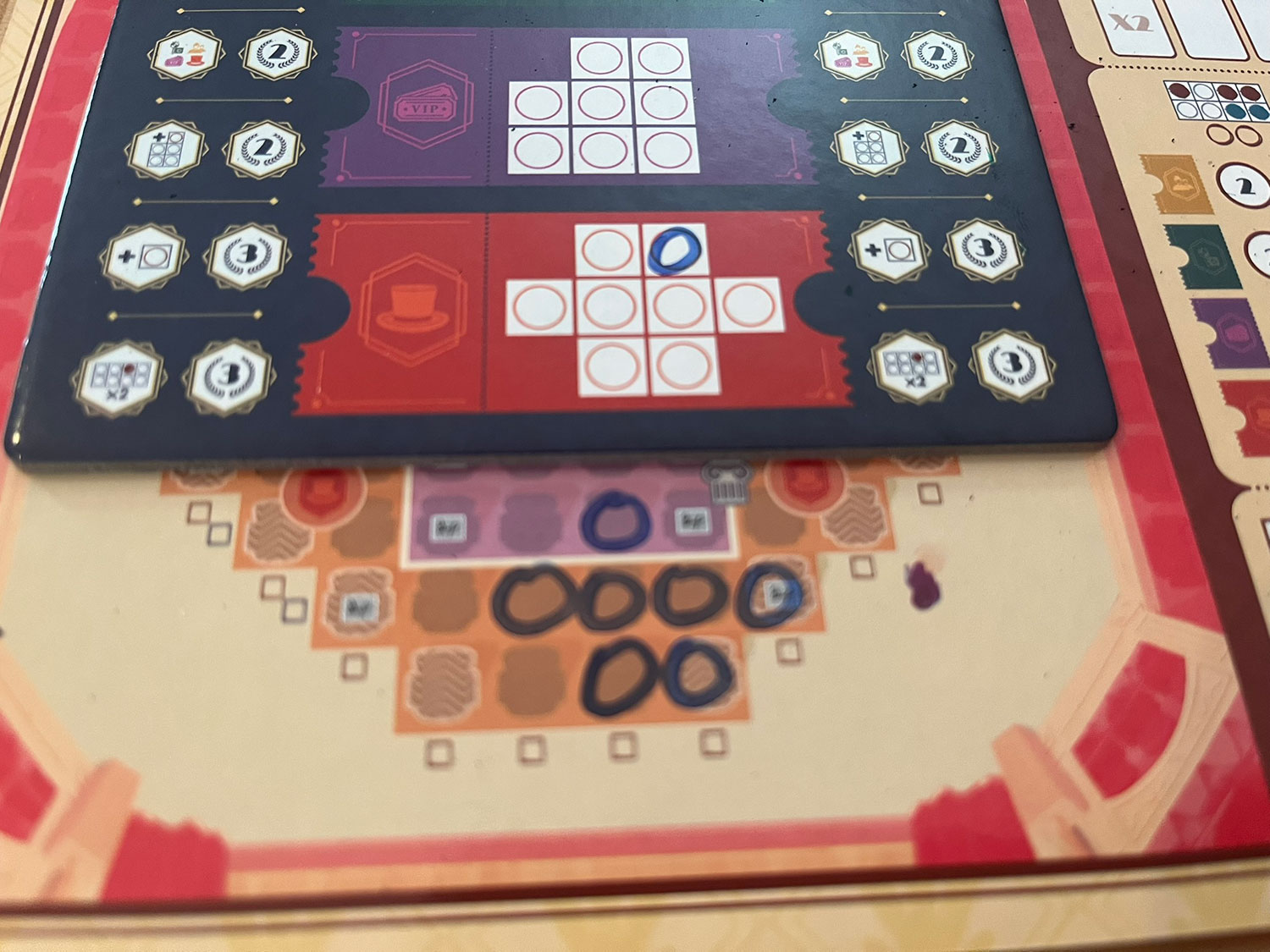
I’ve also gotta crow, that I get a kick out of the concept of polyomino pieces shrinking over time in a manner influenced by multiple players. It helps generate a nice arc as well as some tension in the game. If you are in desperate need of a long vertical skinny piece to complete a particular theater section, there might be multiple ways to achieve this. You can hope maybe this time I’ll be lucky and my opponent will help me create such a piece. Could be, who knows? Or you can use an usher ability to rotate an existing horizontal skinny piece to suit your needs now. Either way, the remaining options of your theater and reservation boards have been changed for good, and you’ll have to think through these new restrictions in later turns.
How about complaints? The graphic design is clean and functional, but it doesn’t send me over the rainbow. Also, certain objectives are simply more s’wonderful than others. There are four objectives related to completely filling in all of a particular color’s section, and these are okay, but you probably don’t want multiple of these in the same game. I also much prefer the 7 objectives that award points per unit of whatever as opposed to wide threshold ranges, as they do a better job of differentiating between the success of different players. Wouldn’t it be loverly if all 14 objectives were equally exciting? I also think we could do better with alternate polyomino starting shapes on the backs of the reservation boards (which are currently blank) for even more enhanced replay value.
Final Thoughts:
Take a Seat is a theater-themed polyomino share-and-write with a unique combination of desirable qualities: simultaneous play, ample player interaction, flexible player count of 1-6, and thinky decisions throughout. On any given turn, you’ve got possibilities galore: 4 objectives to satisfy, 4 area majority contests, and up to 8 usher abilities to exploit. The changing objectives every game, as well as 2 different theater maps, provide ample replay value. Some of the objectives could be more interesting, and the artwork is ironically plain for a theater-themed game. Nonetheless, the solid gameplay should make this game a high-flying, adored filler choice for game night.
Final Score: 3.5 Stars – A simultaneous, player-interactive share-and-write that’s sure to razzle dazzle lovers of polyomino fillers

Hits:
• Simultaneous play
• Ample player interaction
• Thinky decisions throughout
Misses:
• Bland artwork
• Some objectives could be more interesting

Note: There are 23 musical theater “easter eggs” sprinkled throughout this review. After all, there are only so many opportunities in life to combine one’s passions for both board games and theater, and I am not throwin’ away my shot. Okay, 24 total.