



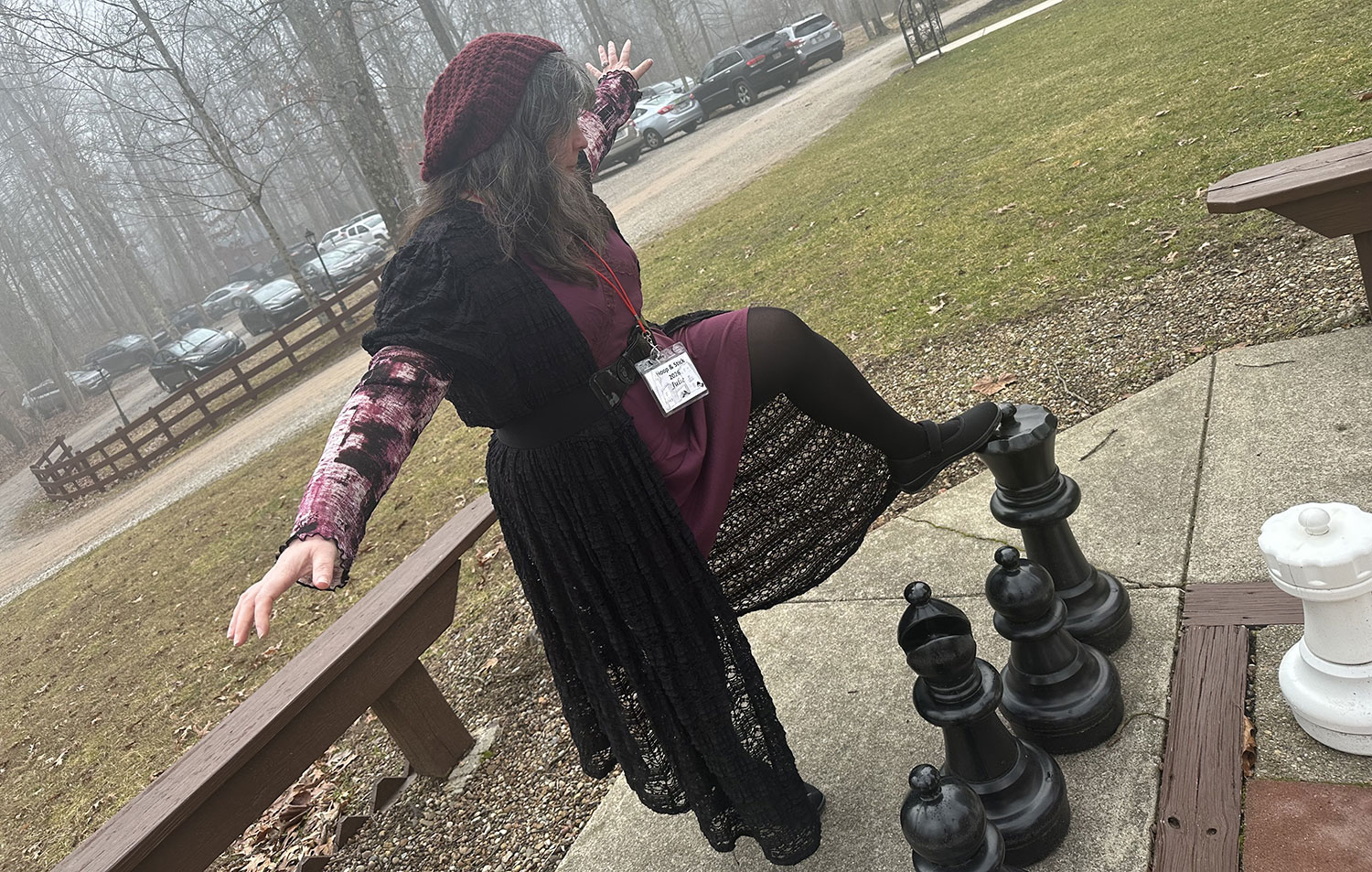
After sixteen years in the industry, Julie Ahern has worn all the hats. From writing to project management to podcasting to marketing, she’s been part of every step of the game-making process and has helped create some new ones along the way. She’s worked for Greenbriar, Van Ryder Games, and starts her tenure as COO of Cephalofair Games this month. Known throughout the industry for her organizational skills as well as her commitment to raising up other voices, she’s also been the Secretary of GAMA and an Educational Advisor for Sovranto.
I first met Julie back when I started writing about games (over seven years ago now). Since then, we’ve caught up at trade shows, exchanged industry news via DMs, collaborated on some game promotions, and hosted a Terry Pratchett-themed stream. After the Cephalofair announcement, I reached out for an official and in-depth update.
I was excited to hear that you’d been appointed the COO of Cephalofair. What changes can we expect to see from the company as a part of this change? Are you hoping to steer a particular project or enter a new market?
Thank you! I am so very excited to be at Cephalofair! The team here is amazing, and while it looks quiet to the outside world, that’s because the company has been working on several new games. My first priority is to work with Price to streamline the process. We want these new games to be released on crowdfunding and retail smoothly. I love that you’re asking for spoilers right off the bat; it is a bold move! I cannot say too much except that in addition to the RPG, there are new games coming out in the next year that will be part of the Gloomhaven universe, but will be a different gameplay genre… as well as new content you’ll be more familiar with.
The pipeline from finishing game development, to crowdfunding, to getting it to backers and retailers has been a twisty path for many publishers. Can you share any steps you’ll use to streamline the process?
I don’t think I’m doing anything revolutionary. It’s more of having the time to do a dedicated job of tracking actual timelines, being realistic about when a project can be completed, and keeping the team focused on a few goals at a time, rather than trying to complete four games simultaneously. I think many companies use project management tools (ClickUp, Monday, Trello), but it’s much harder to divide your time between doing actual creative work and updating your project boards.
That’s an interesting point about project boards and the potential for over-organization in general. Do you think there’s a golden ratio for project management versus creative project work?
If there is, please tell me all about it. I have yet to find it. I think it’s more about finding the right fit for you, your team, and your company than there being a one-size-fits-all.
Through Greenbriar, Van Ryder, and now Cephalofair, you’ve had the opportunity to work with some amazing IPs and games. Do you have a favorite?
Oh no, you didn’t. You cannot make me Sophie’s Choice this. I have been spoiled by the amount of sandboxes I’ve played in, and I do not want to slight any one of them. I still go back to Zpocalypse, I will play Final Girl any time I’m feeling spooky, Buttons and Bugs is on my Desk with my current campaign ready to go during my lunch break. I answer Folklore: The Affliction questions on BGG a few times a month. I will absolutely run a Revenants Society one-shot for anyone interested. The one I love the most is the one in front of me at that moment.
You’ve seemingly been in every position in a game company, from writer to COO. If you were to give someone one piece of advice on making it in the games industry, what would it be?
I’ll stick to the one embedded in the question: there are a variety of things you can do in the industry. It’s not just about playing games and designing them. Do you like the idea of working for or running a small business? Do you know how things like tariffs, AI art, or more environmentally friendly materials will affect your life, and have you made your peace with it? Can you balance the creative things you love to do with the business aspects, and find both rewarding? I get giddy looking at new art for a game, but also at projection spreadsheets of sales, which are part of a conversation on how many units of a game should be in our reprint. I feel true joy in playtesting an unfinished game that still needs work, and I equally enjoy talking about layout deadlines to my team. If you think one aspect is the boring part, understand that the business side is going to make delving into the creative side much harder when you tether the two together. I enjoy touring warehouses to talk about shipping solutions and demoing a game I helped make at a convention. A small business owner/employee truly has to wear all the hats, and I hope you find it holistically interesting.
From hosting a podcast about running a small business, writing for numerous tabletop outlets, and serving on the board of GAMA, you’ve used multiple platforms to give sage advice and mentor people in the industry. What gives you your drive to help?
I love seeing people succeed in doing the things they enjoy. It’s a challenge, but I think it’s a rewarding one. Running your own business is important on so many levels, and business examples based on corporate conglomerates are mostly exploitative. I think having a strong community that works in symbiosis with our fellow small businesses is the best way to overcome those challenges. In addition, I enjoy seeing people strive to create and learn to balance that artistic sensibility with business understanding. I do it because it makes me happy
In addition to your game design skills and business acumen, you’re an accomplished writer and have several short works in games like The Revenant Society. Are you still writing regularly, or do you have plans to publish anything soon?
Again, thank you for all the nice compliments! I wrapped up writing for Tales and Myth and Legend and Sail Legacy—two very big writing projects—in the past year. As of yet, I have not had any downtime from writing. I think that my focus is a little different as the COO of Cephalofair, and I will be taking the first few months to focus on this new role. However, there is plenty of opportunity to potentially write something amazing here. Writing is one of my favorite creative expressions, so I am sure I will continue.
I’ve had the pleasure of hanging out with you on a few streams, and one thing I know about you is that you’re a die-hard Discworld fan. What insights from Sir Terry do you bring into your real life?
Oh my goodness, how do I do him justice? My wish, every day, is to have the unfailing critical eye that looks for the silly, ridiculous, and hypocritical found in the world around me and within me…and does not blink. I can meet these imperfections of the human condition with strident opposition, fearless anger, empathetic understanding, and analytical deconstruction, but I never want to succumb to the hopelessness or desire to look away. Because as many horrors that there are in the world, there is also wonder.
Also, cats are helpful in making life worth living. Finally, if you find yourself realizing you are either a Granny Weatherwax or a Nanny Ogg, you’ve had a wonderful life.
Your roots are in education, and you designed some educational games and RPGs to be used in state-wide education programs. What value do you see in introducing games to the classroom?
Well, this question was a fully researched paper and dissertation at one point in my life, but let me be succinct. In Bloom’s Taxonomy of critical thinking, you go from basic memorization, to understanding, application of knowledge, to analyzing that information, evaluating, and then creating. Most standardized testing in our current education system relies on the first step only: memorization. Some things, like papers or projects, go to higher levels, like analyzing. Tabletop games allow learners to go through most—if not all—of these levels of critical thinking. Moreover, they do it with the promise of fun and engagement. From there, we could touch on the interpersonal and intrapersonal intelligences of working cooperatively or versus other students, the kinesthetic intelligences of tactile learners, and the importance of learning through experience rather than explaining… but I think you get the idea. Oh, board games also apply reading comprehension and math skills, can’t forget that!
 It’s been sixteen years since you started working on Zpocolypse, your first game with Greenbriar. What’s the best change you’ve seen in the tabletop game industry in the last decade?
I’m going to use an expression my dad always said to me growing up: “She who aims highest goes higher.” I am using it as a preface because I think it’s important to understand that setting goals is not always about achieving them; it’s about striving for excellence and also celebrating what comes from that effort in the moment.
What am I even talking about? Inclusion. I have seen so much more inclusion over the past decade than I ever had when I started. That’s in gaming spaces, in game themes, and with industry peers. But not for one minute do I want to say, “OK, great, everyone! We did it. We can check the box on inclusion and move on.”
Some may complain, saying it’s moving the goalpost… and it is. But resetting goals is not always a punitive thing. It’s setting a goal for achievement, for going the highest, so that we can always go higher. Others will say that it’s not enough. Also correct! I think there are so many people in the world who would love to delve into board games, but are wary because they don’t see many people like themselves in the tabletop gaming space. We still need to work on that, but we also get to high-five our industry’s progress along the way. Asking this question gives me a moment to reflect on a decade ago, and note how we have grown as an industry, and to applaud my friends and peers who hold the door open for more folks to come through.
A number of people in the industry would point you out as a stellar example of someone who practices “a rising tide lifts all boats”. Do you think there is more that the community can do to help each other?
Short answer, yes, always. Longer answer, we are all super busy people, so when you find a part of the community you want to support (higher visibility of emerging artists, advocating in DC for lower tariffs, fair contracts for your support teams at shows/playtesting/writing), be realistic about what you can do. How many hours a week can you dedicate? Are you trying to start something new? Have you checked if something already exists that you can add your voice and time towards instead? And remember, it’s ok to focus your support. It does not mean you do not want other great initiatives to happen. You are one person. So the other thing I try to remember is that if someone is not paying attention to the things I’m passionate about, but they are doing something else that is important to them, and still helps our community? That is totally amazing and I don’t need to find fault with it.
Inclusion is a constant area in which the community can improve. What steps would you like to see game spaces and the industry as a whole take to improve this?
Maybe it’s the former teacher in me, but I would love to have all community spaces have their policies posted publicly and enforced. This means online forums, conventions, and retail stores. I am starting to get to know everyone in the Cephalofair Discord, and they are awesome, but we’re just getting to know each other, which I am so excited about. For the past 4 years, one of the best online places on Earth, in my opinion, has been the Van Ryder Games Discord. The rules are simple and enforced. It means that even if I saw someone tell another person they were out of line, it was done with kindness but definitively. The community I have met in real life is just as awesome as they are online, and they carry that mentality of making sure everyone is being thoughtful of their fellow humans into other spaces. It makes it a wonderful place to feel included.
It’s fantastic to see safe online spaces for every gamer to feel comfortable in. Are there any physical spaces that you think do as good a job of posting policies and enforcing them as the Van Ryder discord?
I think METATOPIA and DEXCON are the two I’ve personally attended that do the best job of prioritizing communication and safety.
Do you have a dream project you’d like to work on? (It could be something currently being produced or even something fanciful, like a series of LARPs based on the Watch books.)
The last time I was asked this question, I think I said I wanted to work on a project with Banana Chan, and then Revenant Society happened, so here’s to putting goals out into the universe! Let’s see… I definitely would like to see the next in the Gloomhaven series come into this world. There are a few IPs I wouldn’t mind playing in, but I’m going to keep those in my brain. I have a few games and one book I started a while ago, and I think I would like to finish one of them next year. They may never get published, but I would like to have the time to complete one of them.
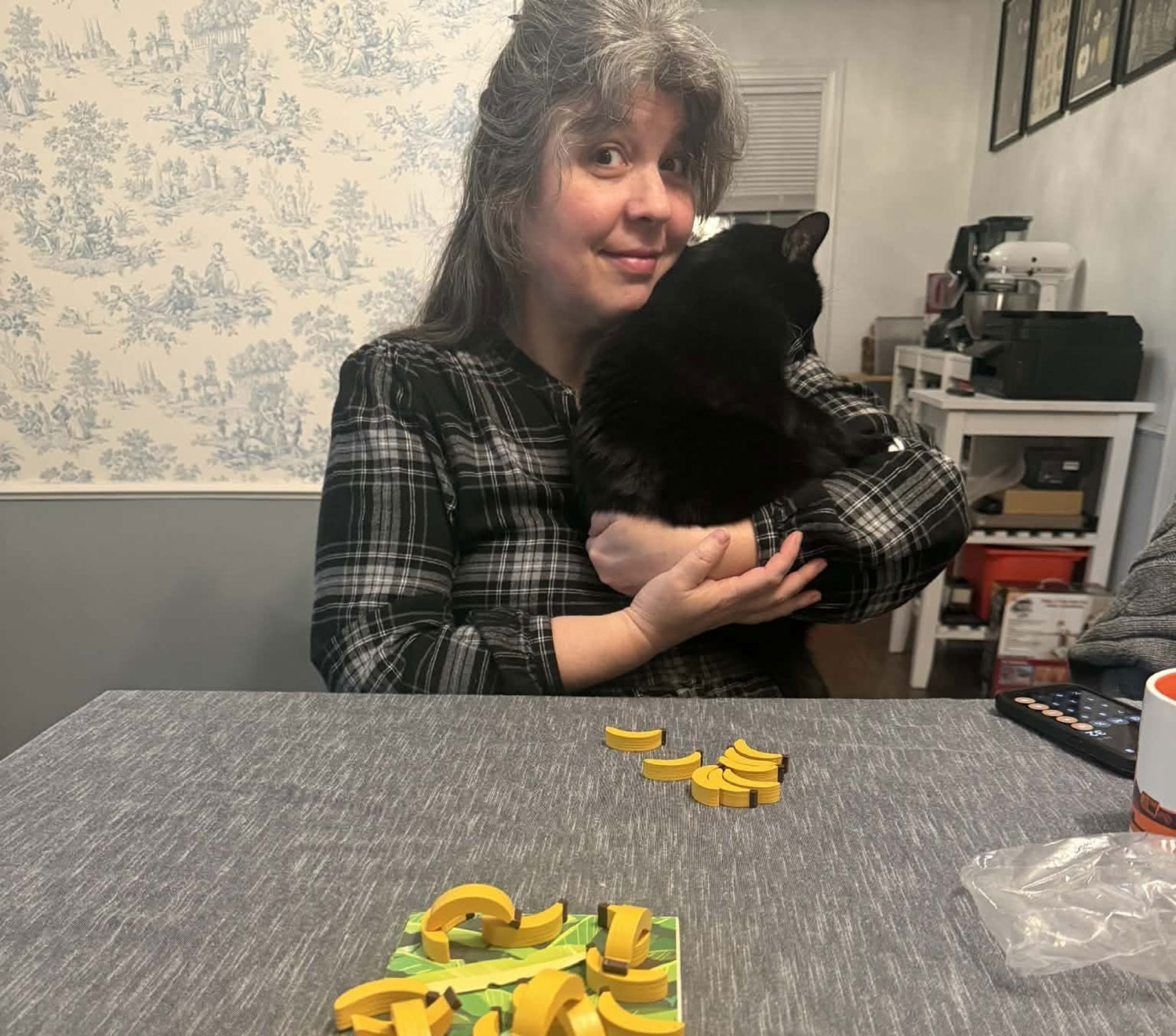
I know you’re a cat lover! Is it three or two that you have? Mazzy and ?
I attend to Mazzy, Annie, and Leo, plus about 3 feral porch kitties I leave food for outside, whom I am not allowed to name. I will leave you with Sir Terry’s quote to show it may be a losing battle regardless:
“It’s an interesting fact that fewer than 17% of Real cats end their lives with the same name they started with. Much family effort goes into selecting one at the start (“She looks like a Winnifred to me”), and as the years roll by, it suddenly finds itself being called Meepo or Ratbag.”
With this information, determine for yourselves my final feline tally.
You have at least 6 cats. Is one named Yaargeroffoutofityarbastard?
It’s entirely possible.
Is there a maximum number of cats one should have? Is that number “all cats”?
I simultaneously have too many cats and not enough cats. Is this a math question? Nobody told me there was going to be maths.











Julie, I really like what you said about posting policies publicly (“I would love to have all community spaces have their policies posted publicly and enforced.”)–that’s something we do at Stonemaier Games in our Facebook groups, website, and Discord. However, I haven’t found a great place to do that on our Facebook page–Facebook doesn’t seem to enable that option in the same way as in their groups, with their suggestion simply being to pin a post with guidelines/policies. I realized today that I could just look at Cephalofair’s Facebook page to see how you’re doing it, but I can’t find it there either. Perhaps I’m missing it? I’d love to follow your lead on this, so if you have any insights as to how you’ve posted Cephalofair’s policies publicly on your Facebook page, I’d like to do the same for Stonemaier. Thanks!
Hi Jamie! I’m just starting to get into what our community rules are here at Cephalfair so no, they are not up yet. While you are waiting, may I suggest joining the Van Ryder Games Discord and reading their rules?
Thanks! Feel free to check out the wording we use in our Facebook groups and Discord server too–it’s similar to Van Ryder. I tried to post it all here to make the examples easily accessible to people, but my response isn’t appearing. In the meantime, we’ll post our moderation policy as a pinned post on our Facebook page!