


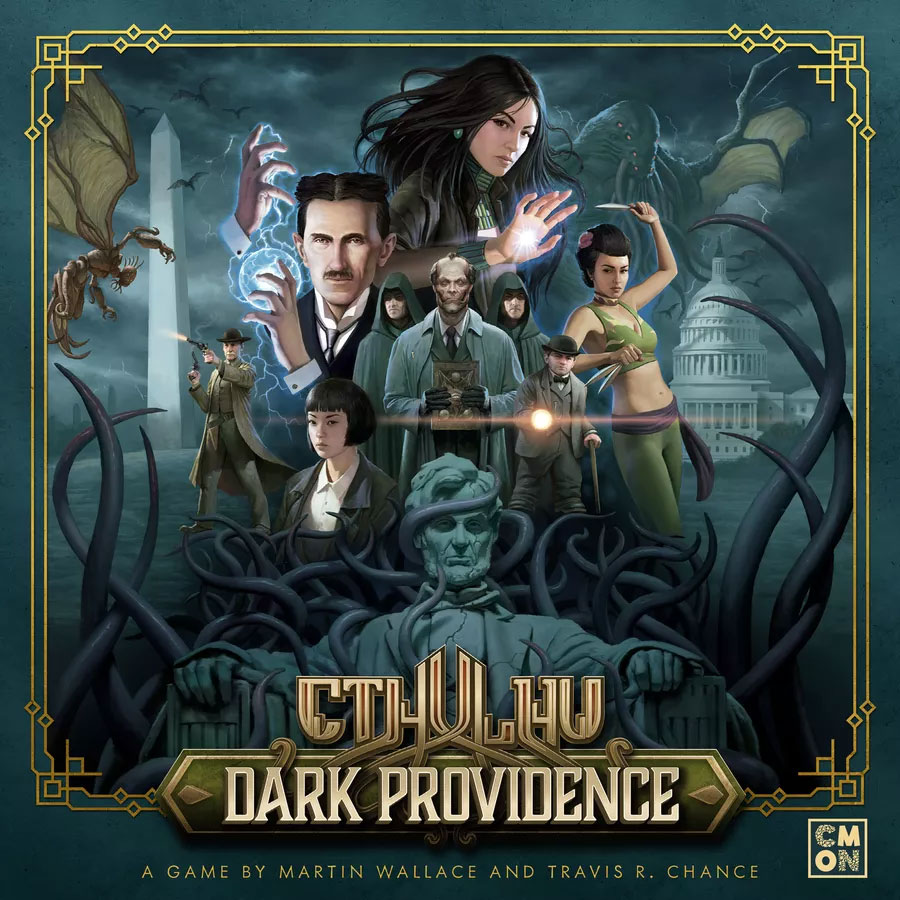
 Close your eyes and imagine the United States of America on the verge of collapse. Greed, selfishness, and dark deeds are running rampant. Now, open your eyes and experience it firsthand. Cthulhu Dark Providence harkens back to the post-Great Depression era of the US and adds in a sinister twist—great old ones. In this game, players secretly take the role of investigators, cultists, or dissidents, attempting to score the most points for themselves. The game features hidden roles, deck building, hand management, and area influence. It plays 1 to 5 players and lasts about 60-90 minutes, depending on player count.
Gameplay Overview:
Players start the game with a secret allegiance card. They may be an investigator, seeking to prevent impending doom. They may be cultists whose goal is to usher in an era of darkness via otherworldly beings. Finally, they can be one of two types of dissidents: either a former cultist or a former investigator. There may be multiple of each role in a game, and a player’s success will be tied to other players on their side to some degree.
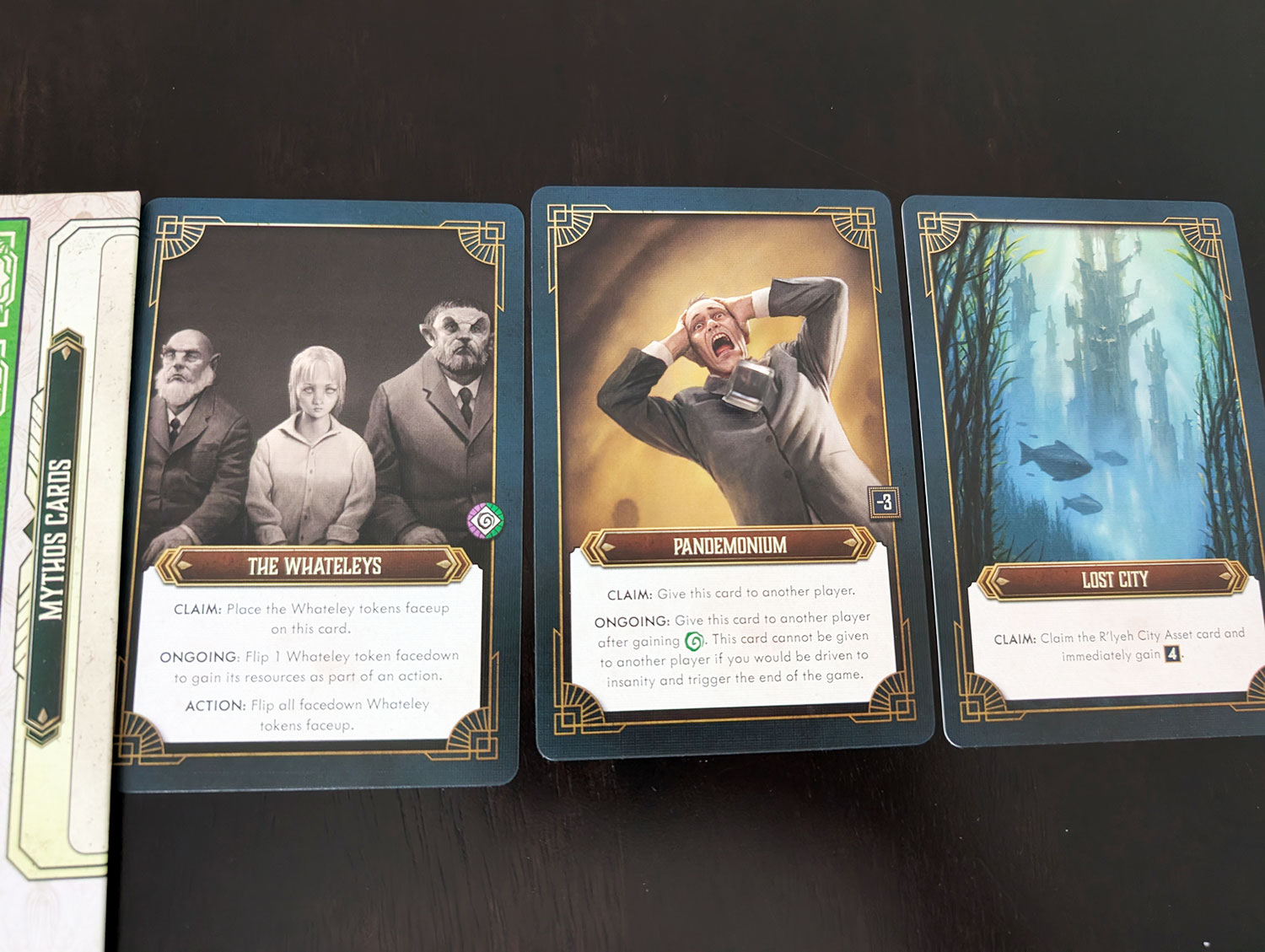
Throughout the game, players will build up their decks with asset cards, claim cities, control agents on the board, collect mythos cards, open/close gates, and manipulate the ritual and investigation tracks. Every turn, a player has two actions plus any free actions they get from cards played. Most actions are tied to a card being played, plus additional cards played for resources such as influence cubes, wealth, or power. Once a player has completed their two actions, they draw back up to five cards without discarding unused cards. A player may spend one of their two actions to discard cards to allow for some deck cycling.
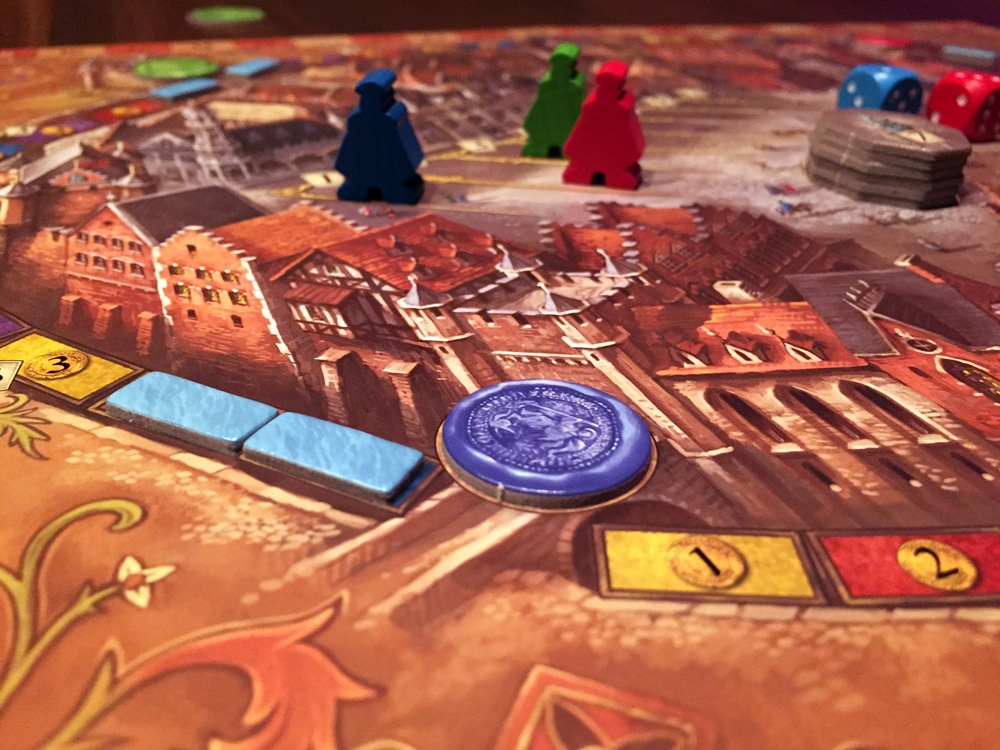
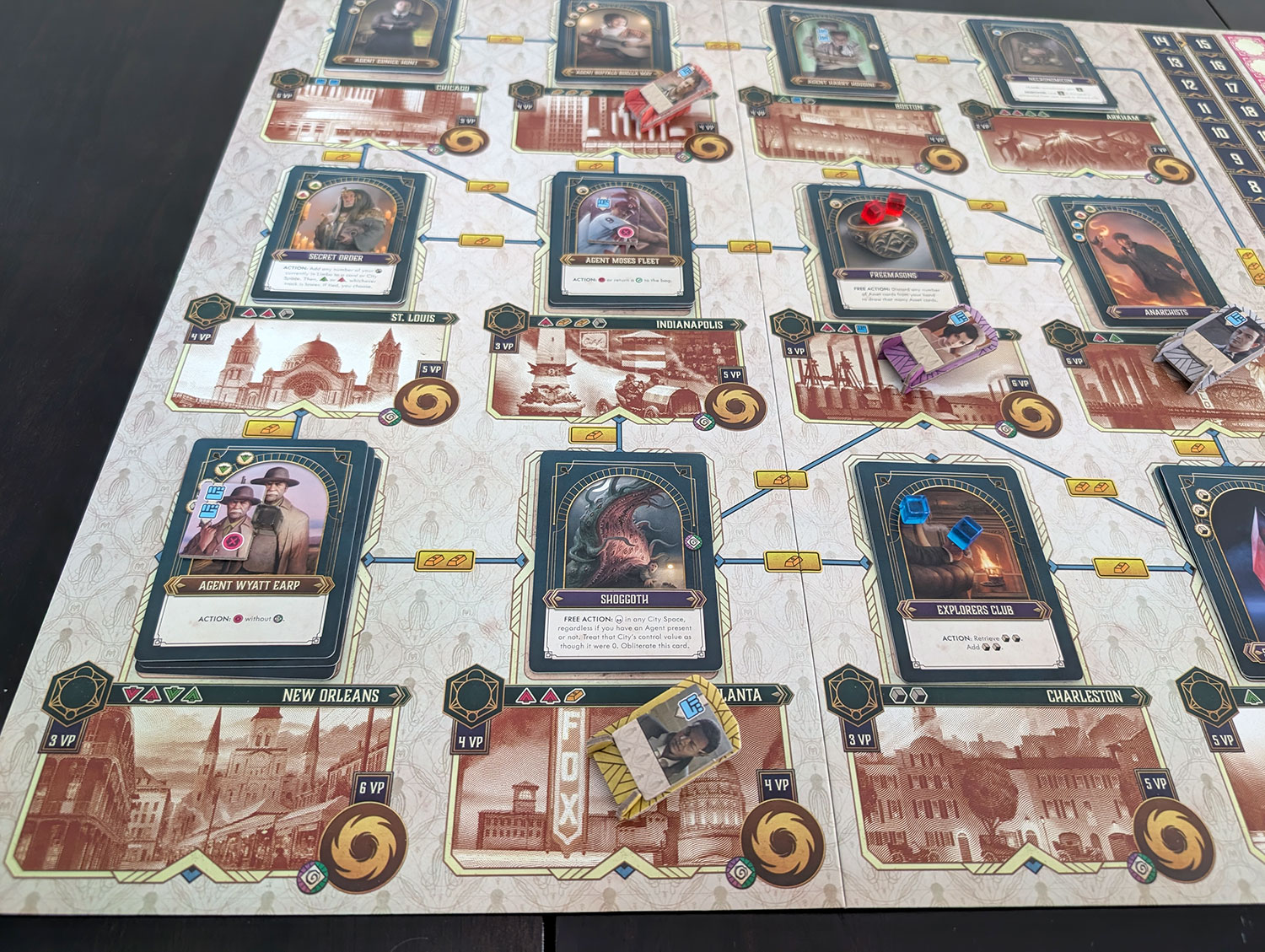
The core mechanic in the game is an on-the-board auction. Players will use cards in their hand to place influence cubes on cards and cities. If, at the beginning of their turn, a player has the most cubes on a card/city, they may spend those cubes to claim it. Players’ agents, including those claimed from asset cards, travel around the board, open/close gates, and assassinate other agents.
The game ends when a required number of victory points is scored, a player gains their third insanity, a player’s main agent is assassinated, or the ritual/investigation tracker reaches the final space. Each allegiance scores points differently. The winner will be the player with the most victory points at the end of the game. However, if two players share the same allegiance and one of them has the fewest points, neither is eligible to win.
Game Experience:
What you have here is an intriguing mix of deck building, hand management, area influence, and hidden roles. I can’t think of another game that combines all of those elements. While it could have been a messy affair, here, it’s done thoughtfully. The rules overhead seems daunting at first, but is ultimately easy to digest and easy to internalize for repeat plays.
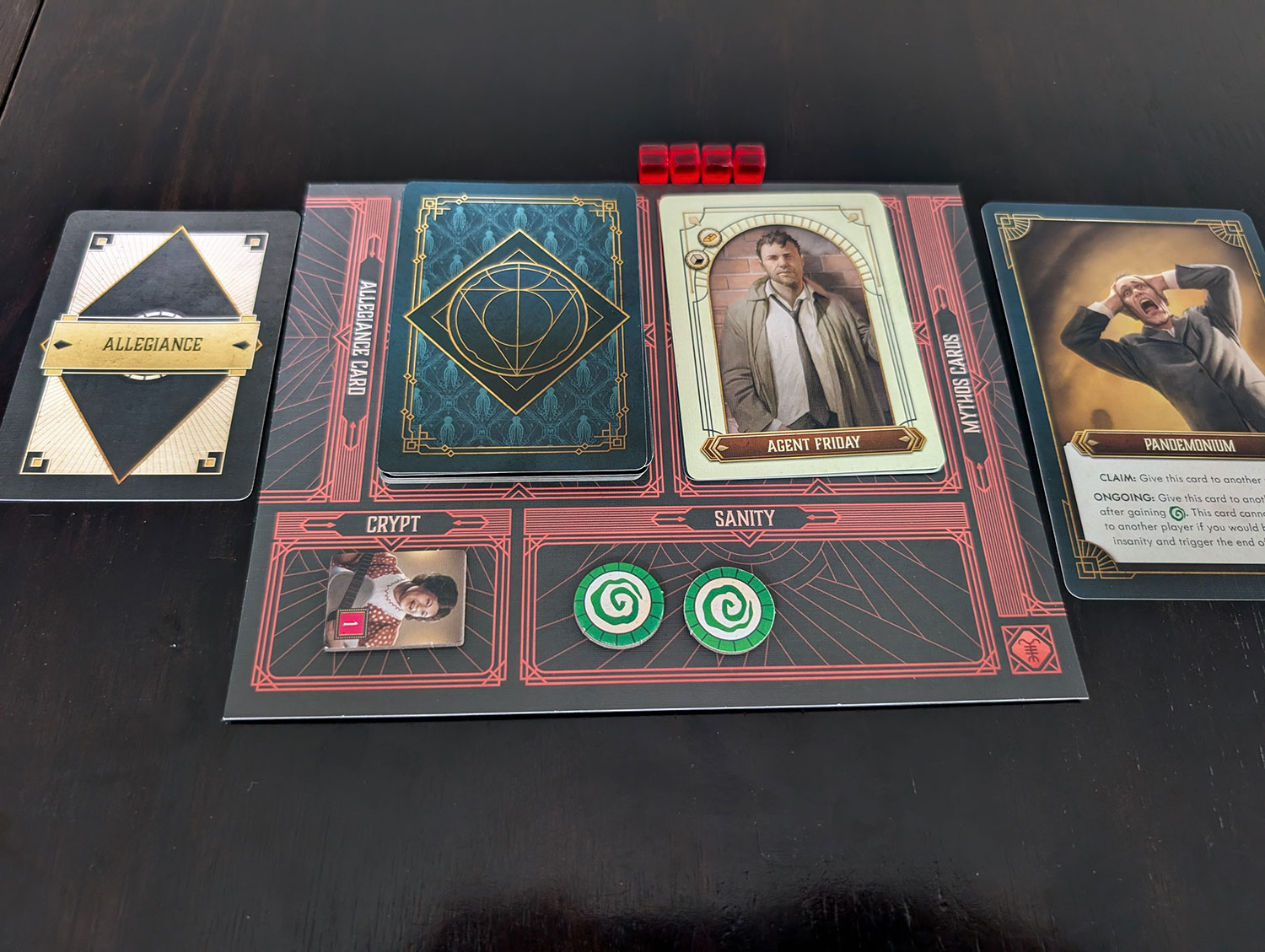
Deckbuilding-wise, you are trying to maximize the cards you have with symbols that you need to employ your strategy. More influence cubes allow you to bid higher on powerful cards. More wealth allows you to move your agents around the board. Power allows you to assassinate and open/close gates. However, the cards in the game have way more going on than just symbols. You’ll find cards that let you draw more cards, take free actions, open/close gates, assassinate agents, and much more. The variety of card effects is one of my favorite aspects of this game design. At times, the board is full of cards you’d like to have. It’s like staring at a 5-star buffet, but you can only stomach a few bites. It is very easy to lose sight of a coherent strategy because a card comes up that sounds so awesome and so powerful, you must have it. That’s not a game flaw, but as I’ll discuss later, it’s the way the game should be played.
The auction mechanic in itself is delightful. Players spend cards to place influence cubes on cards/cities. That means the best cards will often get caught on the board for a few rounds as players vie for control, while trying not to overpay. When a player wins a card, their cubes go into limbo and must be reclaimed with more cards, so overpaying can be disastrous. If a player does not win a card they placed cubes on, they get their cubes back. However, what they wasted in cards and turn actions to put those cubes out can be huge, given the limited action economy. I love that push and pull.

Let’s talk about that limited action economy. While the game has a veil of chaos that pairs well with the theme, every single action matters. You only get two actions per turn. Often, the first is gone immediately when you claim a card or city from the board. I’m reminded of my favorite Knizia game, where I always desperately wish I had one more action. Frustrating at times, but oh so good in terms of tight gameplay.
There is so much going on in this game that I haven’t been able to discuss full mechanics, such as acquiring agents, assassinating agents, and opening/closing gates. What’s important to know is that you will not be able to do most things you want to do in the game. It’s just not possible with two actions per turn. The trade-off here is that there are many viable paths to victory. You can build a wicked, efficient deck that focuses on power, allowing you to assassinate agents and open/close gates. Or you can focus on powerful mythos cards with additional end-game scoring. Or you can get a bunch of cities under your control and try to keep those locked down. Controlling cities is the only form of in-game scoring, but those can also be taken away by other players. Of course, some of what you do will be dictated by which allegiance you have. I enjoy coming into every game with fresh eyes and building a new strategy based on the cards that come out and what other players are doing.
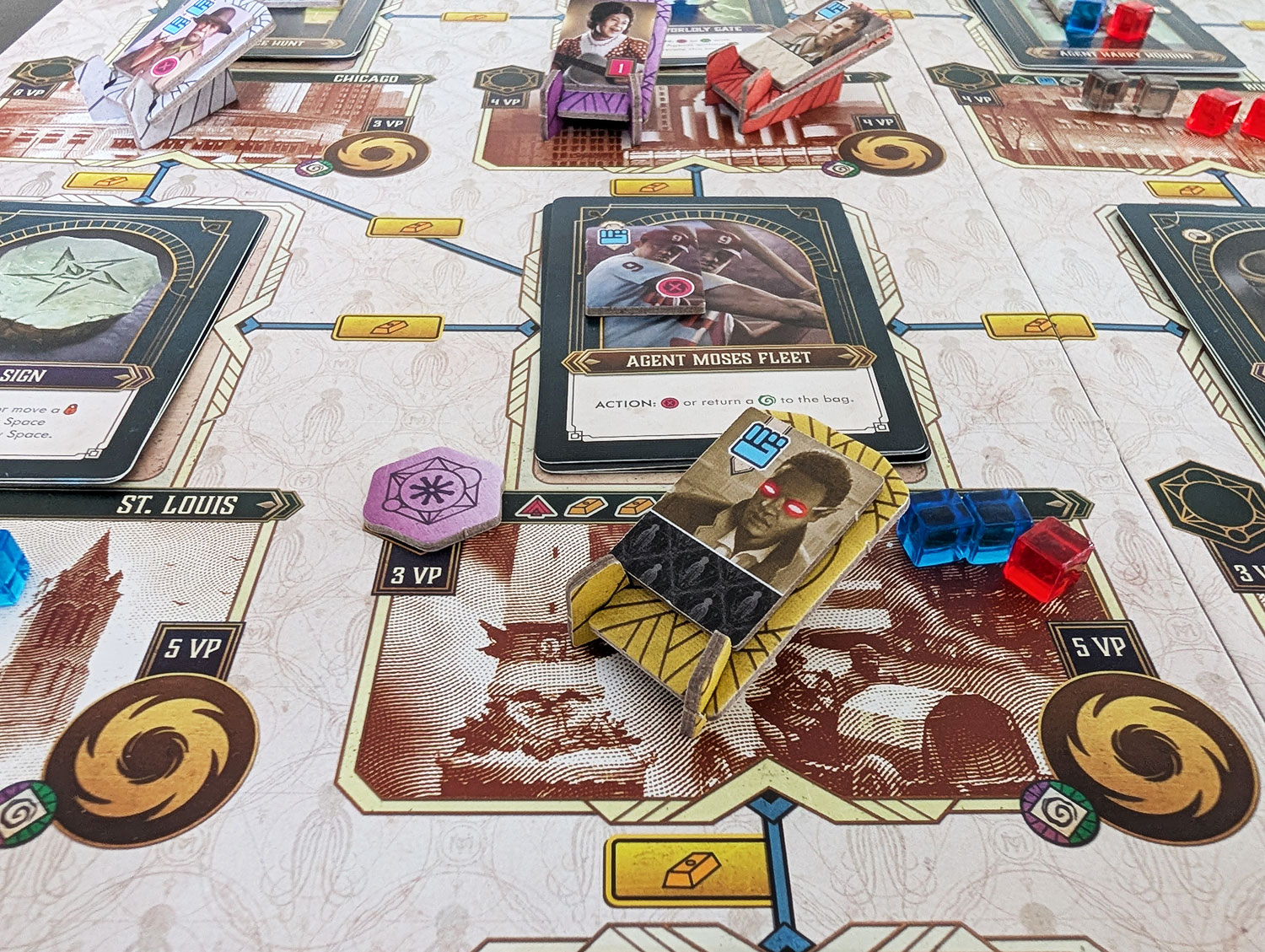
Another engaging aspect of the game, at least for the first few rounds, is the hidden allegiance mechanic. However, it’s not without flaws. There may be a few rounds where being sneaky is advantageous, and you’ll be stroking your chin, trying to figure out who is who. The downside is that it’s not often a smart move to cover your allegiance if it will affect your overall strategy. Again, your actions are super limited. Furthermore, being a dissident removes the concern you have for figuring out who is on your side. Your victory will not be tied to any other player in that scenario. Ultimately, that means someone may have a less fulfilling experience based on a random loyalty card draw.
Final Thoughts:
I have enjoyed every play of Cthulhu Dark Providence that I’ve had with 4-5 players. At lower player counts, I don’t find it as engaging. The hidden roles are less important, and there is not enough competition for cards/cities; two factors that I find to be majorly impactful at higher player counts.
The fun of this game relies a little on playing with a steady mix of strategy and vibes. If you are poring over every card on the table and pondering how it fits into your overall strategy every time you take a turn, it’s going to be less fun than going after the cards that will cause the most action. It’s best when turns are snappy and crazy things are happening across the board. Fits much better with the end-of-the-world vibes. This is a fun one worth repeat plays.
Final Score: 4 stars – A well-done mash-up of deckbuilding, auctions, and hidden roles that allows for a variety of entertaining strategies.
 Hits:
Hits:
• There is a wide variety of exciting cards to add to your deck.
• The auction mechanic is unique and competitive.
• The action economy is tight in the best way.
• There are many viable paths to victory.
Misses:
• The dissident player does not really participate in the hidden role portion of the game.
• Lots of the fun is lost at lower player counts.