
 To create balance and ensure that no one class, move, or play dominates a table, the gaming community has adopted several eternal triangles:
Scissors beats paper beats rock beats scissors
Fighter bests ranger bests mages bests fighter
Pirate King defeats pirate defeats mermaid defeats Pirate King.
You haven’t heard of the last one? Allow me to explain…
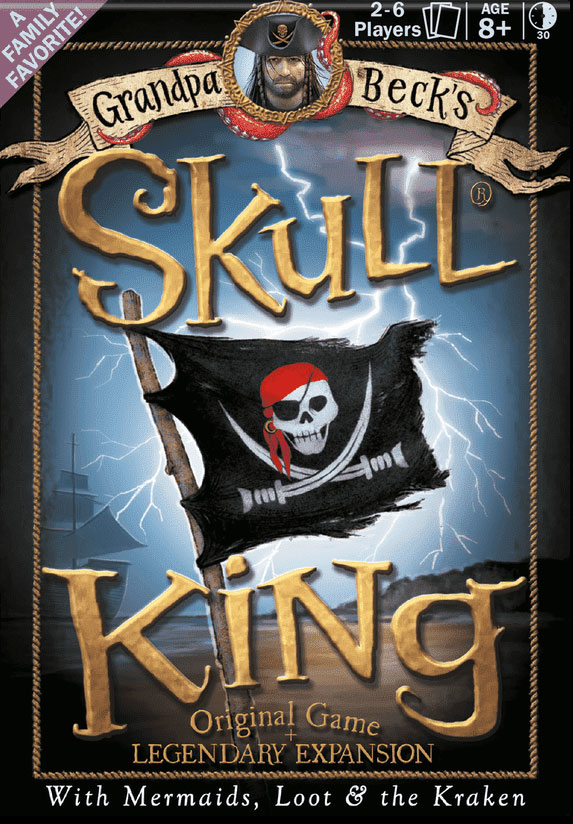
Skull King is a classic trick-taker with a swashbuckling pirate theme and enough twists to make it a great addition to your library. I was introduced to this game by my dear friends Dave and Ilka whose shenanigans—with full-on pirate-y accents, competitive ribbing, and loads of laughter—made this the favorite play of their week-long visit. Since then, I’ve been recommending Skull King to friends, acquaintances, and randos in game stores for a few years, like an evangelist. Let me share with you the good word of this fast-paced, uproariously hilarious game from Grandpa Beck.
Gameplay Overview:
Gameplay consists of 10 rounds, in which players will be taking tricks, with an aim to collect only as many tricks as they have bid. Players will score points based on the correct number of tricks bid, plus any bonuses they receive from special cards. The highest score after ten rounds is the winner. Players may also bid zero, which can give a scoring bonus if achieved.
In the first round, players are each dealt one card. In each round thereafter, another card is added (you’ll play with 2 cards in round 2, 3 in round 3, etc…) Once cards are dealt and players have had a chance to look at their hands, bidding commences. Players bid based on the cards they receive on how many tricks they think they will take. Like most trick takers, Skull King consists largely of four suits (yellow, green, purple, and black) of number cards, with one suit (black) being the superseding suit. Tricks are generally won by playing the highest numeric card of a suit, and players must play on suit unless they have no cards of that color. (There are some exceptions in Skull King, which I’ll get into under Special Cards.)
When all players are ready, they’ll hold their fists out on the table. At the dealer’s lead, players will pound the table (in the case of my family, swing fists back and forth) in unison while chanting “Yo, ho HO!” On the final “ho”, players will extend the number of fingers equal to their bid (for bids over 5, you can just say the number or add another hand’s worth of fingers). Players then take a bid card to correspond to the number they’ve bid.
The player to the left of the dealer starts the trick, leading by laying a card face down in the center of the table. In order from the first player, other players will play a card from their hand, following suit if they have it, until every player has laid a card. The winner of the trick will take the cards, do any special actions required, then place them upside down in front of them. That player will start the next trick. The round ends when all cards have been played.
Scoring each round starts with determining if someone has made their bid or not. If you scored exactly as many tricks as you bid, you’ll receive 20 points per trick taken. If you didn’t make your bid, or you went over, you’ll score -10 for every trick you were off. Capturing a 14 in each suit will award you an additional 10 points, or 20 points for the Jolly Roger (black) suit (provided you make your bid). If you bid zero and manage to take no tricks, you’ll score ten times the number of cards in a round (or receive -10 ten times the number if you fail—high risk, high reward). You’ll also gain points for capturing special cards.
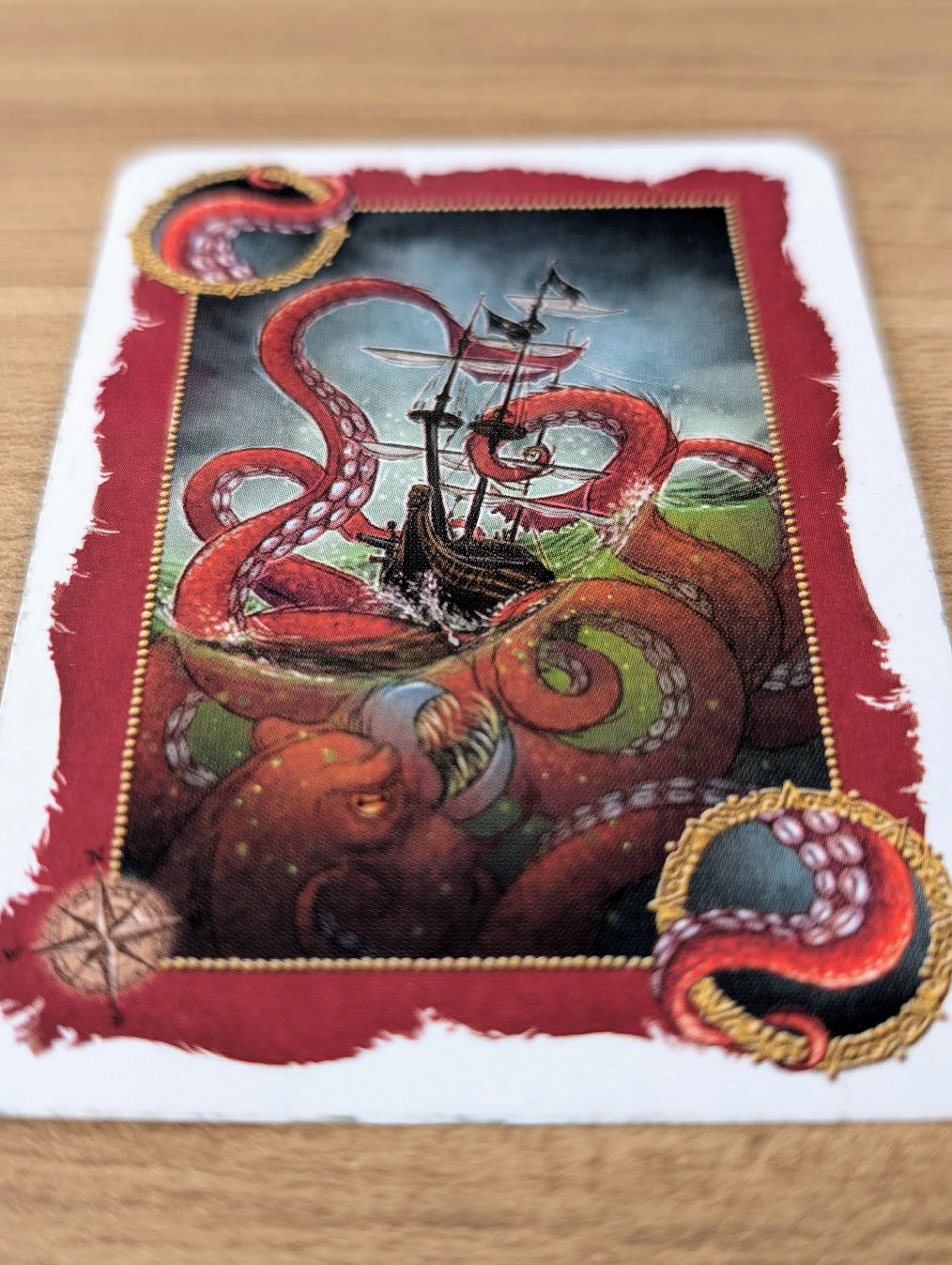
The twist in Skull King, and what reinforces the theme, are the special cards. Special cards will influence gameplay, and many may gain you additional points at the end of a round, though only if you make your bid. They can also be played off-suit.
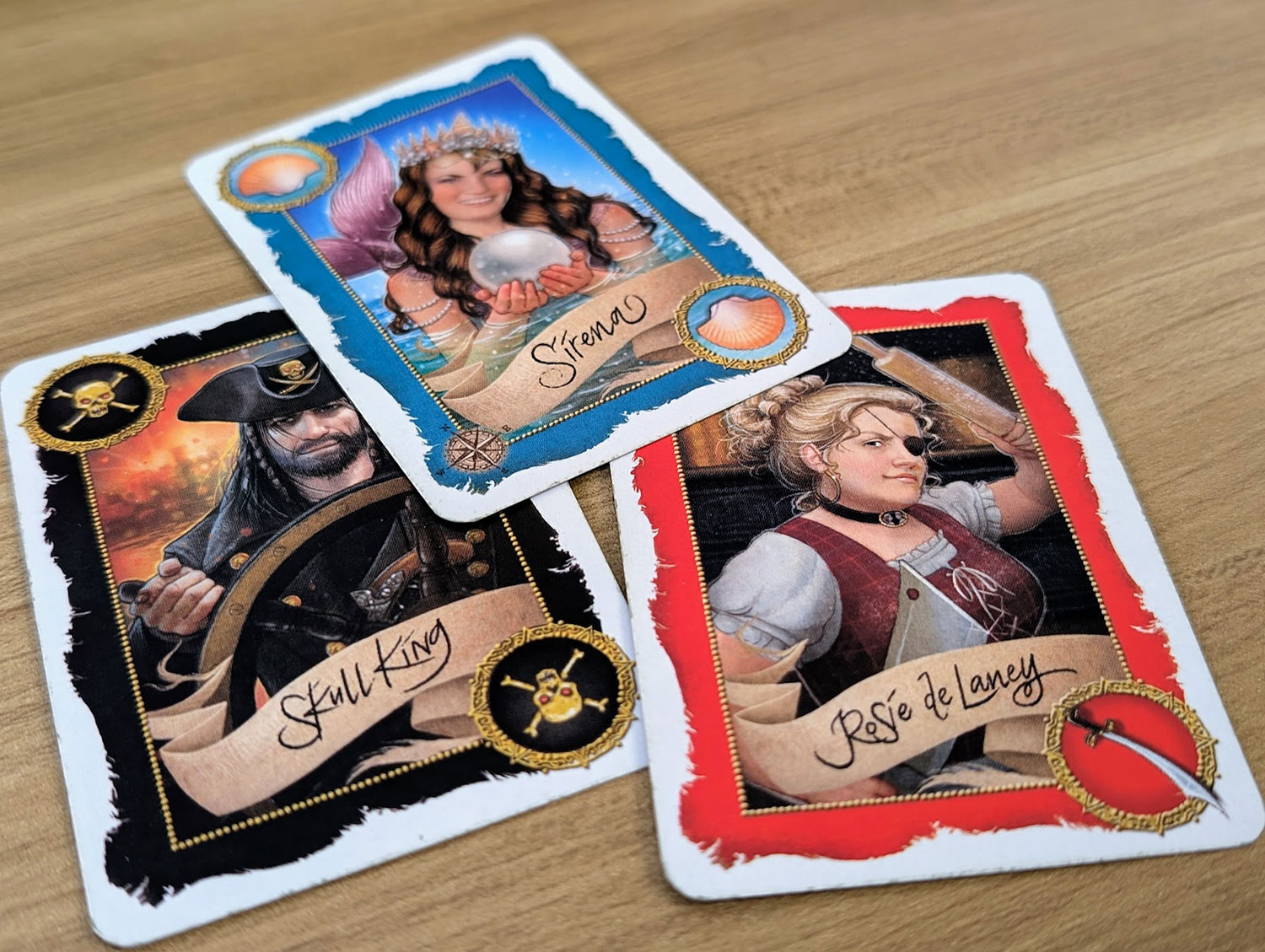
For the special cards, Pirate cards supersede all numbers and mermaids. Additionally, they have a power. For example, Rosie O’Leary allows you to designate who will lead the next trick. The first pirate played in a trick will take any pirates played afterwards (but the winner of the trick can only use the ability of the pirate they played).
Escape cards are straightforward. If you don’t want to take a trick, or you can force another player to take a trick they don’t need, you can play an escape card. Loot cards create a round-long alliance between two players: the one who played the card and the one who takes it. If both players manage to make their bids, they’ll gain an additional 20 points.
The Skull King is a single card that takes most cards, including pirates (he is the king after all). Capturing a pirate with the Skull King is worth 30 points per pirate. However, the Skull King is weak to sirens, and a Mermaid, tho she may be captured by a pirate, will take the King. Capturing the Skull King this way is worth 50 points. Mermaids will also take all numeric cards, and in the case that Pirates, Skull King, and Mermaid have all been played, the mermaid drags everyone down to her watery depths.
Finally, there’s the Kraken, who sinks all. The Kraken will destroy the entire trick. No one takes the cards, they’re set aside. Play resumes with the player who would have won the trick leading.
Gameplay Experience:
Skull King is like a comfort food—familiar, heartwarming, and smile-inducing. I stopped logging my game plays ages ago, but in total, this competes with games like cribbage and scopa, which I’ve been playing since I could sit at the table. It’s a fast-paced game, so it makes a good filler while waiting for folks to arrive for a longer game, or in the case of longer game parties, while waiting for another table to finish.
Trick takers are familiar to many, making Skull King a relatively easy teach. Different game printings mark the expansion cards, so you can have the choice of playing a modified version while you introduce someone new. Then you can throw in all the extras for some real hijinks.
I generally play with a pretty competitive group, but it’s hard to get too salty (ha) over a game of Skull King, largely because the point swings can be huge. A player can be down by 70 points one round, then in the lead the next. It’s got Mario Party vibes—you’re playing less to win than to hang out with several of your friends.
I don’t generally make or endorse house rules, but Skull King encourages them. The game comes with a few blank cards to make your own twists. In my house, we start the first round (one card) with the card facing outwards, not towards the player who holds it. Then you blind bid if you think you’ll take the single trick for the round based on everything else you see. Again, points are easy to win or lose, so starting off with a round of silliness doesn’t affect the endgame score, and it really sets the mood for the laughs and banter the rest of the game.
Skull King plays up to 8, and really shines at higher numbers, tho even a three-player game is filled with magical moments. We’ve played teams and combined sets for more players and even more chaos.
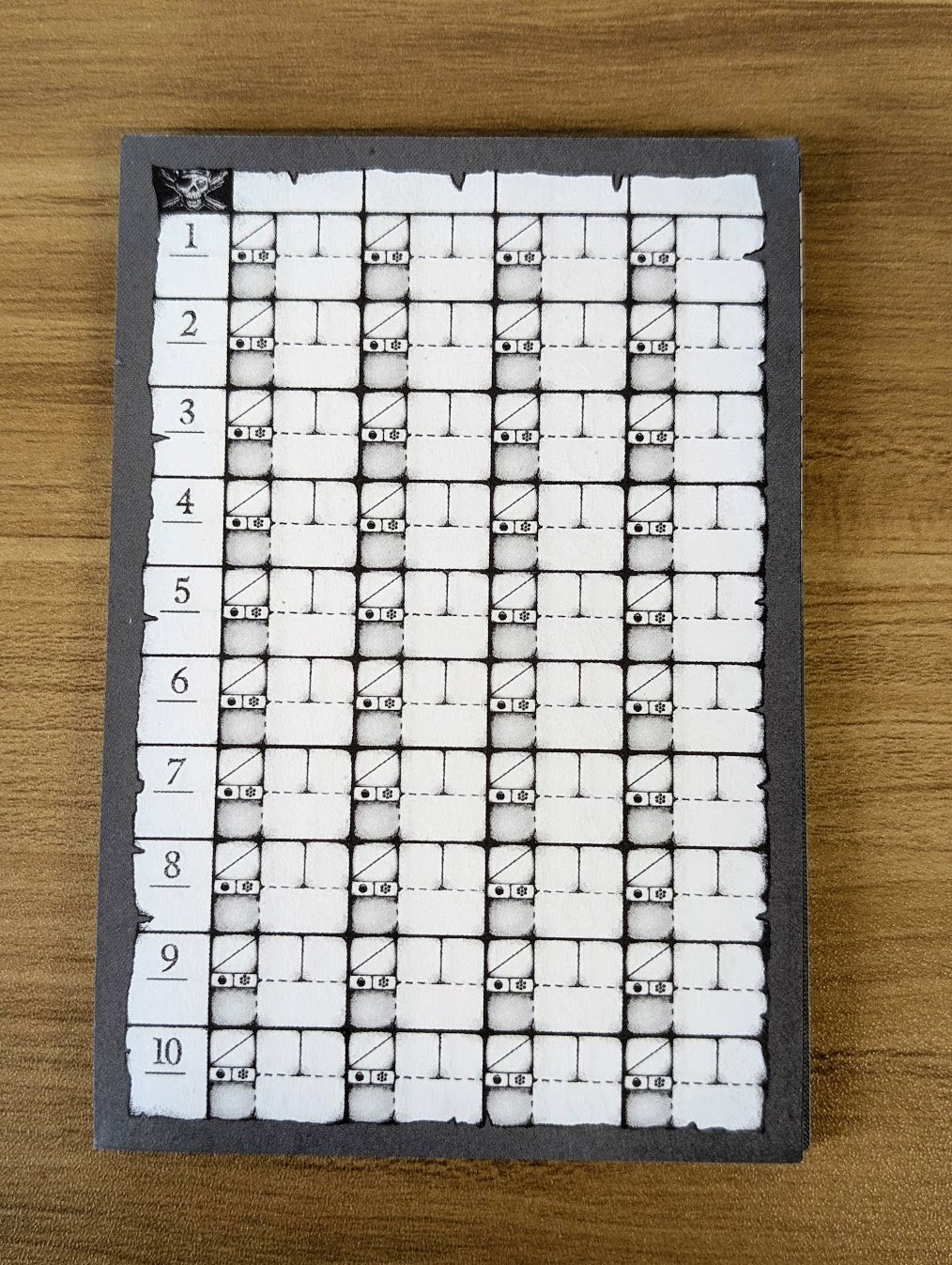
Everything about the game feels designed to make the play easy. There’s little to feed into AP, so even the thinkiest of players have their choices narrowed to keep gameplay from dragging. The game also includes a score sheet, making record-keeping simple. The box is small enough to just stack cards back into, no bagging, but no tuck box wrestling either. There’s lots of interaction as well, which makes it feel more like a jolly evening with your mates, rather than an activity you’re doing concurrently.
Final Thoughts:
For trick-taking fans, folks who prefer lighter-weight fare, new players, players of older card games, or anyone looking for an evening filled with joy, camaraderie, and a lot of bag pirate accents, Skull King is a winner.
Final Score: 5 stars – Like Mary Poppins, practically perfect in every way. With pirates.
 Hits:
Hits:
• Clever twists make trick-taking feel fresh
• There’s no ‘winning’ card, keeping the suspense high
• Keeps everyone at the table engaged
Misses:
• Probably not for folks who give trick-taking a miss