

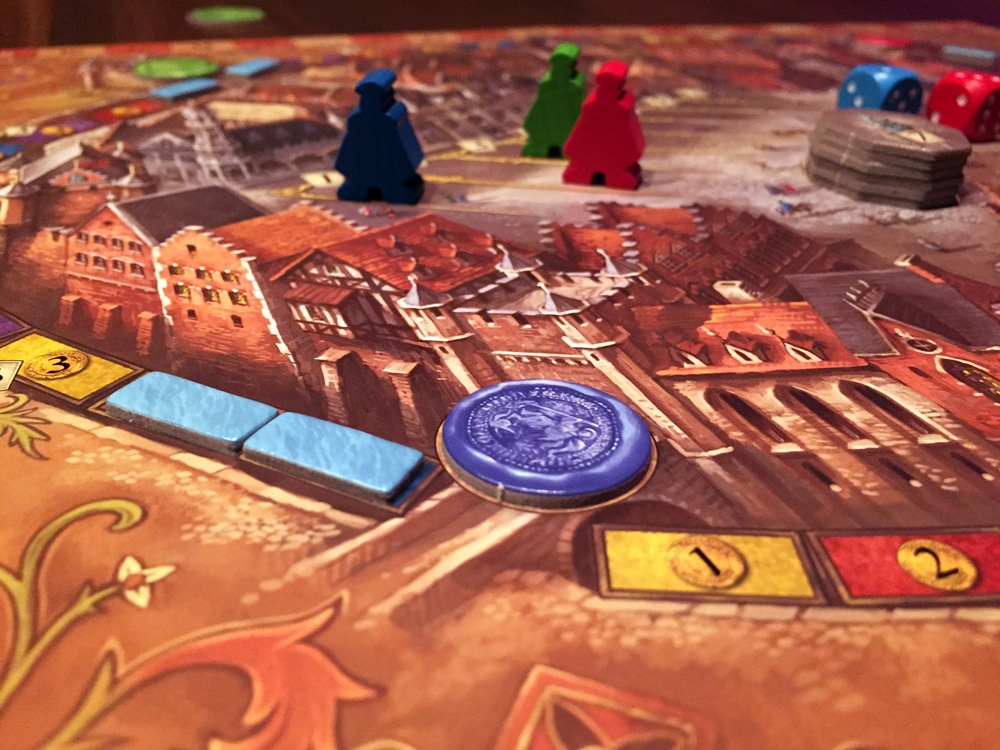



 Splendor, designed by Marc Andre, crashed into the boardgaming scene in 2014 as a fantastic gateway-level game that’s a straightforward engine-building race made extra appealing due to its poker-like chips. It is currently ranked 53rd as a family-weight game, and 243th overall on BGG.
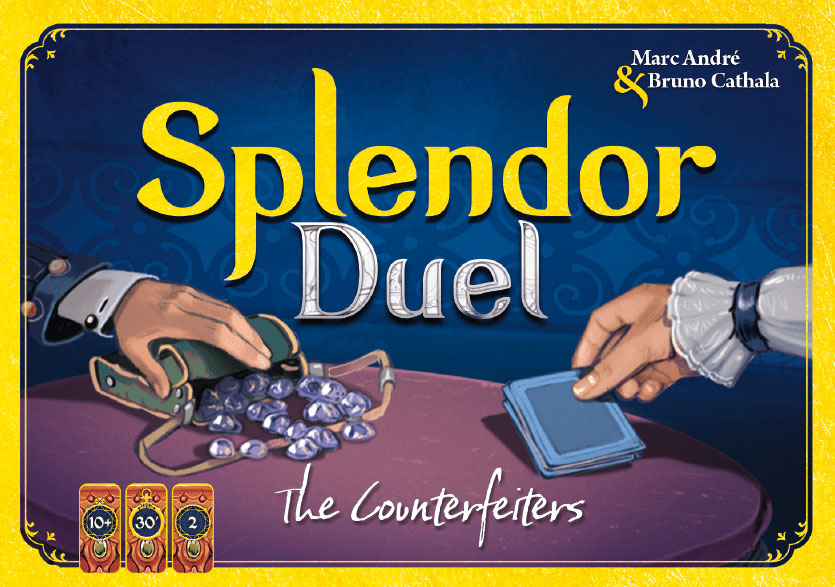
Though the base game plays well at 2-players, a Duel version of the game co-designed with Bruno Cathala (Five Tribes) was introduced in 2022 that I would argue is even better, owing to three routes to victory and a drafting mechanic that’s part abstract puzzle for an extra layer of thinkiness. Most seem to agree, as Splendor Duel currently sits at #13 for family-weight games, and 111 overall on BGG. Now, the first expansion for Splendor Duel, The Counterfeiters, designed by the same duo, has been released. Can it elevate the regard for this esteemed title even further?
Gameplay Overview:
I will assume readers are already familiar with base Splendor. To give a brief overview of the changes in Splendor Duel, it has an identical engine-building mechanic, but some of the Jewel cards also have crowns in addition to points. There are three win conditions (instead of one), which include accumulating (1) 10 crowns total, (2) 20 points total, or (3) 10 points in one color. Any player accumulating 3 or 6 crowns is also eligible to earn a Royal Card that confers special rewards. The final major change is that all Gemstone tokens are laid out on a shared 5×5 grid and must be claimed in spatial arrangements of up to 3 vertical/horizontal/diagonally adjacent pieces. There’s a bit more to it, including pearls, privileges, and special abilities on some jewel cards, but I recommend a how-to-play for a more comprehensive overview.
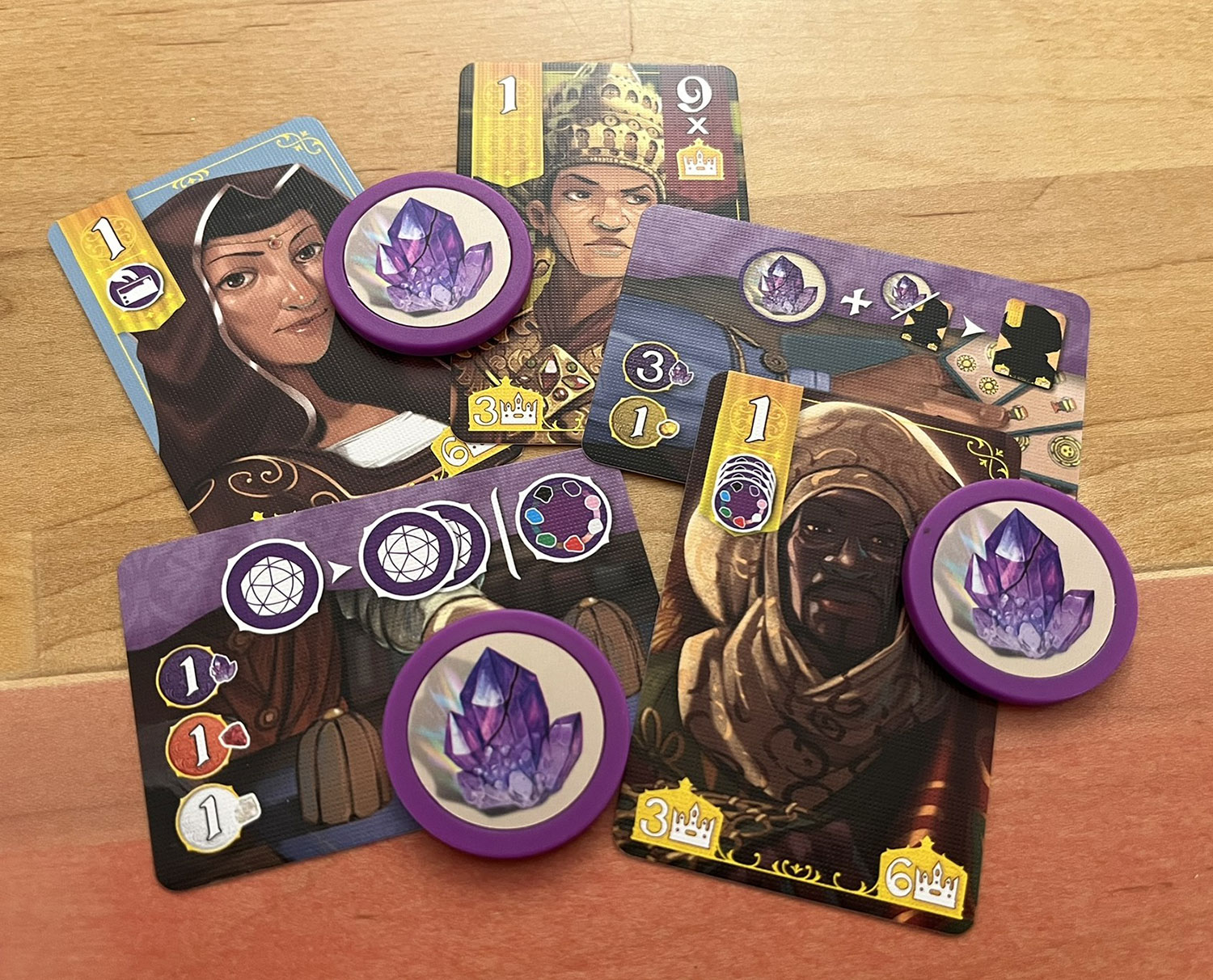
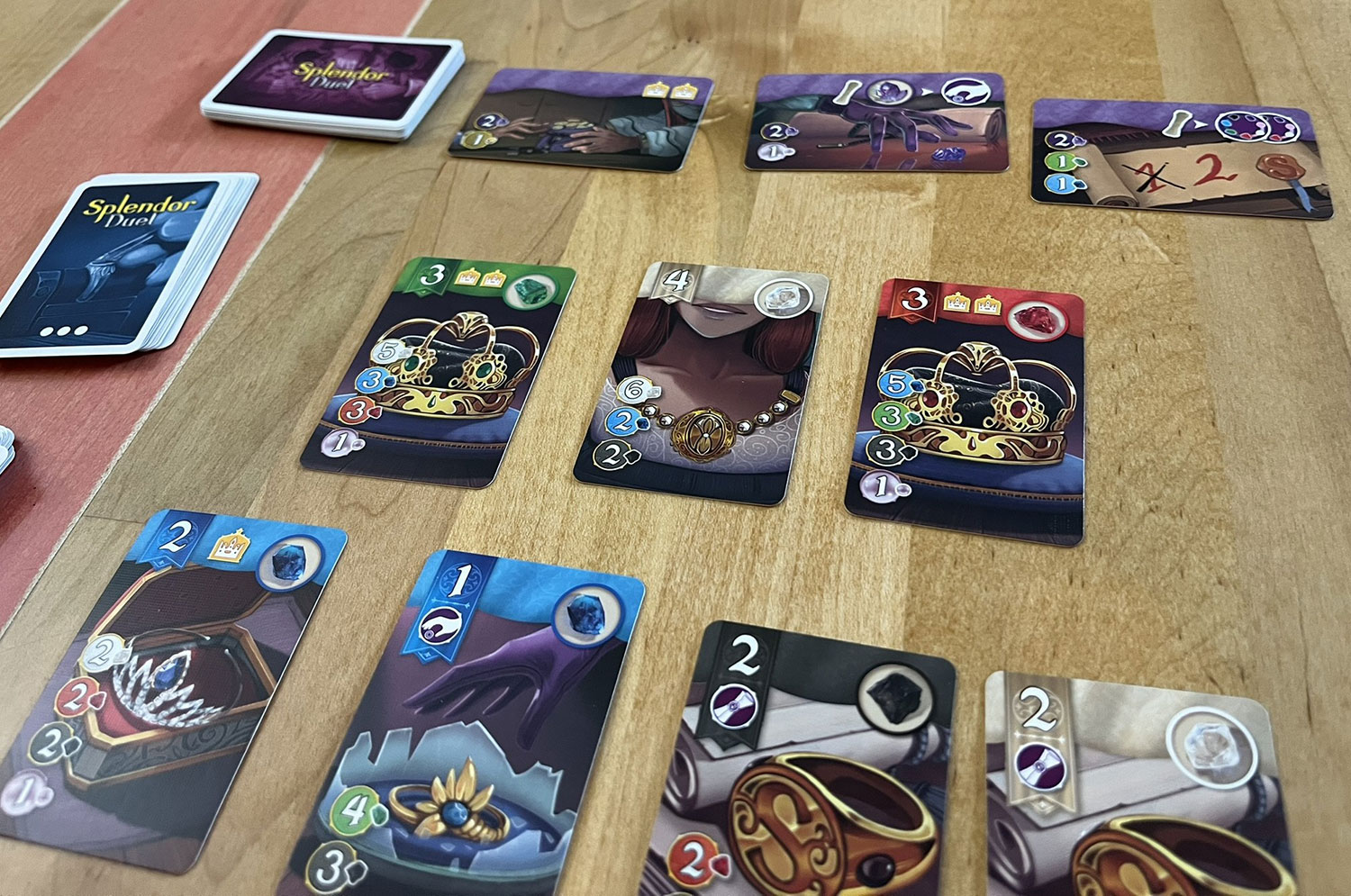
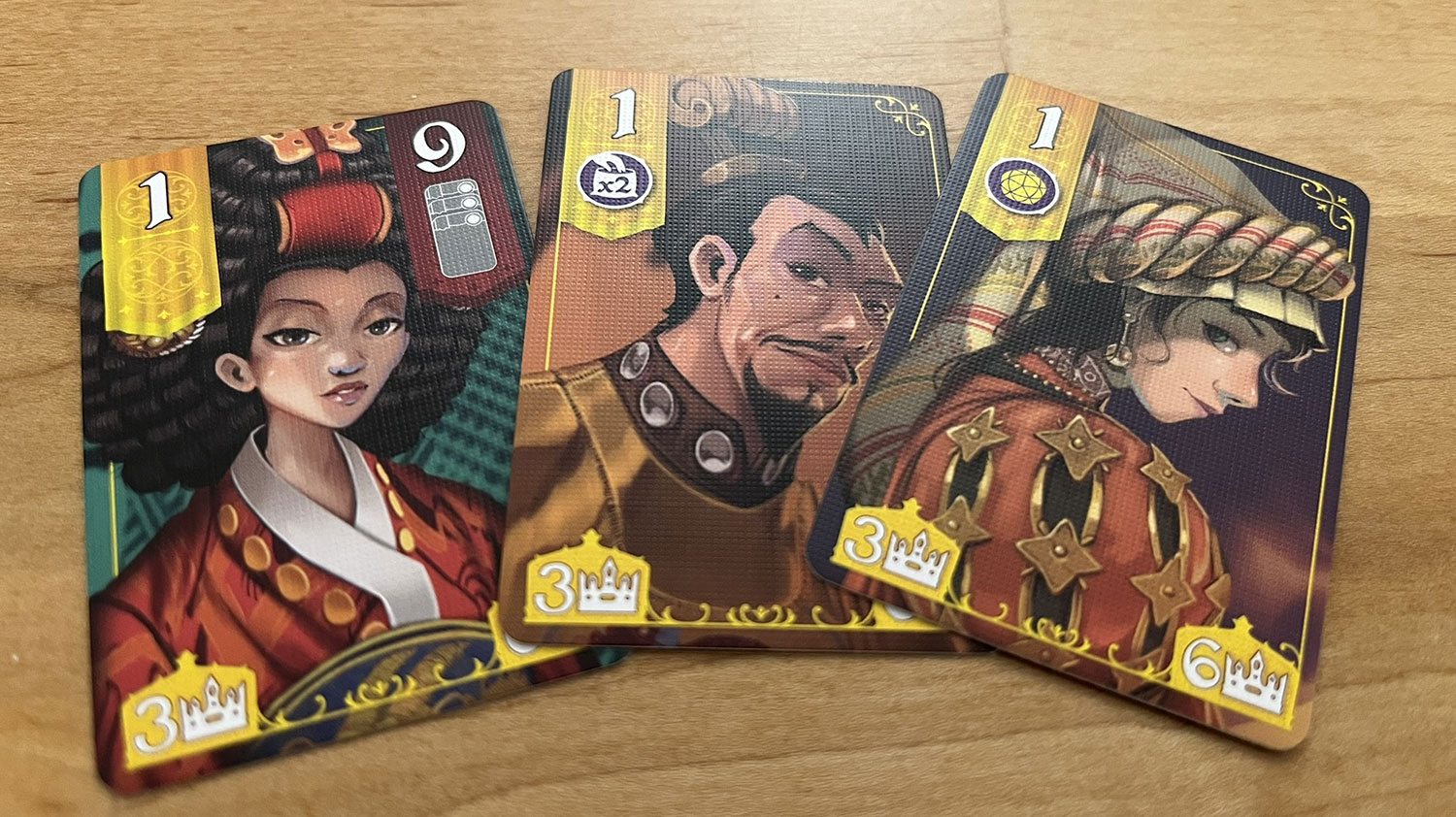
The Counterfeiters expansion for Splendor Duel adds 8 new Royal cards that get shuffled in with the original 4; they also require 3 or 6 crowns to be earned.
The bigger change is 4 purple Glassware tokens that get mixed in with the existing Gemstone tokens. These get drafted from the 5×5 board in the same manner as any normal Gemstone. To go along with these tokens are 17 Counterfeiter cards that get revealed as a market of 3 at a time in a separate row along with the Jewel cards. Counterfeiter cards are purchased just like a Jewel card, except they all cost at least one glassware token as well as some Gemstone tokens.
Once acquired, Counterfeiter cards go into your tableau to provide either a one-time reward, an ongoing passive benefit, or a special once-per-turn benefit that costs glass tokens.
That’s it! The 3 victory conditions are the same.
Game Experience:
This expansion is really 2 small modules. The first is the additional variety provided by the 8 new Royal cards. Two of these allow players to change the win conditions (for yourself only) by only needing 9 Crowns or 9 points in one color, as opposed to the standard 10. The others provide new one-time bonuses like taking a counterfeiter card for free, taking 3 tokens from anywhere on the board, and taking a gold token. I’m a fan of this module; it’s straightforward and adds nice variety that can be easily mixed in with the existing Royal cards without fundamentally changing the gameplay.
The second module is the counterfeiter cards, and the theme here is that not-so-honest jewelers are trying to substitute glass in lieu of gemstones. Splendor barely has a theme, so this mildly elevates what’s there. The premise of these cards is to
provide asymmetric, powerful effects, most of which require glassware tokens for activation, and this sounds great in theory—more engine-building options! And granted, some of the cards have pretty nice effects. Some examples are 2 free crowns, using glass in lieu of pearls, eliminating the 10-token limit at end-turn, and getting 2 gem tokens for a privilege (instead of 1).
Some of the other abilities are also nice, but a bit more conditionally useful. An example includes doubling the ability of certain icons on the jewel cards. The usefulness of this ability is context-dependent. What if no cards with those abilities are currently out? Or what if the abilities are on cards that don’t fit with your current strategy (crowns or green gemstone cards)? Sure, there’s some luck with the basic engine-building paradigm of Splendor/Splendor-Duel, but if you’ve built a card that provides discounts on blue gemstones, there are pretty good odds that it will be helpful at some point in the game.
Furthermore, 7 of the 17 counterfeiter cards are some version of trade glassware for discounts on certain gemstone colors. These aren’t bad, per se, but they don’t feel so much better or more special than the normal gemstone discounts players get when building their tableau using normal rules.
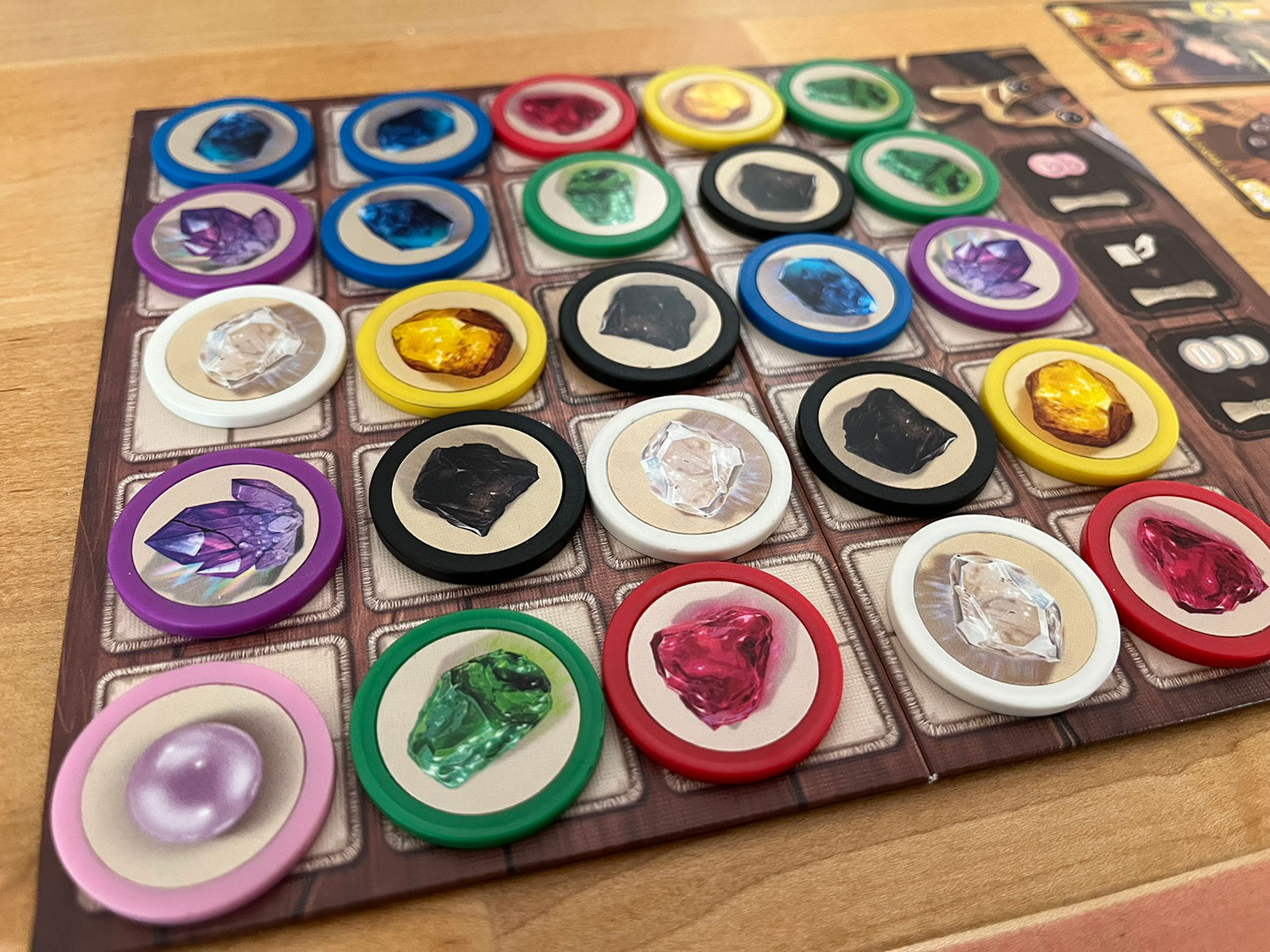
So I’m underwhelmed with the counterfeiter cards. The bigger issue is that the 4 extra glassware tokens that go with them now take up space on the 5×5 grid in lieu of pearls and normal gemstone tokens, even preventing some of those more universally useful pieces from coming out. If you don’t have a counterfeiter card that requires regular use for the glassware tokens, then they are useless to you and actually get in the way of what you want. Thus, players feel required to get at least one counterfeiter card, so they have something to do with their glassware tokens that do count towards the 10-token limit, even if that counterfeiter card only feels so useful.
If the right counterfeiter cards come out at the right moment, this module introduces some interesting decisions, but overall, my partner and I felt that it clogged up what was already tight and elegant gameplay. We’d ultimately rather play without this module.
Final Thoughts:
The Splendor Duel Counterfeiters Expansion introduces two new modules to Splendor Duel. The first is 8 new varieties of Royal cards that get shuffled in with the existing 4. These add variety to the game without additional complexity, which is super. The second module adds 4 glassware tokens into the mix that are used to buy counterfeiter cards, which modify rules and provide additional engine-building effects that range from meh to pretty decent, but many of which have context-dependent usefulness.
The glassware tokens get in the way of the normal pearl and gemstone tokens, so this new card mechanic can actually feel rather frustrating if nothing comes out that you think is worth buying. I’m not a fan of this second module and would rather play without it. Altogether, this was a mixed bag for me. If you’re a diehard Splendor Duel fan, the Royal cards alone might be worth the purchase, but I’m of the opinion that it’s best—in life and in gaming—to avoid the counterfeiters and just use old-school authentic forms of payment.
 Hits:
Hits:
• New royal cards add nice variety
• Fits in the original box, with the insert
• Same stellar production
Misses:
• New glassware tokens clog up the 5×5 grid
• Only some counterfeiter cards feel worthwhile















BoardGameArena (BGA) also has an excellent implementation of Spendor Duel. They also just introduced the Counterfeiters expansion, so you can try it there before you buy the physical version to see if it’s your thing. I’m in the midst of a first game with the expansion and don’t have an opinion yet, but your review is helpful! Thanks.
That’s an excellent suggestion James! Thanks for the comment.