


 The world is now more inter-connected than ever. While this may sound like a good thing, it also means that a butterfly flapping its wings over the Straight of Hormuz can cause a cascading disruption to global supply chains, which you can doomscroll and read all about on any of your 3+ internet-connected personal devices. Wouldn’t it be nice to just fast forward through it all, imagine that nuclear catastrophe has already wiped everything out, and humanity is now ready to re-emerge from its underground fallout shelters to rebuild the world anew?
Well, that’s the theme of Perro Loko Games’ 2024 title Pheonix New Horizon. If the idea of post-apocalyptic rebirth doesn’t excite you, then maybe the game’s novel central mechanic of worker placement within a tech tree will do it. Phoenix New Horizon is a medium-weight Eurogame that sees 1-4 players competing over 60-120 minutes to build a better tomorrow.
Gameplay Overview:
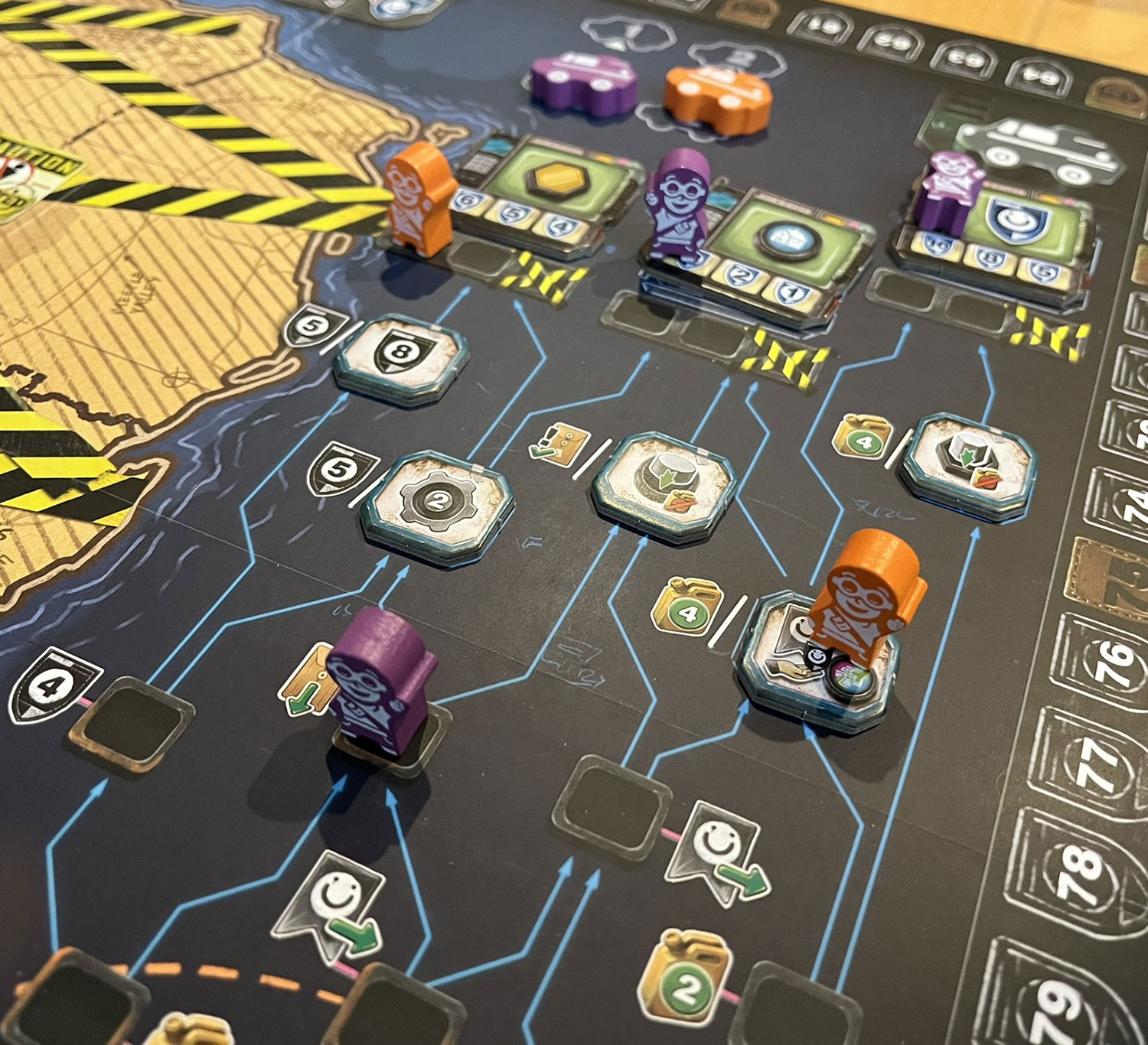
Phoenix New Horizon is played over 4 rounds, and each round will see players deploy their 3 workers on some location of a 4-tiered tech tree one turn at a time.
The lowest row of the tech tree offers free access to basic abilities like building a city or generator, or advancing up a track. Placing your worker on a higher level of the tech tree costs resources, but it also grants you new abilities like gaining technological advances or enhanced versions of the basic actions. Importantly, once a worker is on a higher level of the tech-tree, it starts on that level for all future rounds, unless you invest additional resources to move it further up towards even better actions.
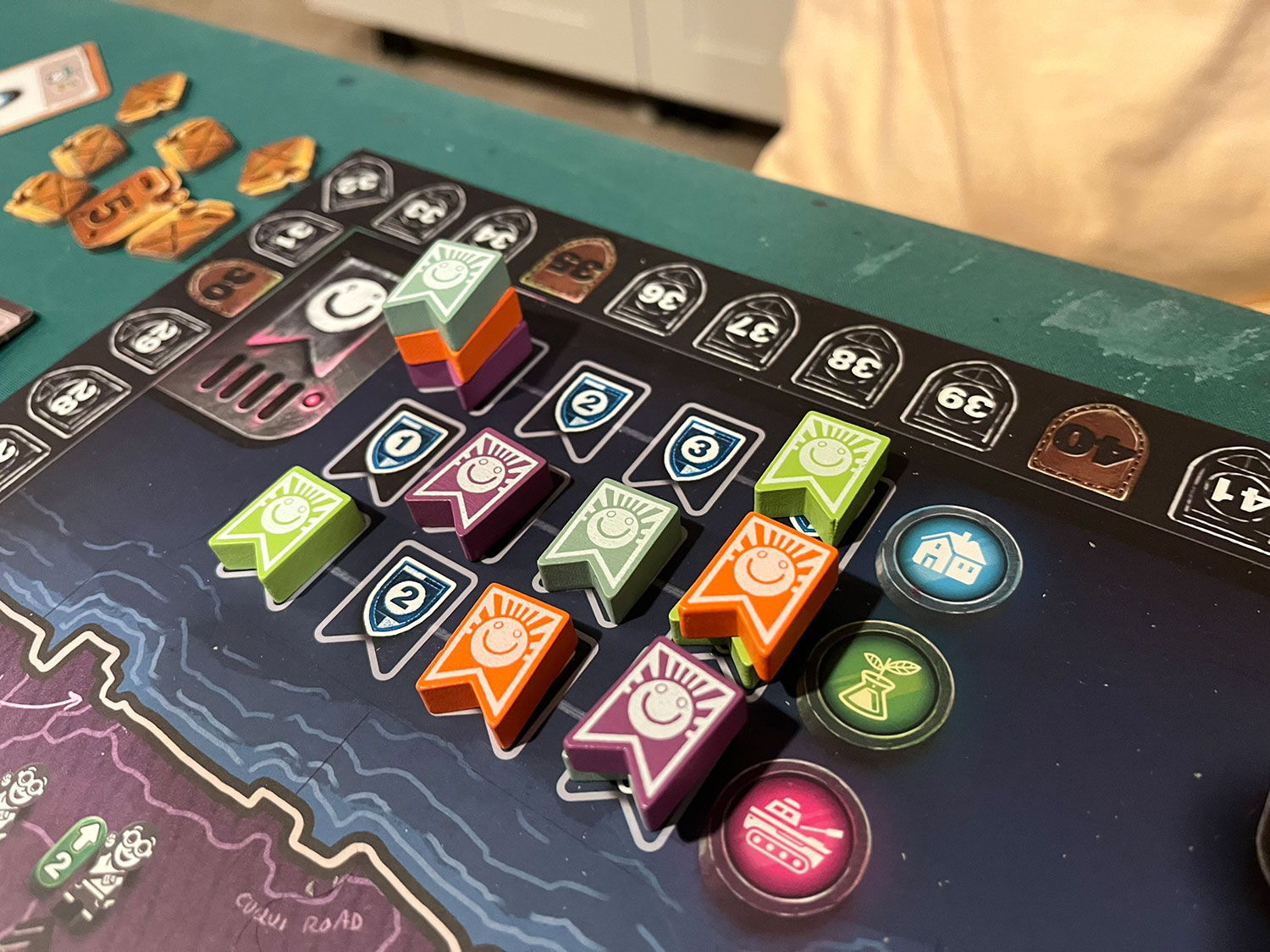
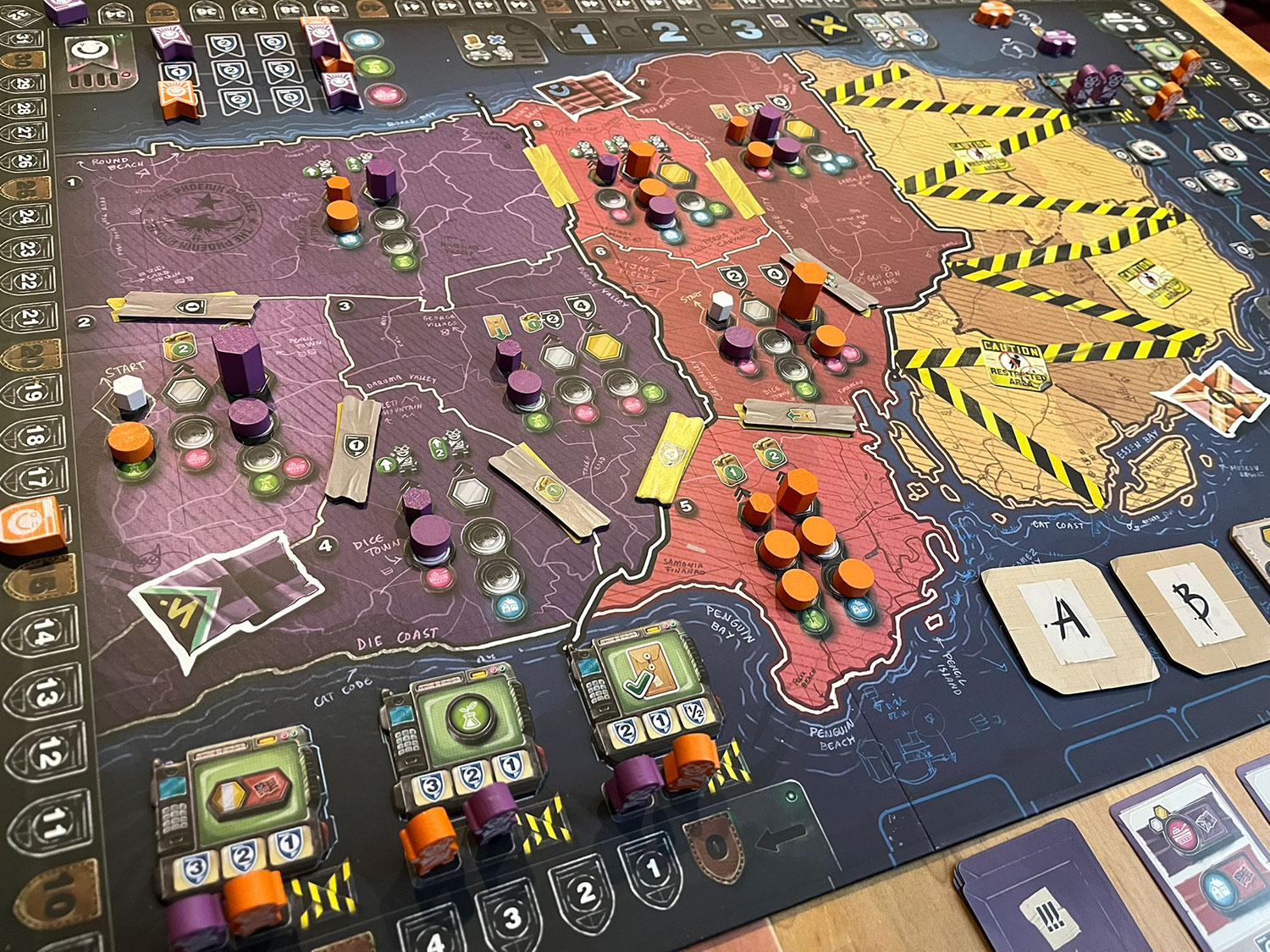
The main goal (and point-driver) of the game is to build cities of specific types (military/research/residential) in specific regions (2-3 depending on player count) of a shared map. Cities will score points based on point-multiplier tracks, shared goals, end-game objectives, and personal contracts. Before cities can be built, however, the region must first be powered by generators. Building a generator grants players an immediate location-specific bonus, enhanced energy production on their playerboard (the main resource) in between rounds, and it opens up construction spots for 1-2 new cities. Anytime an opponent (not yourself) builds a city on one of your generators, you’ll receive the immediate bonus again.
Other key elements of the game include:
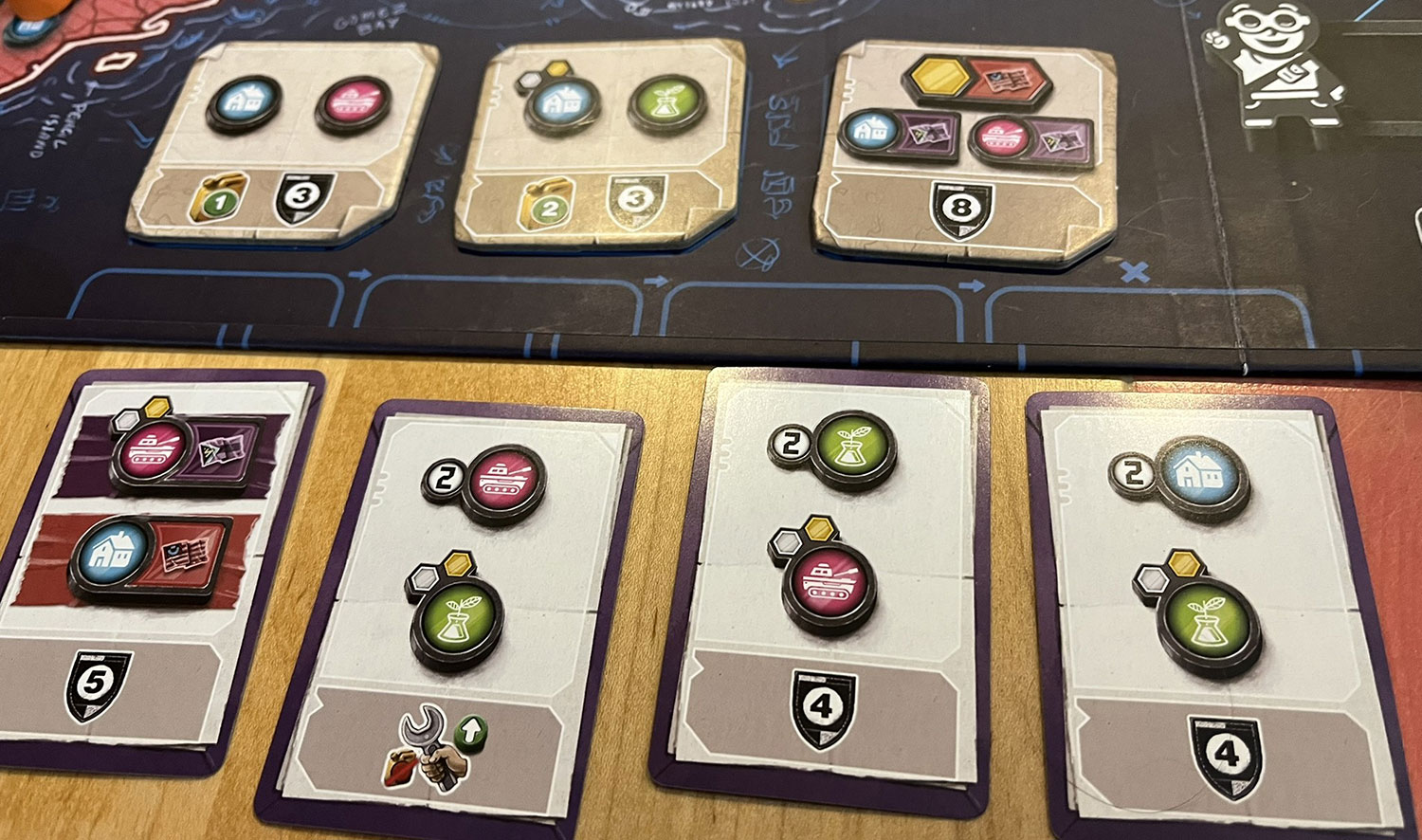
- Contract fulfilment: owning generators/cities
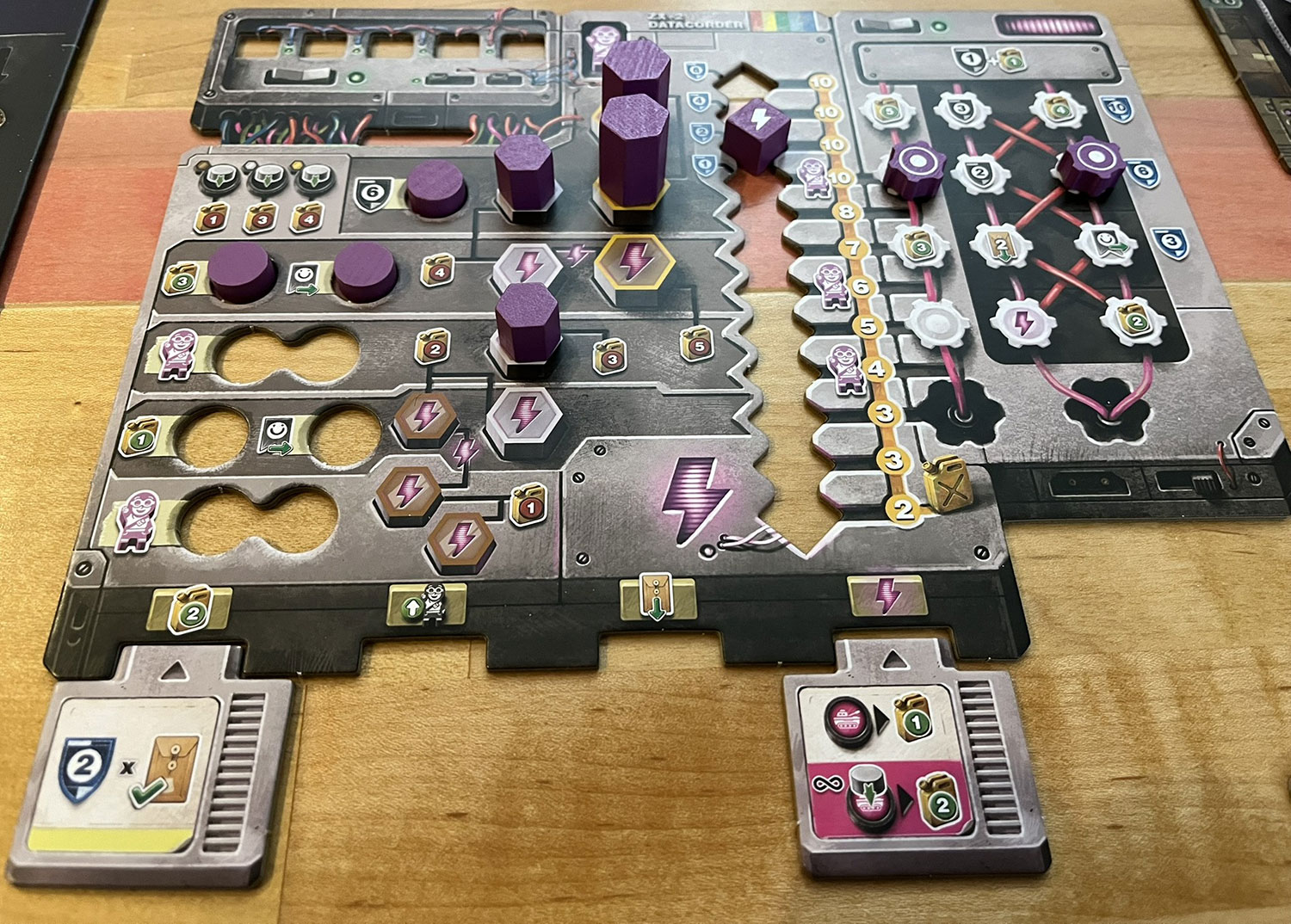
So many tracks! This multi-branching track provides all sorts of reward possibilities. of specific types in specific locations grants rewards
- Track bumps: Moving tokens up various tracks grants various rewards
Rewards from contracts and track movements include things like resources, new contracts, bumps on other tracks, free actions, and points.
Reaching the end of various tracks and/or the tech tree allows eligibility for certain end-game scoring conditions.
After 4 rounds, the highest score wins!
Game Experience:
Worker placement and tech trees are some of my favorite game mechanics, so the idea of combining the two together had me quite excited for this title. Let me start this review by saying my expectations were met and then some.
The worker-placement-tech-tree is REALLY cool
Like most tech trees, this one also contains branching paths that get more restrictive as you advance. Whereas your workers have access to all the basic actions on the lowest level, that may not be the case on the higher levels. So even though actions generally get more powerful as your workers move up, you definitely need to plan ahead for which advanced actions are worth prioritizing, as well as end-game scoring opportunities available at the very top of the tree. Importantly, all worker-placement spots on levels 2 through 4 are randomized each game, creating a unique puzzle with each play. Also, any worker reaching the top of the tree is eligible to come back to the tree bottom and start the upward journey anew, potentially allowing players more than 12 actions per game.
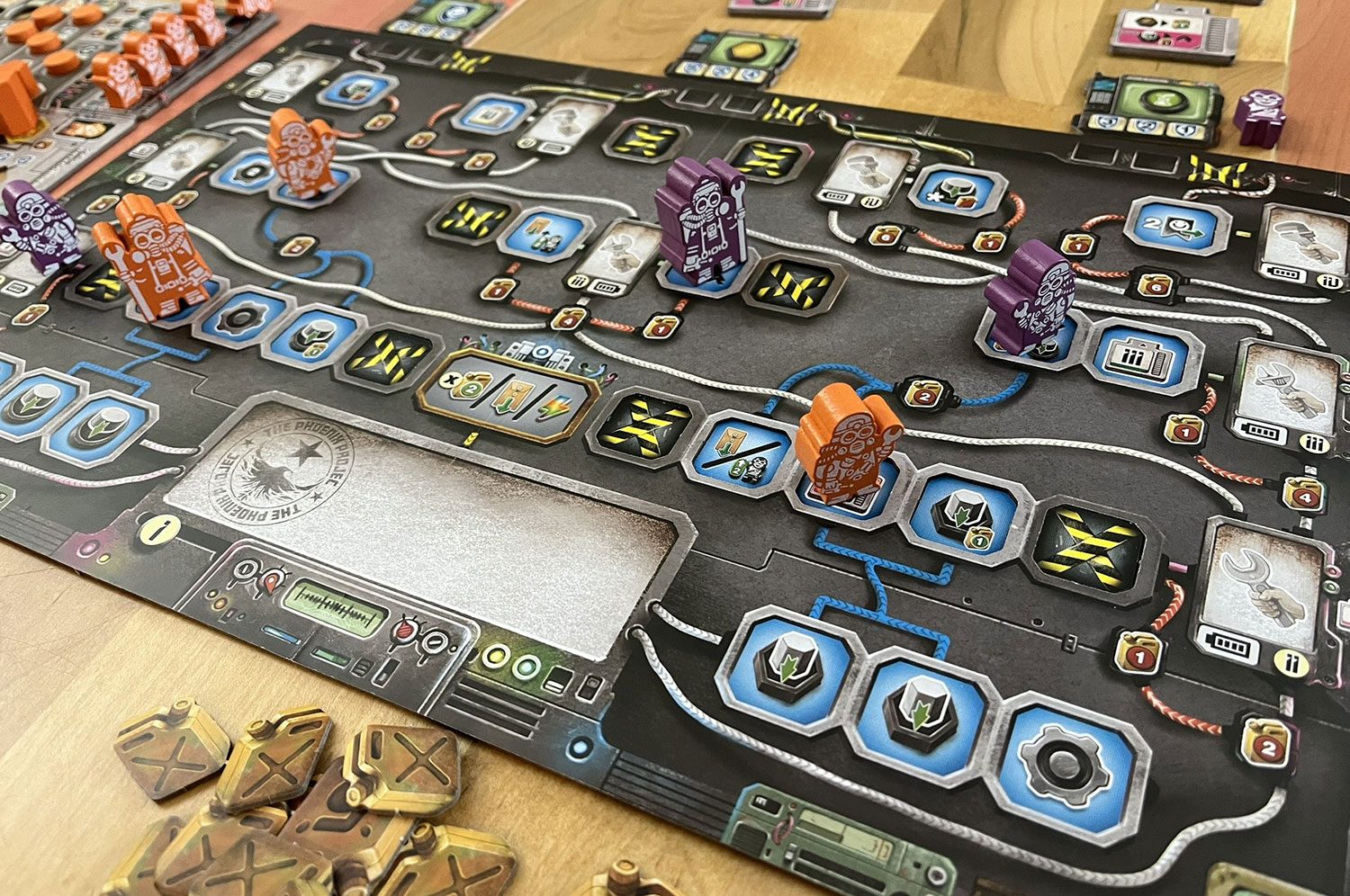
The player interaction within the tech-tree is also excellent. The number of spots scales to player count, so it always feels somewhat competitive. Furthermore, there are four shortcut paths available between levels 1-2 and 2-3. Any given shortcut becomes activated when the worker placement spots below its lower-level are filled, thus allowing future players to elevate their workers to the upper-level without paying resource costs. Players frequently play chicken to avoid activating these shortcuts for their opponents.
If players elevate their workers up the tech-tree the traditional way (paying resources to do so), they have the option of either paying an extra fee to take their action immediately, using their single “leader” worker to forgo the fee to take their action immediately, or waiting for their next turn to take an action. Depending on the game state, players may be incentivized to rush towards a desirable worker placement spot or otherwise purposefully delay because they’re hoping the contracts market will update in their favor or one of those shortcuts will become available.
There’s also player interaction on the main map
The bulk of the points in the game are usually related to building cities on the shared map. Each player has certain objectives related to their personal contracts and end-game scoring opportunities, all of which are public knowledge. If you know your opponent desperately wants to build a green city, even though no green spots are currently available, you could build a generator in a green zone, knowing that you’ll receive the build bonus a second time when your opponent constructs a city next to your generator.
On the flip side, if you were really hoping to use that green spot for your own city construction, it might be frustrating if someone else swoops in and steals “your” spot. It’s the equivalent of someone drinking your beer in Brass Birmingham; positive or negative depending on the game state and your personal goals. The game also awards bonuses on a first-come, first-served basis for building generators in adjacent regions as well as achieving three shared goals of increasing difficulty. Notably, the map scales depending on the player count. Ultimately, the game is fantastic at 2 players, but it really does shine at the higher player counts.
Is there anything not to like?
My main critique is the graphic design on the worker-placement tech tree, which has consistently confused first-time players regarding which paths they are eligible to take at the upper levels. This problem doesn’t typically outlast the initial play. Furthermore, the game comes with a big stack of contracts, and it is possible to luck into a contract becoming available at the perfect time, for which someone has already completed the requirements; some players may find this frustrating.
There could also possibly have been more end-game scoring conditions, but that’s really it.
Final Thoughts:
Phoenix New Horizon is a competitive medium-weight Eurogame with a wonderfully executed worker-placement-tech tree as its central mechanic. It manages to achieve impressively crunchy gameplay using just a single resource type and within a reasonable playtime. It’s fully recommended at player counts 2-4, as it’s filled with meaningful player interaction—both positive and mildly negative—it scales beautifully, and it contains ample replay value. The theming may be post-apocalyptic rebuilding, but the fun factor is definitely a pre-apocalyptic nuclear blast.
Final Score: 4.5 stars – Climb out of your fallout shelters and up a worker-placement tech-tree to create a greener tomorrow
 Hits:
Hits:
• The worker-placement tech-tree is excellently executed
• Meaningful player interaction throughout
• Fun combo-tastic engine-building Euro goodness
Misses:
• Graphic design on the upper tech-tree is mildly confusing at first glance
• There could have been a greater variety of end-game scoring goals
• Really, two different shades of green for the workers?














I bought this on a whim when a local seller had it for cheap. That was many months ago, possibly not this year. Took me this long to be excited to play it. Thanks for the review!
Thanks for the comment Jacob! I’m glad to hear my review got you excited, and I hope you end up loving it as much as I do. If you do end up liking it, keep your eyes out for the design team’s next release, ASHES Blackout Protocol, which is the thematic prequal to Phoenix New Horizon.