



 Hegemony made a huge splash in the board gaming world with its 2023 debut, representing one of the most thematic politico-economic Eurogames ever released. Containing seven unique policies about which four asymmetric factions could push and pull levers to their class’s unique benefit, this creation was equal parts board game and government simulation.
The main elements holding Hegemony back from reaching a wider audience were the rules overhead of four very distinct factions, the fact that it needs 4 players to truly shine, and at 4 players, it requires a minimum 3 hours to play, making it more of an “event game.”
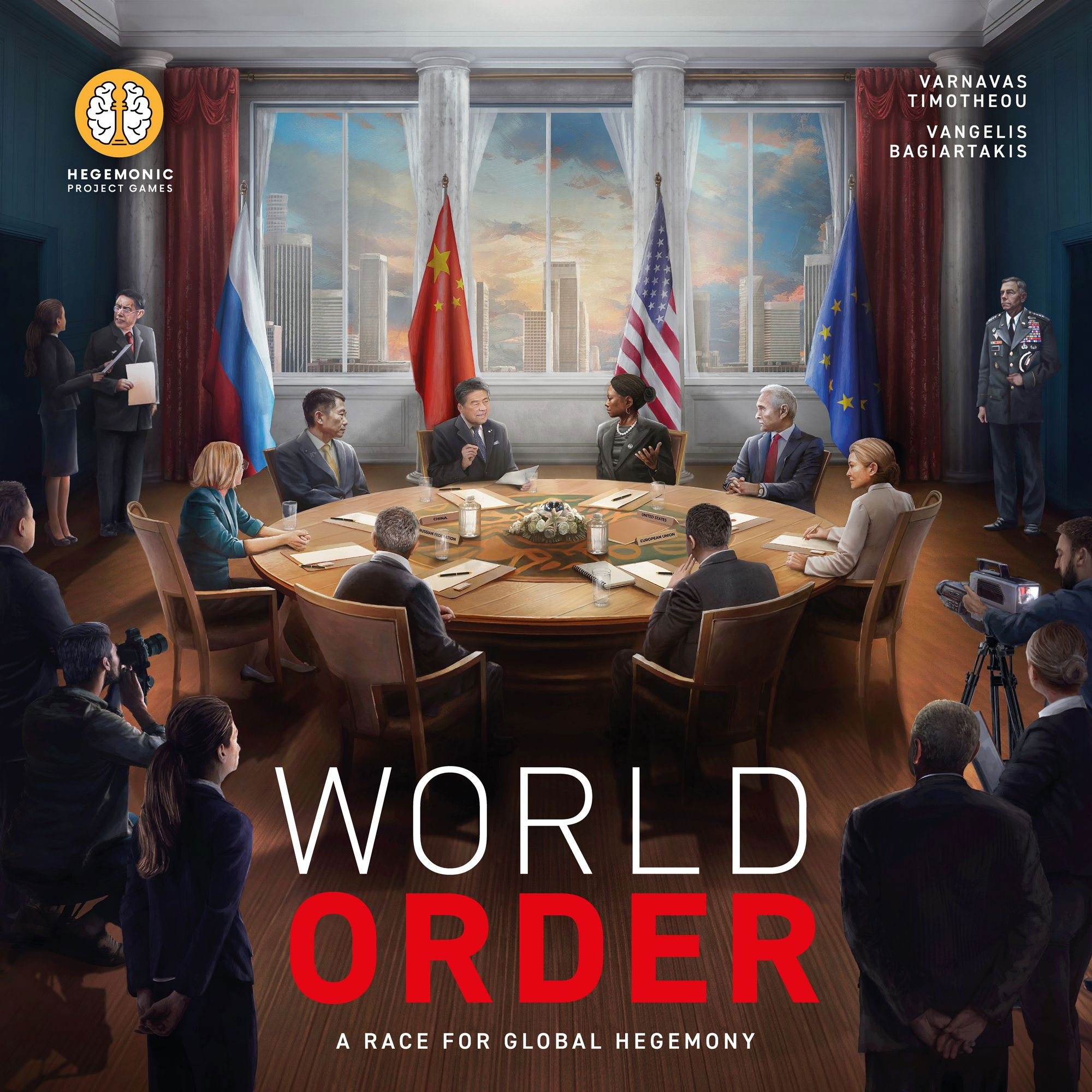
Now Hegemonic Project Games has released its latest title, World Order, which sees four asymmetric factions representing the major world powers circa 2010 compete to exert the most international influence. Intended for 2-4 players over 90+ minutes, World Order is also a heavy politico-economic card-driven game, and it was my “most anticipated game of 2026.” Let’s see if it meets the high expectations, at least from a 2-player perspective.
Gameplay Overview:
World Order is played over six rounds. At the beginning of each round, players will draw 6 cards from their personal decks; four of these will be used to take actions, and the remaining may be used to purchase new cards at round-end.
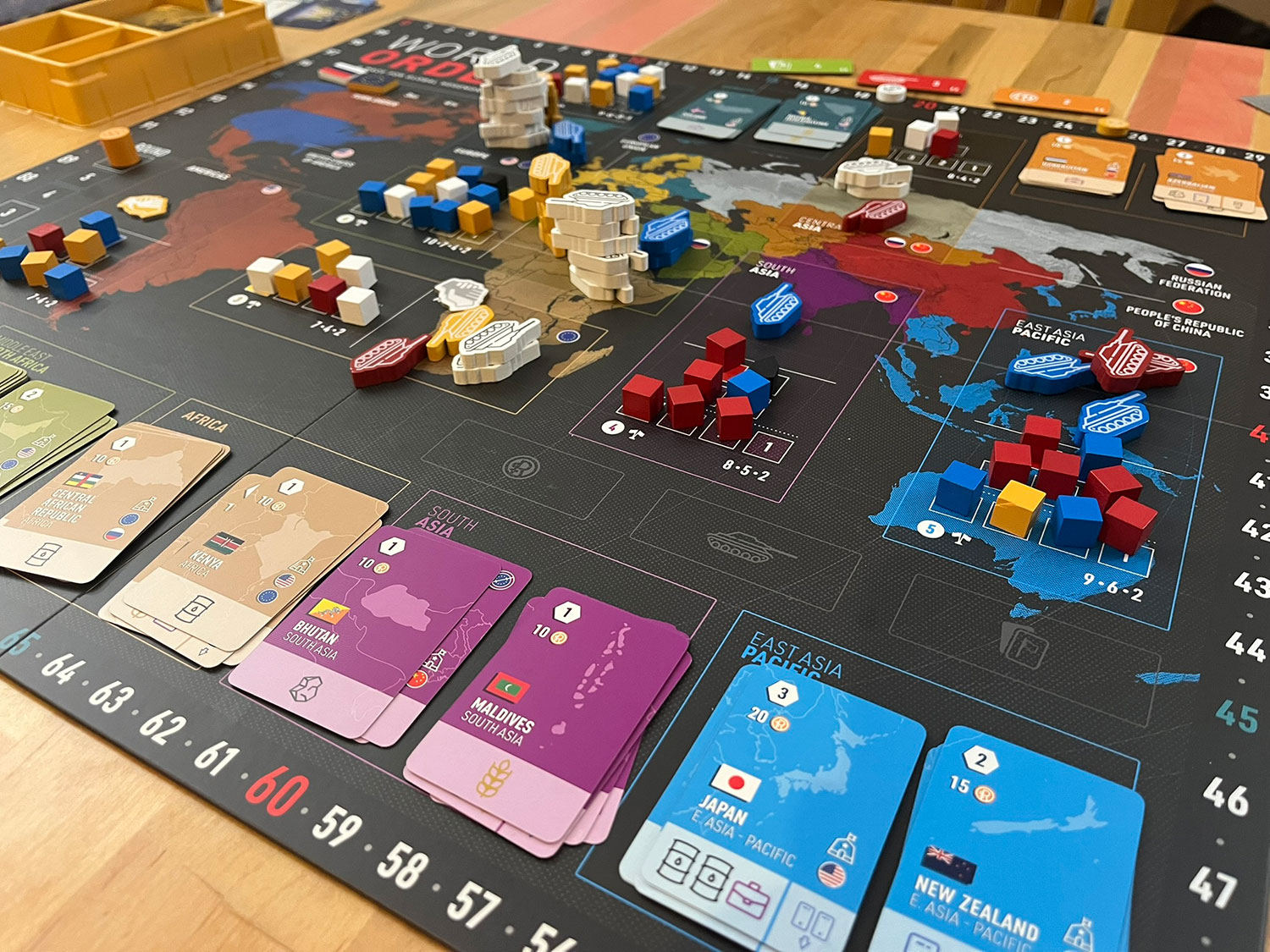
Cards allow players to exert influence on the world via 3 techniques: diplomacy, economic deals, and military force. Each of those techniques has a minor action that helps build up your capabilities, and a major action that allows the player to place an area control cube in one of 7 relevant regions of the world, as follows:
Diplomacy:
- Minor action: improve relations with a specific country by spending diplomatic power to make a new ally
- Major action: engage with a world region where you already have at least one ally by spending diplomatic power
Economic Deals:
- Minor action: trade with your existing allies or other world powers to make money and/or gain needed resources
- Major action: financially invest in one of your existing allies
Military Force:
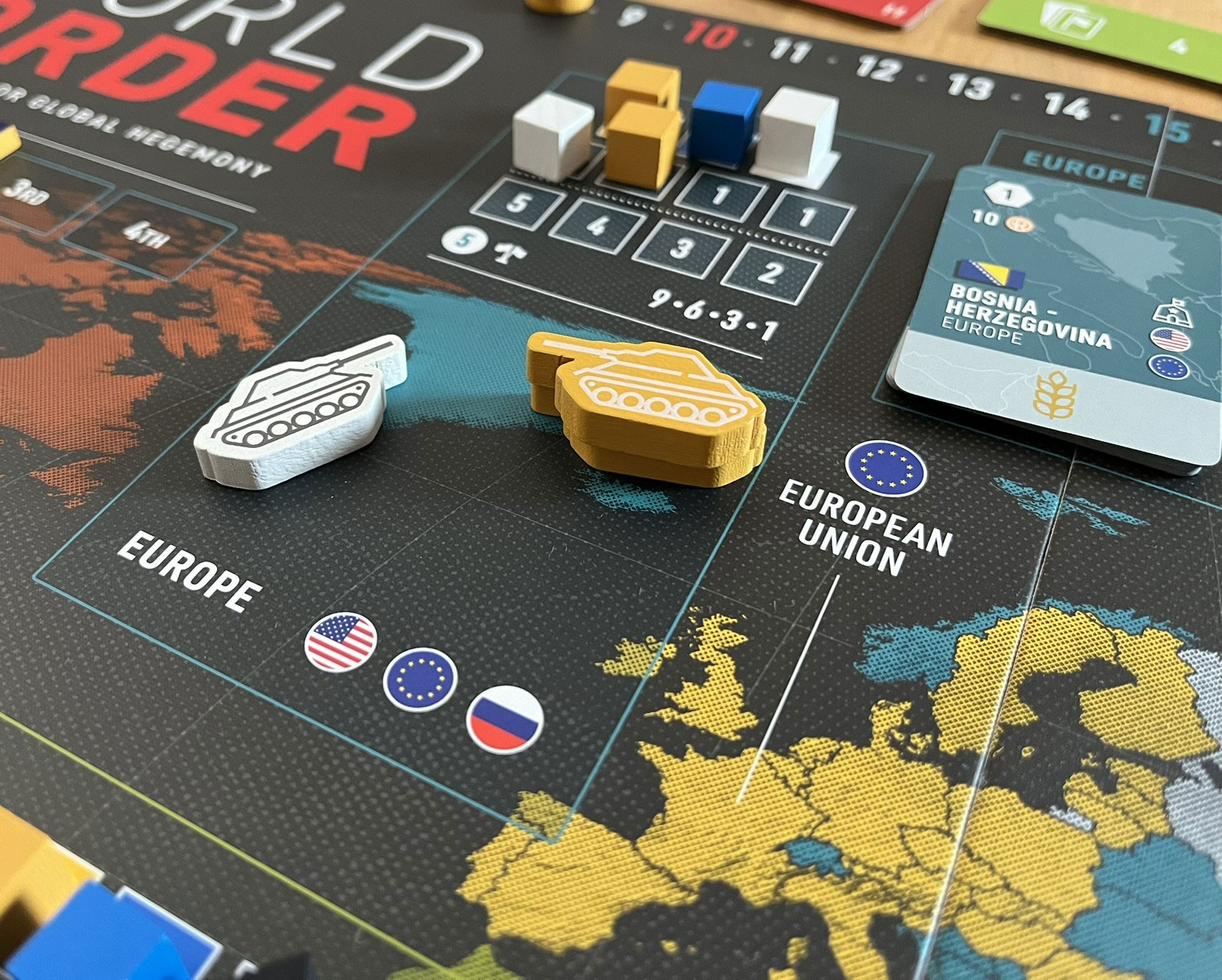
- Minor action: move tanks into one of your zones of interest (ZOI) or a region containing one of your existing bases
- Major action: establish a base with an existing ally, potentially deploying tanks there as well
At the ends of rounds 3 and 6, points are awarded for:
- Area majority cubes in each region of the world
- Possessing the greatest amount of allies, deployed tanks, and money
Points may also be earned during the game by focusing on domestic affairs in two ways:
- Advance up your prosperity track by providing your citizens with consumer goods, resulting in points and money
- Boost your domestic infrastructure by gaining “growth cards,” which provide special ongoing abilities as well as points
There’s a bit more to it, but at game-end the player with the most points is declared the dominant World Power.
Game Experience:
We only tested World Order at two players for this review. World Order is a much easier game to table than Hegemony, in part because the four factions essentially play the same way, making the teach immensely easier. The asymmetry in how the factions play derives from:
- Slightly different starting decks
- Different zones of interest (regions of the map, ZOI) that you are responsible for defending
- Different starting allies
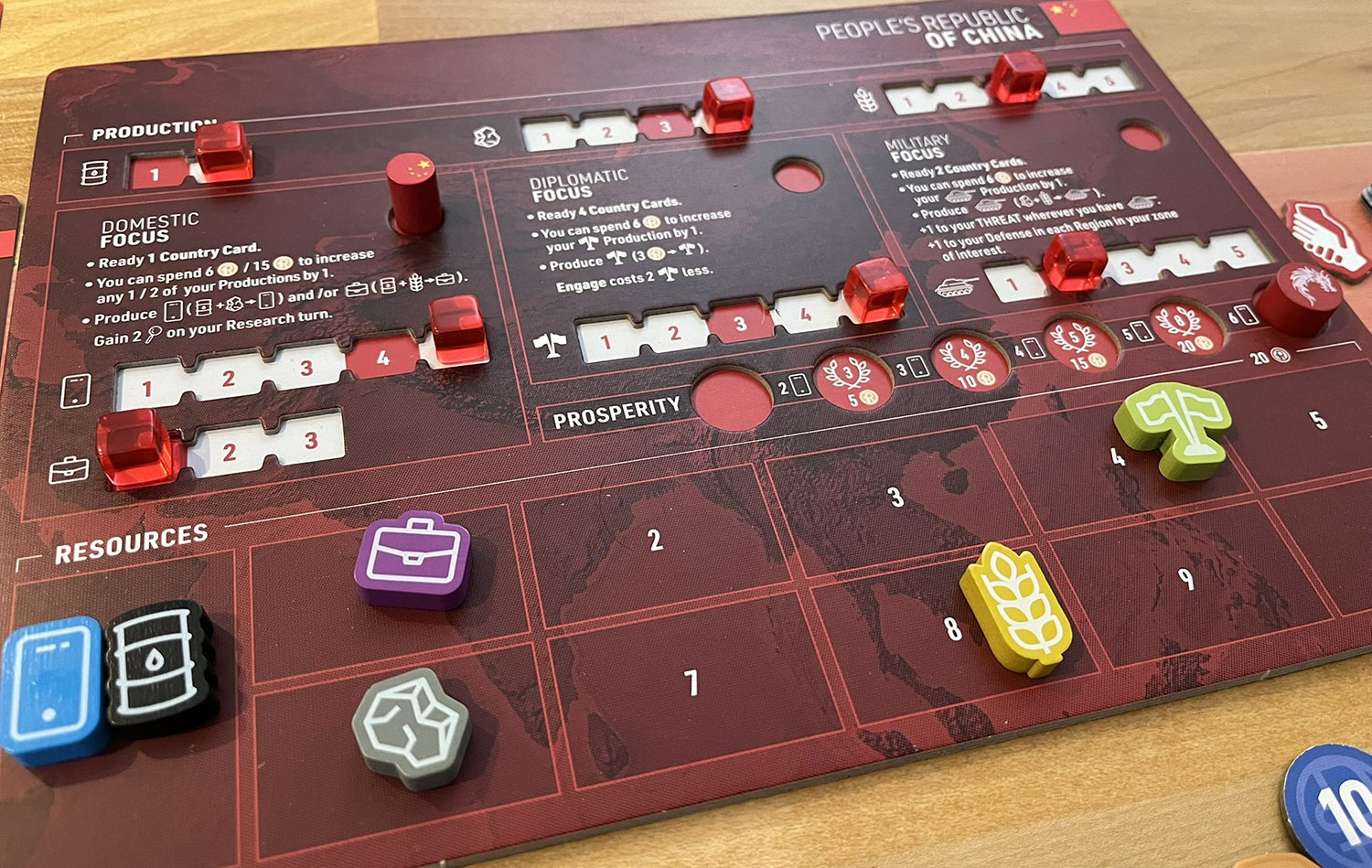
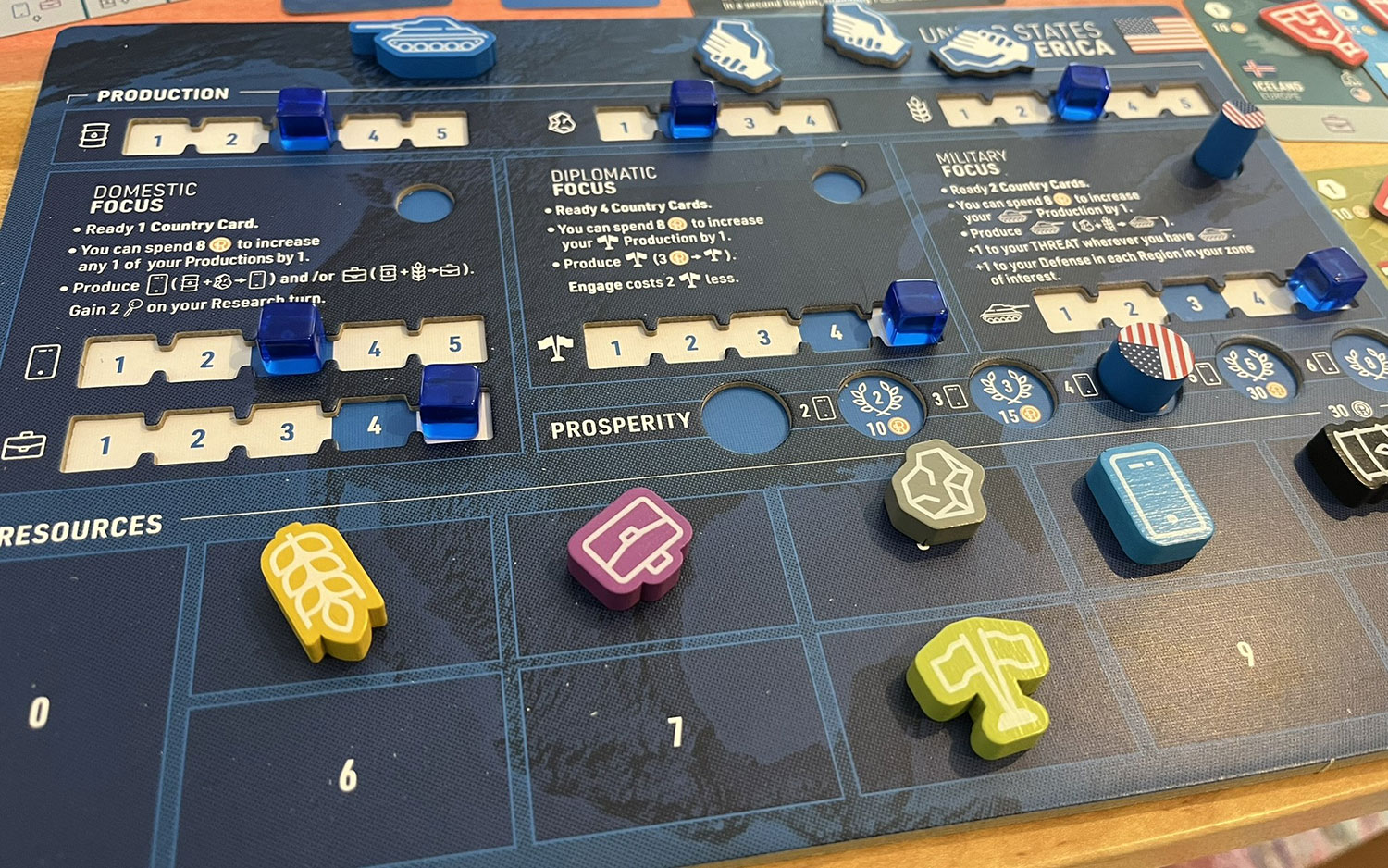
- Unique resource production capabilities
- Special scoring conditions for some factions
- Asymmetric one-time use strategic asset cards
As members of NATO, the EU and US cannot be threatened by one another’s tanks. In all other situations, players can lose points every round if they’re outnumbered by enemy tanks in any of their ZOIs.
The above factors provide each faction with both strengths and weaknesses, and it’s up to the players to decide whether it’s best to lean into their strengths or try to bolster their weak areas. The best course of action often depends on the actions of your opponents.
The specialty of the EU, for instance, is diplomacy. They start with an extra ally, and diplomatic actions are slightly easier for them. If playing against China, they will likely be able to largely focus on diplomatic, domestic, and trade actions. If playing against Russia, the most militaristically aggressive faction, they will likely need to put out more defensive tanks, lest they start losing 2-6 points per round.
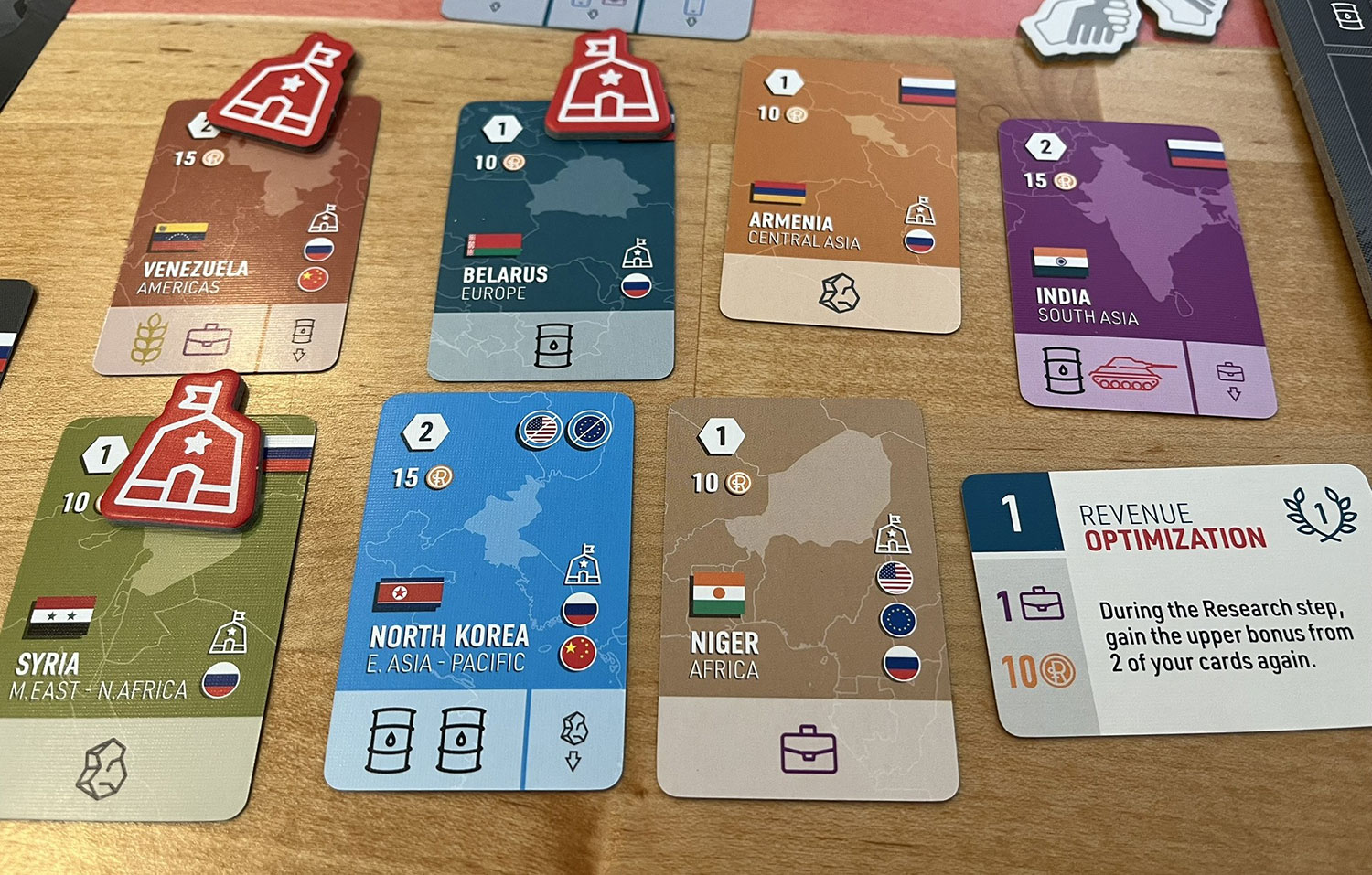
Russia, in my experience, is the most difficult to play at 2-players, as they’re relatively weak at producing high-value goods, and they are thus absolutely dependent on trading their plentiful (but relatively cheap) oil and minerals for basic income and acquisition of other goods. Their strength is producing tanks, for which they alone have special scoring incentives, but otherwise don’t directly help with area control.
The US, by comparison, is flush with money and resource production, as well as a strong military. They are expected to exert absolute area control in at least 4 of 7 world regions lest they get penalized. The necessity of diverse international influence can make it difficult to also succeed with more domestically focused point opportunities.
China’s strength is consumer goods production and financial investments; they earn end-game points for having diverse investments in the varying world regions. Of course, spreading your investment focus too wide could mean you miss out on points for area majorities.
Each round, players can tailor their strategy by acquiring new market cards. These cards are more powerful versions of the basic actions, combinations of two different types of actions in one turn, or entirely new capabilities like culling your deck and/or drawing extra cards. Importantly, all new cards are placed on the top of your deck and are guaranteed to come into play for the next
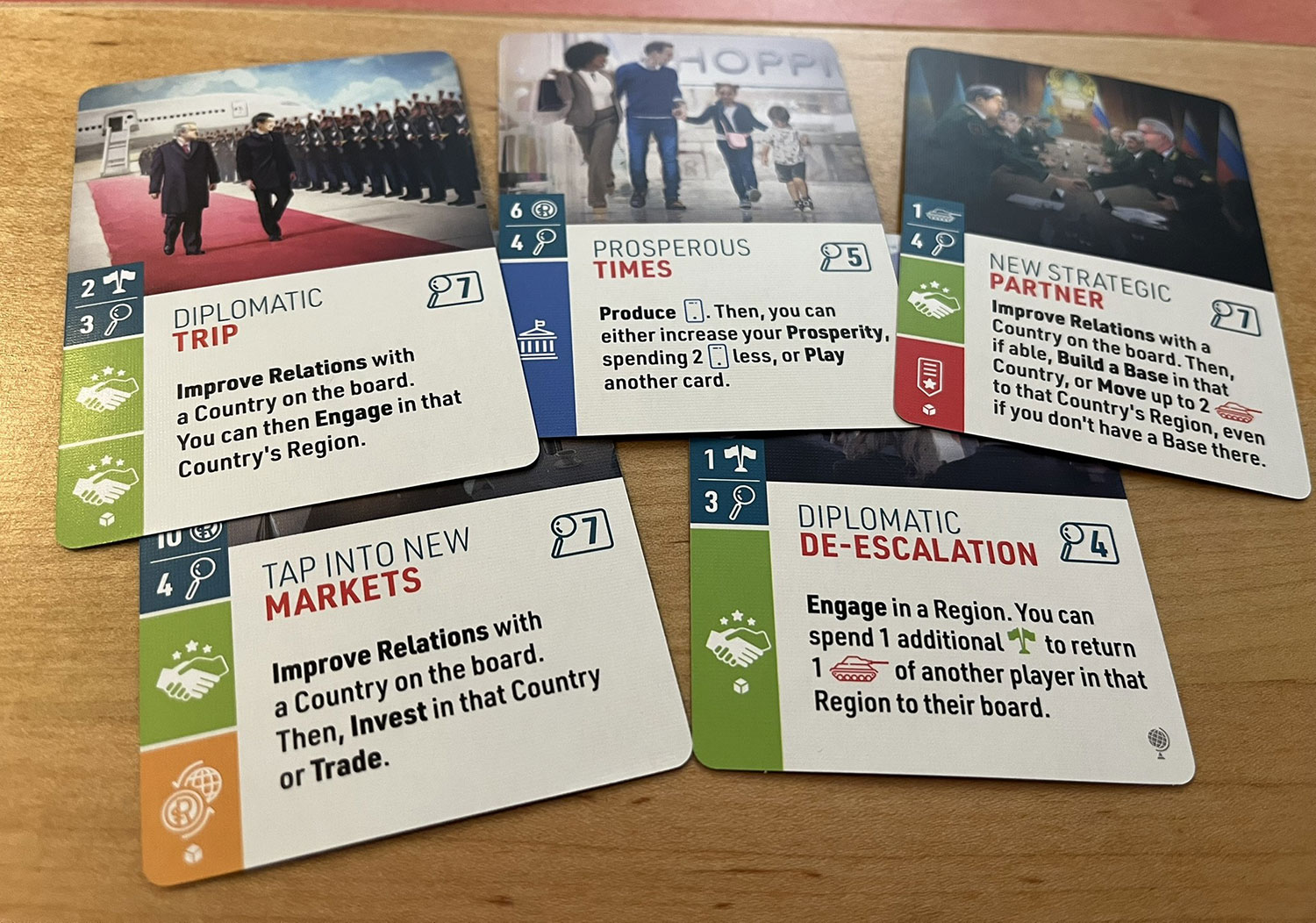
round. Players may also choose to invest in growth cards, which provide ongoing benefits like deck manipulation or powerful one-time benefits.
In terms of expanding your allies, you may choose to bolster your influence within starting ZOIs or expand into new zones. South Asia is not a default ZOI for the USA, but many countries, like India, are willing to become allies. Others, like Nepal, will even allow USA military bases. Countries, like Myanmar, refuse to have any relations with the USA. Each ally card symbolically depicts willingness to align with the different factions as well as types of goods they are willing to import/export. Choosing worthwhile allies is multi-factorial, and there can be some luck with regard to which are available round-to-round.
There is much nuance to the game, and it definitely helps to play a few different factions to understand the best strategy. My first play at 2-players took 3 hours, but we have subsequently gotten it down to 90 minutes. The good news is that the game actually plays really well at 2-players. There is a minimal-effort automa to replace the two non-player factions, which
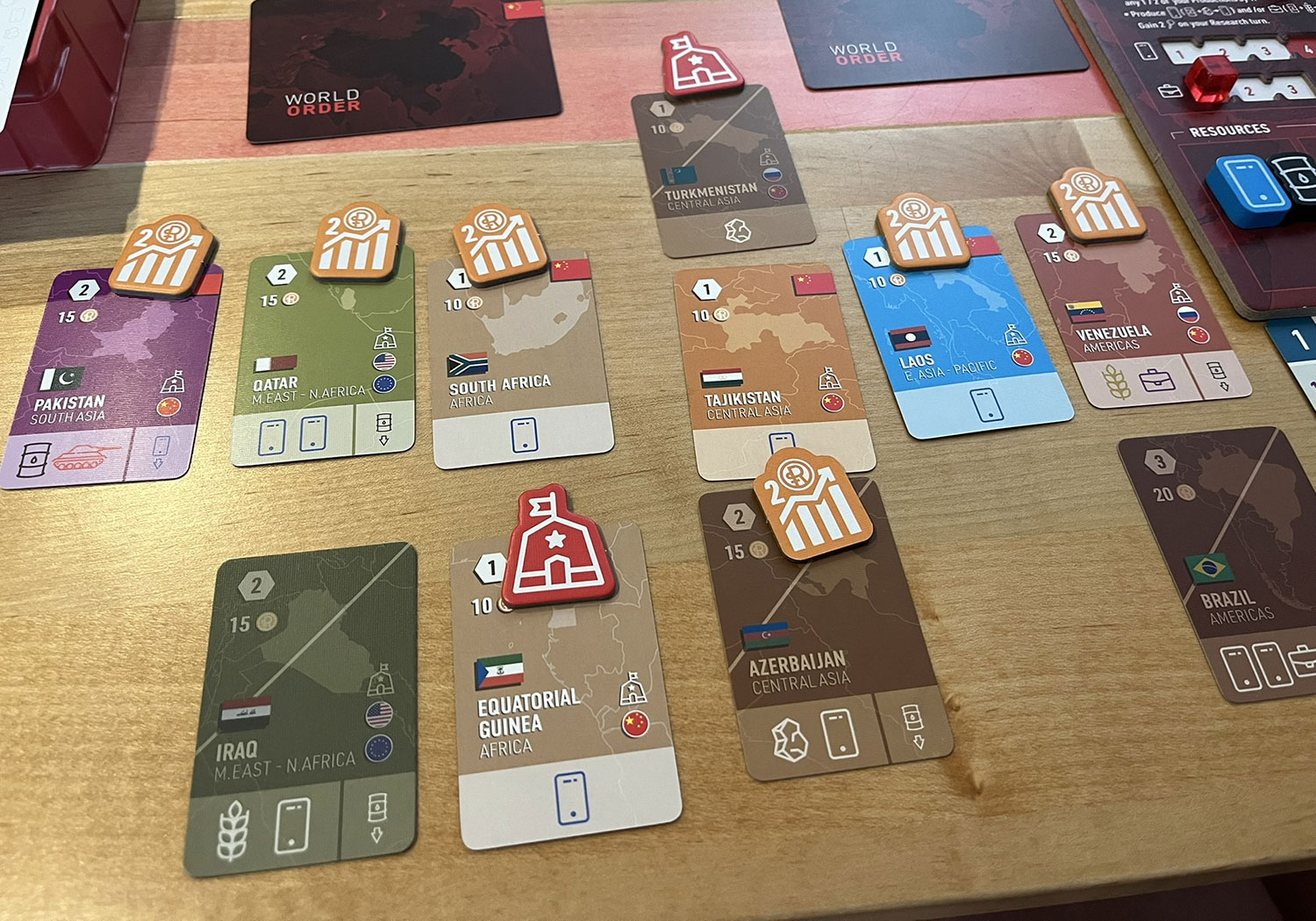
effectively places out cubes and tanks each round. You get a full round of advanced notice of where the cubes and tanks are going, so you can plan accordingly. While Hegemony is probably still the more thematically impressive socio-politico-economic simulation, World Order is ultimately the game that will get tabled more frequently, owing to the shorter playtime at 2-players.
My main mechanistic gripe is that your actions are always limited to what is on your cards. You may have purchased some amazingly powerful military cards early-game and are hoping to use them in the last round, but you’re not guaranteed to draw them, and there’s no way to take military actions otherwise. There are also limited options to increase your card draw and/or cull your deck, and it very much depends on the whim of the card market and growth card availability.
Final Thoughts:
I’m waffling between calling this a very good or a great game. It is a thematically impressive production that takes into account real-world capabilities and alliances of the world powers circa 2010 and wonderfully implements this into area-control game mechanics. The factions are not so asymmetric that the teach is terribly difficult, but they’re different enough that they’ll force different play styles.
Replay value is excellent owing to the 4 unique factions, a thick deck of market cards, growth cards, and asymmetric strategic asset cards. The main mechanistic complaint is the luck-dependence of deck-building and ally formation and the frustration of sometimes not having the right cards to take an optimal action. Playtime might be problematic at higher player counts, especially with first-timers, but the fantastic news about World Order is that it plays legitimately well with 2-players in as little as 90 minutes, which means you could feasibly conquer the world on a weeknight.
Final Score: 4 stars – Vie to be the dominant world power—and potentially reinvent history—in this immersively thematic Eurogame of international relations
 Hits:
Hits:
• Superb incorporation of international relations principles into game mechanics
• Minimal effort automa allows for a great 2-player experience
• Ample variability in the base game
• Cool tank meeples
Misses:
• Limited and somewhat luck-dependent deck-building opportunities
• Game length at higher player counts












Now that you’ve played it at 3 a few times, how do you feel about the game?
It plays even better at 3 than it does at 2-players. Real-life opponents who can react to the current board state simply make the gameplay more interesting. Also, the power balance among the factions changes– Russia receives more regular cash influx due to willing human trading partners, and the US needs to work much harder to achieve absolute dominance. It creeps more into “event” game territory length-wise, but it definitely helps when new players diligently learn the rules ahead of time via video 😉