
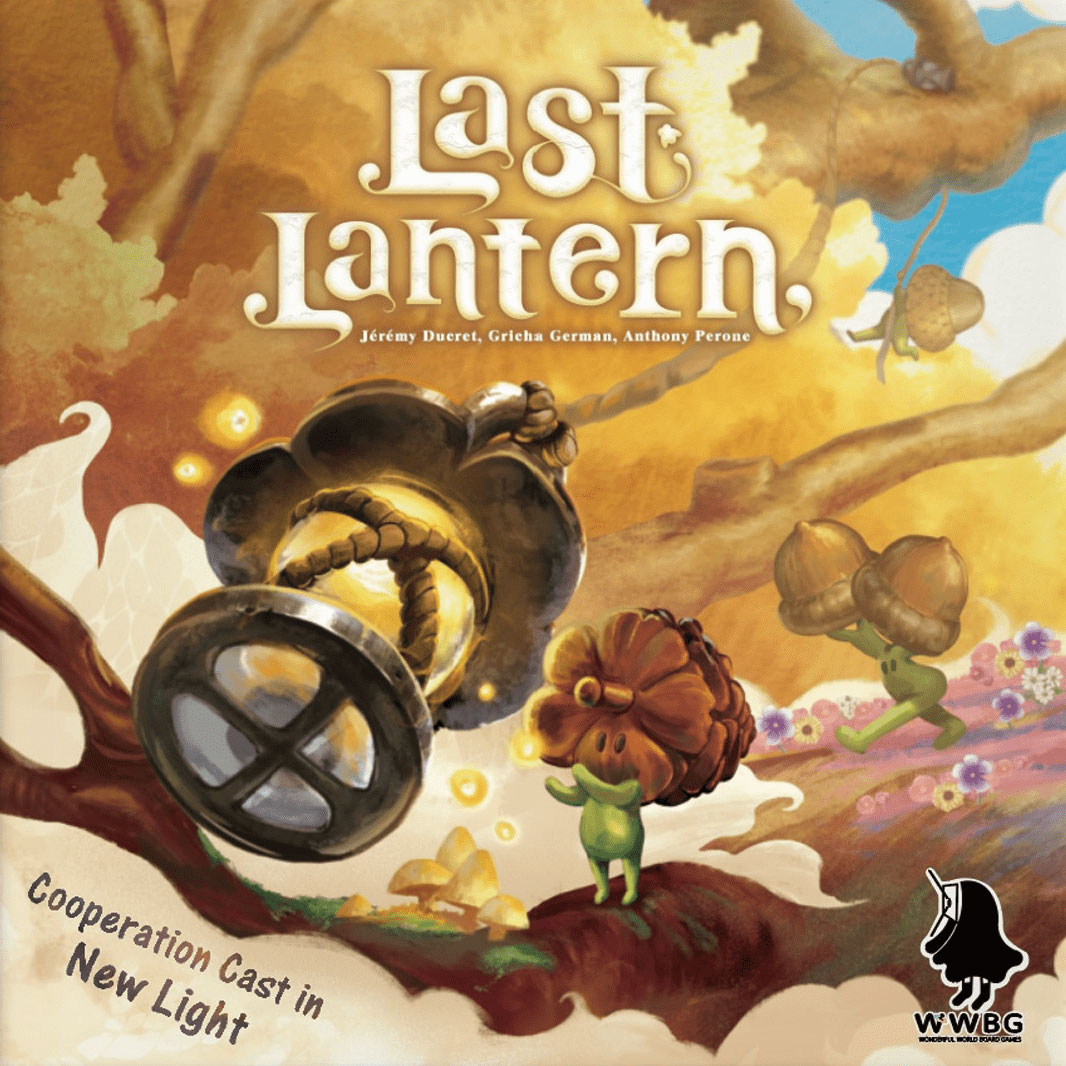
 A fog lingers over our tree, and we are lost in our home. We need to set out and place the last lantern to fend off the fog.
*Pause for dramatic effect*
*Crickets chirp*
*sighs* Last Lantern is a cooperative game with points of limited communication for two to four players that plays in about thirty minutes. It was designed by Jeremy Ducret, Gricha German, and Anthony Perone with illustrations by Zingco Kang and published by Wonderful World Board Games.
Game Overview:
Each round is made up of four phases which play out as follows:
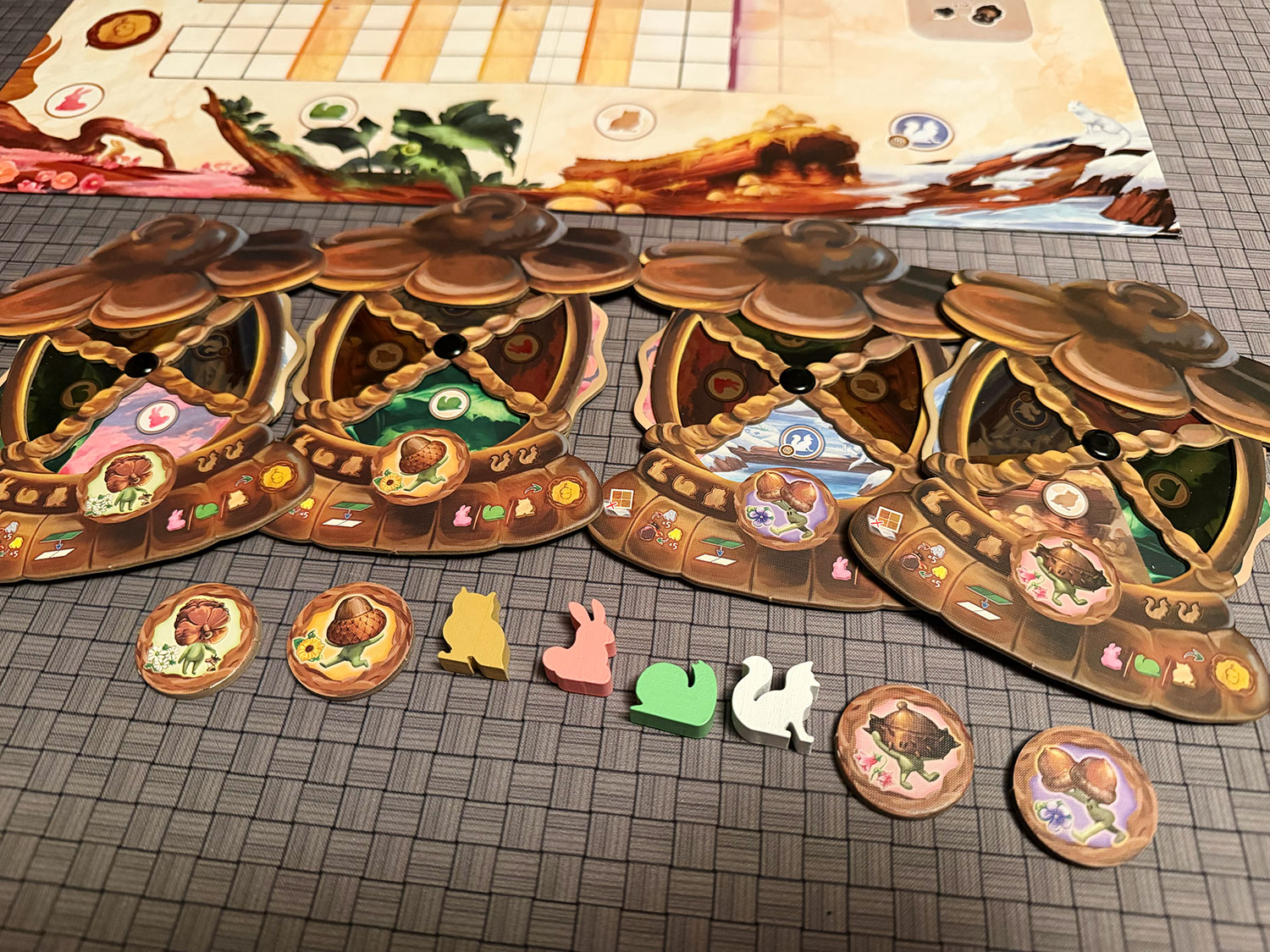
Voices in the fog – Draw tree tiles and place one by each of the three or four familiar types. Without communicating intent, each player simultaneously uses their character wheel to pick a familiar location. Reveal and take the tree tile and familiar from the chosen location. If two players picked the same area, they’ll need to discuss who takes what, including one or more players not getting anything. The tree parts not selected are used later.
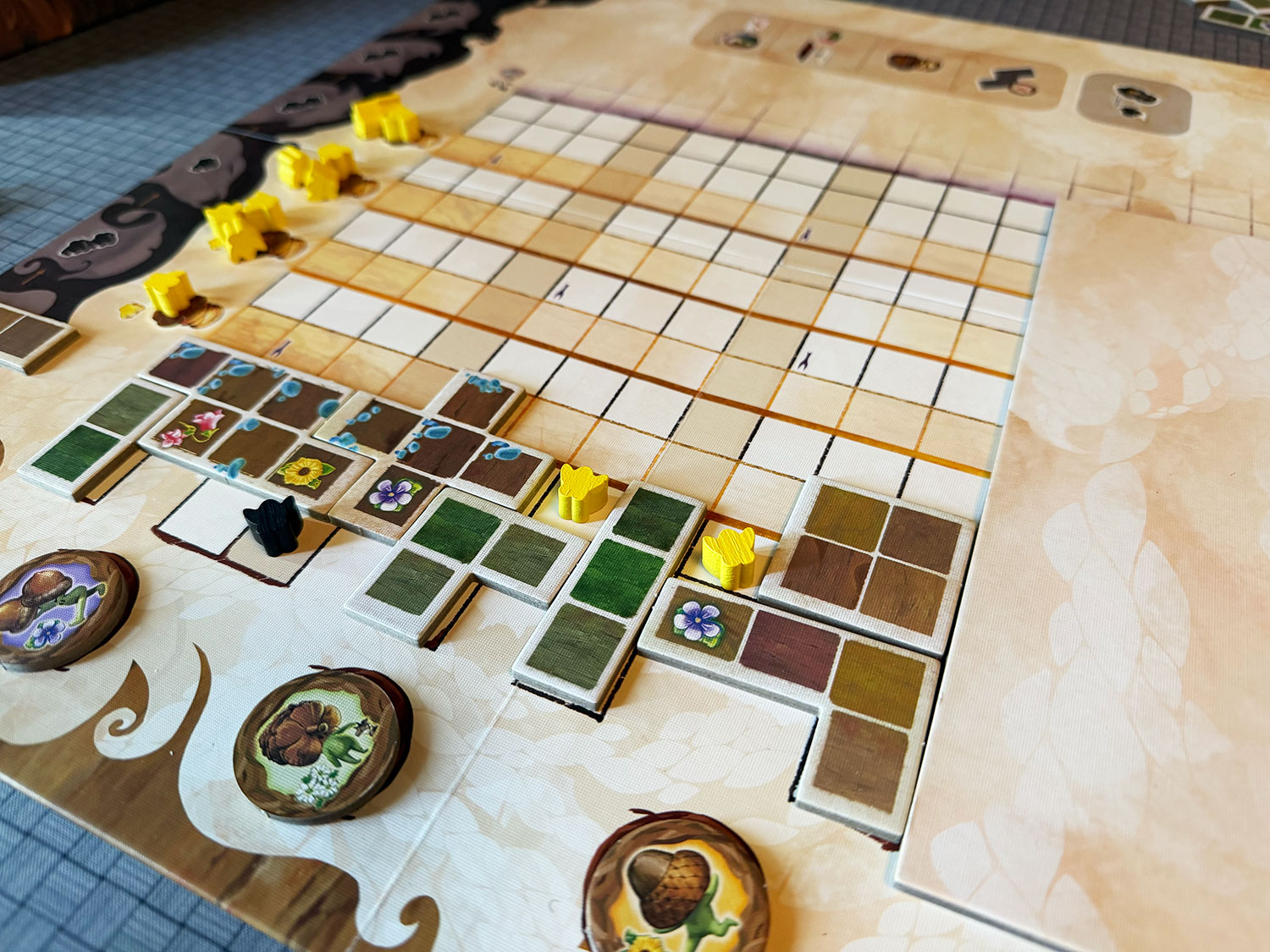
Journeying – In any order, players place their selected tiles adjacent to previous tiles, including ones just placed. There’s a shared row between paths that may be used by either player adjacent to it, but they can’t extend into any other player’s area. If you cover a firefly (I’ll explain where they came from later), it goes back to the supply.
Activate familiar abilities – These may be done in any order, and players may activate multiple familiars if they want. These abilities are:
a) Back on track: Take the last abandoned tree tile and return it to the bag
b) Lighting the way: Draw 5 fireflies from the firefly bag and return them to the supply. Then add five yellow fireflies to the bag.
c) Through the fog: Choose an ability tile and place it anywhere adjacent to previous tiles. These can extend through shared rows.
d) Guiding Hand (4P only): Take one of the other familiars from its location and give it to any one player.
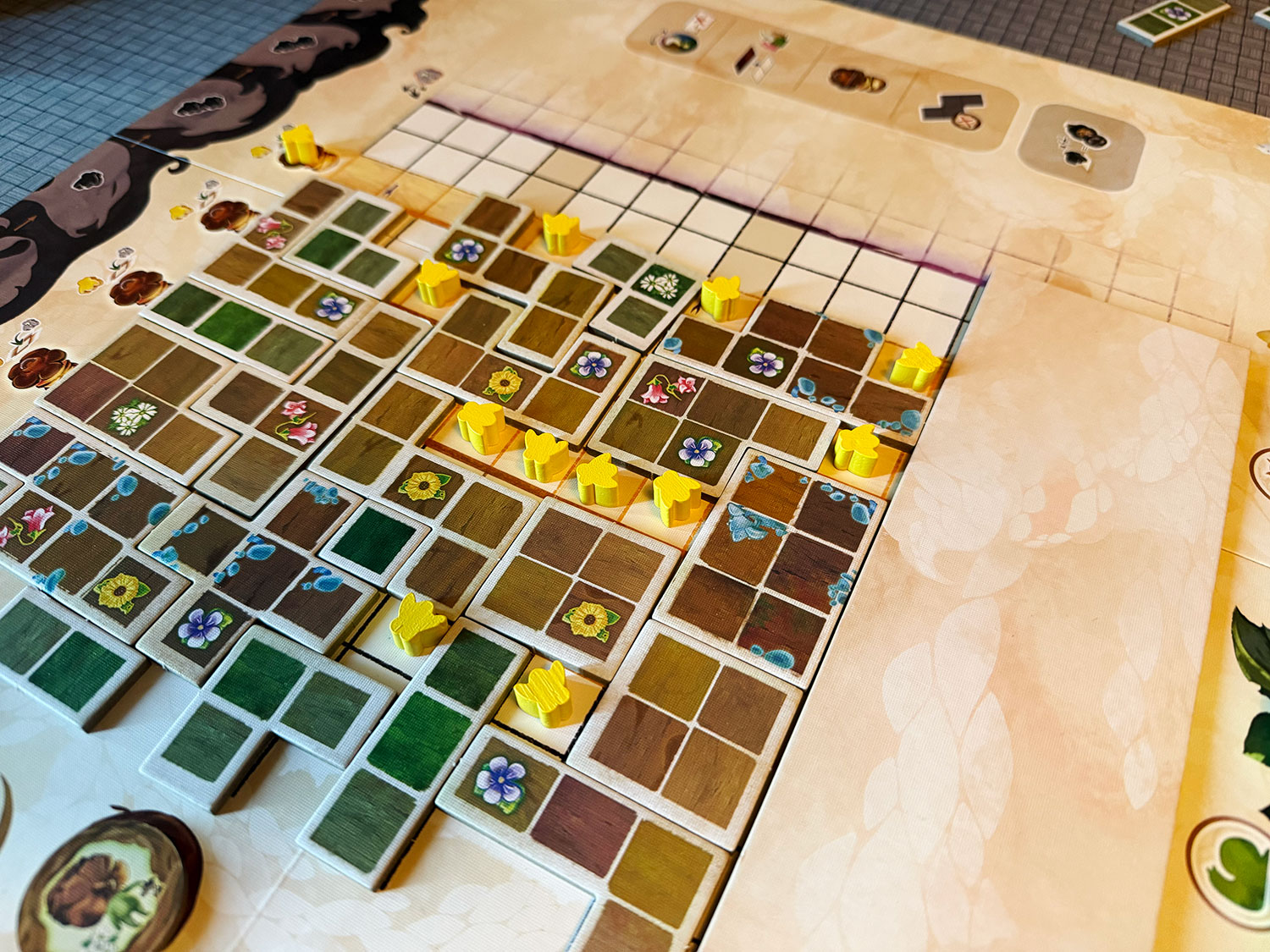
Lanterns – If a player crossed a lantern column, add one firefly to the bag. Then draw and place one firefly at a time for each open space, including shared spaces, between the lantern and the start of the path. If the bag is empty, add a black firefly from the supply to the board. If there’s ever more than four black fireflies on the board, the players lose.
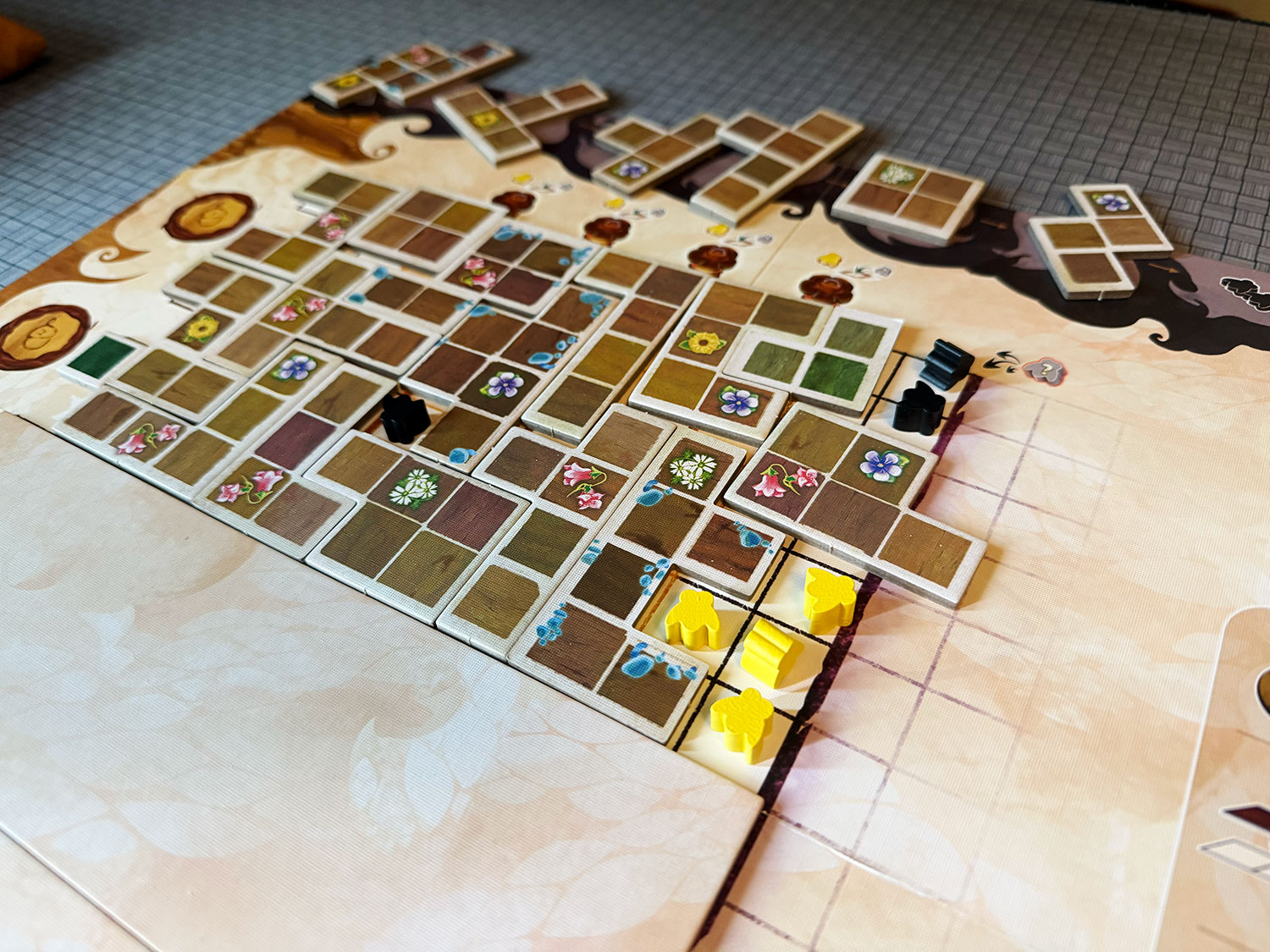
Path Astray – The tree tiles that were not selected are added to the path astray track at the top of the board, then add black fireflies, as indicated on the board, to the bag.
The game ends when one or more players cross the purple goal line. After each player places their final tile, fireflies are drawn and placed in empty spaces. If there are three or fewer black fireflies, the players win.
The game also comes with an envelope of additional components to add more challenges to the game.
Game Experience:
Without the communication limitations, this game would be a cakewalk. The secret selection creates a huge amount of tension as each player enters a battle of wits with each other. However, having the familiars available to help purge the bag of black fireflies, place ability tiles, and remove tiles from the path astray track is critical to winning. I enjoyed how, after everyone has pooched the first phase, you can work together to try and fix what you all done goofed. Or even when things have gone really well, it’s a way of setting yourselves up for future success when everyone claims the owl location.
The game flow was a bit awkward as you collect your tiles and meeples and then leave the path astray tile until later, after you’ve used all your abilities and placed your tiles. It would make the game harder to draw fireflies with more black ones added to the bag, but the game would flow slightly better if everything was handled at the same time.
Meanwhile, I do think this is a game where three players might be easier than two, as it’s possible to not populate the path astray track, which then frees up actions to place ability tiles. One of my plays we finished with zero black fireflies and only two in the bag. Earlier in the game, we had drawn a few and then covered them with tiles. Meanwhile, at two players, and likely at four, it seems more likely that tiles are going to populate the path astray, and you’ll more easily start running out of ability tiles, despite the game ending sooner with four than the lower player counts. Your mileage may vary, and knowing your fellow players and their tendencies is a big part of trying to guess each player’s intentions.
One of my favorite aspects of the game is trying to place your tree tile to leave specific shapes open that can be covered using ability tiles and timing crossing lanterns to minimize the firefly drawn. With limitations for tree tile placement, limited supply of ability tiles, and randomness of fireflies, there’s a balance to be struck for what are actually fairly limited choices once a tree tile is in hand. Being able to cover that one annoying black firefly with a tree tile in a future turn is a powerful way to cover bad draws.
But the availability of ability tiles and even familiar abilities is tied to each round’s initial choices. And if you’re heading too far up the path astray, you’re filling the firefly bag with the black fireflies of impending doom, possibly leading the players to have more problems than their actions. This adds tension to each firefly draw, especially if there’s a lot to be drawn or there are a few already on the board.
Production-wise, I love the little boards that cover the unused parts of the board as it makes it clear where your focus needs to be. A slight ding on production is that the tiles sometimes didn’t fit together perfectly, making some bulge a bit as the smaller tiles didn’t fit into the openings, but not dissimilar to games like Barenpark and Patchwork. The art, while fairly limited, is neat and whimsical with a unique theme. I can’t think of another game with sentient acorns traveling through a dense fog in a tree with dimming lanterns. But the theme is window dressing for those really pining for a deeply thematic game with acorns and lanterns.
This might seem like a silly complaint, but the box is just a tad too small. Once it’s all punched out, you have to perfectly pack the components so you don’t have any box lift with the cardboard insert. I ditched the cardboard insert, and it fits. Barely.
This is a game that, despite the satisfying puzzle it presents, could get repetitive over repeated plays with its pretty straightforward base loop. There are also six challenge modes that can be added if the base game is too easy, repetitive, or light for your group. I haven’t played with these, but I like when publishers add content to give players more to explore. It’s like the base game comes with an expansion.
Lastly, this can be a bit hard to teach for its relative complexity due to how many steps are in each round, but most players should catch on in a few rounds. Each of these steps themselves is straightforward and generally intuitive. I once taught the first round with open discussion to explain what would happen if we made different decisions before following the intent of mum’s the word during the voices in the fog phase.
Final Thoughts:
If you enjoy cooperative games and don’t mind limited communication, Last Lantern can be a solid game to try. But if limited communication sends you running for the exits, be aware that it’s an important part of this game.
Final Score: 3.5 Stars – Last Lantern is a limited communication cooperative polynomial game that presents an interesting puzzle with a lot of self-inflicted challenges.
 Hits:
Hits:
• Each round gives opportunities to fix prior mistakes
• Great tension around decisions and the random draws of tiles and fireflies
• Challenges are like having an expansion included in the box
Misses:
• Limited communication will not be for everyone
• Box is too small, or ditch the insert to avoid box lift