



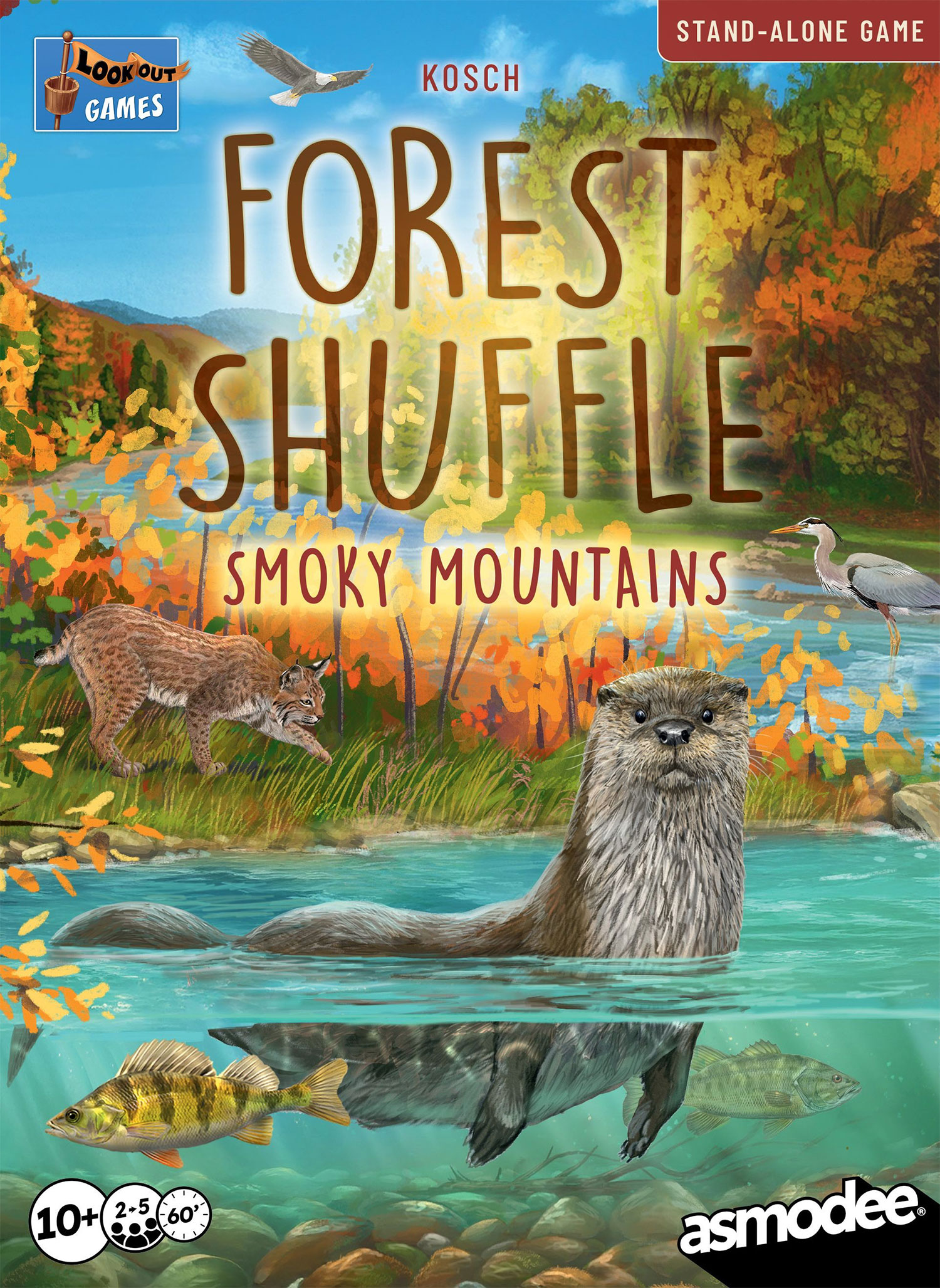
 The great outdoors offers a great place to relax, so long as you don’t run into certain dangerous forest creatures. In Wyoming there’s the speedy Jackalope, in Scotland there’s the sneaky Wild Haggis, and in Australia they’ve got the viscous Drop Bear. The Smoky Mountains, located along the border of Tennessee and North Carolina, are no exception, featuring the fearsome Eastern Chipmunk, and as any well-trained hiker knows, the only way to scare them off is to do the Forest Shuffle.
Now there’s a card game celebrating this protective dance of the Smoky Mountains, aptly named Forrest Shuffle: Smoky Mountains. This is a stand-alone sequel to 2023’s more generically named Forrest Shuffle, and it introduces some new river mechanics, special card abilities, and many new creatures, including the aforementioned Eastern Chipmunk. Suitable for 2-4 players over 60 minutes, Forest Shuffle: Smoky Mountains is a game of set collection, drafting, and hand management that brings the great outdoors indoors for some gaming fun.
Gameplay Overview:
The rules for Forest Shuffle: Smoky Mountains are nearly identical to OG Forest Shuffle, where a turn consists of:
- Drawing 2 cards to your hand
- Playing a card from your hand to your tableau, paying its cost in other cards
You’re essentially attempting to build a tableau of trees and critters that provide synergistic scoring opportunities. See our Forest Shuffle Review for a more complete rules overview.
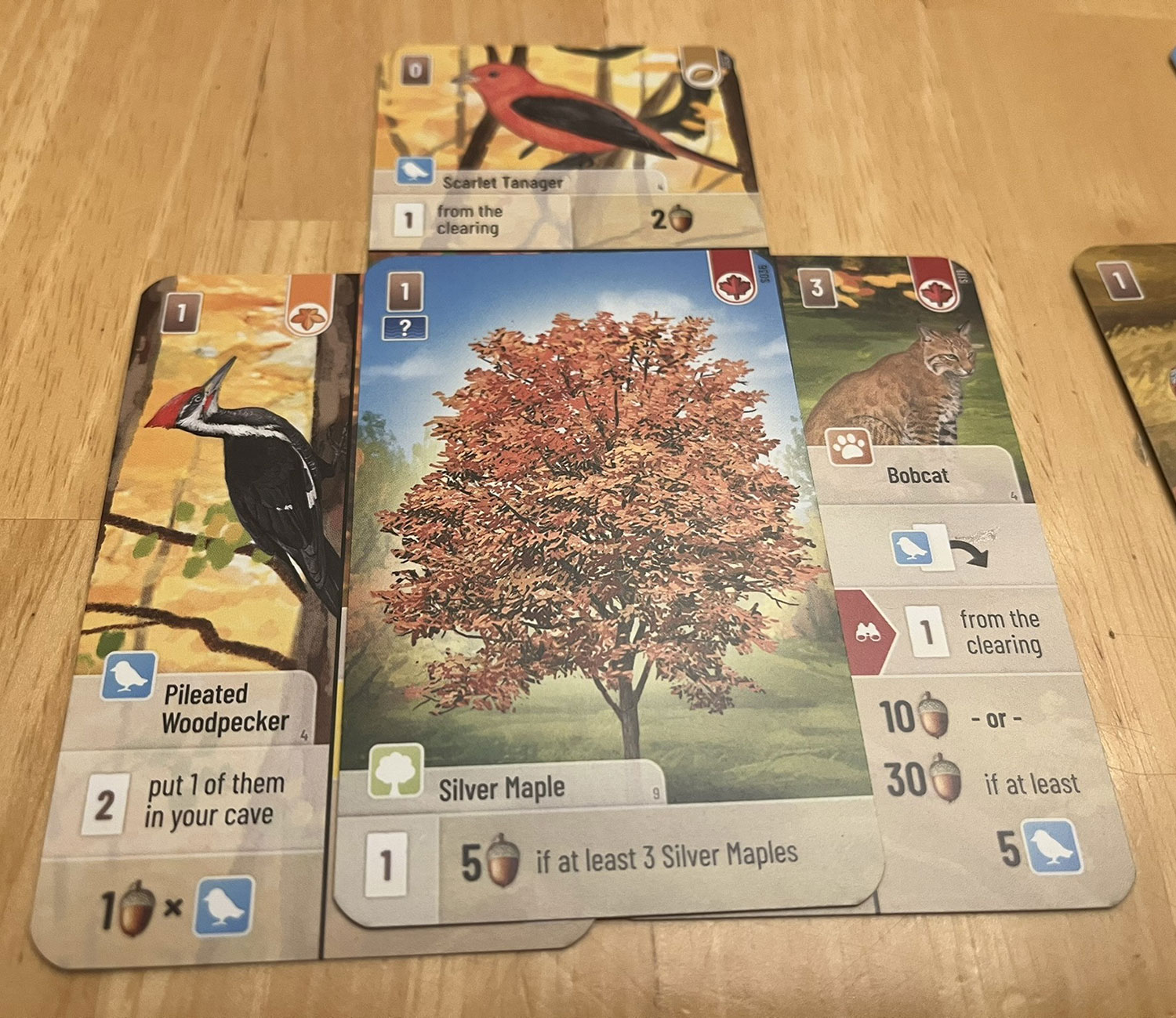
The new elements to Forest Shuffle: Smoky Mountains are as follows.
1. Stand-alone river terrains can now be built
-
- Whereas previously a tree was required before any fauna could enter play, now river terrain cards (9 total) can be entered directly into play as a habitat supporting future fauna
- Each river contains unique abilities and/or scoring opportunities once played
- Rivers can support up to 2 cards above and below, but not any to the sides
- Only cards containing the new “water requirement” icon may be played above/below a river terrain
2. Rivers may be attached to trees
-
- All card backs show a river
- Unlike in Forest Shuffle, where any card can become a generic tree, instead these rivers can be entered into play from your hand attached to a tree, whenever you play a new tree
- This tree-connected river can support up to 2 cards underneath so long as they both contain the “water requirement icon”
- The top and sides of this water-connected tree can each support 1 card, whether it has a water requirement icon or not
3. New searchable icons
-
- Many cards contain icons that allow you to play a specific type of card from the clearing into your forest for free.
- If no cards of the appropriate type are currently in the clearing, you may add up to X cards from the deck to the clearing to hopefully find one
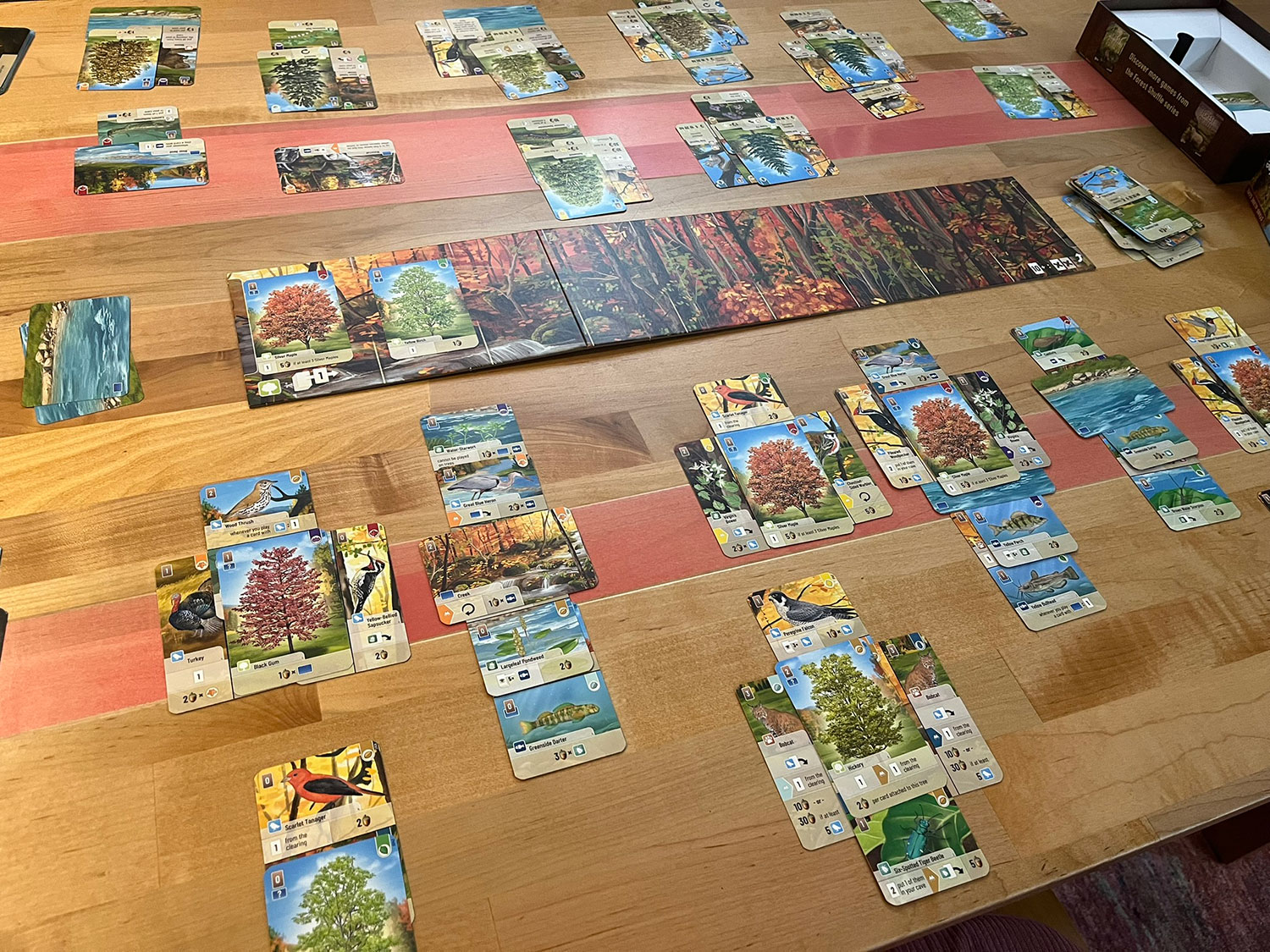
Game Experience:
The first time I had ever played OG Forest Shuffle, I thought it was fine, but not amazing. My biggest gripe was that I had decided to lean heavily into a specific card type (birds), and towards end game I felt like I was simply taking a lot of “draw cards” actions to search for more birds or other cards worth playing, and this made the late-game less exciting.
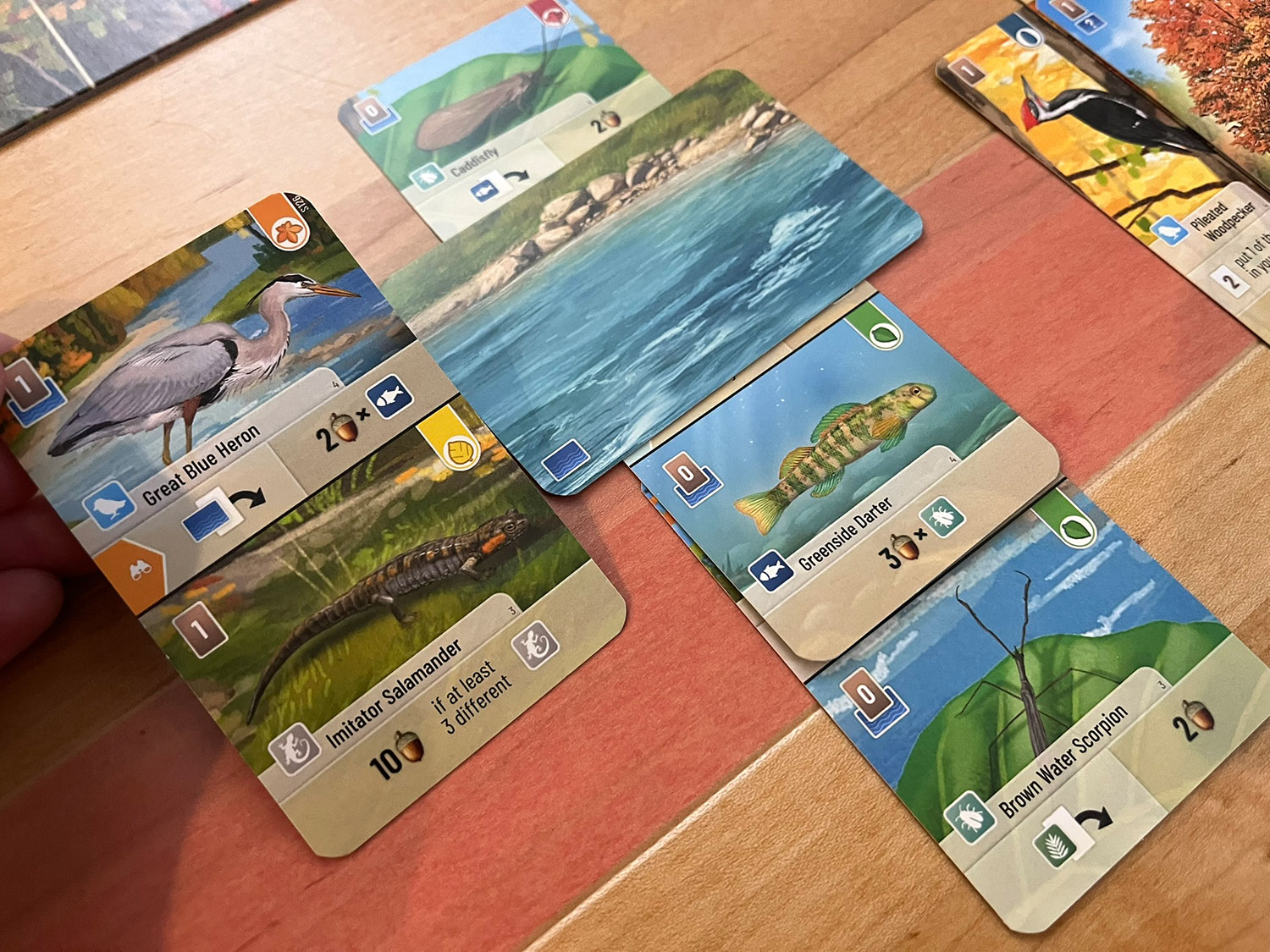
While any card-based game containing 176 playable cards will have some inherent amount of randomness—and Smoky Mountains is certainly no exception—this new rendition of the game now offers more combos and luck mitigation. For instance, when playing one of the searchable-icon cards (say, for birds), there are two general strategies. First, pay for the card using at least one bird card, which you can then play for free. This essentially gives you a free turn and can let you get more expensive cards into play easily. Second, you can use it to search the deck, and if you find a bird within x cards, you can play it for free. This mechanic has the secondary effect of speeding up the end-game, and it can be used to fill the clearing up to or past 10 cards, causing it to be wiped. These secondary effects could be a part of your strategy if, say, you pay using a card your opponent wants and then make sure it gets wiped away. Overall, I’m a fan.
One of the other changes is the addition of rivers. The biggest impact of this is that it creates some restrictions on where your fauna can be played, since cards with a “water requirement” icon must be played on a river, and cards without this icon need a tree. Depending on which type of critter(s) you think you’ll be specializing in, this new dichotomy forces you to make plans as to which type of habitats/terrains you’ll build. Sure, you can always hedge your bets and build trees attached to rivers (which can accommodate both aquatic and dry critters), but this costs you an extra card and still limits the bottom-tucked cards to aquatic types. I like this mechanic just fine—it’s not better or worse, but it does create the need for more pre-planning.
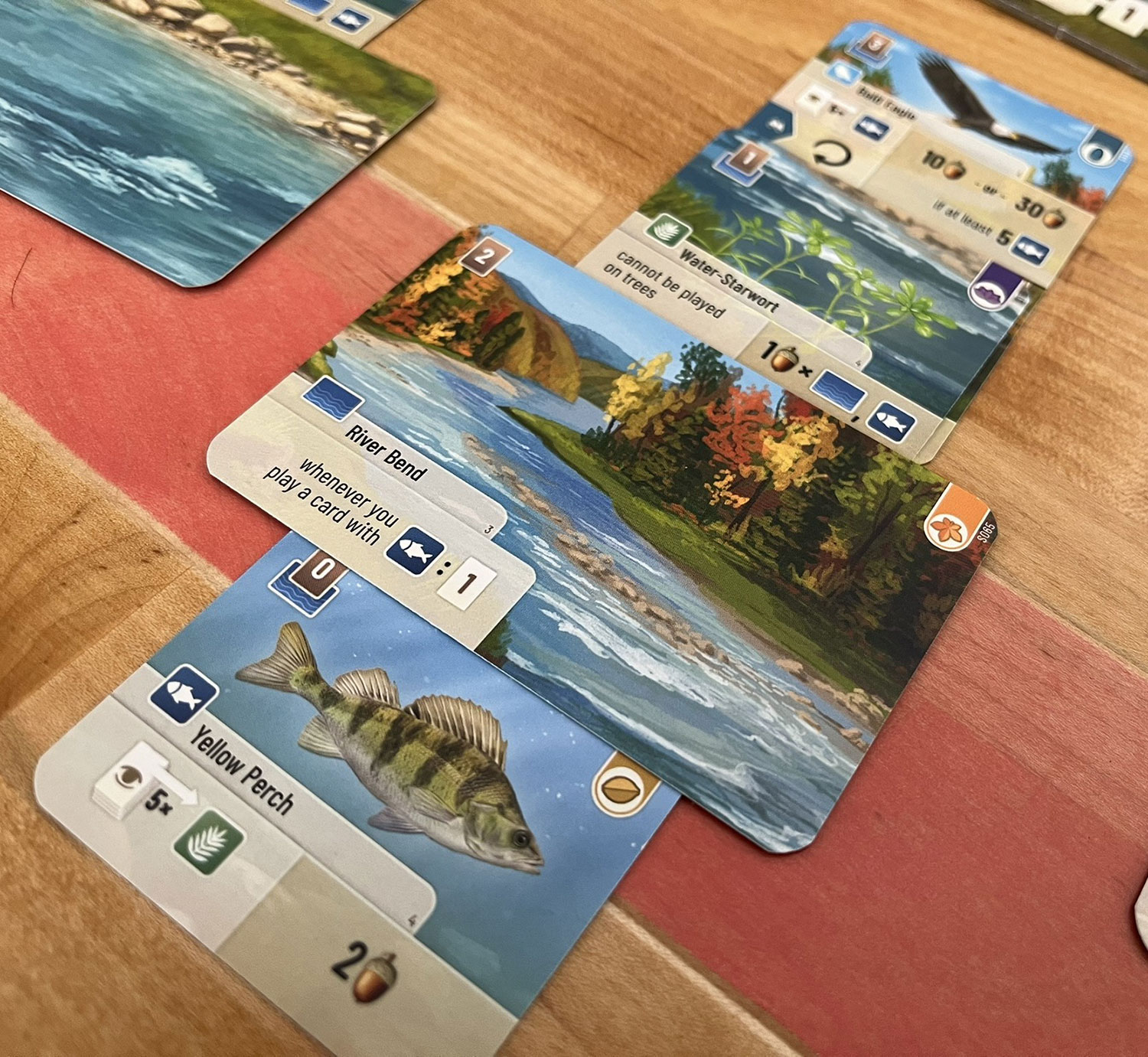
Probably the biggest difference I’ve seen is the overall re-balancing of various scoring strategies. Based on the plays I’ve had so far, Smoky Mountains seems to be a bit more balanced than OG Forest Shuffle, though as a scientist I don’t want to make a firm statement on that while I still have <100 plays under my belt. I’ve seen much online chatter about how certain “30/10” cards might be OP, but I don’t think so. These cards are expensive (3-card cost), and most of them guarantee 10 points at endgame, which can increase to 30 points if 5+ of certain symbols are in your tableau. There are 21 such 30/10 cards in the deck, with 8 relating to fish, 4 for pawed animals, 5 for a variety of trees, and 4 for birds. This might make fish seem like they’re super-strong, and they can be, but with only 20 fish in the deck, only so many players will be able to get their hands on 5 of them.
Doing well in Smoky Mountains, just like OG Forest Shuffle, usually involves specializing in one or two things that not too many other players are also specializing in while also playing efficiently to take advantage of card powers and synergies. Outside of the 30/10 cards, there are cheaper cards that offer 10 points for smaller collections of insects, mice, and other critters. Additionally, many cards offer point multipliers for repeats of mouse, fish, bird, tree, plant, water, squirrel, pawed animals, insect, and amphibian symbols. And if you can, say, accumulate a few 1-point-per-mouse cards, this can equate to big points.
Final Thoughts:
Forest Shuffle: Smoky Mountains still feels like OG Forest Shuffle, with the addition of a new river mechanic, the ability to search for specific symbols, new flora and fauna specific to the Smoky Mountains, and possibly improved overall balancing. If you already own Forest Shuffle with expansions, you probably don’t need Smoky Mountains, but you’ll probably enjoy discovering combos and strategies with the new card assortment.
If you’re looking to acquire a version of the game for the first time, this is likely a better starting point. Similar to its predecessor, Smoky Mountains packs a lot of fantastic set-collection and hand-optimizing gameplay into a relatively tiny box, brimming with colorful flora and fauna on each of its multi-use cards.
Final Score: 4 stars – Run, don’t shuffle to try your hand at this excellent nature-themed card game
 Hits:
• Multi-use cards offer many interesting decisions
• Multiple routes to victory
• Full-sized gameplay in 180 cards
Misses:
• Some may dislike the somewhat variable/unexpected game-end timing
• Final scoring can be time-consuming
• Card stock is just okay