
 There are some wild hotels in the world. Igloo hotels, castles, caves, and treehouses are just the start. Compared to the hotel room that used to be a crane (still works, you can move the crane to change your view) or a renovated giant wine barrel, a treehouse starts to feel downright boring. How about a plane? There are a couple of planes that have retired from flying and serve as hotels. That could be cool. I am going to take a hard pass on the hotel that literally looks like a glass tube hanging off the side of a mountain; the elevation is 1,312 feet. If that’s your thing, well, you do you. I’ve stayed in a castle, which was awesome, and I think the wine barrel sounds interesting. I say no to dangling off mountainsides, though.
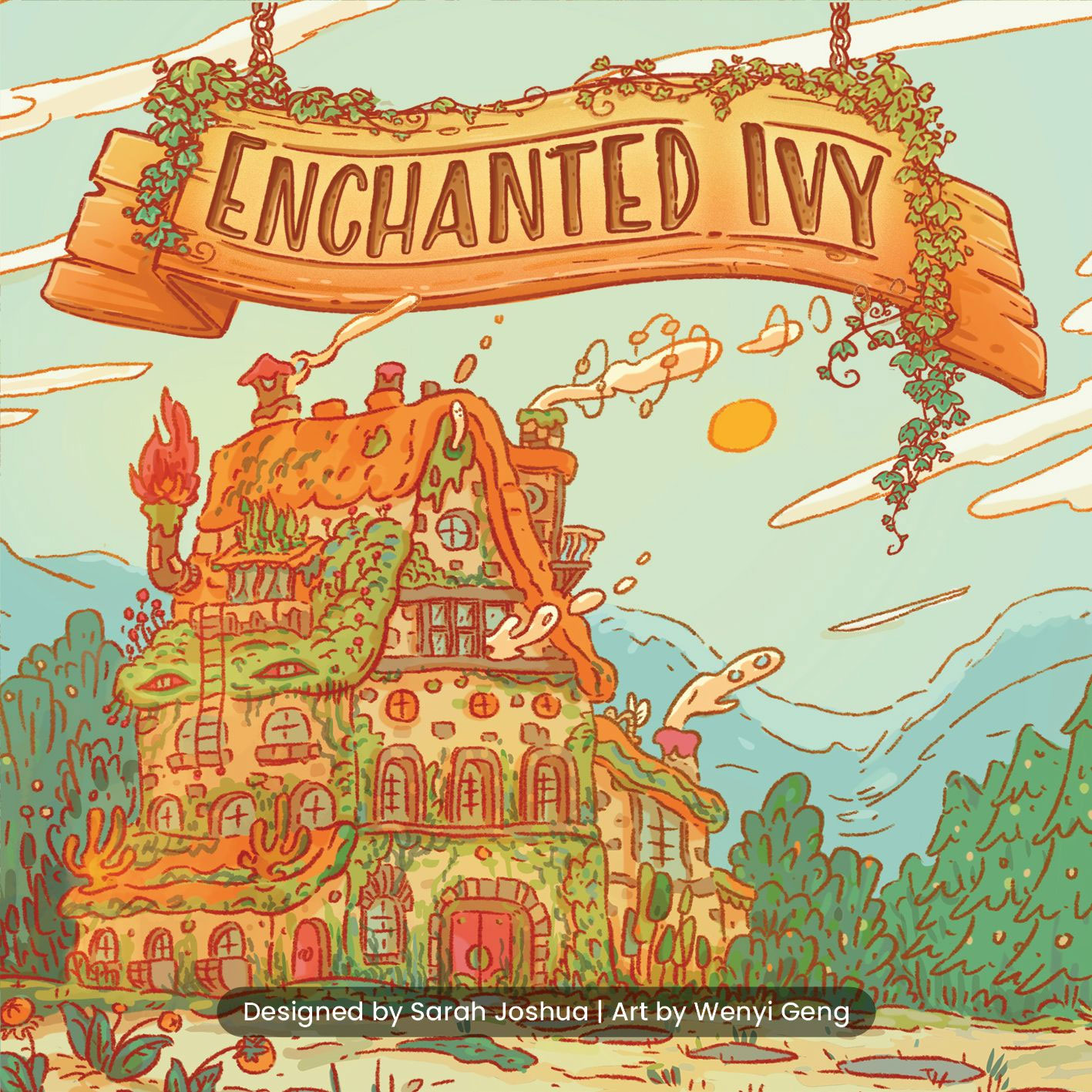
Or were you looking for something more magical? Well, we’ve got hobbit houses and some hotels with fairy-tale inspired architecture. Oh, you mean literal magic? Fairy dust and unicorns in the stables, magical. Sorry, you are going to need to open a dimension to an alternate world for that. Or play a couple rounds of Enchanted Ivy.
Dimensional portals are tricky. I went with Enchanted Ivy.
Gameplay Overview:
Enchanted Ivy puts you in the role of the proprietor of a magical inn. This is a solo-only game.
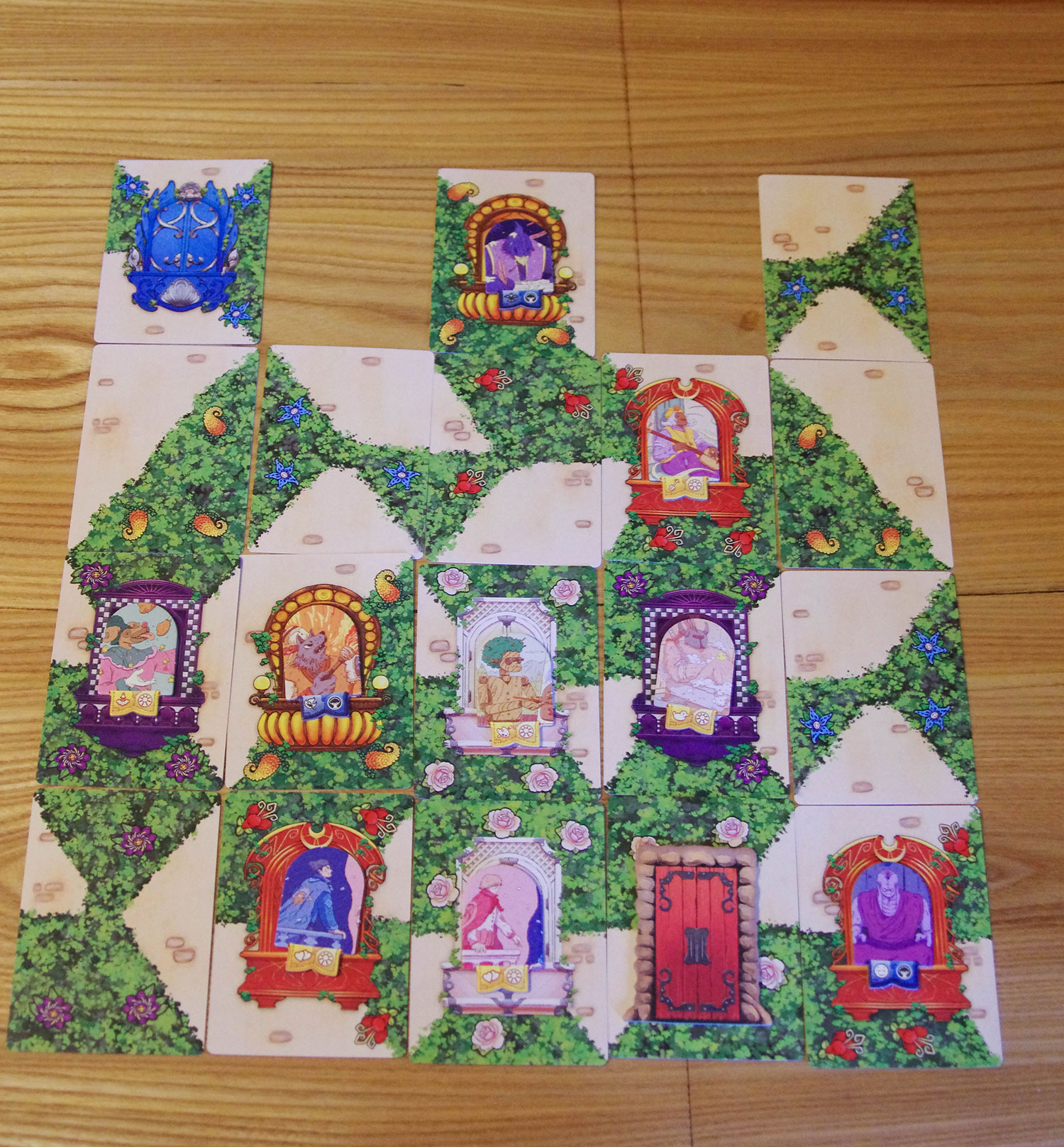
Rules don’t get much simpler than Enchanted Ivy’s. Select a scenario from the storybook. The scenario tells you how many cards you will need to build your inn. It gives you the diagram of the inn layout and tells you which guests to use. Shuffle up the cards, and put the guest tokens into a bag. Draw two cards and two guest tokens. Place one card with the balcony side showing, place the second with the ivy side showing, and add one guest to the balcony. Then draw two more cards and one guest token. Repeat until the inn is built. One guest will remain unplaced. That’s it.
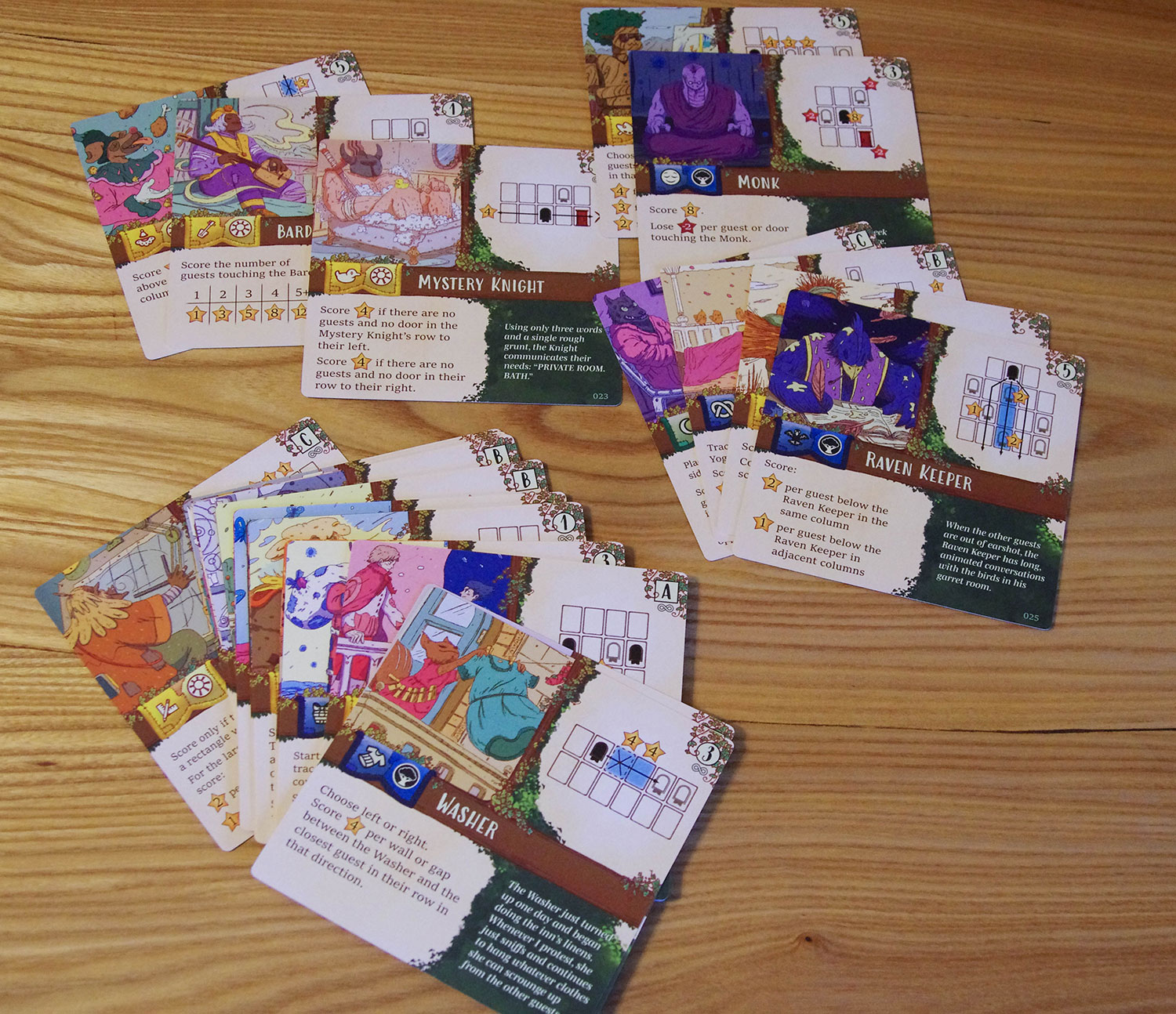
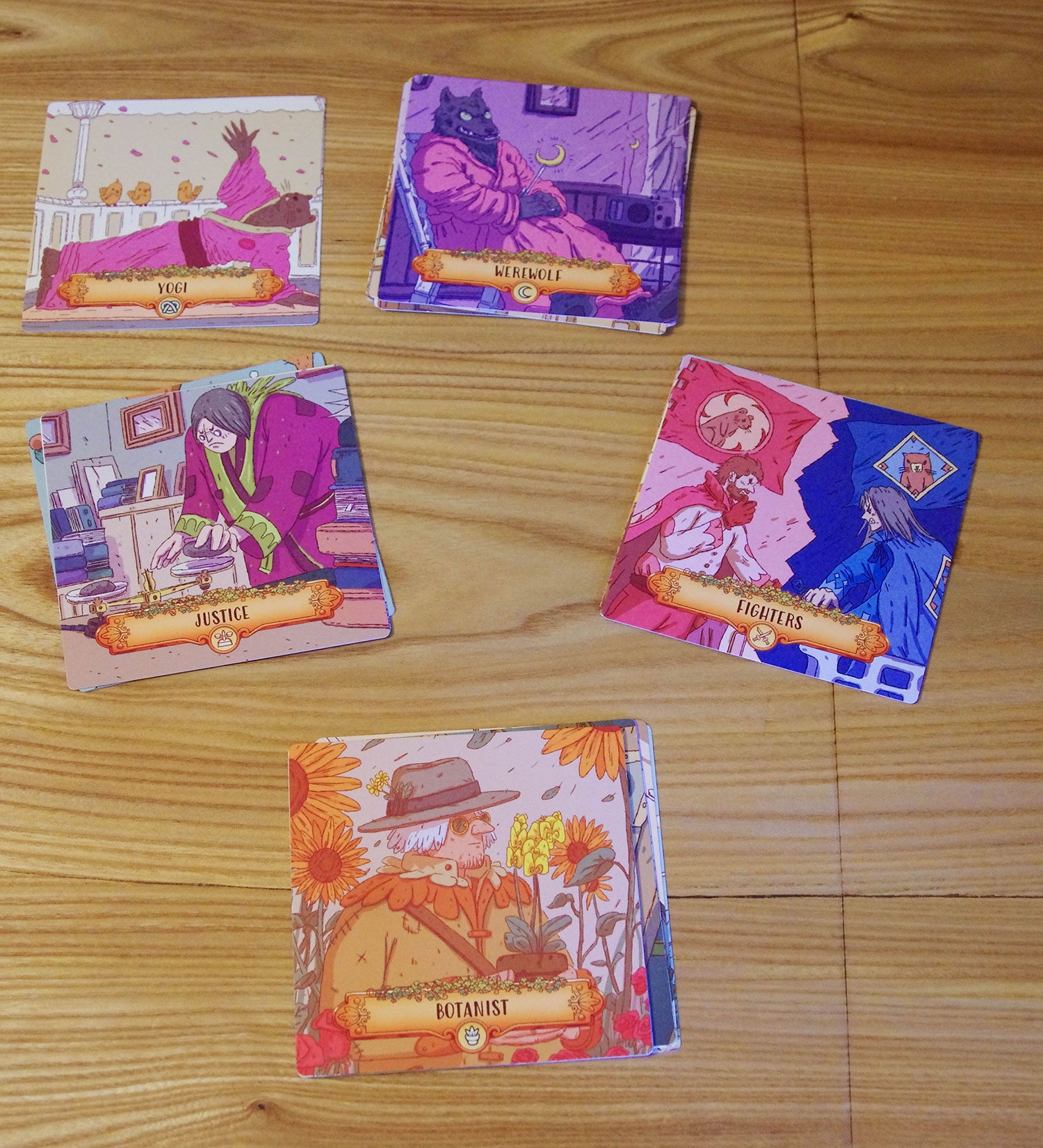
Each guest has preferences for who or what they want nearby. These are described on the guest cards so you can refer to them while creating your inn. Guests score based on how well you have met their preferences. The inn layout, scoring goals, and some additional challenge goals are all laid out in the scenario. If you meet enough challenges, you can add special doors to your inn that give you unique bonuses.
The scenarios are contained in two storybooks. In addition to each game’s layout and required guests, these include a couple of paragraphs of story to create an overall tale you can play through. You can play the scenarios in order, or you can select just one to play. The game also has Endless Mode, which plays with the same general rules. Endless Mode is a deck of cards with inn patterns to create and score. Guests are randomly chosen with some general guidelines described in the rulebook. Build your inn, check in your guests, then tally up your score. Like I said, easy.
Game Experience:
Do not be fooled by the small size of this box or its simple rule set. There is a lot in here. For starters, there are 30 different guest types. Thirty different guests means thirty different sets of preferences. Remember that old adage: you can’t make everyone happy all of the time? You really can’t. This game will have you deciding who to make happy and whose happiness is sacrificed for the sake of more points.
You aren’t just scoring based on the guests either. You need to look at the pattern of ivy you are building as well. In addition to happy guests, you score based on the number of distinct ivy patches. A few large patches, meaning you’ve successfully linked more cards, score higher than lots of small patches.
This game has a ton of variety. There are two storybooks of scenarios of increasing complexity, bonus doors unlocked only after achieving challenges, two modes of play and there is already an expansion available. That’s a lot, and it’s all packed into a 4 1/2 inch square box. It actually might be just a little too much. Once everything is punched, no matter how I organize the contents, there is lid lift. That’s always annoying, but it feels extra annoying on a small box like this.
Final Thoughts:
Enchanted Ivy is delightful. It’s a quick-to-learn, quick-to-play game with a lot of replay value built in. You can play through the same scenario multiple times without ever feeling like you’ve done this all before. Extra bonus: the character cards with scoring details are big. They are box size (4 1/2 inches square). Big cards like that mean that not only do you have room for text describing the scoring conditions, but you also have room for some diagrammed examples. No squinting to read fine print and no confusion on what is considered ‘touching’ versus ‘adjacent’. Very clear, easily readable. Kind to eyes that have spent a lot of time squinting at small text. Good things come in small packages, and Enchanted Ivy is a very, very good thing!
Final Score: 4 Stars – Enchanted Ivy is going to be your new favorite inn. The one you keep coming back to time and again.
 Hits:
• Quick setup and learn
• High variability and replay value
• Beautiful art
Misses:
• Lid lift
• Ivy scoring gets complicated