 Whether it’s Smaug, Drogon, or Toothless, dragons have conventionally been portrayed as giant, malevolent, fire-breathing beings feared for their ability to maim and murder. What would happen instead if they were more diminutive and used their fire-breathing and magical abilities for good, or at least for good artisanal endeavors?
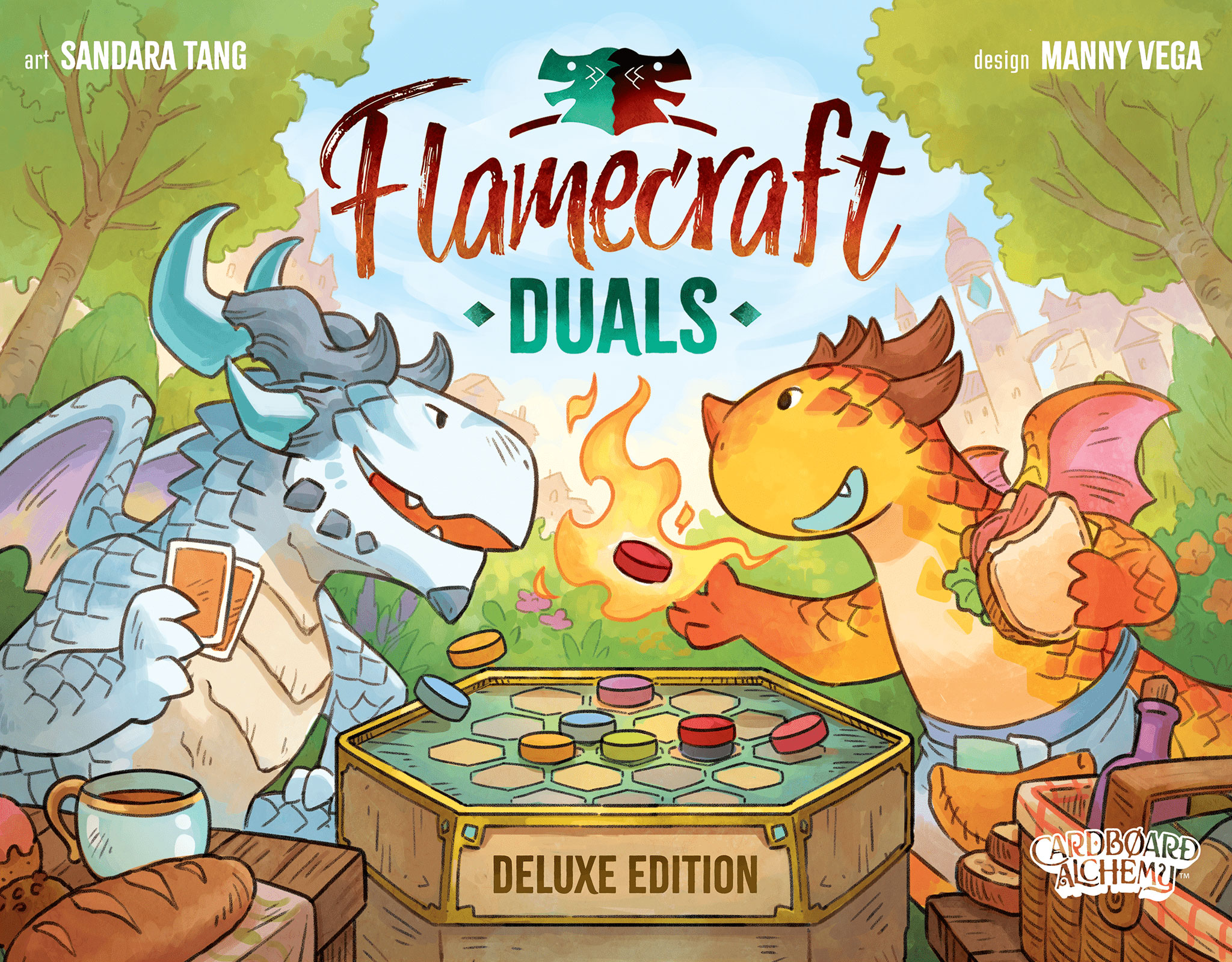
This is the idea that fueled 2022’s medium-weight Eurogame Flamecraft, where crafty dragons are employed in a variety of shops helping to fire everything from bratwursts and bread to horseshoes. Now, Flamecraft’s artisanal dragons have returned in the 1-2 player 2025 abstract sequel Flamecraft Duals, which plays in about 30 minutes. Sandara Tang has kept the artwork similarly adorable and whimsical. Will the game design by Manny Vega bring the heat?
Gameplay Overview:
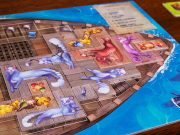
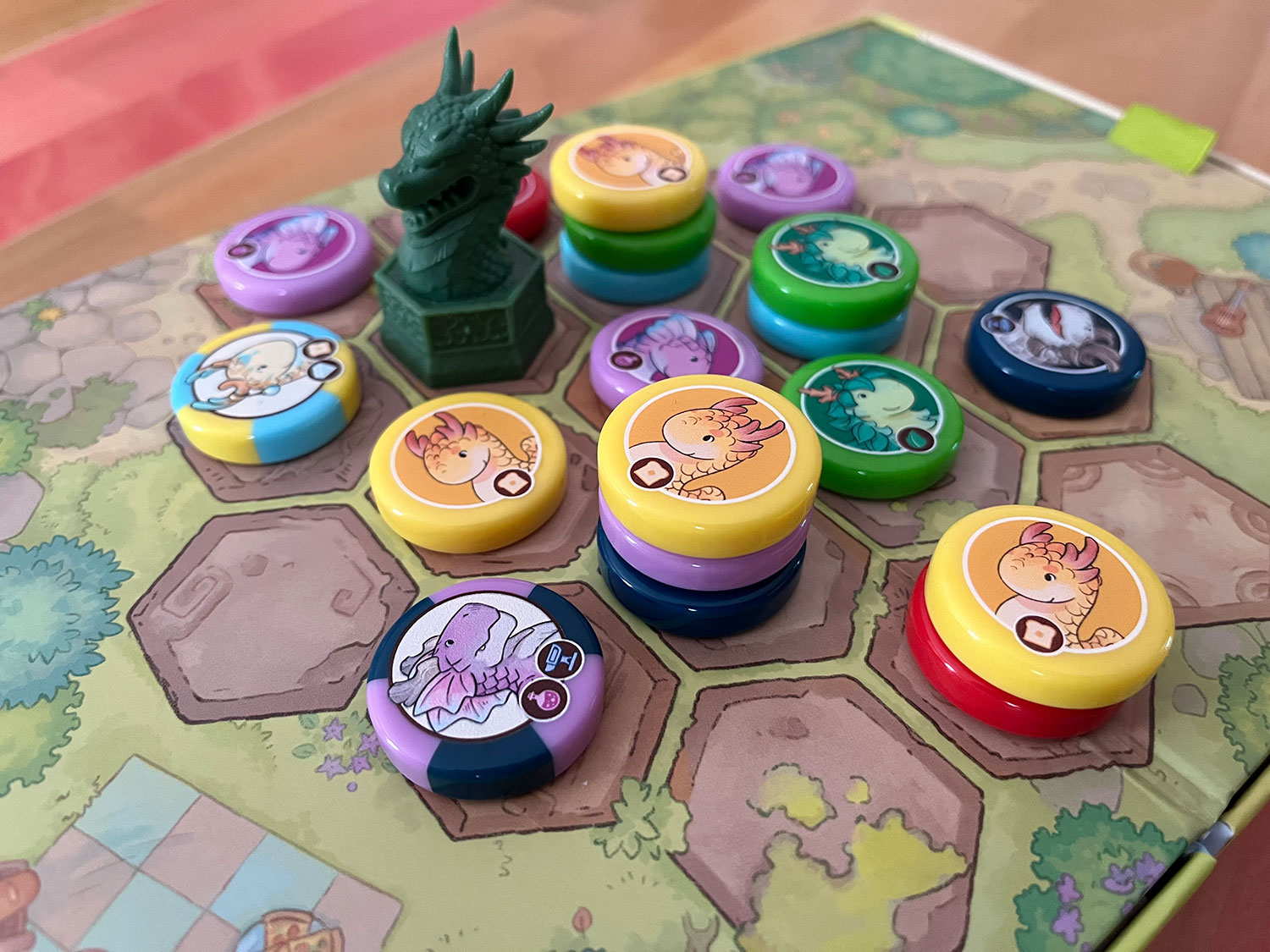
Dragons of six types (bread, crystal, meat, iron, potion, and plant) are represented on colorful tokens, and to start, one of each will be randomly positioned on the shared board.
Each player will start with two random secret shop cards depicting a particular arrangement of 3 dragon tokens needed for fulfillment.
Players will alternate taking turns as follows:
- Draw a new dragon token randomly from a bag
- Place this token on any open space of the shared board or atop any existing dragon token, so long as that stack remains within the 3-token height limit
- Fire up the token just placed by activating its dragon’s ability. Abilities generally involve moving tokens around the shared board in specified ways or playing additional tokens.
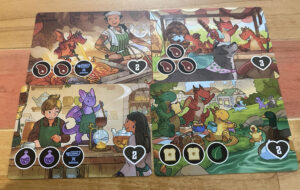
A sampling of shop cards, each with unique artwork, is shown here. Each card depicts desired patterns for scoring (bottom left) consisting of three total tokens arranged in a line or triangle. - If the patterns on any of your shop cards match the arrangements of top-most tokens on the board, you may add them to your score pile and replace them with new shops.
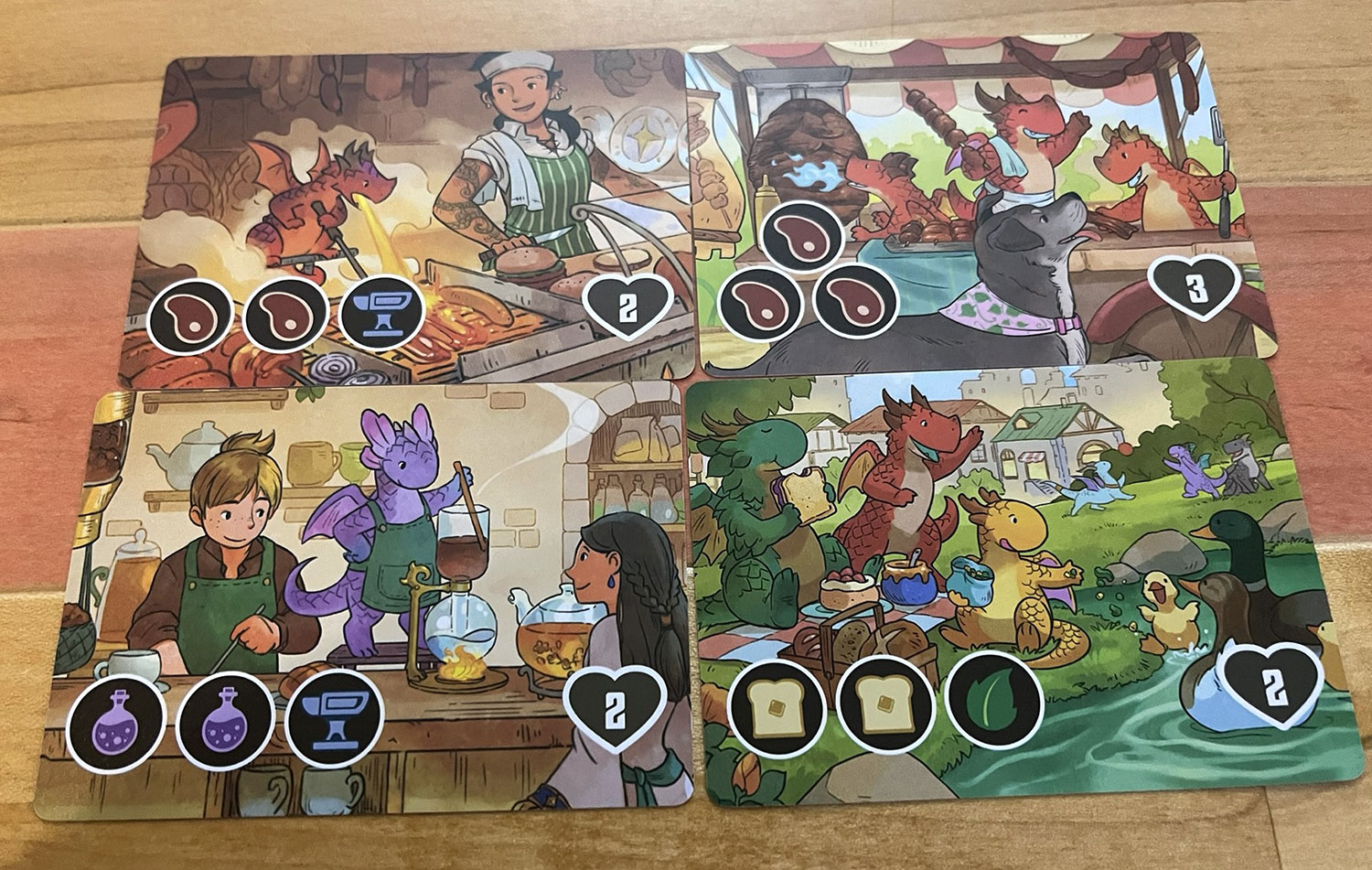
Each player starts with 3 coins, and on any turn, you may trade one of these to exchange your existing shops for new ones. Remaining coins at game-end are worth 1 point each.
The game ends when the last token is drawn from the bag, or the deck of shop cards runs out.
Sum up points from shops in your score pile (2 or 3 each) + leftover coins to determine the winner.
Game Experience:
Unlike Splendor Duel and Yokohama Duel, Flamecraft Duals represents a major departure from its parent game from a mechanics perspective. While the artisanal dragon theme has been wonderfully carried over from Flamecraft, including fantastically colorful artwork on each of its 42 unique shop cards, that’s about where the similarities stop. Flamecraft Duals is a pure abstract game. Players have specific, secret, token arrangements they’re attempting to create on the shared map as efficiently as possible through a combination of clever placements and movements of various tokens.
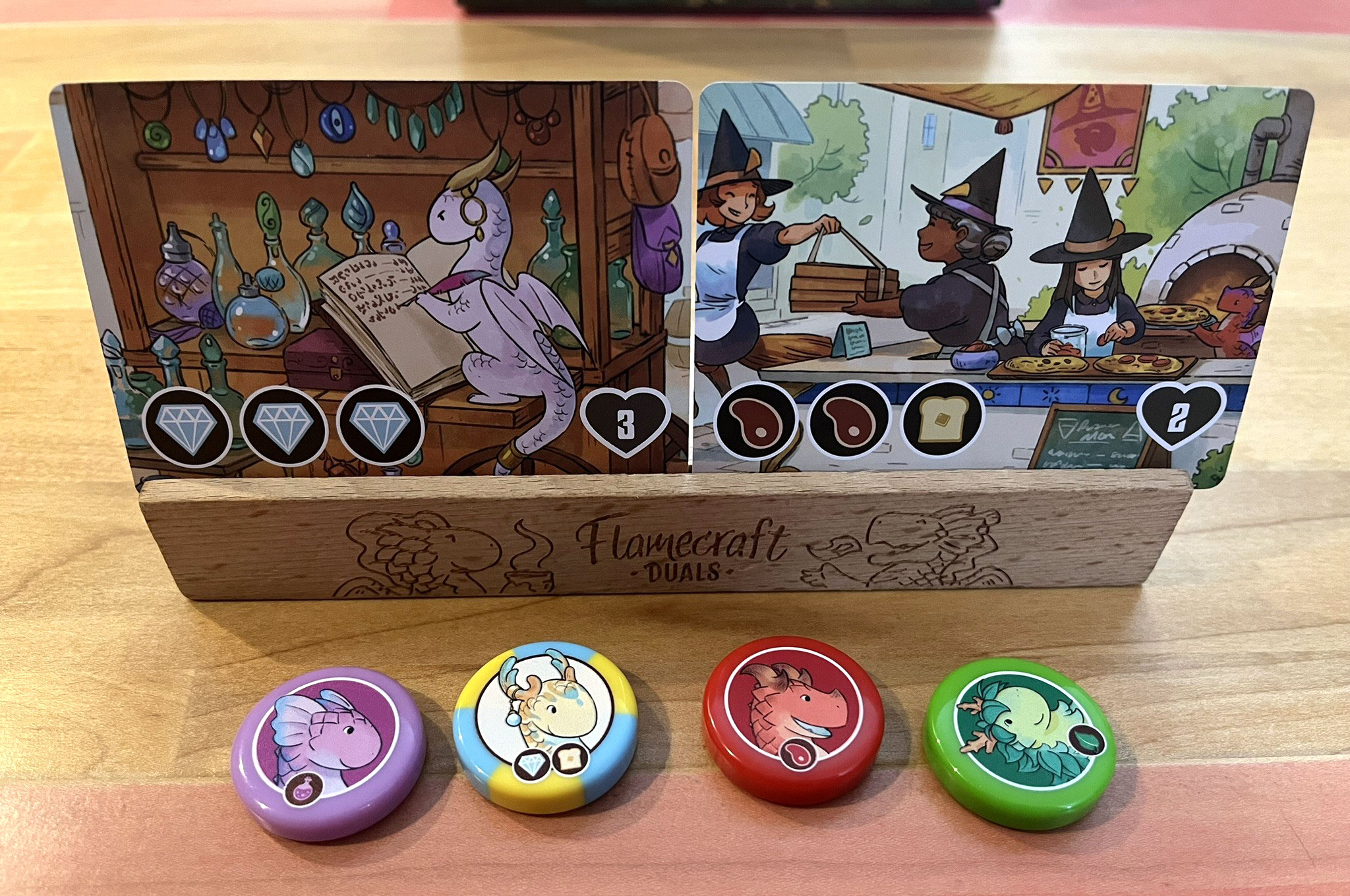
Though the token you’ll draw each turn is random, there are several layers of decision-making associated with its placement. If said token matches one needed for your shop pattern, you’ll probably want to place it in a spot adjacent to other tokens required for that pattern. Depending on that token’s dragon ability, you may also desire other token adjacencies. For example, iron tokens allow you to move 2 adjacent tokens 1 space each. Meat tokens let you move 1 adjacent token to any space. Plant tokens let you fire up any 1 adjacent dragon to use its special ability. Note: some abilities function without any special adjacencies, like the potion, which lets you swap any 2 dragons. With a combination of clever initial placement and smart manipulation of other tokens, you should aim to accomplish at least 1, if not 2, shop cards every turn.
It should be noted that luck will play some role in your ability to efficiently fulfill shop cards. Early game, the tokens you need may simply not be available yet; maybe you need 3 bread dragons in a row, but there are only 2 currently available on the board. Or maybe the third bread token is currently buried under another, and instead of drawing a dragon that could let you unbury it, you simply draw a crystal dragon, which only lets you draw 3 new random dragons and place 1 (without firing). If none of those 3 are bread, you won’t be fulfilling that shop pattern this round.
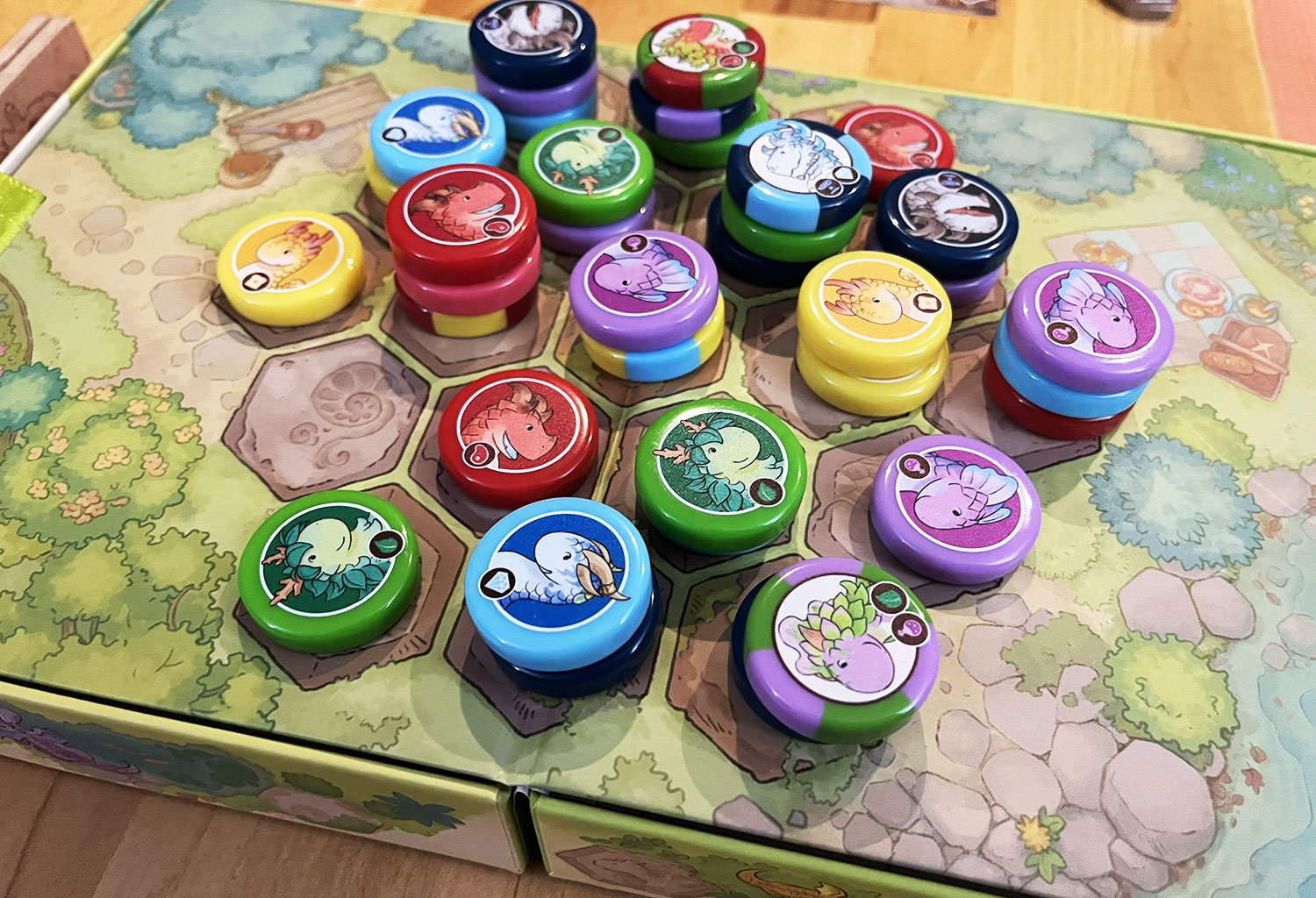
The other major luck element comes from your opponent’s actions. Since the shop cards are kept secret, your opponent never knows what token arrangements you’re attempting to achieve. On any given turn, it’s possible they randomly create one of your patterns for you. Alternatively, they might accidentally break apart or bury tokens that were already perfectly placed and part of a nearly completed shop arrangement that will now take you several turns to re-create. In the basic version of the game, both of these scenarios happened quite a bit, such that I considered the game a major luck-fest and was ready to score it relatively low.
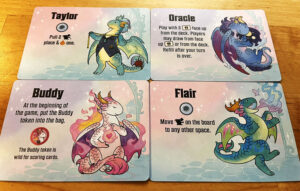
This is where the modules come into play. Fancy Mode allows players to choose 2 among 8 available “fancy cards” to tweak some of the gameplay rules. Many of these are rather minor rule tweaks. My hands-down favorite is the Oracle, which creates a 2-card face-up market of shop cards, so there’s an element of choice when grabbing new shops, and more importantly, knowledge of your opponent’s shop requirements allows for gameplay that is less random and more strategic. My other favorites are Trinity, which allows players to have 3 shop cards at a time, and Buddy, which introduces a single wild dragon token to the bag.
The Fountain is another module which starts the game with 6 neutral fountain cards, each worth 3 points, and each requiring four linear adjacent repeats of one type of dragon (ex., 4 irons in a row). When a Fountain pattern has been achieved, a Fountain miniature must be placed on the board, resulting in the removal of all tokens in that spot back into the bag, and the active player getting to choose one token to keep for their next turn. The combination of the Fountain and the Fancy modules makes Flamecraft Duals a much more thinky and open-information experience.
In the base game, achieving one shop pattern per turn is usually pretty straightforward and doesn’t require much creativity. With the open information of the modules, on a good turn you might be hoping to achieve 2-3 shop/fountain cards, while simultaneously placing tokens such that it makes it more difficult for your opponent to achieve their desired shops on their turn. You can play offense and defense all at once, solving for multiple desired board states, which can actually be a bit AP-inducing. Sure, luck can still play a role with these advanced modules, but it becomes much more of a skill-based game over the length of the game.
Final Thoughts:
Flamecraft Duals is a thematic successor to Flamecraft, bringing back the superbly rendered dragon crew crafting a variety of adorably creative foods and wares. The gameplay is pure abstract, involving placing and manipulating colored tokens on a shared board in an effort to achieve specific patterns of tokens. The base game has some interesting decisions but ultimately feels too lucky for this reviewer, as opponents are constantly helping or hindering one another by sheer chance. The option to add in two separate modules helps Flamecraft Duals really take flight, providing potential for a more open-information, thinky gaming experience with more purposeful player interaction. In short, the full Flamecraft Duals package is cute, colorful, and brain-burningly fun.
Final Score: 3.5 stars— An adorable dragon-themed abstract game that sizzles
 Hits:
Hits:
• Modules allow a customizable gaming experience
• Crunchy abstract decisions
• Outstanding production quality of the deluxe
Misses
• Too much luck for some, even with the modules
• Only some of the Fancy dragon cards seem worthwhile
• Player interaction in base game is largely inadvertent