
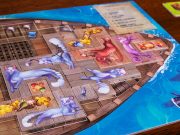
 It’s been a long road, gettin’ from there to here. It’s been a long time, but the time is finally near. I can feel the dream come alive at last. I can touch the sky. No, they’re not gonna hold me down no more, no they’re not gonna change my mind, ’cause I’ve got new Captain’s Chair.
When Star Trek: Captain’s Chair came out in late 2024, the question on everyone’s mind was “where’s Kirk?”. The answer was, in the second stand alone box, To Boldly Go, which was previewed over a year ago. After many revised release dates (that’s the long road I was referring to), our next box of Star Trek: Captain’s Chair is here. As someone who really enjoyed the first set, I was very interested to see if the gameplay held up in an expansion.
Star Trek: Captain’s Chair – To Boldly Go is a game for 1 or 2 players. The rulebook suggests a play time of 1-2 hours, and since it is a complex/crunchy game, I’ve found that to be fairly accurate. It is a standalone game, so you do not need a copy of the original set to play.
Gameplay Overview:
Before getting to the review proper, I’d like to apologize to the designer, should he ever read this. As a big Star Trek II: Wrath of Khan fan watching the VHS till it nearly broke back in the 90s, against your advice, Khan was my first game with the set. It was a combination of the Titanic and the Hindenburg. Others who read this, be warned. Back to the review!
If you’ve read Tony’s review of the original Captain’s Chair, much of this will be familiar to you. The game is a heavy deck-building game which can be played against 1 (and only 1) opponent or against various difficulty levels of bot as a solo game. The goal is “simply” to have the highest score between your cards, completed missions, and Glory tokens. Thematically, the game is a simulator set in the 31st century at Starfleet Academy, loaded with many great captains, aliens, and technology from history, and the whole thing is a training exercise.
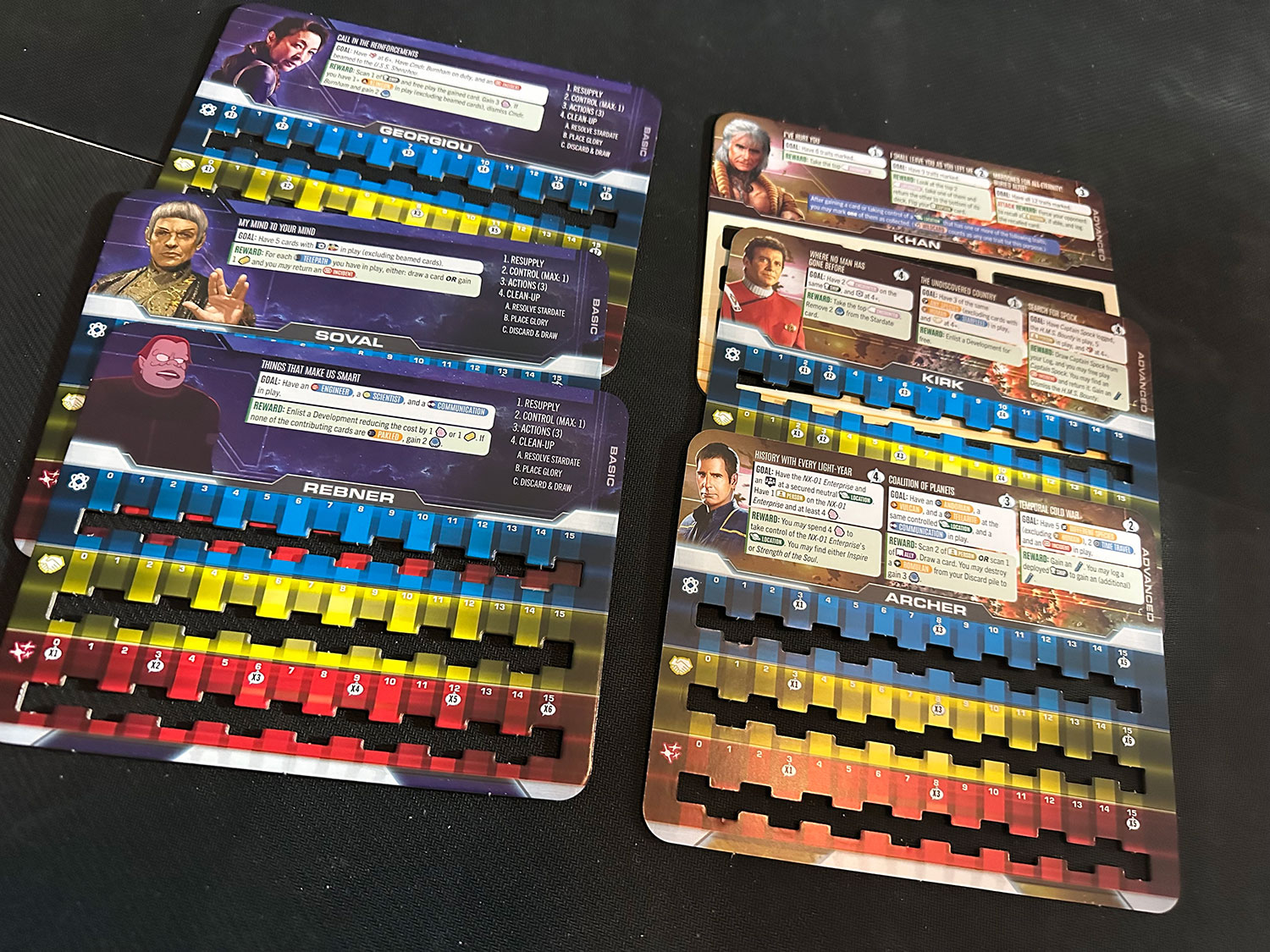
Like the first set, there are 6 captains from across the franchise. In this set that’s: Rebner, Phillipa Georgiou, Soval, Jonathan Archer, James T. Kirk, and Khaaaaaaaaaaaannn. Each captain starts with a unique deck and possibly a ship already deployed. You add cards to your deck and play area (a tableau of cards that won’t return to your deck immediately) from both a central market and a neutral zone of planets that you jostle for control of, all while attempting to complete your captain’s unique missions.
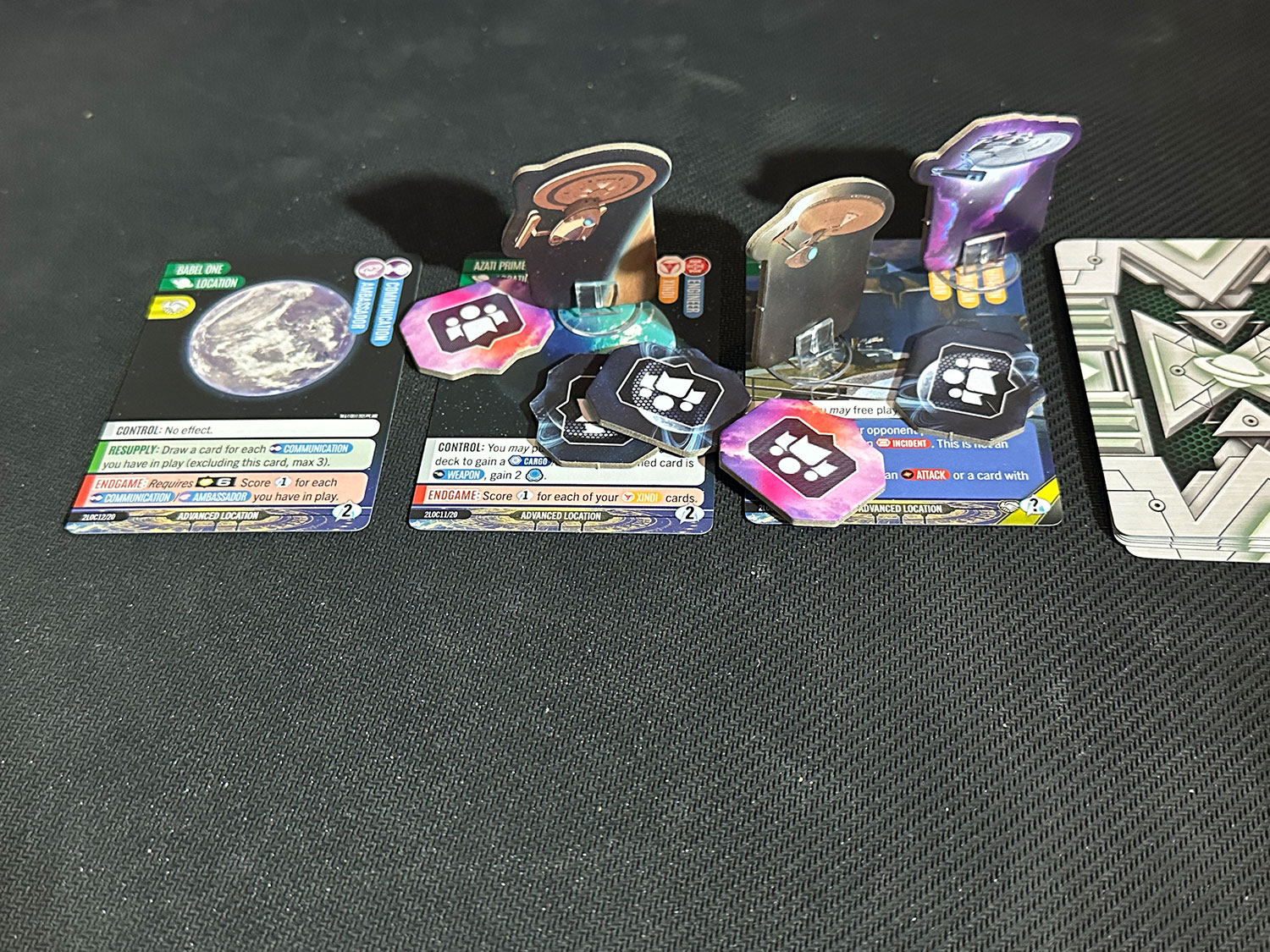
Each turn begins with the Resupply step, where you carry out any Resupply operations on cards in your play area. Often this step is skipped, as not all cards have Resupply text. Following any Resupply operations is the Control step. You check if you have secured any locations in the neutral zone with your ships and/or away teams, and if so, take control of one such location. Locations typically have a one-time bonus for controlling them. After resolving the Control step, it’s time for the meat of the turn: the Action step.
During the Action step, you have 3 action tokens (shaped like isolinear chips). Most cards have play operations; some of which are free, and some of which require your action tokens. These play operations are the effects you use when you play a card from your hand. These effects can do many things, from sending Away Teams, gaining resources such as Latinum, or even gaining cards or Incidents. Notably, if a card has other effects that are prefaced by a different word (such as “ACTIVATION:” or “PASSIVE:”) you do not get those effects, only the Play effect.
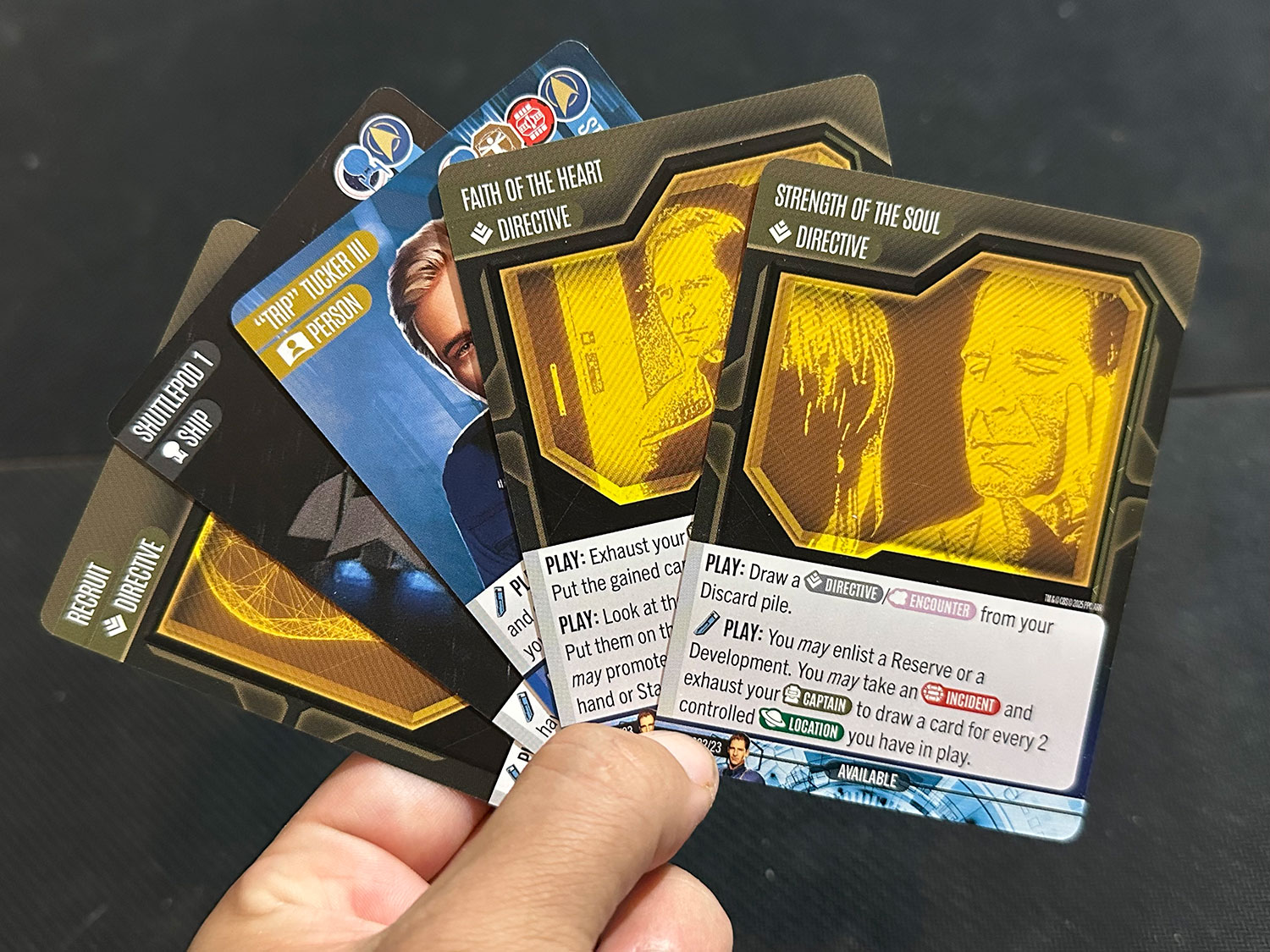
Other card effects, typically in a blue box, are called table operations. You only get these effects when the card is in play, allowing you to exhaust it once per turn for a listed activation effect. Many captains will have an Activation (they are always in play), and most locations and ships do as well once they are controlled or deployed. Other card types need some other way to stay in play to be able to use their activation effects. Rarely, they have an ongoing trait which leaves them in play for an indefinite period of time. More often, Person cards can be promoted to Duty Officer (usually with the aid of your starting ship’s table operations).
After you’ve run out of action tokens and/or cards (or do not want to take any further actions), the turn ends with a Cleanup step. You can discard any cards remaining in your hand if you choose, but do not have to, unlike many deck-building games; and you must discard all cards in your play area that are not a duty officer, ship, location, or have the ongoing trait. Then, draw back to your max hand size, remove a Glory from the current Stardate card (the game’s timer), ready your cards/action tokens, and pass the turn. Players (or bots) alternate turns until the last Stardate card is exhausted. Since any Glory gained by players during the game comes from the Stardate card, the number of turns is variable based on player actions.
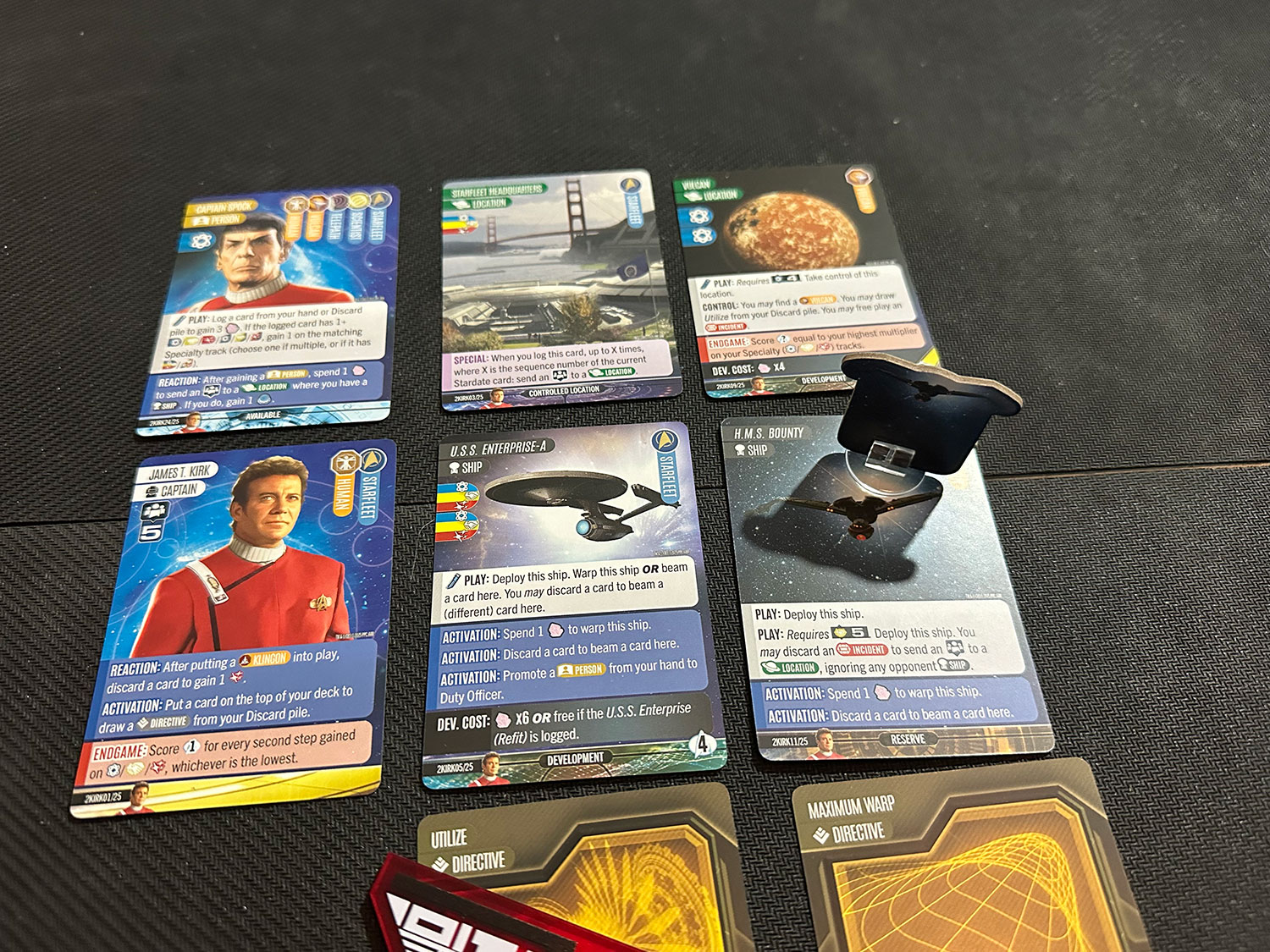
Game Experience:
Phew! That was a lot. This is a complex game. The first few times I played it, I did not know what was going on entirely, and things didn’t really click for me until I’d been able to play a captain a couple of times. Once I understood a captain, it got really interesting. Whether you’re playing with Kirk or Georgiou or whomever, you’re playing the same game under the same rules… but when you understand the basics, you see that they take advantage of those rules differently. Sometimes when I was first looking at a captain deck, even understanding the game from having played the first set, what role a card was supposed to play in a new captain’s deck wasn’t clear at first. As I got more familiar with each of the captains, though, I started to see how each card has some role to play in what that captain wants from the game, and helps them complete their unique objectives.
I’ve mentioned it a couple of times now: captains each have unique missions they are trying to complete on their captain boards (a single mission on the basic side, and three on the advanced side). These missions are thematically based around the captain’s appearances in the shows (Kirk’s, for example: Where No Man Has Gone Before, Search for Spock, The Undiscovered Country), and usually involve finding certain traits or cards and having them in play, along with a certain amount on one or more of your captain’s 3 specialty tracks (military, influence, research). They are worth a chunk of points and typically will give other bonuses on completion; sometimes even one of the valuable Encounter cards. These missions really guide your strategy, and figuring out how to do one or more of them is a big part of the learning experience with each captain. They are just a goal, though. How you reach that goal isn’t set in stone. Captains have multiple pathways to getting to where they want to go, so even once you figure out a captain, it’s not an on-rails experience. You have a lot of agency in how you achieve your missions and what to do along the way, as well as how to deal with the game state as it progresses.
Your missions aren’t your only endgame goal. Each captain has development cards that can be a big boost to your deck as well. Every time you have to reshuffle your deck, you add a card to your deck first from your Reserve deck (unique cards similar in power to your starter cards), and then from your developments once your Reserve is exhausted. Developments usually cost Dilithium and/or Latinum (resources you gain during the game), though they can have thematic text as well. The Enterprise-A costs 6 Dilithium, but is free if the Enterprise has been logged (my god, Bones, what have I done???). These can generally be enlisted in any order, depending on your strategy. Knowing which developments to enlist and in what order is a key part of each captain, especially if you are able to get an early enlistment, as in addition to being good for scoring, they will usually help further your missions.
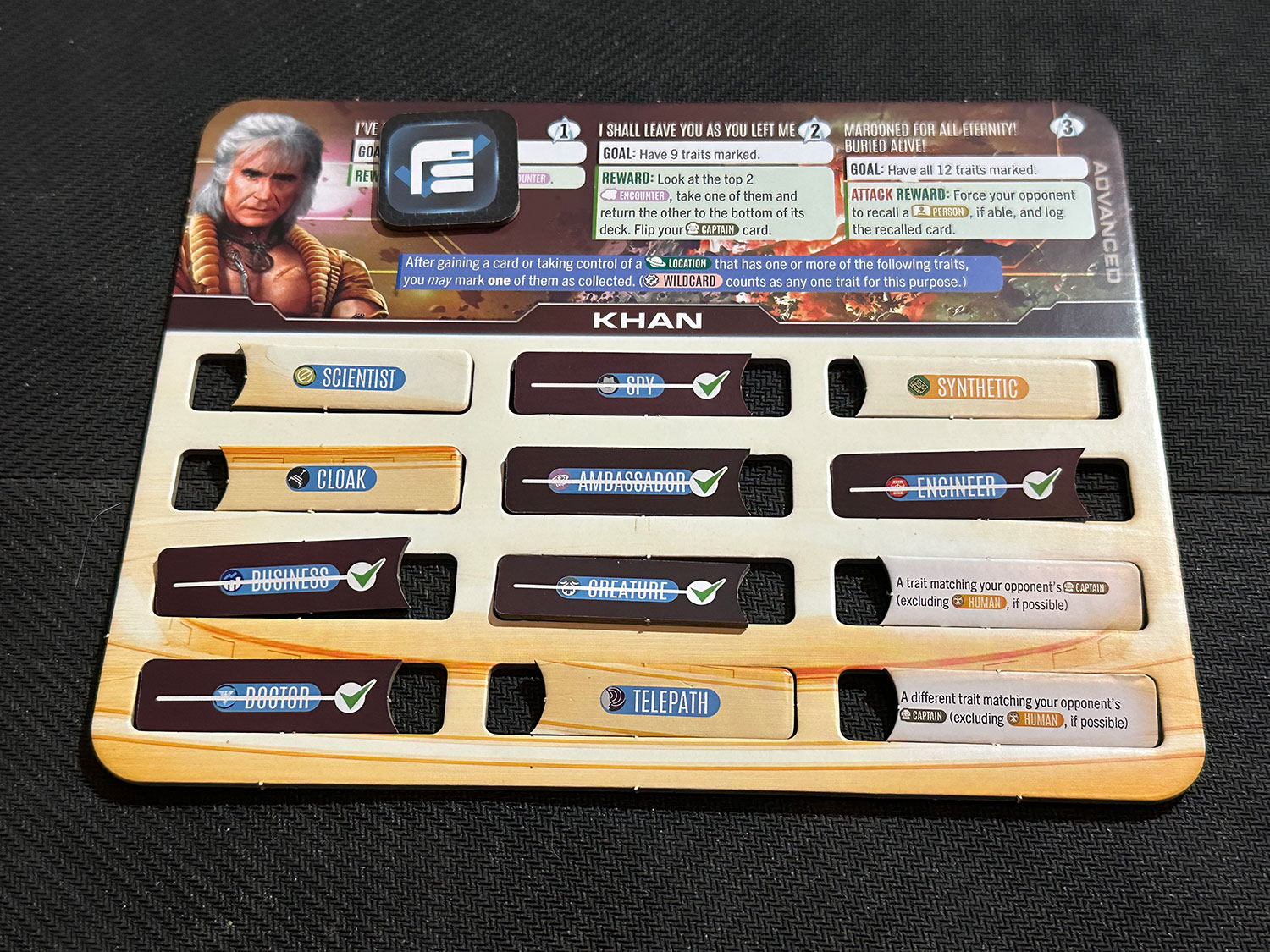
As I alluded to early on, not all captains are created equal. Each captain has a complexity rating from 1 to 10. This box skews a bit higher than the first due to Rebner and Khan. These ratings aren’t the gospel by any means, as sometimes a lower complexity captain’s style just doesn’t work for you, and a higher complexity captain might click for you. They are, however, a useful guide. The higher complexity captains do tend to subvert your expectations of the game. I’d played a lot of the first box, and Khan was certainly a wild ride. He has a lot of incidents, really struggles to contest the neutral zone early on, and does something completely different with missions and specialty tracks—that is, he has no specialty tracks. Don’t be like me. Don’t start with Khan.
Given all the ins and outs of every captain, one of the big pluses of this game is that there is a bot-less cadet mode on which to practice, as well as multiple levels of difficulty of the unique bot rules. The cadet mode is not a way I would choose to play the game consistently, but it is a great way to learn how each captain interacts with the game. The bot mode, however, is excellent for replay value. Each opposing captain has their own unique bot instructions, so facing Picard Bot is different than facing Khan Bot. It can also be as challenging or as laid back as you’d like, with different levels ranging from Ensign to Admiral.
Final Thoughts:
This game has a lot going on. I know I’ve called it complex a few times, but I don’t think that tells the full story. It is complex, but it also isn’t really all that hard to understand. You have a limited number of cards and actions to complete your missions and get as much Glory as you can every turn. It does take a little bit to see how things work, but the actions you’re doing are actually pretty simple. Once you get into it, it flows really well. It is not a light game, to be sure, but I wouldn’t want to put anyone off with the talk of complexity, because once you learn it it’s a good game, and learning other captains is simpler than the first (except Khan…). The rulebook does look like it has been improved compared to the original, though it’s certainly not perfect. Rulebooks truly are hard.
As a Star Trek fan, I can tell that the designers are also fans. Thematically, everything is really well thought-out, and you can see what the references are. Soval isn’t great militarily (at least early on), but is great at diplomacy—the opposite of his frenemy in box 1, Shran. Archer uniquely has to recruit his crew out of the market instead of having them all in his starting and Reserve cards, as he had to do in the premiere of Enterprise. And, of course, Rebner likes Helmets. Especially big ones.
Having extensively played the first box, To Boldly Go offers a different experience, but if you’ve never played the game at all, it is still a good place to start. On the other hand, if you have played the original set, the captains here are all significantly different than those 6, so it is worth the time from that perspective as well.
My biggest criticism is: where’s Janeway?
Final Score: 4.5 Stars – A heavy game with a lot of replayability that also has many strategic choices and paths to victory. A home run when it comes to Star Trek theme.
 Hits:
• Each captain plays differently and is thematically on-point for that character and the show they originate from.
• There is a huge amount of replay value
• These captain choices are excellent, from the classic (Kirk and Khan) to the unexpected (Georgiou and Rebner); none are a miss.
Misses:
• There are a lot of keywords and iconography that can be quite daunting to keep up with.