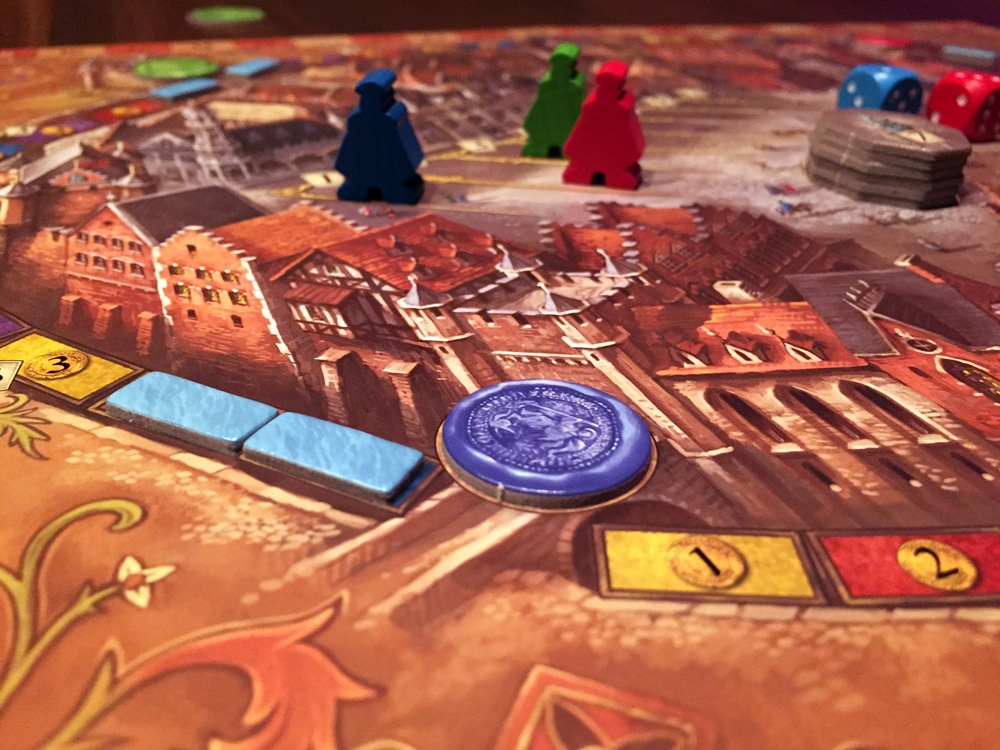
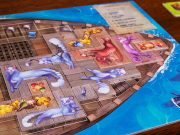
 Yokohama’s debut in 2016 marked it as a rare Japanese-themed board game by a Japanese Designer (Hisashi Hayashi) to qualify as a top 200 game on Board Game Geek. Its primary mechanism of contract fulfillment wasn’t entirely novel, but it brilliantly merged it with mancala-style worker-placement, variable board setup, multiple ways to score, and just the right level of player interaction in a medium-weight Eurogame.
Yokohama’s popularity led to a 2-player “Duel” edition published in 2018, a Roll & Write edition published in 2021, a second edition Yokohama with improved artwork published in 2024, and now a second-edition re-print of the 2-player only Yokohama Duel published in 2025. As someone who already loves and owns Yokohama (2024 edition) and believes it plays wonderfully at 2 players, I had my doubts that the duel version deserved a place on my shelves, especially knowing the beloved mancala mechanism was removed. After just one play, however, I knew it was a keeper.
Gameplay Overview:
Yokohama duel is played over 4 rounds, with players guaranteed 4 turns per round.
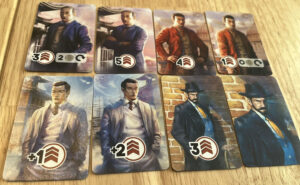
The mancala of original Yokohama has been eliminated in place of “workers” that come in preset values of 1, 2, 3, or 4. On a turn, players must place their lowest available worker in one of 10 available areas to activate its function at a matching power value. Areas are lifted from the original Yokohama and provide the following abilities:
- Acquire or trade resources of varying value
- Acquire technology for in-game engine building or end-game scoring
- Acquire new contracts
- Contribute unique goods to the church for points + rewards
- Flip imported crates for points
There are several methods to enhance the power of activation throughout the game:
- Each worker placement may be enhanced upwards by 1 or 2 power by applying single-use “extra-power” cards
- Any player activating an area with 4 or 5 power-value is entitled to deposit one of their shops or trading houses (for a price) such that future activations of the same location are boosted by +1.
- At each round-end, players may permanently upgrade a single worker by +1 by paying a cost
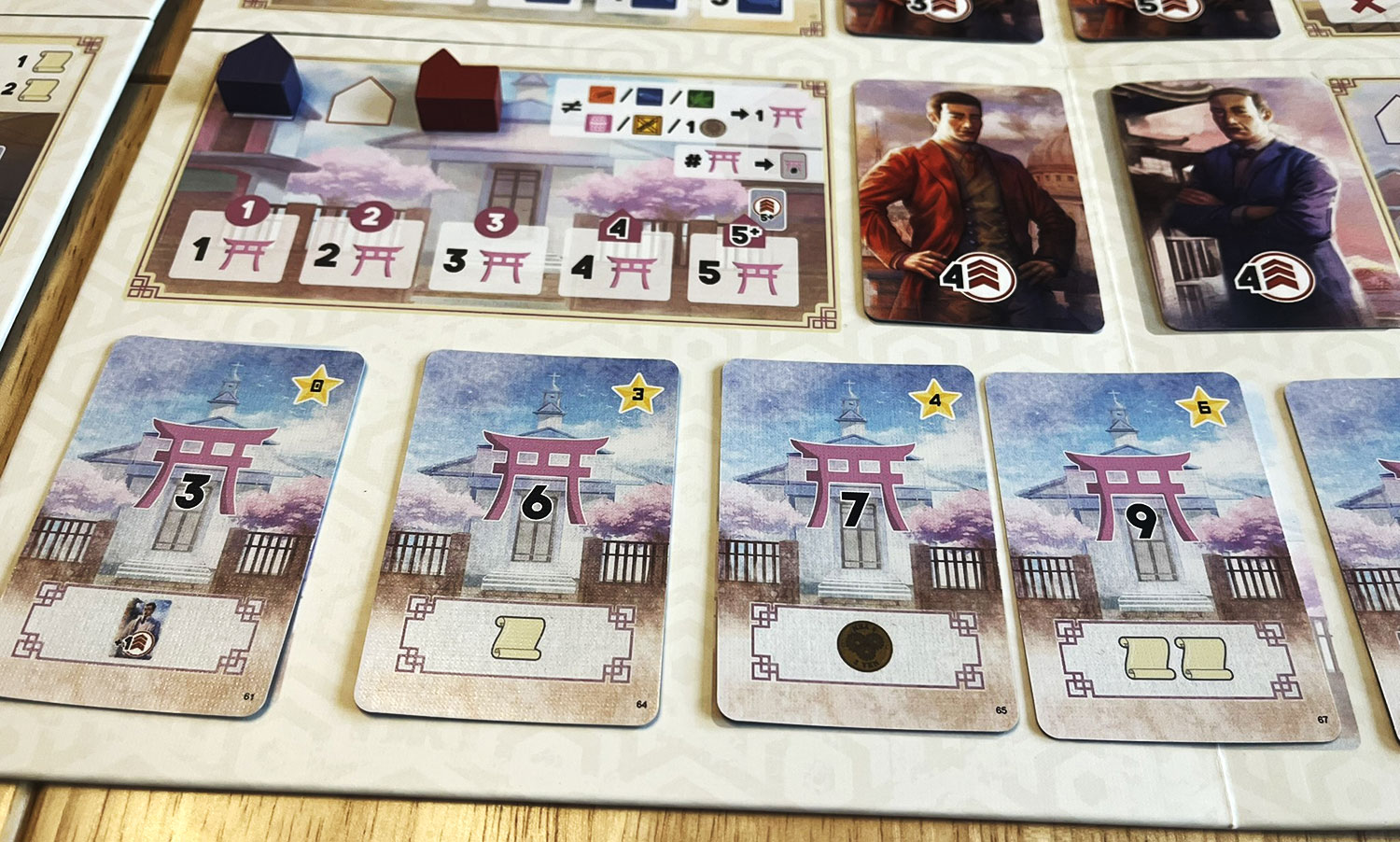
Importantly, all but the technology and contract areas function like traditional worker placement spots; once they’re visited by a worker, other players are blocked from visiting that spot for the remainder of the round.
The exception to this rule is foreign agents, which are used for additional free actions and cannot be blocked from visiting any spot, but they only possess a base power of 3. Foreign agents can be earned by players after they meet various conditions.
After four rounds, players tally up points from fulfilled contracts, flipped crates, church donations, placed buildings, majorities of technology/contracts, and leftover resources to determine the winner.
Game Experience:
Players already familiar with Yokohama will likely think this Duel version possesses similarly excellent gameplay, if somewhat shorter and more streamlined. Those new to Yokohama will be in for a fantastically novel experience of medium-weight Eurogame goodness.
Possessing workers of a range of power values and forcing players to use them in ascending order nicely replicates the feel of gradually increasing power from mancala cube deposition. A key difference is that there’s no longer a need to unlock additional workers (or buildings) through a distinct action, thus streamlining the game.
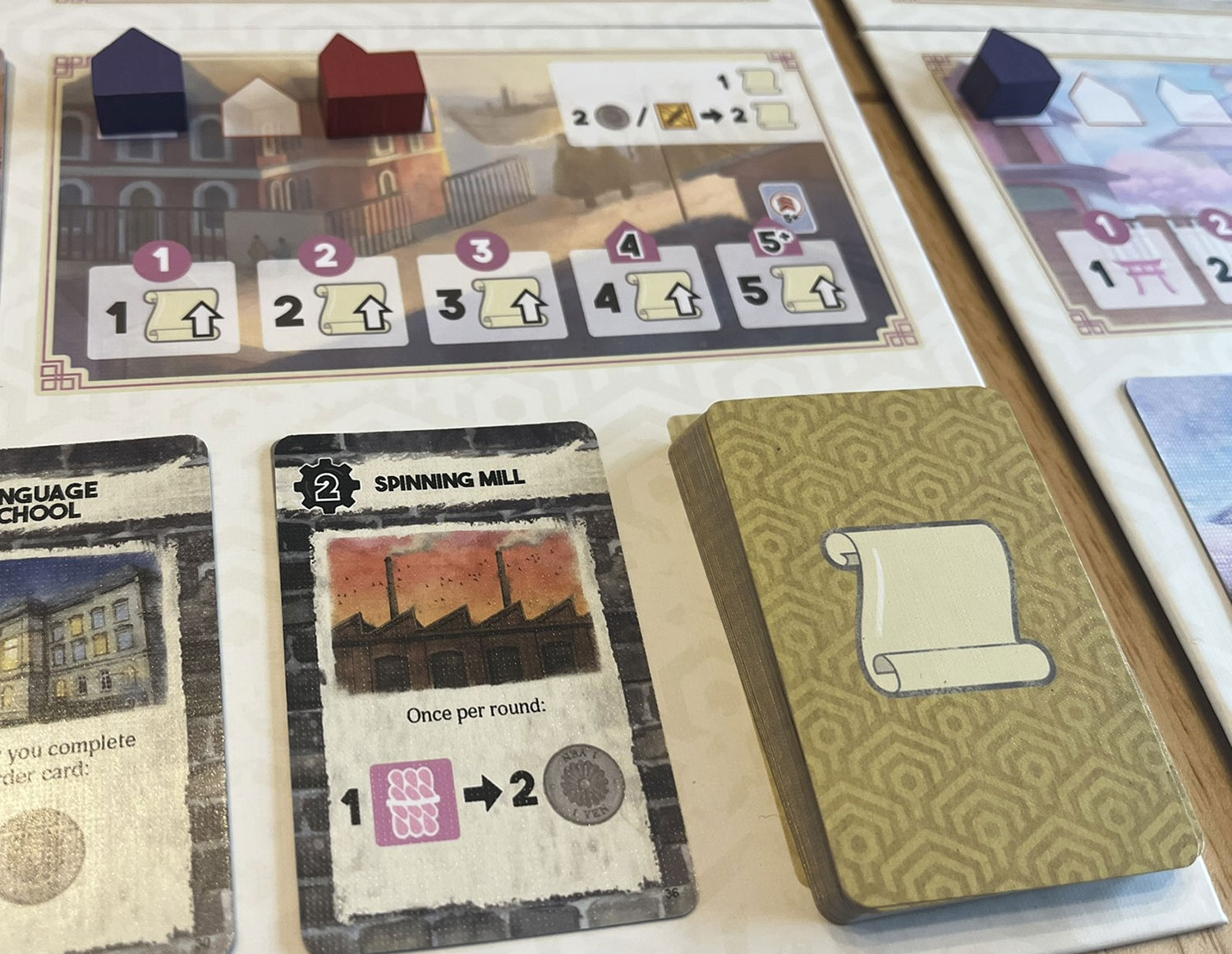
The blocking element creates a very interesting tension here that is much enhanced over that of regular Yokohama at 2 players, where areas are typically only blocked for a single turn. In Duel, if you’re blocked from an area, you’ll be blocked until the next round (up to 4 turns). Say you want four fish to complete two separate contracts. Maybe if you wait until your fourth worker placement (with a power-4 worker) you’ll be blocked from this action completely. An alternative is to visit the fish area a bit earlier with a power-3 worker enhanced with a +1 extra-power card, but maybe that’s wasteful of these rare extra-power cards. Alternatively, you could guarantee yourself two fish by visiting the area with your first turn with a power-2 worker and completing just one contract this round. The game is filled with such trade-offs.
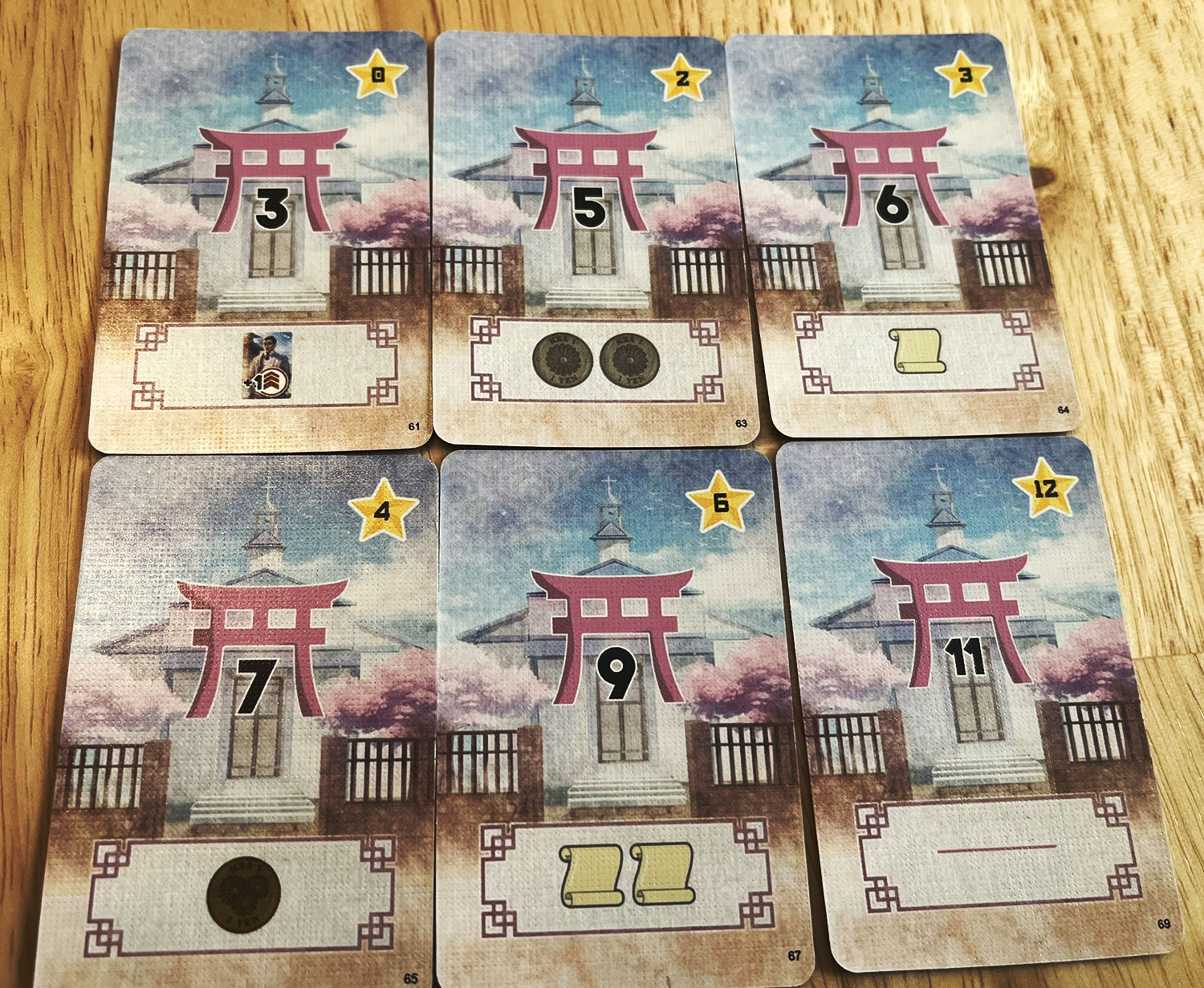
And yet Duel usually prevents your plans from being completely ruined by providing the power-3 foreign agents that cannot be blocked from any location. These agents are limited to 7 total, so they must also be used wisely, and each player can only earn a maximum of four, thus creating a new tension of trying to unlock the agents as quickly as possible. This can be accomplished by completing 3 orders, 2 church donations, 2 crate flips, or obtaining 3 technologies. Thus, players may feel incentivized to seek out lower-value orders/church donations/technologies so they can quickly obtain the 4 agents. Also, unlike in regular Yokohama, where players might completely ignore orders or church donations, these new foreign agent pre-requisites encourage diversification of actions. They also eliminate the somewhat luck-dependent set-collection of country tags present in OG-Yokohama.
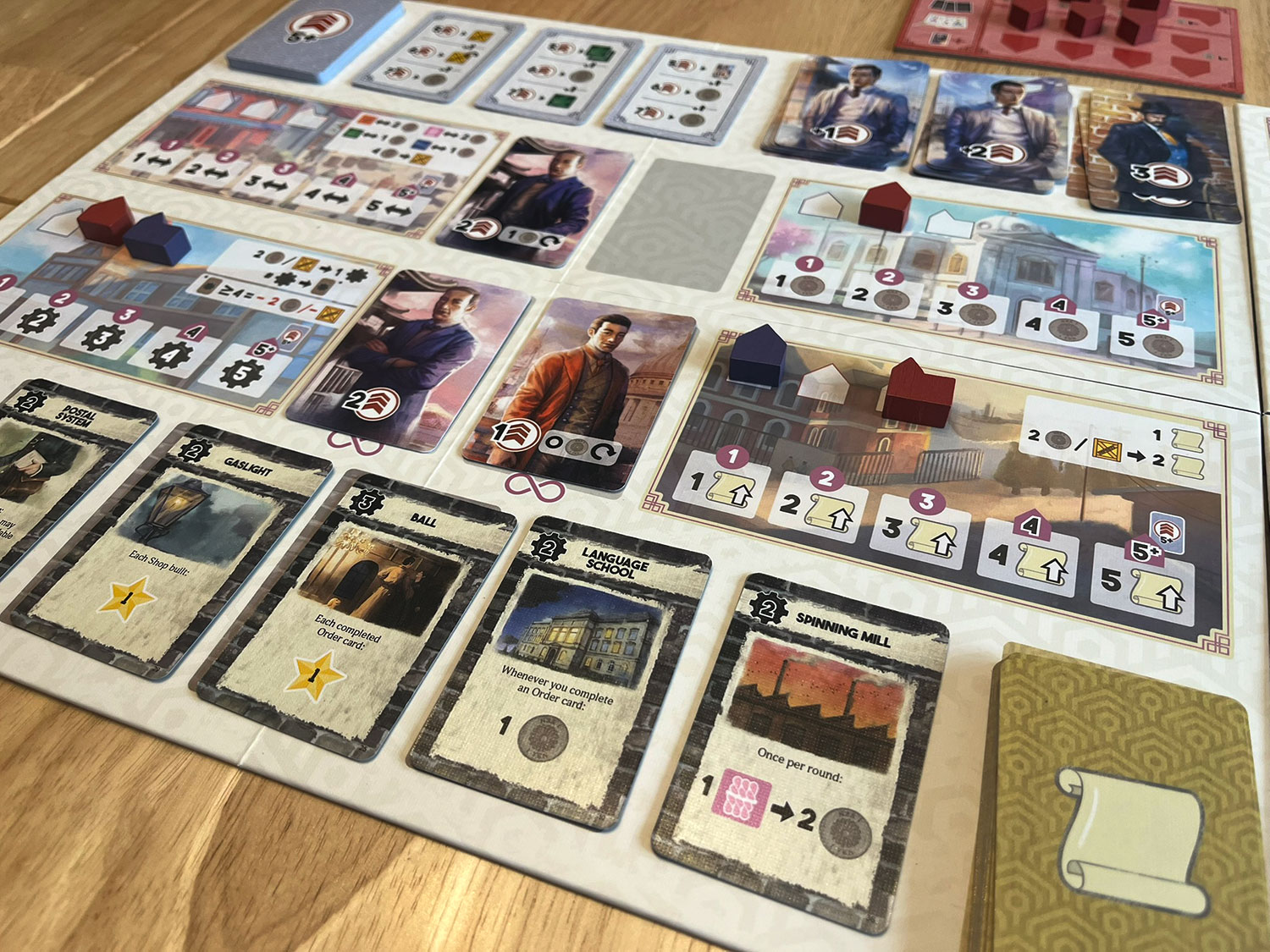
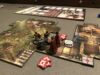
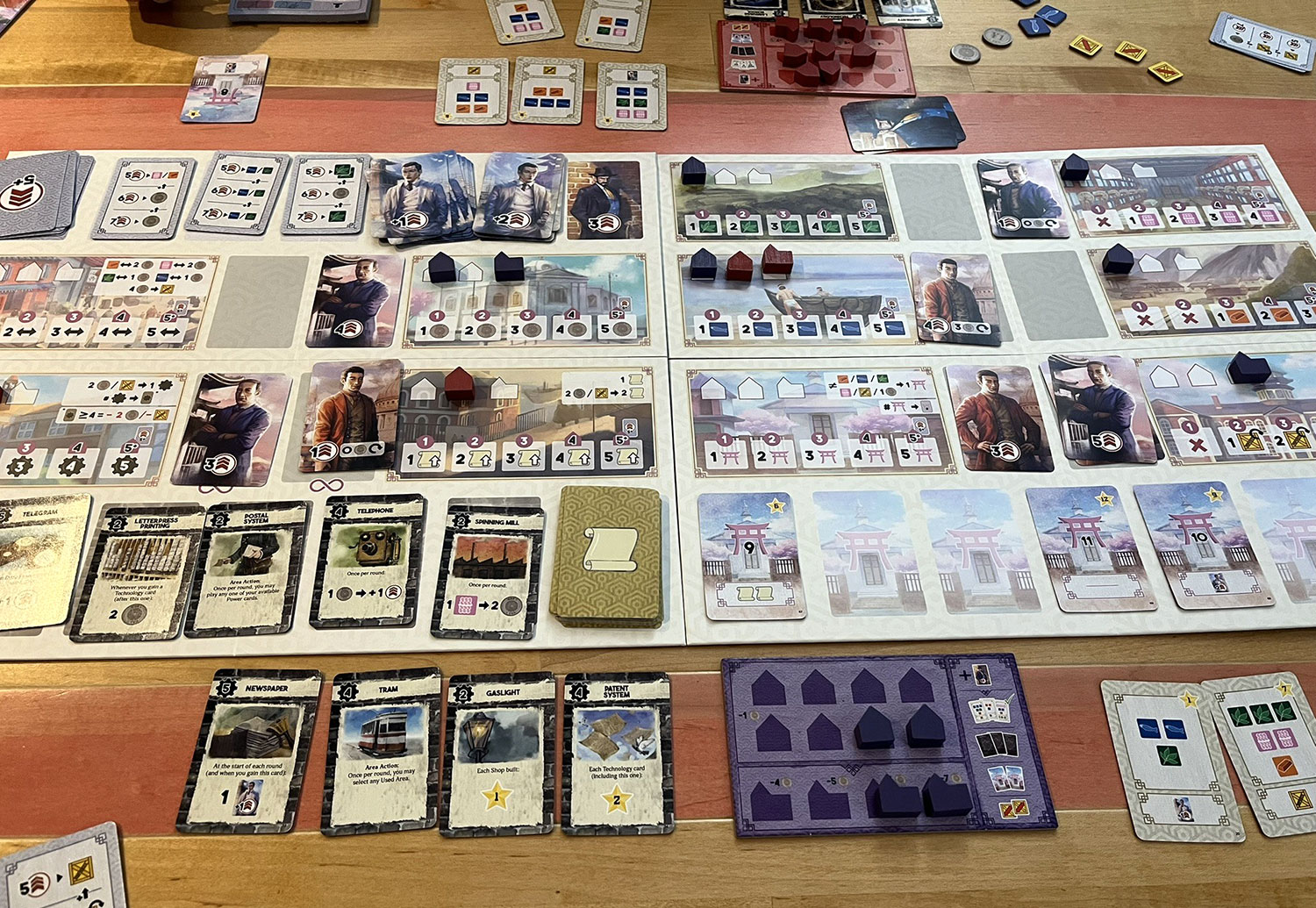
Another change is the presence of a 3-card market for “power bonus” cards. These provide players with bonuses ranging from resources, new contracts, crates, and/or +1 extra-power cards whenever they visit any area at power 5 or above. This ever-present market of potential bonuses can be a huge tactical boon in a game of limited overall turns, so I’m a fan. Finally, the most obvious change is that with the elimination of mancala, the randomized locations of various areas are no longer needed; thus, the game consists of two boards that fold out side-by-side. Set-up is much simpler. Randomization still exists within the available church donation cards, the aforementioned “power bonus cards”, the order in which technologies become available, and the randomly shuffled deck of order cards. Thus, the game still possesses plenty of replay value.
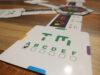
As for critiques, I only have nit-picks, including the questionable choice for the two player colors of purple and red, which are fairly similar, and the “workers” represented by cards showing stern Japanese men, that get lost on a board containing many other cards. Some sort of wooden token or other more exciting-looking option would have been preferred.
Final Thoughts:
Yokohama Duel is an outstanding 2-player only medium-weight engine-building Eurogame with contract fulfillment and worker placement as the central mechanisms. If you already own and love Yokohama, this will feel similar, albeit more streamlined, with a quicker set-up, quicker playtime (45 vs 90 minutes with 2 players), and a substantially smaller box size that’s comparable to 7 Wonders Duel.
The limited number of turns creates an excellent tenseness and increased weight to every decision, even if the game itself is a smidge lighter-weight than its 4-player predecessor. Yokohama deserves the high regard and several reprints in this reviewer’s opinion, and this newest Duel version maintains the superb gameplay while making the game easier to get tabled if 2 players is your primary player-count.
Final Score: 4.5 Stars – it’s a duel for efficient collection and conversion of resources into contracts and donations using variable-powered worker placement
 Hits:
Hits:
• Solid, thinky, and tense Eurogame play
• Smaller, shorter, and more streamlined than regular Yokohama
• Great replay value
Misses:
• Workers as cards is somewhat boring
• Theme is somewhat lacking