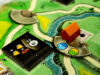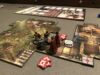
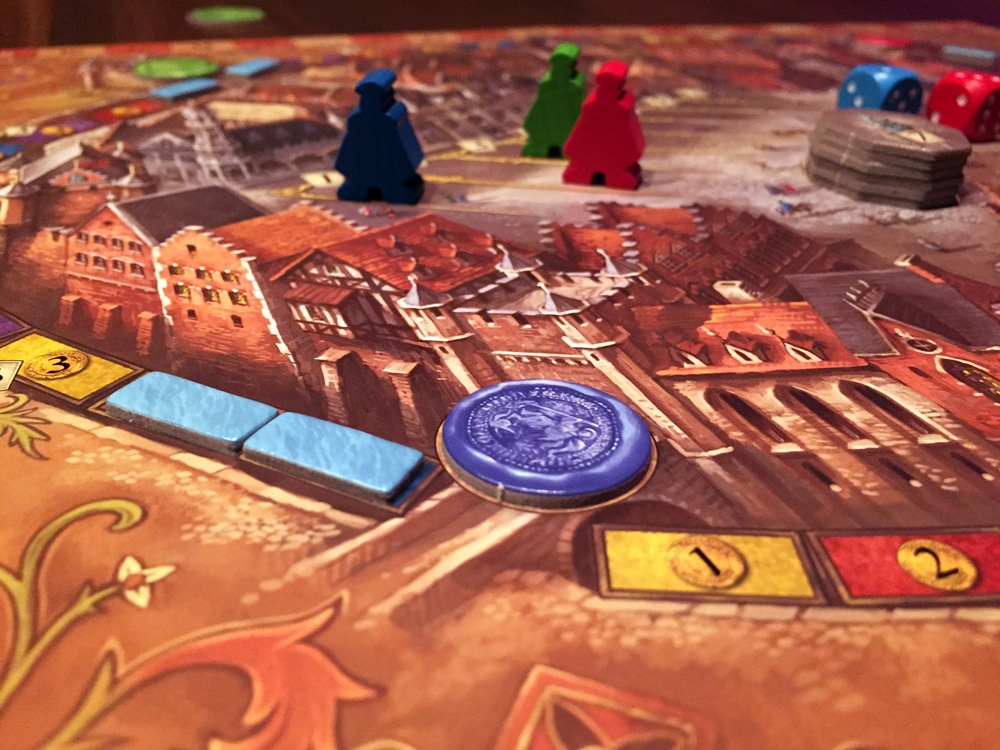

 Everdell is a medium-weight city-building game that has garnered great attention and popularity owing to its solid worker placement/engine-building design (James Wilson), the fun toy-factor of squishy berry resources, and also its evocative artwork by Andrew Bosley replete with adorable anthropomorphic animal critters. City building is just so much more fun when the post office is run by a postal pigeon, and your storehouse is the hollow of a tree managed by a squirrel.
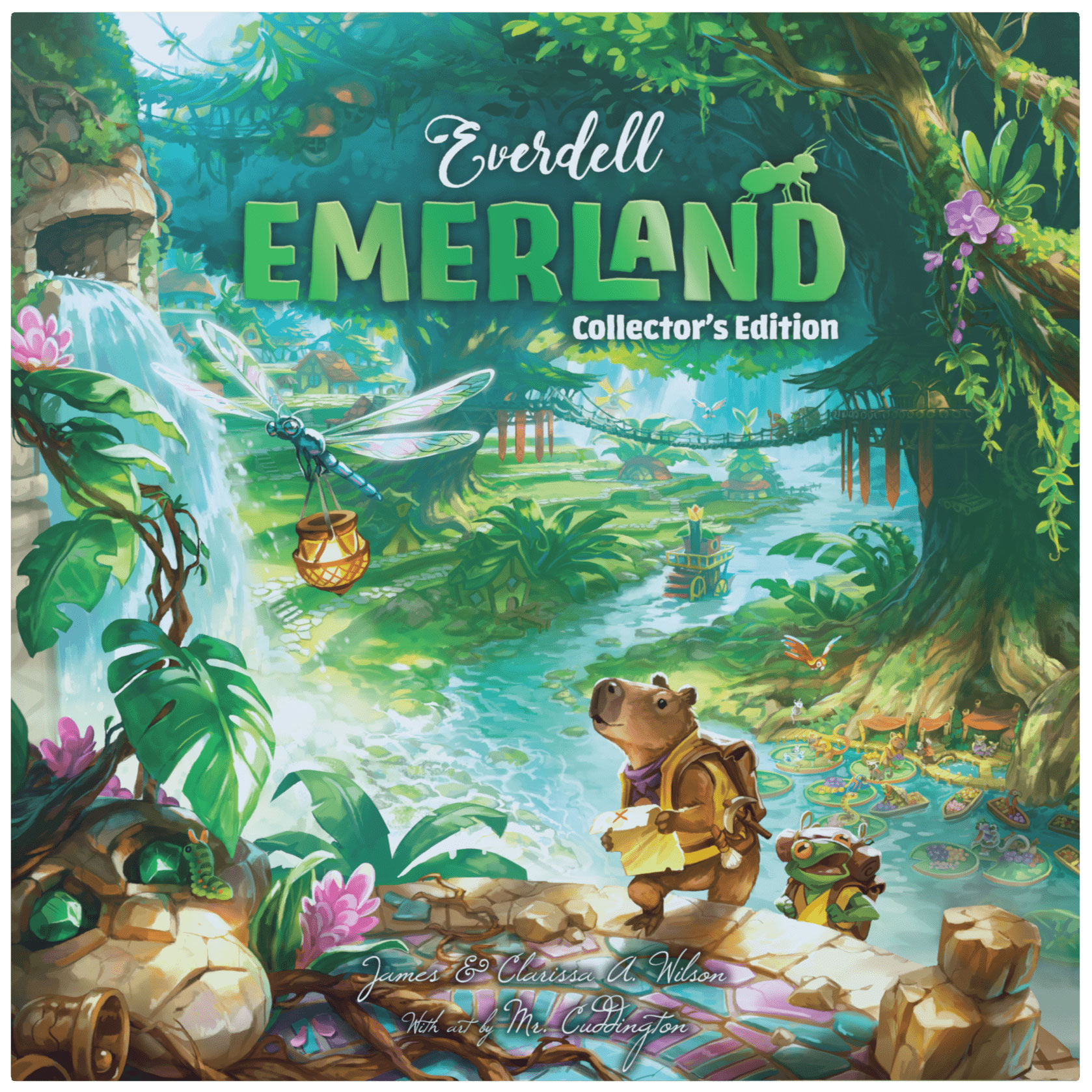
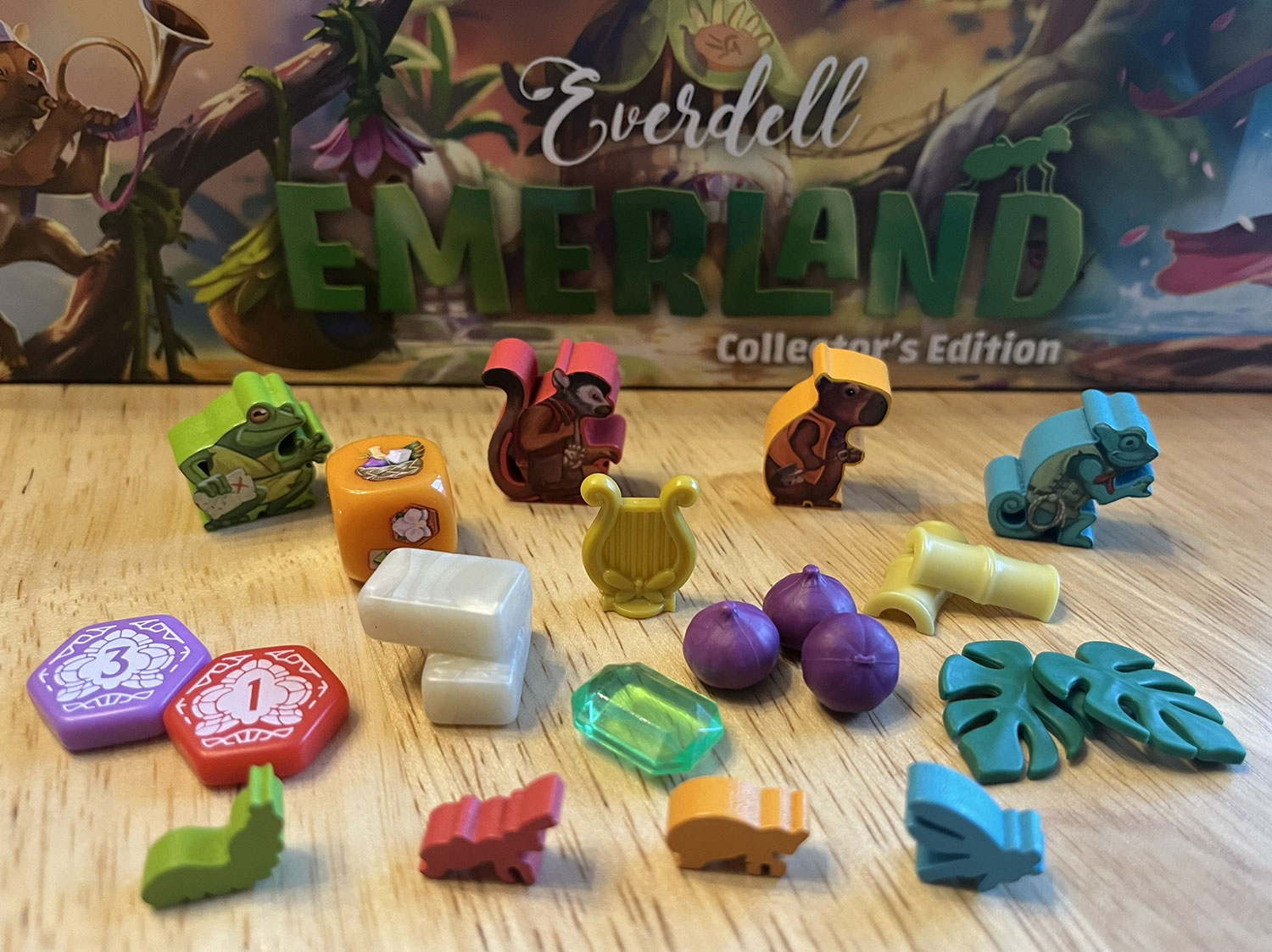
Everdell’s popularity (currently #46 overall on BGG) has led to a slew of expansions and spiritual successors, the latest of which is Everdell: Emerland. Set in the tropical jungle adjacent to Everdell, Emerland is a somewhat heavier stand-alone game for 1-4 players that introduces archeological exploration, upgradeable double-sided cards, as well as a twist on worker placement by introducing helper bugs. That’s right, the art team of Lina Cossette and David Forest was tasked with making bugs cute, and shockingly to this squeamish reviewer, they succeeded. Is the game design by James and Clarissa Wilson similarly excellent? Read on to find out.
Gameplay Overview:
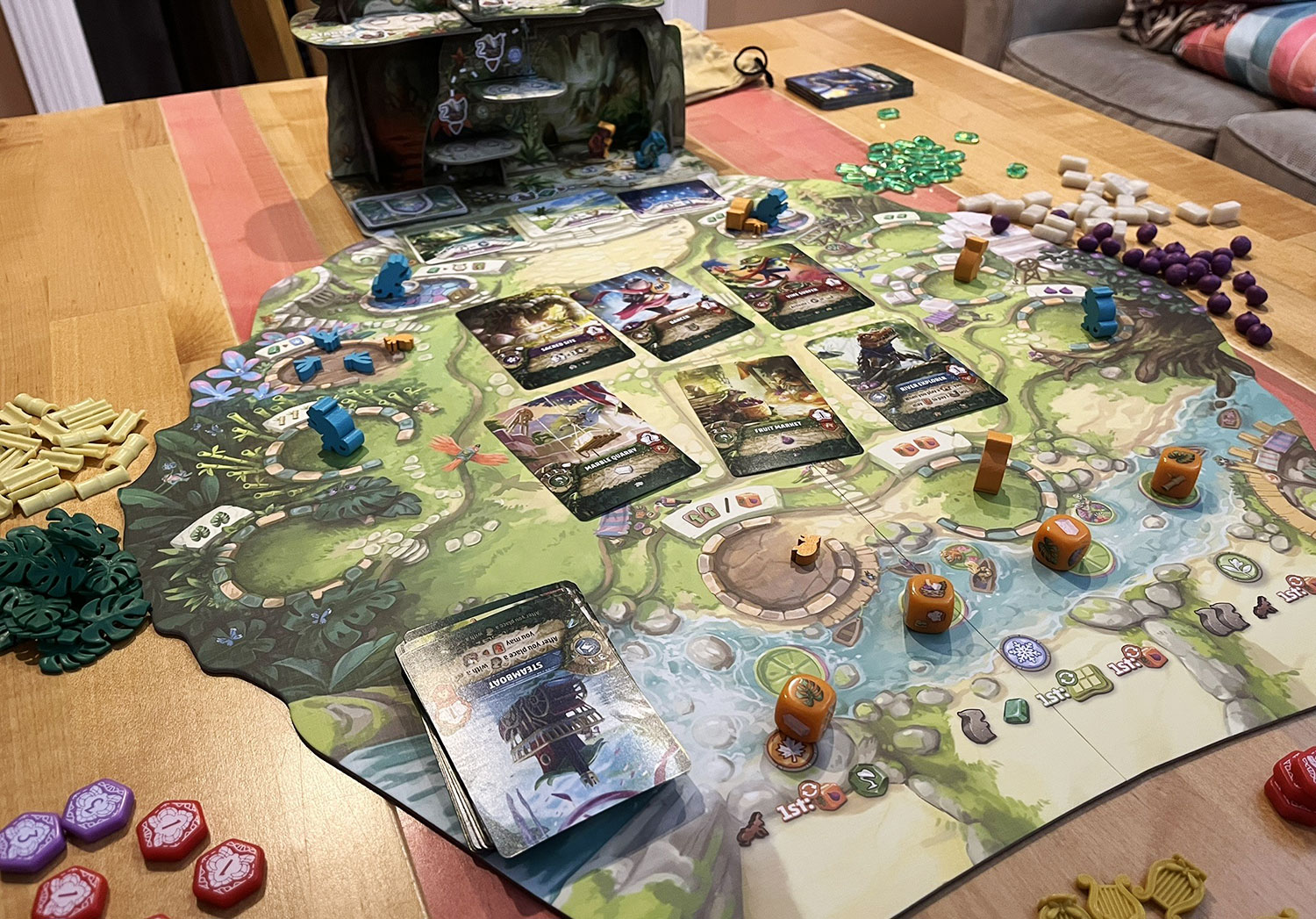
The central game loop of base Everdell has players placing workers to collect resources, which are subsequently used as payment for playing cards to your tableau, which provide the following benefits: recurring resource production, one-time instant effects, new worker-placement spots, passive engine-building effects, and point-scoring opportunities. All of this is still present in Emerland, albeit de-emphasized in light of some new mechanics.
Some key changes in Emerland include the following:
- Worker placement works differently. Players now start with helper bugs, which have 3 main functions:
- If used along with a worker, they can double the spot’s rewards
- They can grant your worker access to a spot already occupied by another worker.
- They can be used independently to access new bug-only spots.
- Your card tableau is now limited to 12 cards (vs. 15 in the original), but this number can be increased by purchasing realms, each of which also provides a unique scoring opportunity.
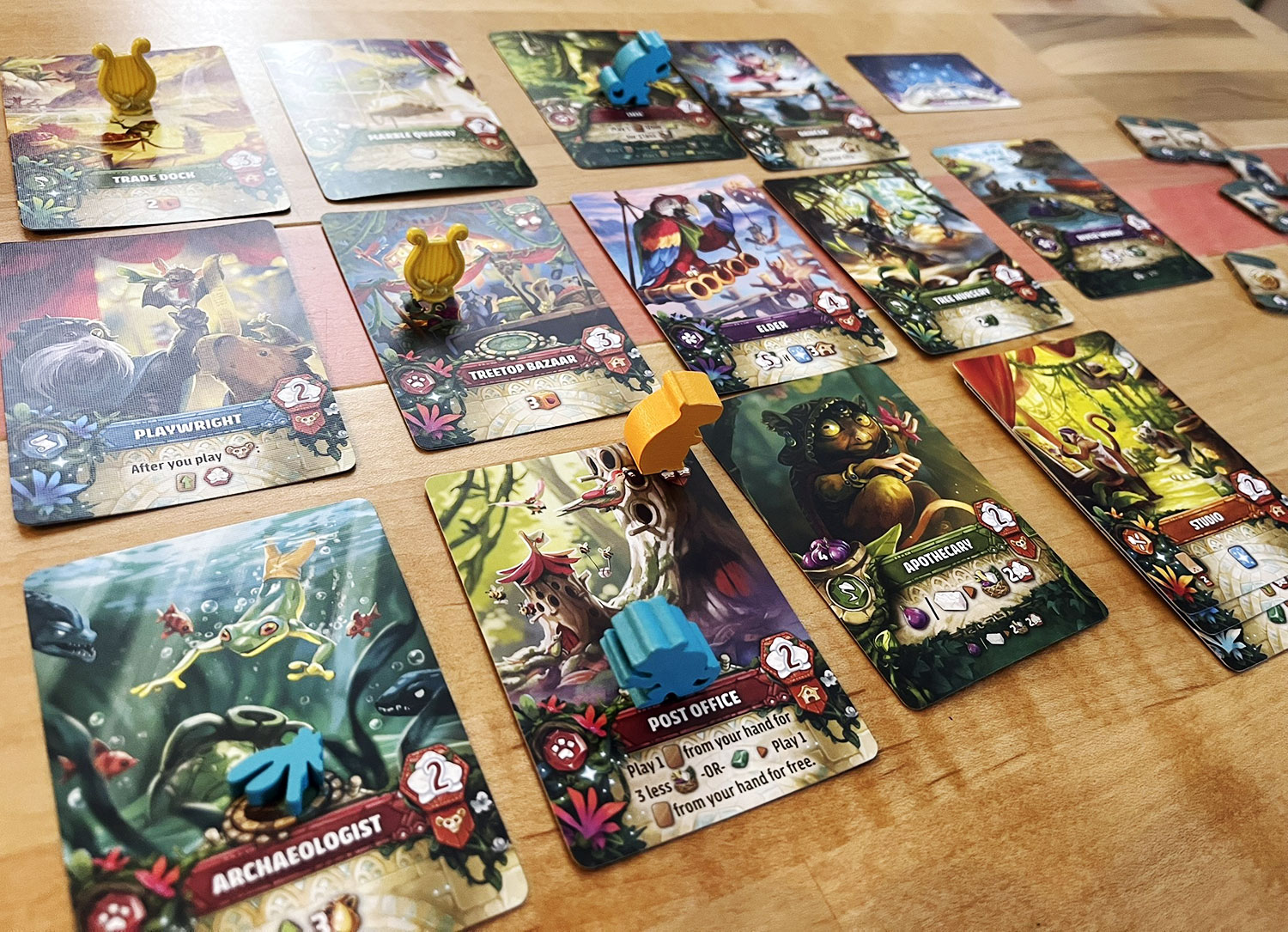
- There is a new card-type available, artisans, colored orange. Nothing happens when these cards are initially played, but on future turns, you can tuck a card from your hand to activate its effect.
- Cards can be upgraded/flipped, with stronger effects on the back, and if the card is:
- Green: Its new production ability is immediately triggered.
- Brown: Its instant effect is applied again.
- Red: With a worker already on it, the worker may take the associated action again.
- There’s a new way to play cards for “free.” Acquire a harp, and then as your main action, place it on an already upgraded construction (of a unique color without a harp) to enter any critter into play on its upgraded side.
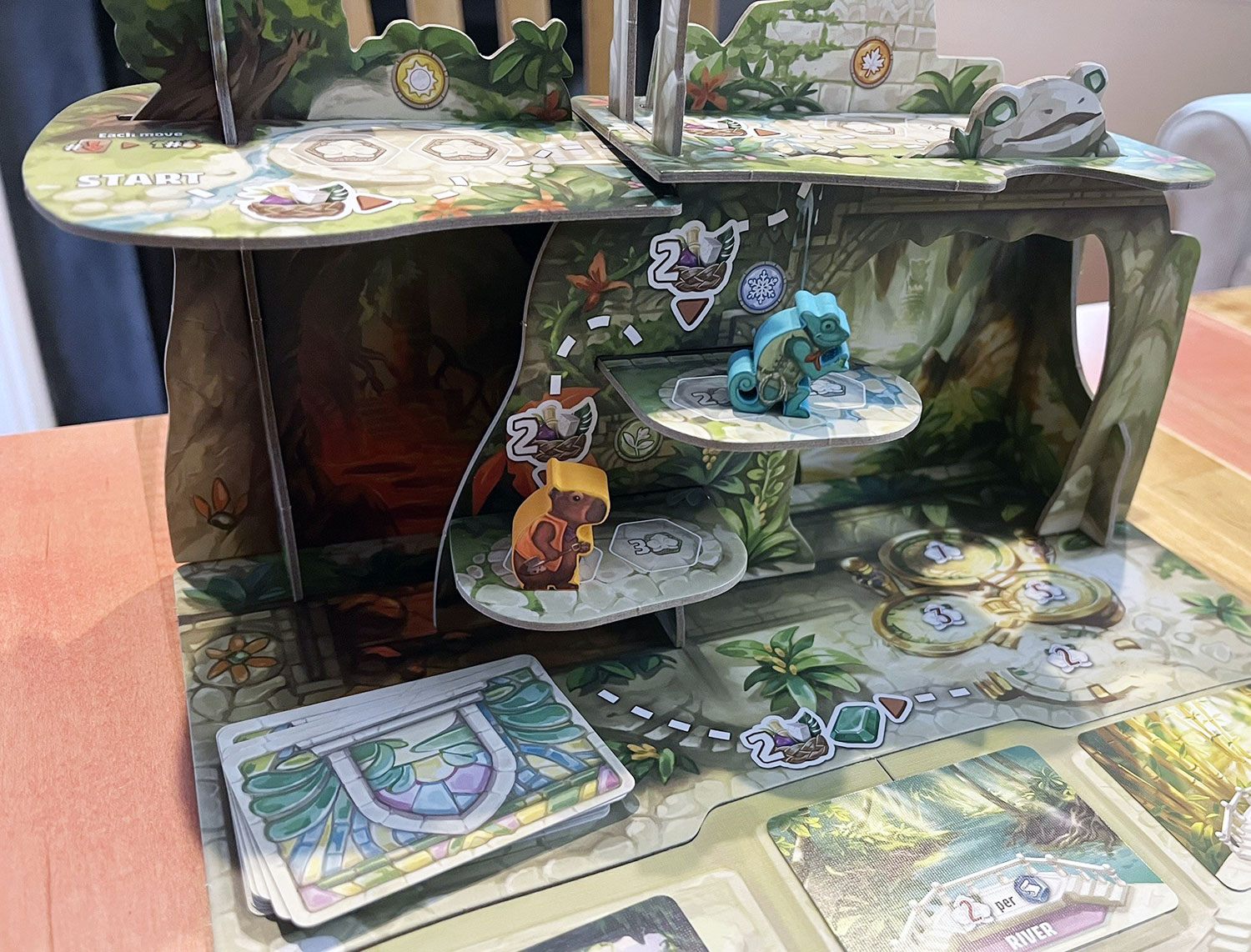
- There’s an archeology track which requires discarding cards and resources for advancement, with early movers eligible for more points than late movers. With each movement, players may draw artifacts blindly from a bag; these provide 1-7 points end-game scoring and sometimes additional instant bonuses.
- A new premium resource, emeralds, is necessary for interaction with several of the new mechanics.
Game Experience:
While Emerland still gives strong Everdell vibes, it constitutes the furthest departure mechanically from the original, more than either Farshore or Silverfrost. I love the new helper bugs as they create interesting decisions and tension between the players. The bugs are very useful on their own for accessing certain bug-only spots, one of which is the main way to upgrade cards. Thus, you’ll need to think carefully when/if it’s worth pairing your bugs with your workers to grant them access to blocked spaces or boosting rewards.
Timing your actions seems to matter more with bugs in play. Other elements that make the game more interactive include racing up the archeology track for max points, as well as a tweak to the red location cards. Many red cards now provide a distinct worker-placement spot for opponents to use that provides their owner with points (and doesn’t block them). Thus, players will often advertise their red cards, encouraging opponents to use them. All these factors make Emerland more worthwhile at higher player counts, whereas I felt base Everdell was best at two. Notably, additional worker-placement spots come into play in Emerland with 3 and 4 players.
There are several other improvements worth calling out, the first being a decreased luck factor for getting cards into play for free, which is quite powerful. In base Everdell, “free” card play requires finding two different specifically named cards that can be linked; ample luck is required for success. In Emerland, free card play mostly requires good planning/timing. Any critter can potentially be played for free from any construction, so long as the upgrade and harp have been achieved. All players (theoretically) have equal access to this mechanic up to 6 times per game.
Beyond equalized free-card play, I love the challenge of properly timing my card upgrades since double-triggering my red/brown/green cards can be quite valuable. I also enjoy the realms, which provide a new asymmetric focus to your game and can provide upwards of 12+ points each. Finally, the increased variety of cards makes this a great entry-game to the Everdell universe. Base Everdell contains 128 cards, but many repeat, with only 8 unique types of red/purple/blue/brown and 16 unique green cards. Emerland contains just 100 cards, but far fewer repeats, with 10 unique types of orange/red/blue/green, 12 unique purple, and 16 unique green.
Emerland may not be all emeralds and rainbows, however, since opinions will vary on a couple of features. Artifacts collected mostly from the archeology track can be worth 1-7 points each, and even when you take measures to increase your choice, it’s possible to draw poorly. It should also be noted that some realms are generally better/worse than others, which matters if you draw blindly.
Finally, it should be noted that the combined mechanics of getting realms, upgrading cards, and playing cards for free are SUPER important for doing well, so much so that about half of your actions in the game will likely be spent doing these things, or acquiring special resources that let you do them (Emeralds, harps). Therefore, finding/playing cards that directly relate to the upgrades/realms/Emeralds/harps aspects of the game is essential. Such cards make up exactly 20% of the deck, so they’re not exactly rare, but it is possible for some players to find them earlier than others, and in two of my plays, a large imbalance of early-game draw of these cards (among similarly skilled players) predetermined the final result.
Final Thoughts:
Everdell Emerland possesses many of the core features of base Everdell, adorable critters included, but then adds on several new mechanics to help it stand out from the worker-placement/engine-building crowd and appeal to somewhat heavier gamers. Some of these include upgradable cards, multi-functional helper workers, and a more strategic “free” card-play mechanic.
If you’re just breaking into medium-weight games, Everdell may be the better game to start with, for its more straightforward central loop of collecting resources to build cards. If you’re an established medium-weight gamer or hoping for a better experience with 3+ players, Emerland is the better entry point to the Everdell universe. My overall ranking of the (base) Everdell games is Silverfrost = Emerland > Everdell >> Farshore. Is Emerland different enough to warrant owning if you already have Everdell + expansions? Maybe? How much empty space do you have on your shelves? They are both fantastic engine-building games with cutesy, colorful artwork, and until I’m forced to make a decision, I’m keeping both.
Final Score: 4 stars – Capybaras, caterpillars, and frogs, oh my! Explore the jungle and excavate treasures in this latest addition to the Everdell universe.
 Hits:
Hits:
• Excellent artwork
• Unique worker-placement mechanics enhance player interaction
• Squishy leaves and figs (in the Collector’s edition)
- Upgradable cards provide a cool boost to your engine
Misses:
• A 3D cave component that does not fit into the box once assembled
• Some may dislike the luck of the archeology track