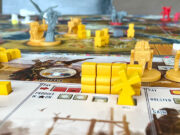
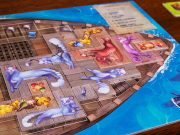
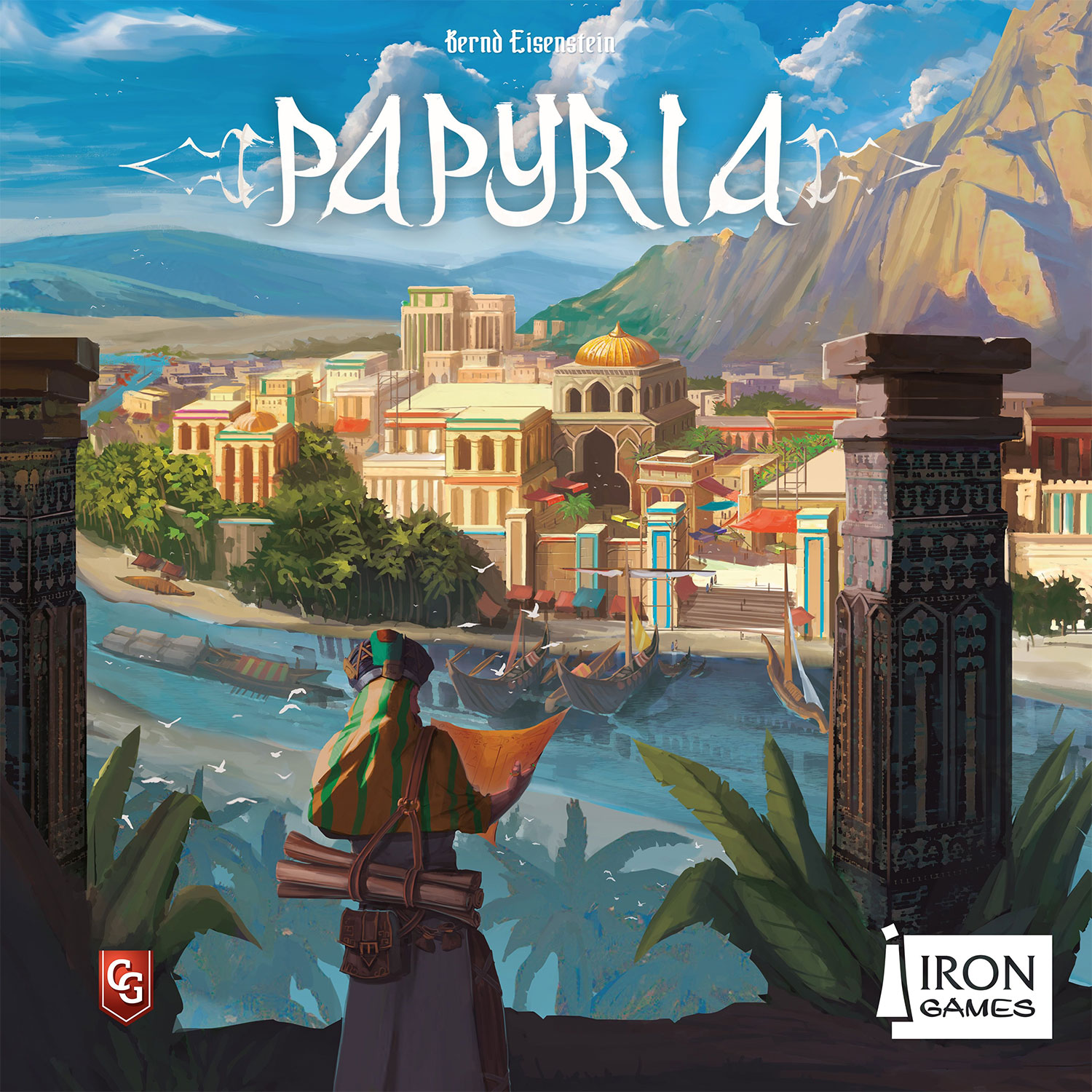
 To attempt to write a thematic intro for Papyria would be as silly as attempting to do so for The Castles of Burgundy (CoB). Papyria invokes the feel of ancient Mesopotamia in the same way that CoB immerses players in medieval France—i.e., other than some papyri and sheep, respectively, not all that much. I bother to compare the two games because they are both excellent classic-feeling Eurogame designs that are likely to appeal to similar types of gamers.
Papyria, designed by Bernd Eisenstein, features a shared double rondel worker placement system that challenges players to competitively piece together their own abstract tile-based terrains. It’s designed for 1-4 players over 60-120 minutes, and at least for this reviewer, it has me wanting to break out the cuneiform to write a rave review.
Gameplay Overview:
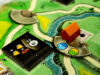
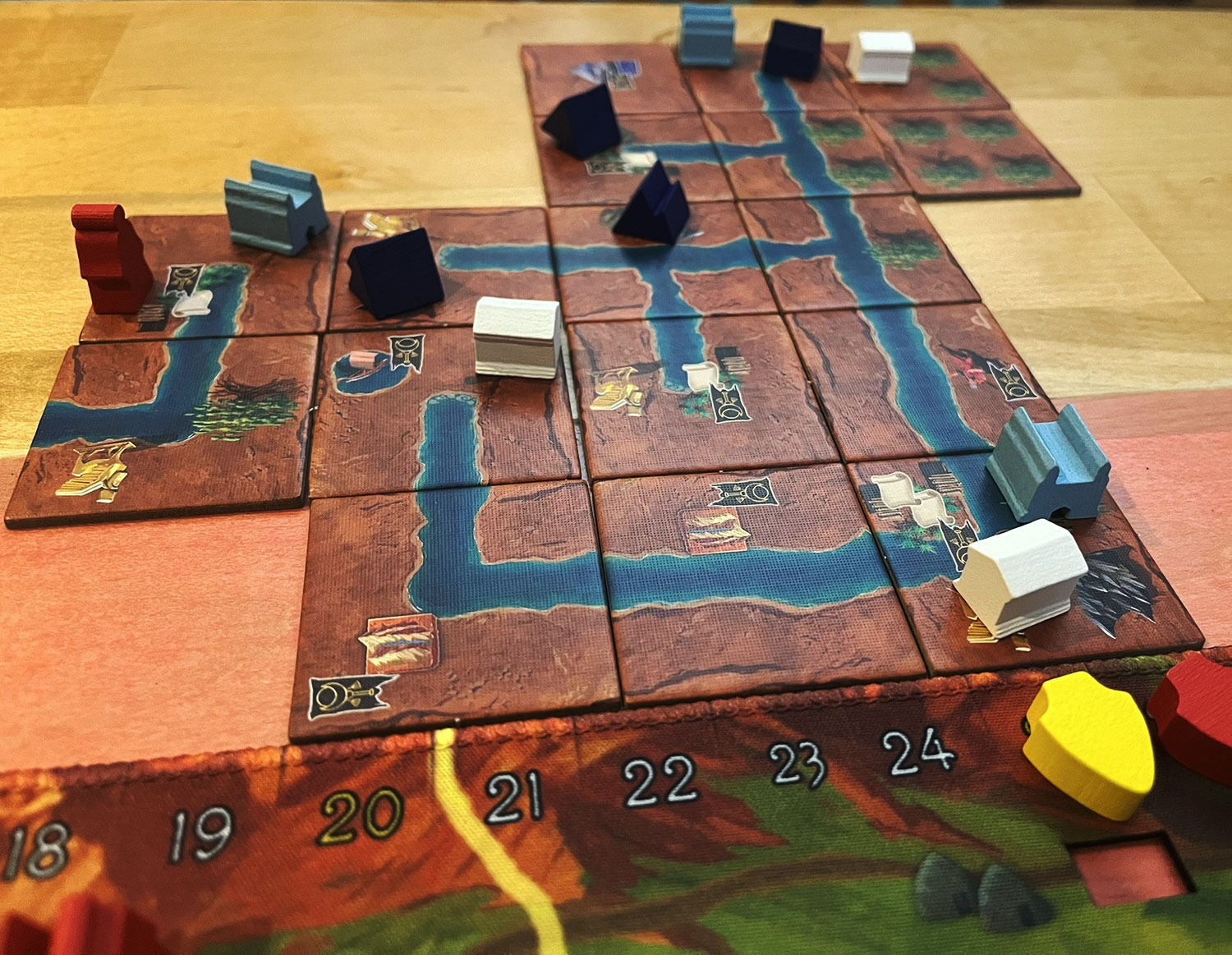
All players of Papyria will begin with a personal landscape consisting of a drafted starting set of square tiles and a priest token atop one of them. Any new tiles added to this landscape must be placed orthogonally adjacent to the landscape tile currently containing your priest, after which the priest will move onto the newly placed tile.
Each tile contains one or more of the following features: forests, mountains, rivers, sanctuaries, and banners. Each of these features scores in a unique manner, with some wanting to be in adjacent clusters of like features, and others preferring to be more dispersed.
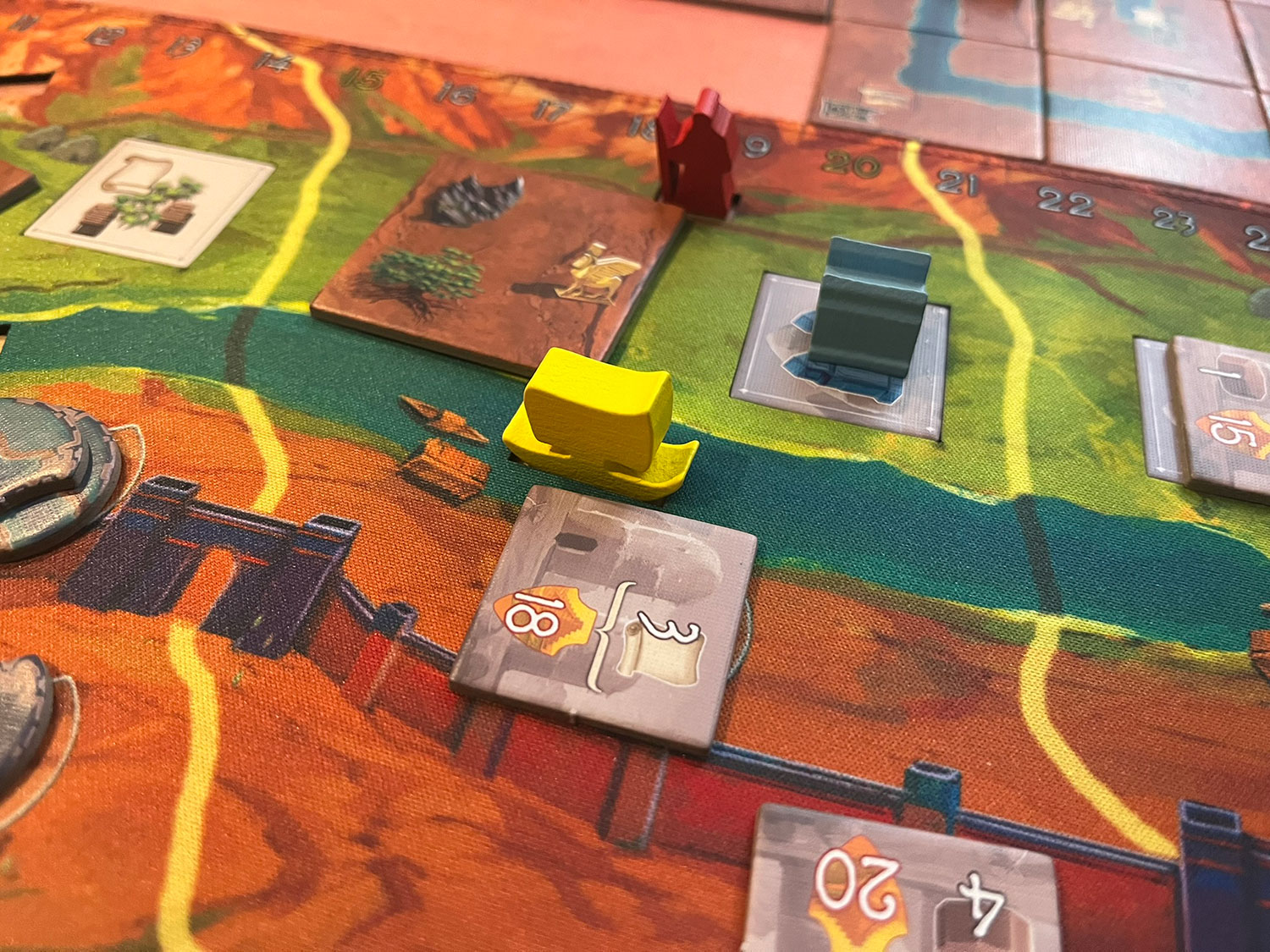
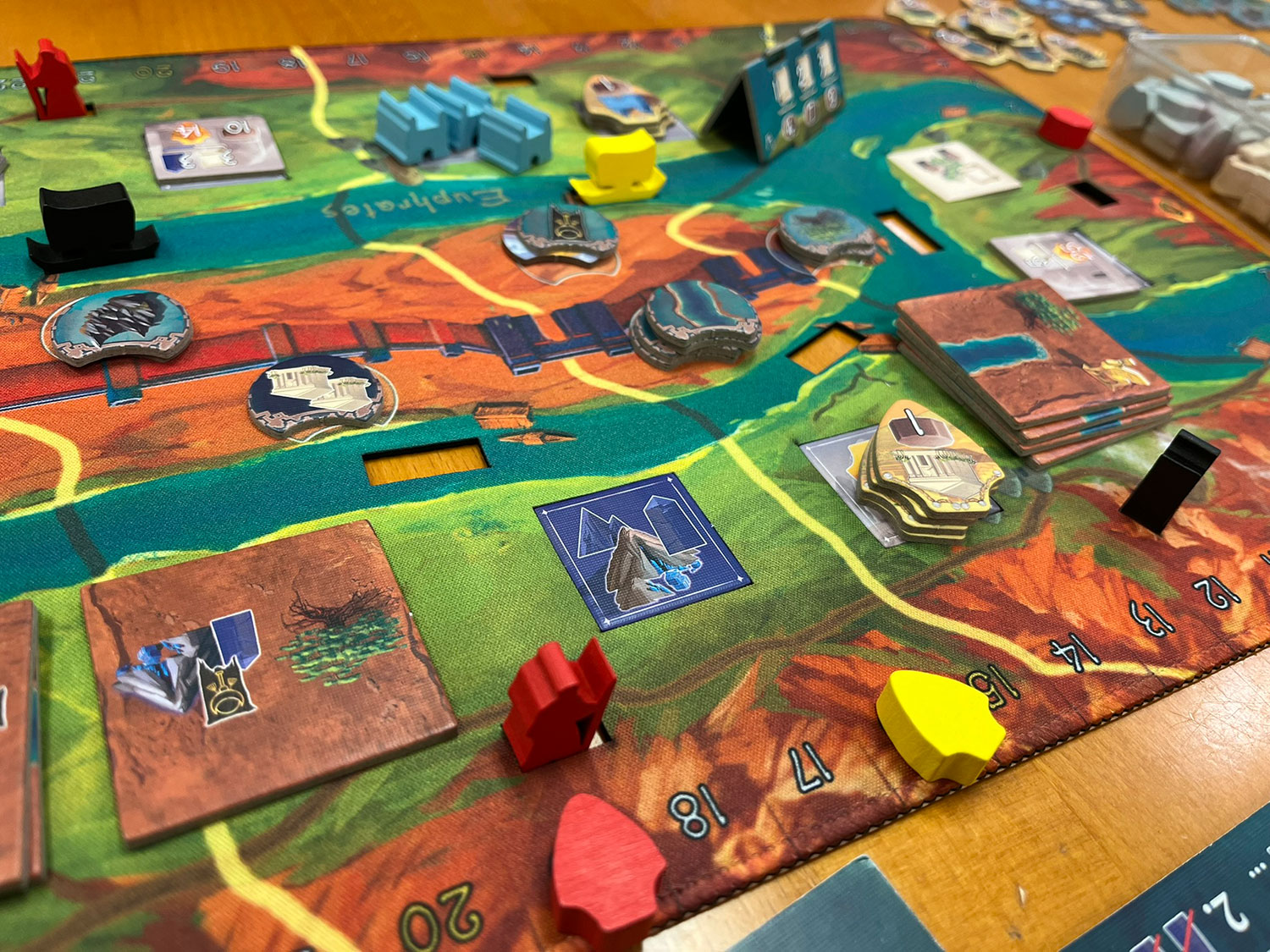
In order to acquire new tiles and boost the scoring potential for various landscape features, players will be moving their personal 1-2 wanderers and 1-2 ships (depending on player count) around an outer footpath rondel and an inner river rondel, respectively. A turn consists of choosing one wanderer or ship and moving it 1-2 open spaces clockwise on its rondel. Its landing space provides access to specific items for collection, including the following:
- New landscape tiles
- City and temple tokens that can be built on existing forest and sanctuary features, for appropriate lapis costs
- Mine tokens added to existing mountain features
- Lapis production (1 per existing mine)
- Papyri production (according to banner features)
- Point multipliers for specific scoring types (7 varieties)
- Scoring tokens (7 varieties) that immediately trigger scoring of the indicated types and provide a small knowledge boost
Whenever a scoring takes place, points are tallied according to a three-step process: (1) Base points for the particular feature on your landscape multiplied by (2) # of multipliers acquired for that particular feature, with the final result (3) capped by the value of your current knowledge.
Two stands (A and B) are placed at opposite ends of the rondels, and anytime one of your player-pieces passes over a stand on your turn, you may opt to pay papyri to (A) give a large boost to your knowledge, or (B) trigger a scoring token ahead of your actual turn.
Meeting specific thresholds for certain features (ex., 9 connected river segments or 3 constructed cities) grants players a “key” for that feature that will let them score it one more time at end-game.
Any time a rondel spot is emptied of its contents (landscape tiles, temple buildings, etc.) a special end-game scoring token gets placed there. The next player to land in that spot may pay the indicated lapis/papyri cost for immediate points and knowledge. Game-end is triggered once no end-game scoring tokens remain.
Final scoring consists of:
- Re-scoring each category for which you possess a key
- Mountain scoring is earned for the player(s) with the largest connected river and collection of scoring tokens
- Forest scoring is earned for the player(s) with the greatest number of cities and temples
Note: each scoring category is capped by the value of your knowledge.
The highest score wins.
Game Experience:
Papyri is the type of game where early scoring events typically net players only 1-4 points, but by late game, a single scoring event could be worth 60+ points with final scores potentially landing in the 300+ range. To improve your scoring capacity through the game, you’ll need to incrementally expand your landscape so it possesses more of the desired features in their required configurations while also collecting scoring multipliers for features in which you’re doing well. Of course, all this effort will be wasted unless you can also boost your knowledge, which otherwise caps the value of any given scoring event and starts at just 5.
There’s a lot that you’ll want to accomplish, but ultimately there aren’t enough turns to do it all, so you’ll need to specialize in specific types of features. Choosing an initial area of focus involves tactical play early-game in terms of what’s available on the shared rondel, and how the items are paired with other things. For example, building mines is a popular early-game move, so you’ll likely want to study what landscape tiles and/or scoring multipliers are paired with the various mines. By mid- and late-game, you’ll likely have a few categories already scoring decently well, and it becomes a longer-term strategy to prioritize scoring of those categories as much as possible while further improving their point outputs. The gameplay has a nice arc to it.
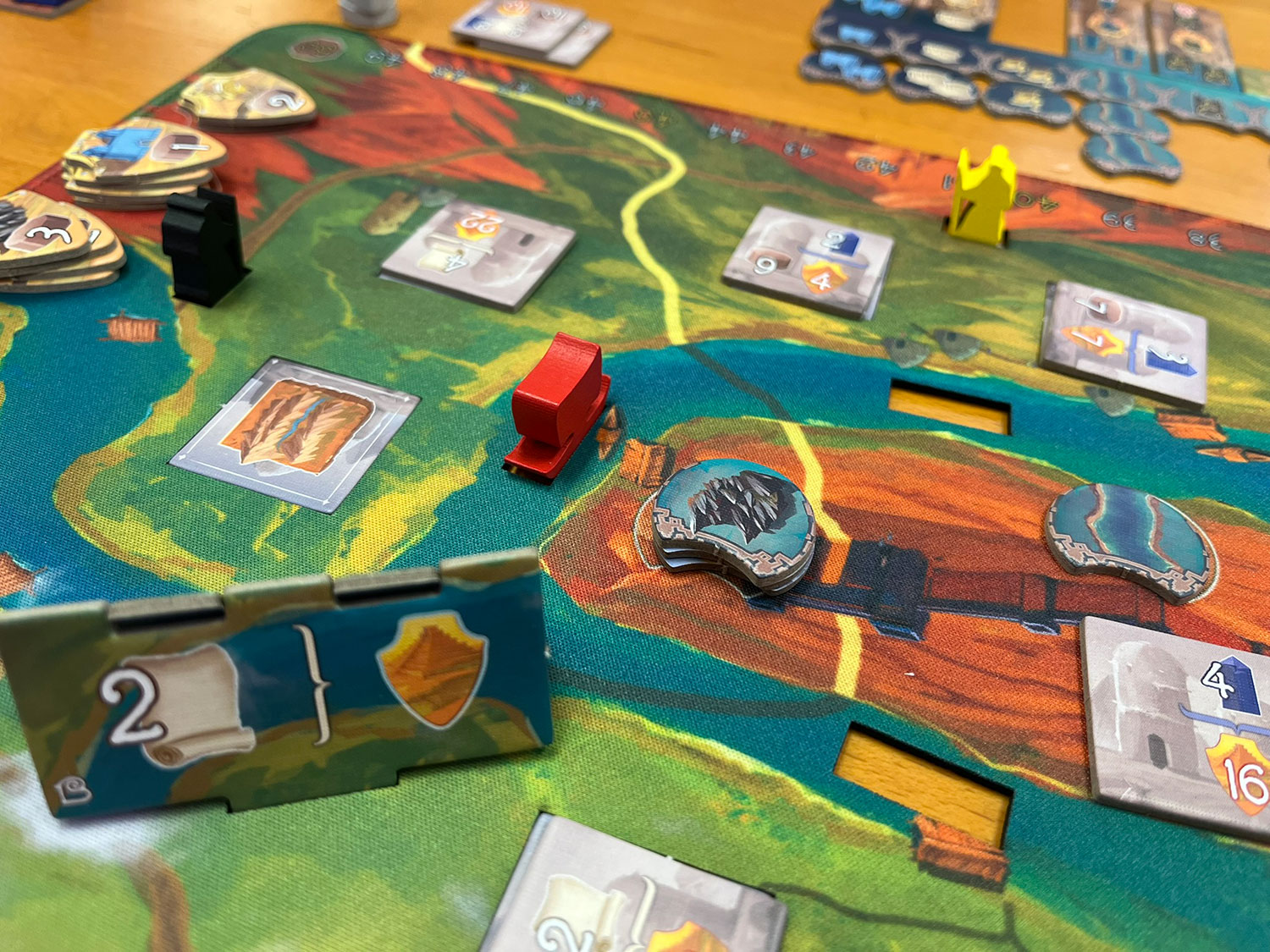
Players are also prevented from simply picking a single focus and ignoring everything else, since at a minimum, generating lapis and papyri is essential to doing well and will need to be done regularly. Lapis is used to pay for building construction. It also provides players the flexibility to bump other players from desirable spots and/or enhance the distance of their movements. Papyri are essential for taking maximal advantage of the A and B stands that let you boost knowledge and achieve extra scoring opportunities.
The game also encourages some specific synergies. For instance, if you’ve chosen to specialize in forest scoring, the only way you’ll get to score it again at end-game is if you have the greatest number of cities or the greatest number of temples. These competitions for extra end-game scoring constantly have players comparing progress in categories like buildings, rivers, and overall # of scoring events.
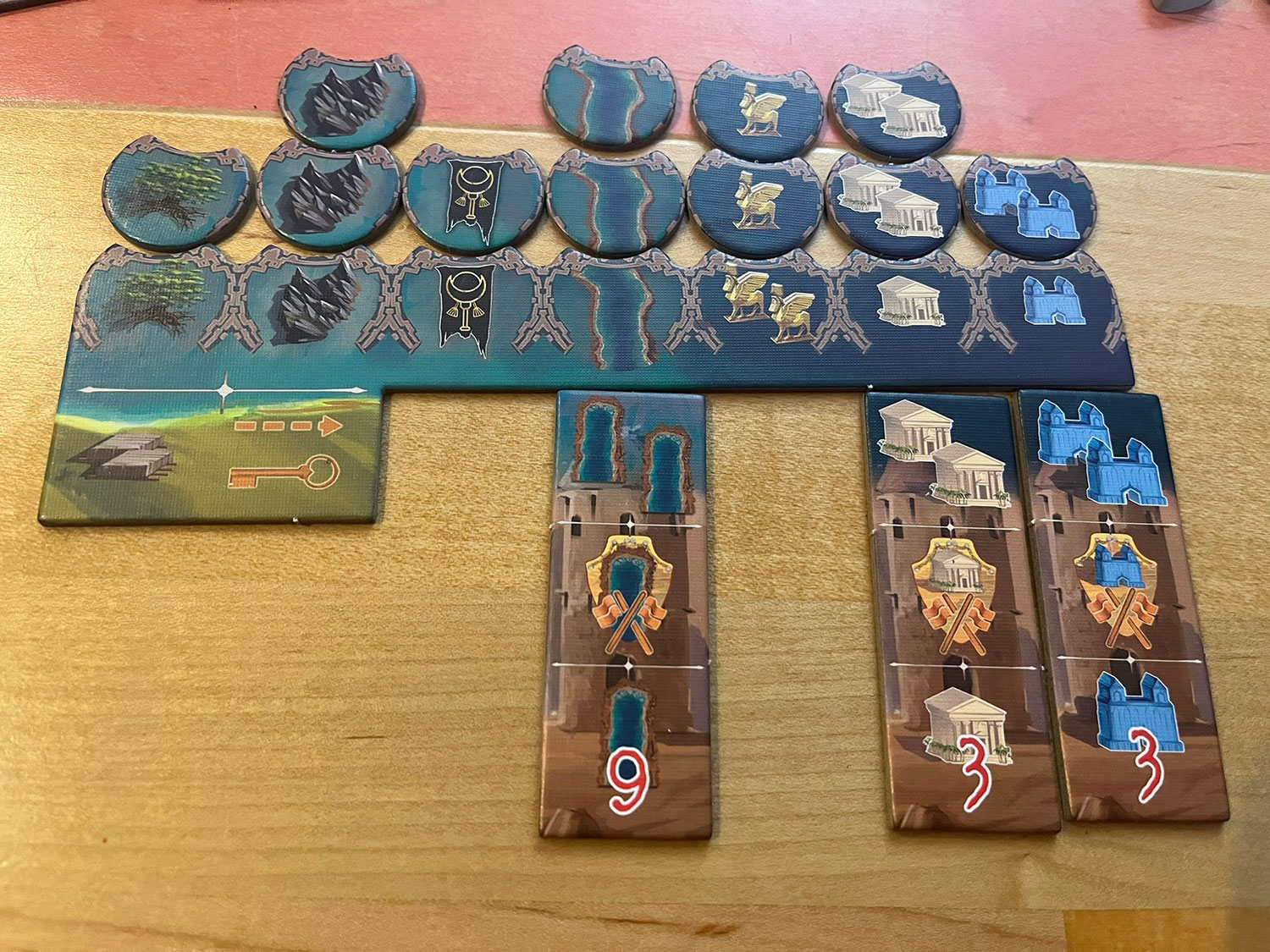
Players are also competing to win the best keys for end-game scoring. While any player who meets the threshold for the various keys gets to acquire one, the first key in each category contains built-in point multipliers, with later ones containing lesser or no multipliers. While Papyria is not quite as player-interactive as Castles of Burgundy, you definitely need to monitor your opponents’ progress in various areas to guarantee yourself access to the best end-game scoring opportunities—and prevent them from doing the same. These competitions can feel especially intense at 2-player, but notably Papyria is thoroughly enjoyable, and probably shines, at the higher player counts of 3 and 4 where the board is a bit less open.
Finally, it should be noted that replay value is excellent. The randomized set-up of 24 activatable spots on the main board (of 7 different types) means the different pairings of options and ordering thereof as players progress through the rondels will create a new puzzle each game, on top of the fact that the various tiles and scoring tokens come out in different orders as well.
Final Thoughts:
Papyria is not for everyone. But for people who love dry, mildly player-interactive, medium-heavy point-salad Eurogames designed by the likes of Stefan Feld or Uwe Rosenberg, this is sure to be a banger. Fair warning, though: the central board is far more colorful than the classic beige. Papyria features worker-placement via a shared double-rondel as a means to build out personal abstract tile-based and (loosely) Mesopotamian-themed landscapes. Optimizing across 7 unique scoring categories requires both tactical and strategic decision-making, resulting in point accumulations that rise exponentially through the game, making for a dopamine-infused end-game. For the right type of gamer, this dry Eurogame offers a huge splash of excitement.
Final Score: 4.5 Stars—the double rondels and crunchy optimization puzzle will leave players dizzy with glee
 Hits:
Hits:
• The double-rondel is an AP-inducing blast
• Combining an abstract tile-laying puzzle with Euro mechanics is fun
• Exponentially increasing scoring is oh so satisfying
Misses:
• Fiddly set-up
• Player aids for each player outlining the 7 scoring criteria would’ve been nice (only 1 included)
• Landscape tile artwork looks like Windows ’95 clipart
• Rulebook could’ve been better