 Many strategy board gamers have encountered the well-meaning acquaintance who shows a polite interest in our hobby.
Acquaintance: So you’re into board games, huh? Do you play a lot of UNO and Monopoly?
Board gamer: Pauses, resisting the urge to disparage Monopoly. I mostly play strategy-oriented games, geared towards ADULTS. Kind of like chess, except more modern. Have you heard of Catan?
Acquaintance: Losing interest. Uh, no. But sounds cool! Gee, look at the time; I’d better get going.
Thus it was with a mixture of excitement and embarrassment that I endeavored to try AllPlay’s Twinkle Twinkle, along with the expansion, “How I Wonder” — a game obviously inspired by the children’s nursery song—with my group of definitely non-child-aged gamers. Twinkle Twinkle is a tile-drafting game that has 2-4 players competing to assemble the most impressive star chart from nighttime observations over 20-30 minutes. Cutesy teddy bear player-piece, box art, and title aside, this is a puzzly abstract game that can be enjoyed by children and adults alike.
Gameplay Overview:
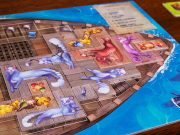
Each round of Twinkle Twinkle will have two rows of astronomy-themed tiles available for draft on a common observation board. The top row is available for the current round, and the bottom row is a preview of what will be available to draft in the upcoming round.
In turn order, players will place their player-tokens atop the tile they would like to draft. Once all players have placed their player-tokens, they will simultaneously take their selected tiles and place them anywhere on their personal 4×5 star chart boards.
The location of player-tokens left to right in the current round will determine player order for the following round.
The game ends when each player has completely filled their star chart with tiles.
Each of six unique celestial elements that players have collected on tiles will be scored according to their specific requirements.

Game Experience:
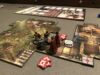
A standout element of Twinkle Twinkle is its appearance: the tiles are all clear acrylic with the celestial elements printed with white ink, and these are placed atop a fluorescent-appearing night sky on the personal star charts that lets the constellations, planets, comets, etc. almost appear as if they’re glowing. It is a beautiful production.
The gameplay itself is straightforward tile drafting and placement with some added player interaction stemming from the ability to influence turn order when selecting your current tile. Early-game, the decisions feel open-ended because your star chart is empty and you are free to establish priorities. Each of six unique celestial elements in the game has different criteria to maximize its scoring; most need to be adjacent to or NOT be adjacent to other specific types of celestial objects.

Stars can score in three different ways depending on the size of multi-star constellations and the overall number of 2+-size constellations. With each tile placed, your options for maximizing scoring with the next tile have been marginally more constrained, and by late-game, tensions are at their peak; best scoring options for each player have dwindled based upon their earlier decisions, and early turn-order takes on the greatest importance. Twinkle Twinkle ultimately feels more constraining than Cascadia, but much less so than Calico.
While the rules are simple enough, with 6 unique elements scoring in 8+ different ways, the ability to see what’s coming up for the draft next round, and the option to influence turn-order means crunchy decisions abound. Light-weight gamers might be overwhelmed on their first play, but they should get the hang of it shortly enough; Twinkle Twinkle’s weight is similar to that of Harmonies.

Stars always have the same three scoring criteria, but variability is introduced from two different scoring options for each of the other five celestial objects (green = standard, blue = advanced), which can be mixed and matched game-to-game. If played with the “green” side for every celestial object, the game isn’t too punishing; with few exceptions, you’re almost guaranteed at least 1-2 points for any given tile placement.
The blue side is trickier. Black holes can start negating points from certain other celestial elements. Asteroids subtract 5 points from the player with the fewest. Conversely, planets award 8 points to the player with the most. I personally don’t love this free/negative points for the most/fewest scoring concept at two-players, as it can make the game swingy, but it’s fine at higher player counts. Regardless, while two scoring options for each celestial object are nice, the base game still pales to the greater variability offered by Cascadia.

The How I Wonder Expansion vastly improves replay value by providing 5 additional celestial objects (each with green/blue sides) that can be mixed-and-matched with the base game, such that 5 total objects are in each game in addition to stars. Each of these new objects has interesting scoring conditions, and some can really change the gameplay beyond basic scoring. For example, wormholes allow players to change the tiles available for next round’s draft. Rocketships give a new incentive to build large constellations. UFOs, part of a separate mini-expansion, might be my favorite, as they gradually increase the scoring value of certain objects as the game progresses.
The expansion is a fantastic addition, but it does have some notable logistical limitations. Many of the new objects, as well as some of the originals (4 total out of 11 non-star objects) require specific other objects to be in the game for their scoring to work; thus set-up cannot be completely randomized. Adding to the fiddliness is the need to sort all but the star tiles either at the beginning or end of each game. One more nitpick while I’m at it: the expansion content cannot fit into the original box.
Final Thoughts:
Twinkle Twinkle is a solidly-designed abstract game about the same weight and playtime as Harmonies, but with beautifully implemented astronomical theming instead. Player interaction is elevated a bit above similar drafting games because of the ability to preview the next round’s offerings and also influence turn order with each draft pick.
The base game includes some variability with two scoring options for five of the celestial objects, but it is still no match for the variability of Cascadia. The “How I Wonder” and UFO expansions add more robust replay value and some cool new gameplay elements without too much more complexity, though they make set-up/tear-down more fiddly, and it must be noted that they will not all fit in the base-game box. Twinkle Twinkle is not re-inventing the category of abstract games, but it nonetheless offers a great amount of fun in a short playtime, along with deeper decisions than the title would imply.
Final Score: 3.5—a short and sweet astronomically-themed tile-drafting abstract game with a production that’s out of this world
 Hits:
Hits:
• Stellar production
• Decent player interaction
• Elegant design
Misses:
• Limited replay value in the base game, mostly fixed by expansion
• Expansion does not fit in the base-game box
• Set-up becomes fiddly with expansion