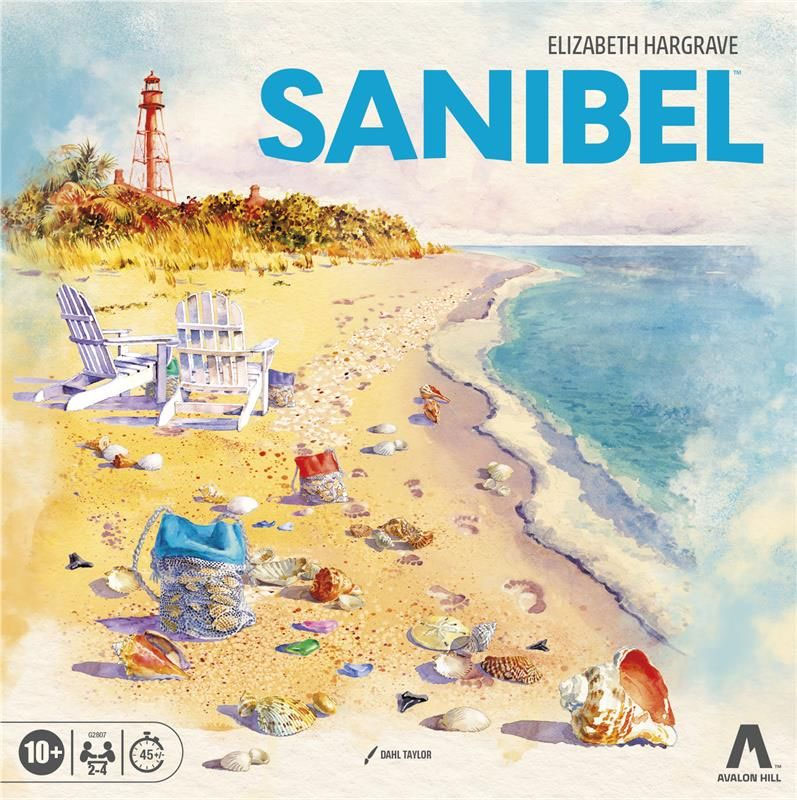
 I may be a board game collector now, but my collecting predilection started at the age of 7 with seashells. Specifically, I loved collecting the vibrantly colored and variously shaped shells that could be found along Florida’s Gulf of MEXICO coast from Marco Island up through Sanibel Island, the latter also being the home of the fantastic National Shell Museum. Life has now come full circle, as Elizabeth Hargraves has designed a board game about collecting seashells. Sanibel is a family-weight abstract board game that has 2-4 players competing to collect the most valuable array of seashells and shark teeth over 45 minutes. The shells all represent true-to-life specimens of Southern Florida, but at least in this game, they can be collected without players acquiring sand in any unfortunate places.
Gameplay Overview:
Sanibel is a rondel-style game where players “walk” across a strip of Sanibel Island, turn around at the lighthouse, and then walk back to their starting spot, collecting shells along the way. The game ends when each player has returned to the start.
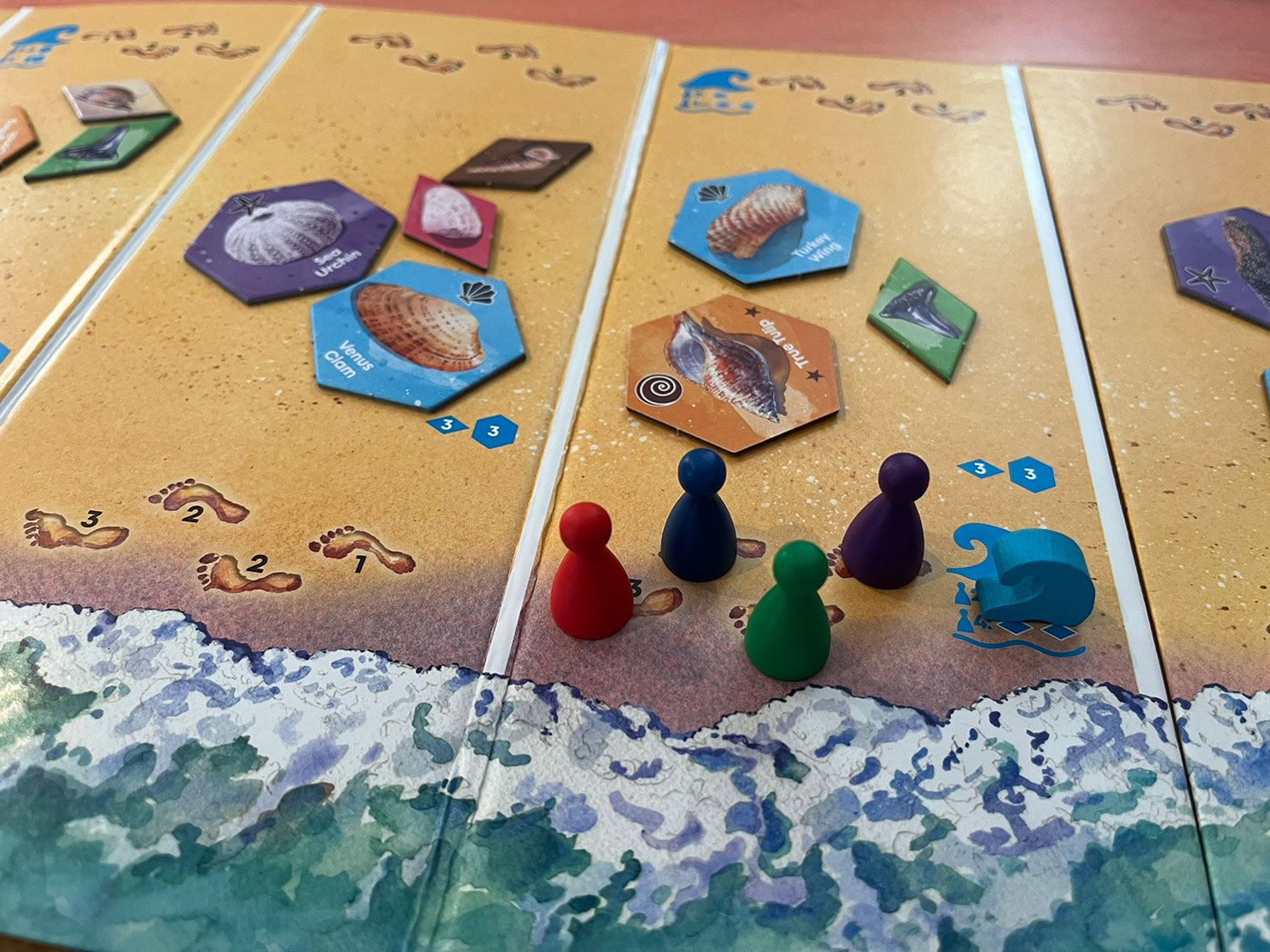
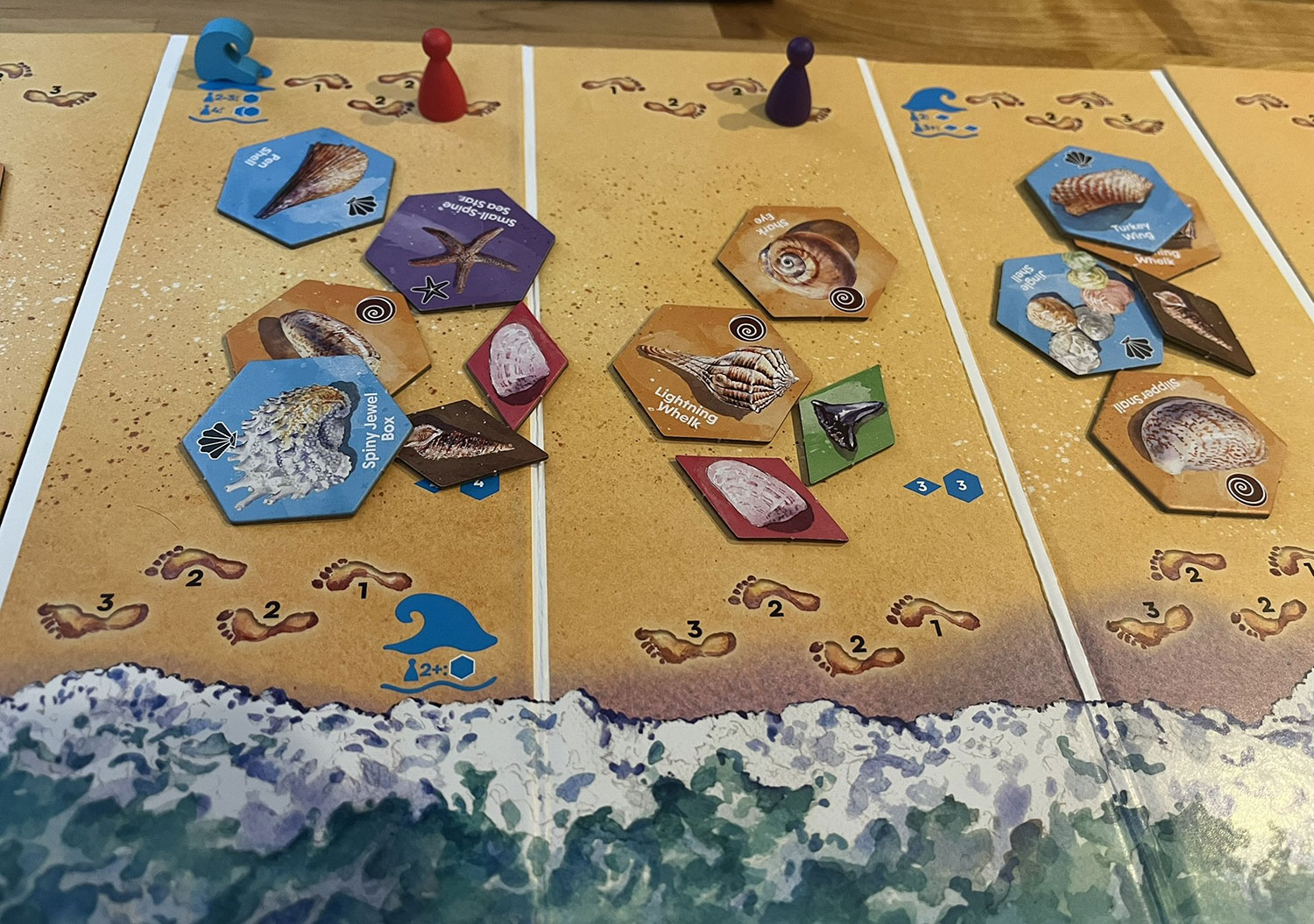
Turn order is dictated by whoever is furthest back along the beach. If a player is far enough back, it will be possible for them to take multiple turns in a row until a different player is further back. There is also a “wave” token on the board that will move any time it is behind all players, causing the beach to be replenished with a new assortment of calcified goodies.
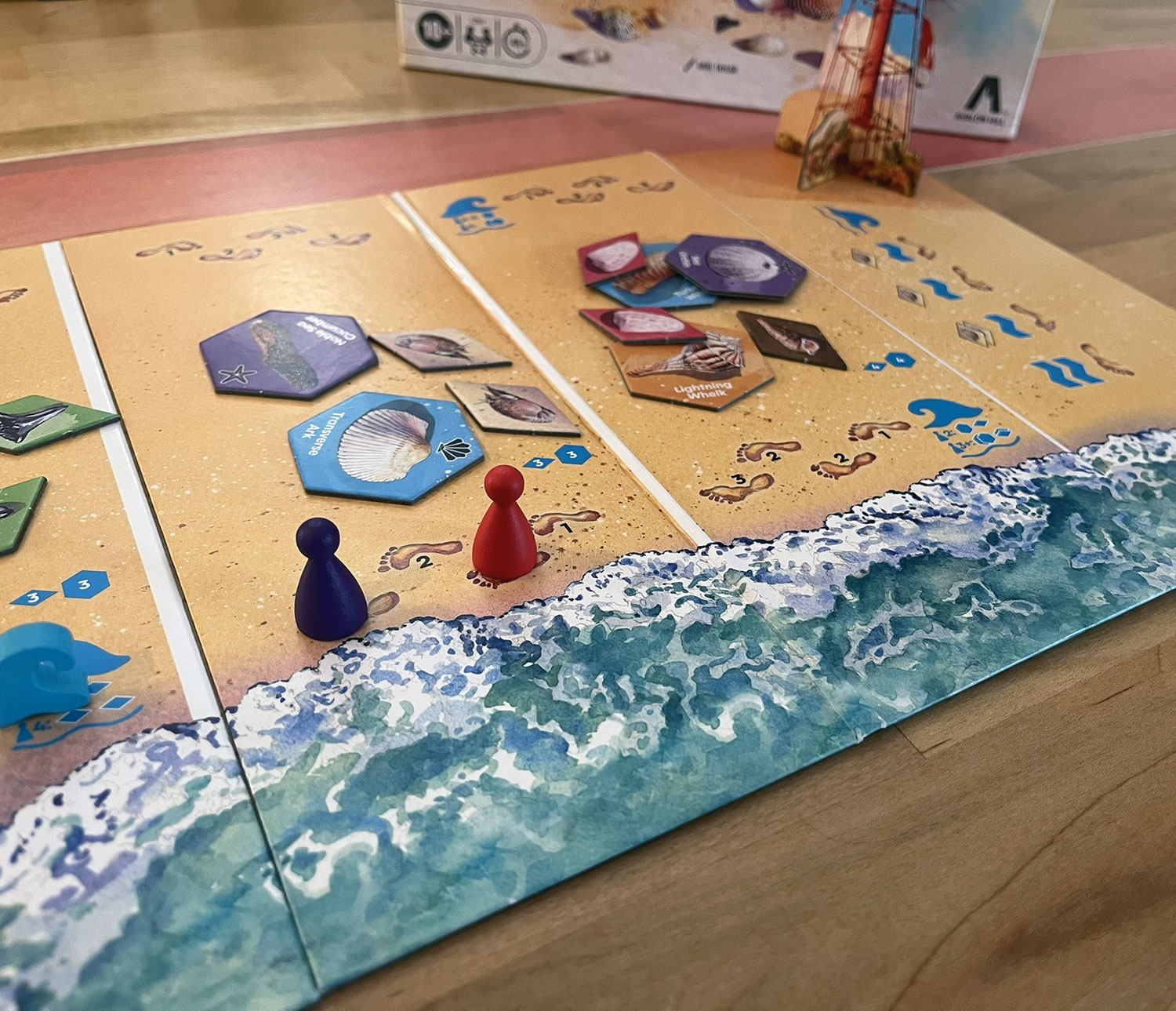
On your turn, you must advance your pawn a minimum of one section of beach forward. Each beach section contains multiple landing sites that allow players to collect anywhere from 1 to 3 different shells/shark teeth. The more lucrative spots (collect 3 items) are closer to the front, so there is a tradeoff between turn order and shell-collecting efficiency.
Collecting involves selecting among 5 possible categories of shells or shark teeth existing in two different geometric shapes (hexagons or diamonds) and immediately arranging them in your personal collection bag, noting that gravity applies, so each item must be supported by something underneath.
Each shell scores slightly differently, with some needing to be next to or apart from other items in your bag, with point bonuses being granted for specializing in certain types of shells.
Players will have one opportunity at the lighthouse to add asymmetric lighthouse tiles to their bags, which provide unique conditions for scoring extra points.
At the end of everyone’s pleasant beach stroll, scores are tallied, and the highest total wins.
Game Experience:
Part of my excitement in trying Sanibel was the theme, and the game exceeded my expectations here as one of the most thematic abstract games I’ve ever played. Shells belong to five general categories (echinoderms, bivalves, common snails, ceriths, and coquinas), for simplicity, but within these categories, one can discover up to 30 distinct seaside entities in the game. As someone who has spent ample time on the Gulf coast of Florida, each of these entities was visually familiar, and it was fun to read about the types of creatures that call them home in the back of the rulebook.
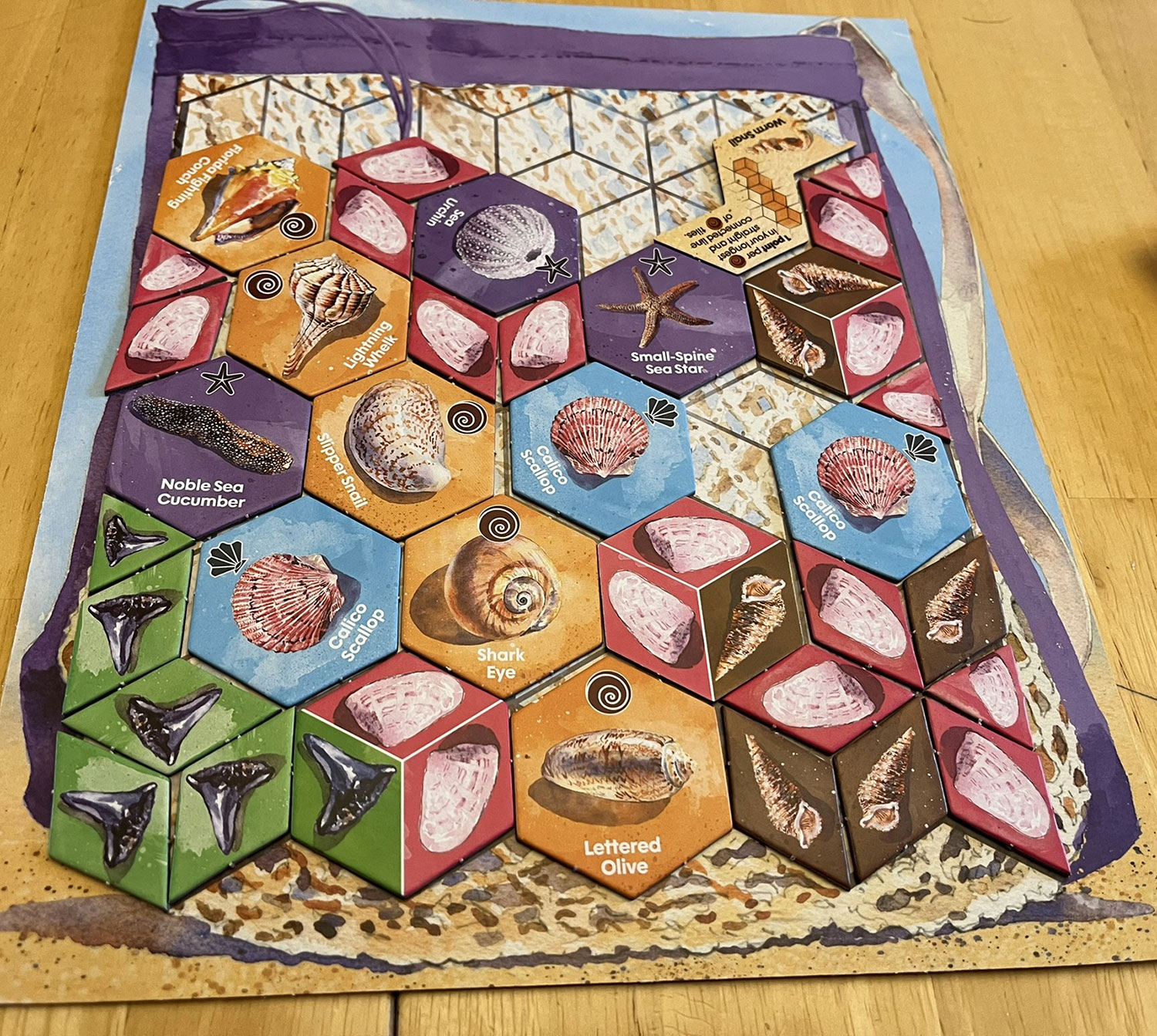
Several gaming aspects also make thematic sense. Bivalves score for having partners. Wave movement introduces new shells to the beach. And if you happen to pick up a sand crab (functionally a “wild” pick in the game), you immediately fling it away in fear—I mean, gently return it to the sand in kindness—and pick up any other item of your choice.
As for the strategy of the game, this is a lighter gaming experience than Harmonies or Cascadia, solidly in the family-weight category. At 2 players, there is rarely an incentive to jump very far ahead in the rondel, although at 3 and 4 players, the board feels a bit more crowded, and there is more competition for the various types of shells, so decisions are somewhat more interesting. Altogether, player interaction is still rather minimal. Only one item (shark teeth) awards points comparatively, with 3 bonus points awarded to whomever has collected the most. Two other shell types, coquinas and ceriths, reward players with higher values per shell if they collect a lot, so there can be some competition to gather as many of these as possible. Finally, echoderms and Snail shells only score for unique subtypes, so there can be a fight over unique specimens that appear throughout the game.
The placement puzzle within your personal bag is generally fairly straightforward; the rules of gravity make intuitive sense, and the player aids help you keep track of which shells want to be touching versus apart.
Where Sanibel falls short for me is the flatness of the scoring. All large shells (hexagon tiles) are essentially worth 1 point if placed appropriately. The smaller (diamond-shaped) tiles are all effectively worth 0.5 points each, unless you have a lot of a certain type, in which case they can each be worth a bit more. Notably, 3 small tiles can fit in the equivalent space of 1 large tile. Your personal collection bags only have so much room, and skilled players can completely fill their bags by game-end, so there is some decision-space in planning to squeeze in as many points as possible. Nonetheless, you will generally collect a mixture of shell types, and considering the similarity of how everything scores, I often found myself wondering if it really mattered if I took one shell type versus another.
Medium and expert-level gamers are thus likely to find Sanibel overly simplistic with limited replay value. The official age recommendation for Sanibel is 10+, but I expect children a couple of years younger may be able to understand how each of the 6 main entities of the game scores with some assistance. The beautiful production—art by Dahl Taylor—with superb thematic integration, should hopefully help Sanibel find an audience, even if a bit of threading the needle for the right type of gamer is required.
Final Thoughts:
Sanibel is a lighter-weight abstract game with an immersive seashell-collecting theme that feels as relaxing as a day at the beach. For the science nerds and Florida coast-vacationers, there’s a nice variety of shells and sea creatures represented and an opportunity to learn about them from the rulebook. For strategy gamers, know that Sanibel is only mildly interactive, and most shells in the game possess similar scoring rewards if placed appropriately; seasoned gamers may find that it lacks a certain depth and variety of decision-making. Families looking to re-live their vacation memories are the target audience and are likely to find Sanibel a visually stunning and all-around pleasant non-combative gaming experience.
Final Score: 3 Stars – a seashell collecting/arranging abstract game that’s as lightweight and pleasant as a stroll along the beach
 Hits:
Hits:
• Immersive and educational seashell collecting theme
• Beautiful artwork and production
• Arranging hexagons and diamonds on personal playerboards is fun
Misses:
• Flat scoring structure may limit replayability and render the game too lightweight for some
• Player interaction may be too mild for some