

 How many editions of Pandemic are there now? Ten? Twelve? More?? Do we really need another iteration with a pasted-on theme and modified ruleset? Haven’t we cured all the diseases?
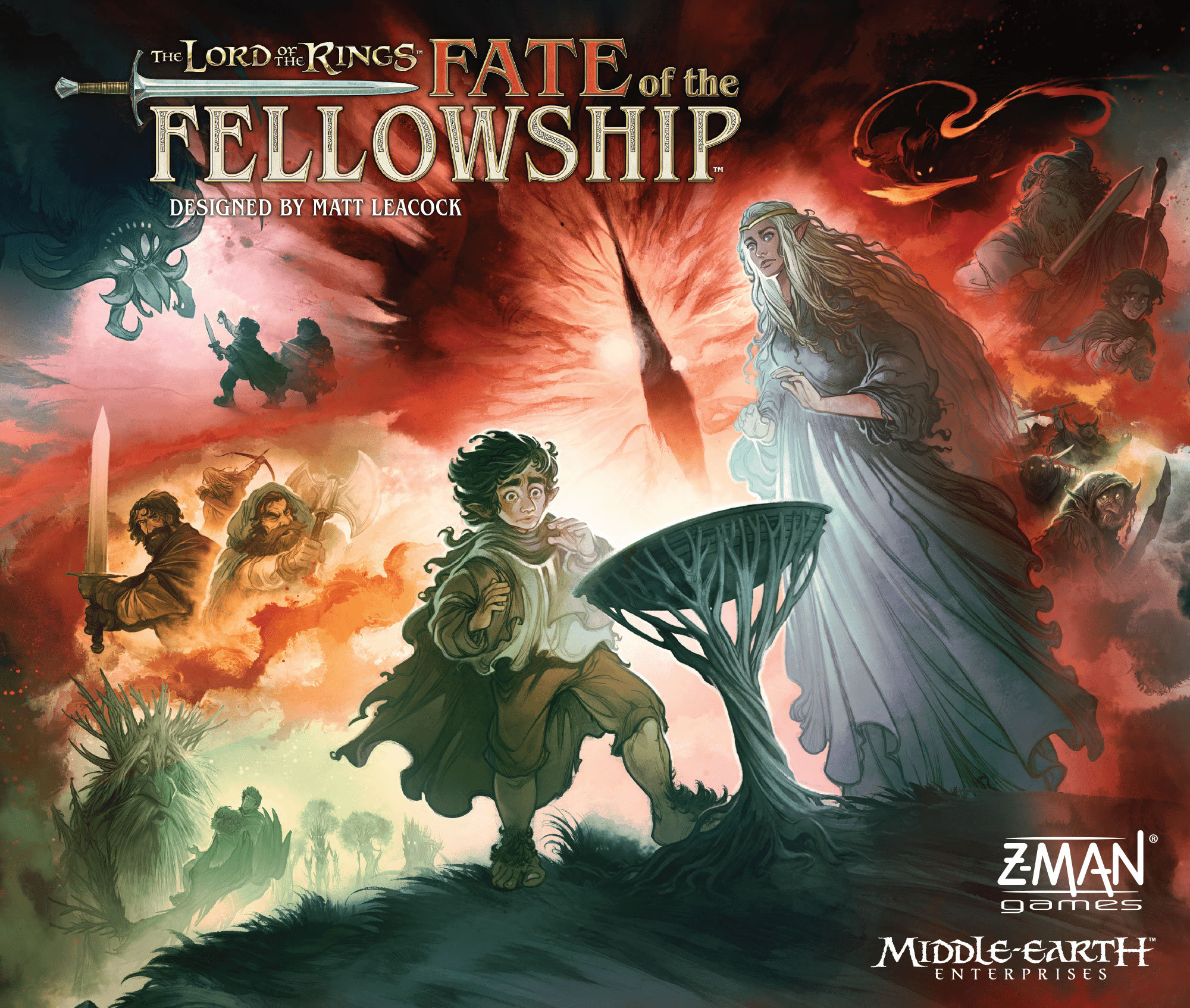
Turns out there is one intellectual property (IP) that continues to saturate the market and maintains a rather high level of esteem: The Lord of the Rings (LotR). Pandemic designer Matt Leacock returns to his roots by adapting the system to the lands of Middle-earth. Published by Z-Man Games, the Fate of the Fellowship takes the sterile Pandemic origins of laboratory and research and throws it into the fires of Mount Doom. Continue reading to learn what emerged from the ashes.
Gameplay Overview:
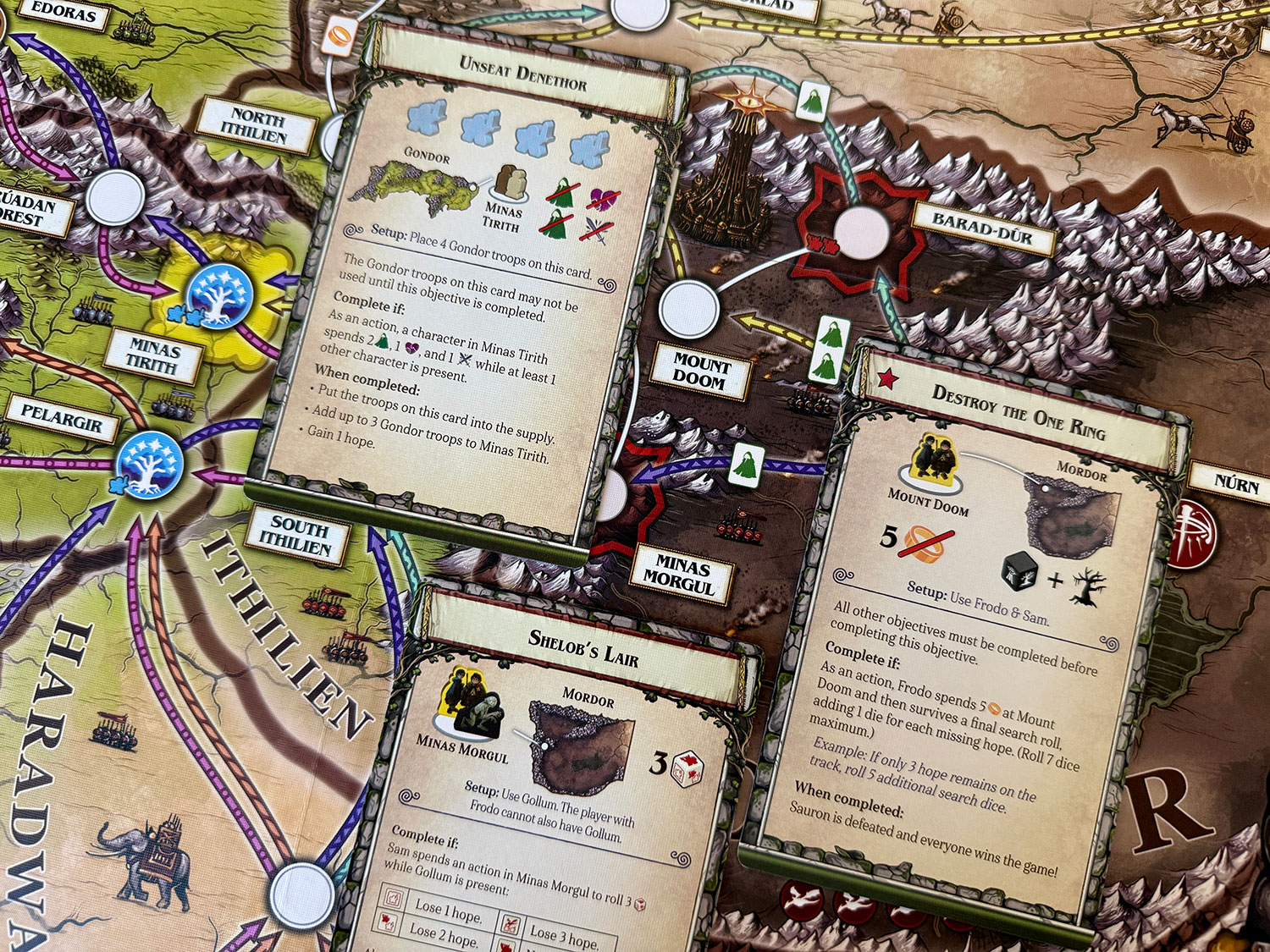
Fate of the Fellowship requires players to cooperatively complete three objectives prior to finishing the session by destroying the One Ring. One to five players choose characters (there are thirteen options) to join the fellowship, and Frodo & Sam must be included in every game. Who else is going to sneak into Mordor and finish the job?
There are twenty-three objectives beyond the ring’s destruction that provide plenty of variety. These feature key moments from the source material that can be reimagined by your chosen characters. While Gandalf the Grey must confront the Balrog on his own, and Gollum (yes, he’s playable here) is required for the confrontation with Shelob, players will find that their combination of characters and the session’s objectives provide plenty of unique twists to the story.
It won’t be easy, though. True to its origins, the Pandemic-style adversary has goals of its own. This is represented by several factions: masses of shadow troops, an ever-present threat of the Nazgul, and the watchful Eye of Sauron. After every player’s turn, two shadow cards are drawn that reshape the landscape of the board. This comes by way of new shadow troops being introduced or existing troops marching to new locations. Or also by the Nazgul and the Eye of Sauron shifting focus to new regions, always on the hunt for the ring.
Prior to play, both shadow troops, as well as friendly troops, are placed onto designated areas. Also, nine shadow cards are drawn one at a time, and a shadow troop is added to the location specified on the card, thus bolstering the enemy in a randomized way. Characters have their own starting locations, as do the Nazgul and the Eye of Sauron.
Players begin with a starting hand of cards that feature board-specific regions, icons that can be useful for certain actions, and possibly even some events that were added to the deck prior to play. There is a hand limit of seven cards, and at the end of a turn, two more are drawn.
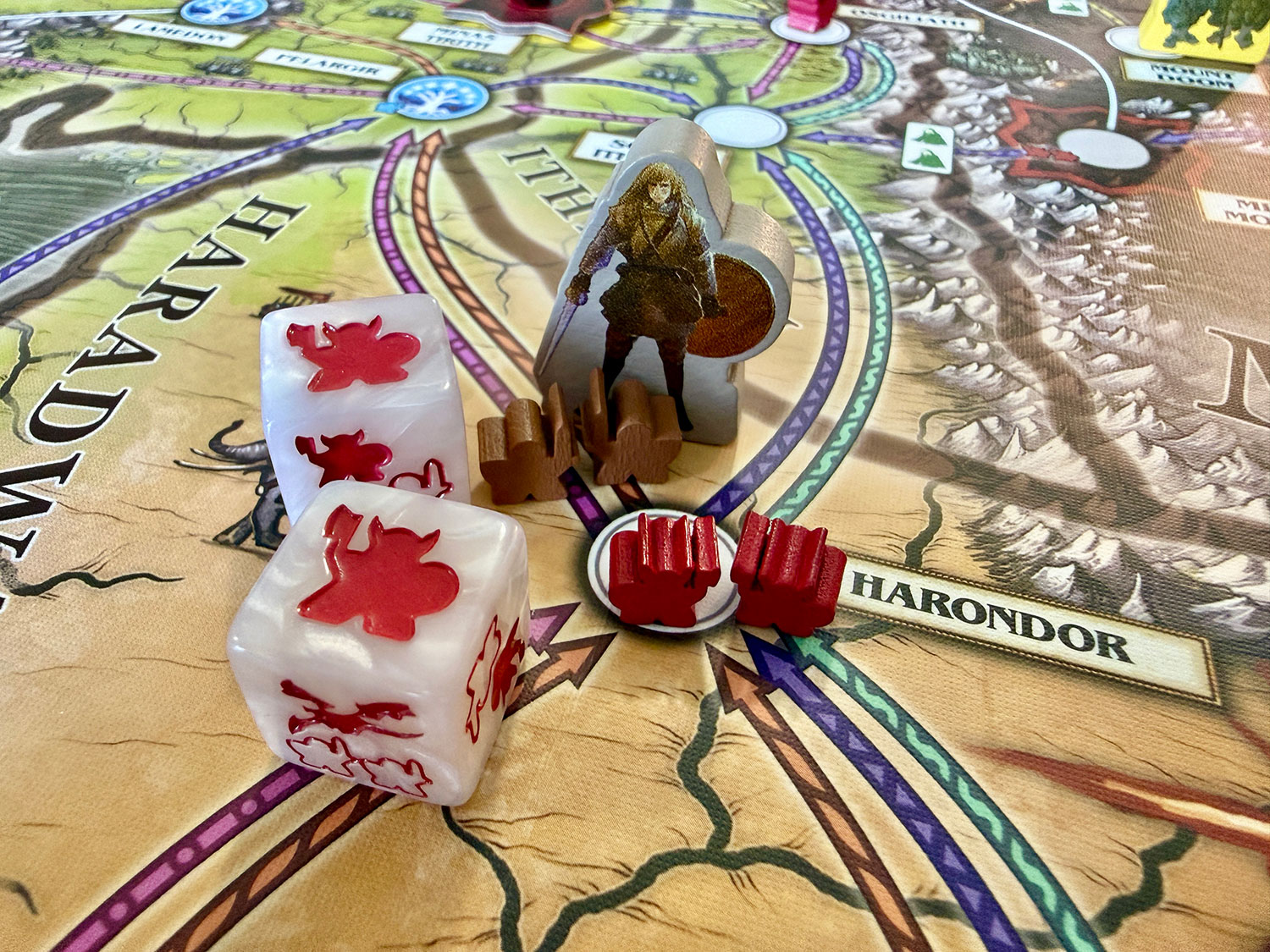
On a turn, players choose which of their two characters take four actions. The other character takes only one action. Actions range from moving to new locations via paths, adding new friendly troops to the board, swapping a card to another character at their location, capturing an enemy stronghold, or swapping a card for a token (to manage hand size).
Card symbols provide many of the resources required for actions. Some paths are secret and need a specific spent symbol(s) to proceed. Cards can only be swapped if the region matches where the character taking the action is located. Troops can only be mustered with a friendship icon. And capturing strongholds requires three matching valor icons. Cards with a resistance symbol allow for dice rerolls.
Two icons are important for the Frodo & Sam character. To move (or be moved by another character) without being seen, they must spend a stealth icon. Otherwise, the player must roll a Search based on the number of enemy troops in the new location, as well as any Nazgul in the region. Search dice feature an icon that lowers the hope of the fellowship. And reaching zero on the hope track ends the game.
Thankfully, characters can muster and maneuver friendly troops into battles with the shadow troops. In fact, battle is another action that requires the roll of dice that may eliminate enemies as well as destroy your own troops. Managing enemy forces is important so that they do not overrun important friendly havens, which would further reduce hope. Thankfully, each battle initiated by a player distracts the Eye of Sauron, moving its gaze to the new location and giving Frodo more time to sneak into Mordor.
Once all three objectives are completed, the final objective of destroying the ring can be achieved. This requires Frodo & Sam to reach Mount Doom, have five total resistance icons (the second important icon for them), and they must also perform one final Search roll based on Nazgul in the region, as well as any enemy troops in Mount Doom. Players must also add a die (up to seven max) for each missing hope. If this roll does not drop hope to zero, Sauron is defeated, and everyone wins.
Game Experience:
Fate of the Fellowship is a breath of fresh air in the cooperative landscape. While it utilizes some familiar rules and structure, the thematic integration is off-the-charts. There’s a revisionist spirit at play, as well as many specific defining moments that ring true to anyone familiar with the IP. Eowyn destroys Nazgul. Boromir sacrifices himself. Gandalf turns white! And even Tom Bombadil shows up on an event. We love you, Tom!
Each character has unique actions available to them that can provide utility. Galadriel can use her foresight to investigate the draw deck. Legolas can pick off enemy troops from afar. Gimli can muster his brethren without the need of icon assistance. Each is catered to their lore and provides plenty of variability to each session. One special note here is Gollum. He cannot perform many of the main actions, but his abilities are super powerful when used correctly, especially in conjunction with Frodo. Theme!
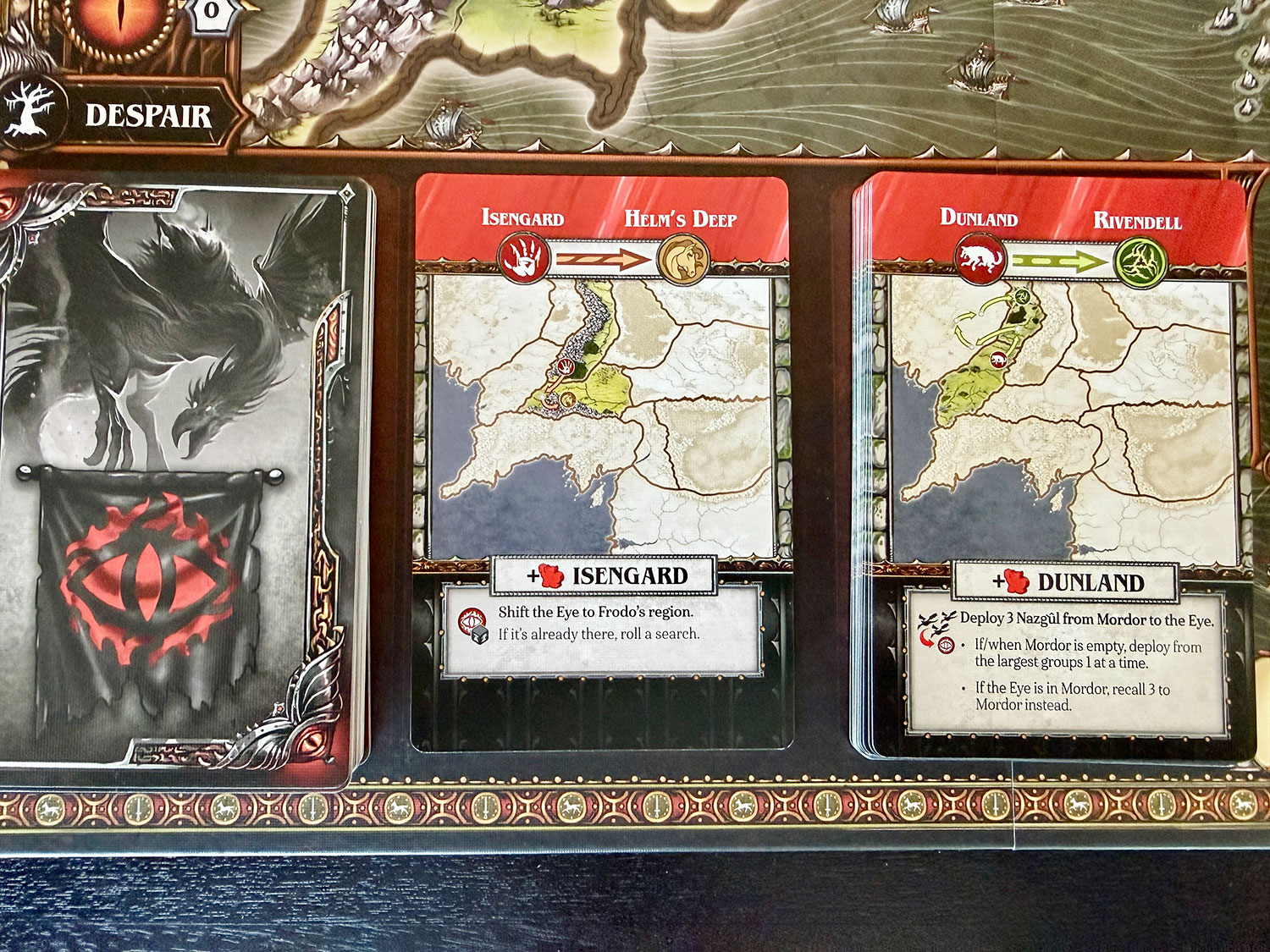
Beyond character thematic highlights, the system’s ability to keep the shadow armies alive and moving along the map’s battle lines is also superb. With each shadow card drawn, there is the potential for troops along a specific battle line to move forward one space. If they encounter friendly troops, a battle ensues. It’s great watching the shadow troops sneak into Havens while you’re not paying attention and capture a location.
And the ever-present threat of the Nazgul and the Eye of Sauron lurking above the action, following around Frodo & Sam, is exciting. It makes it feel like the game is constantly on to you. That Frodo was tempted by the ring. That the Ringwraiths sense your campfire. And yet, every step of the way, characters strike up battles across Middle-earth to constantly keep Sauron guessing.
The shadow cards must be mentioned in more detail. At the end of each player’s turn, a number of these cards are drawn based on an ever-growing threat meter. These cards have two options on them, and the option that triggers is based on the back of the card on top of the draw deck. A red banner means that shadow troops are going to move on a specific battle line. And a black banner means that a new troop is added to the board and the Eye and/or the Nazgul are shifting back to Frodo.
This is not an easy game. Even on the lowest difficulty level, it relies on maximizing actions. And this can be tough when you do not get the cards you need. At times, it feels like the action system could’ve used more nuance, allowing players to trade out cards or mitigate some of the luck. There are even times when players cannot even take an action while they wait for cards to turn up. The restriction on card trading being limited by its printed region restricts this even further.
As such, while the actions all make sense within the options provided, it can at times feel a little undercooked. And this can directly contribute to success. I’ve played this solo, and at two- and three-players, and there have been moments where characters did not feel as integral as others based on their card options. That’s something to share with your team prior to play so that they do not grow discouraged. Typically, everyone can at least focus on one objective to complete.
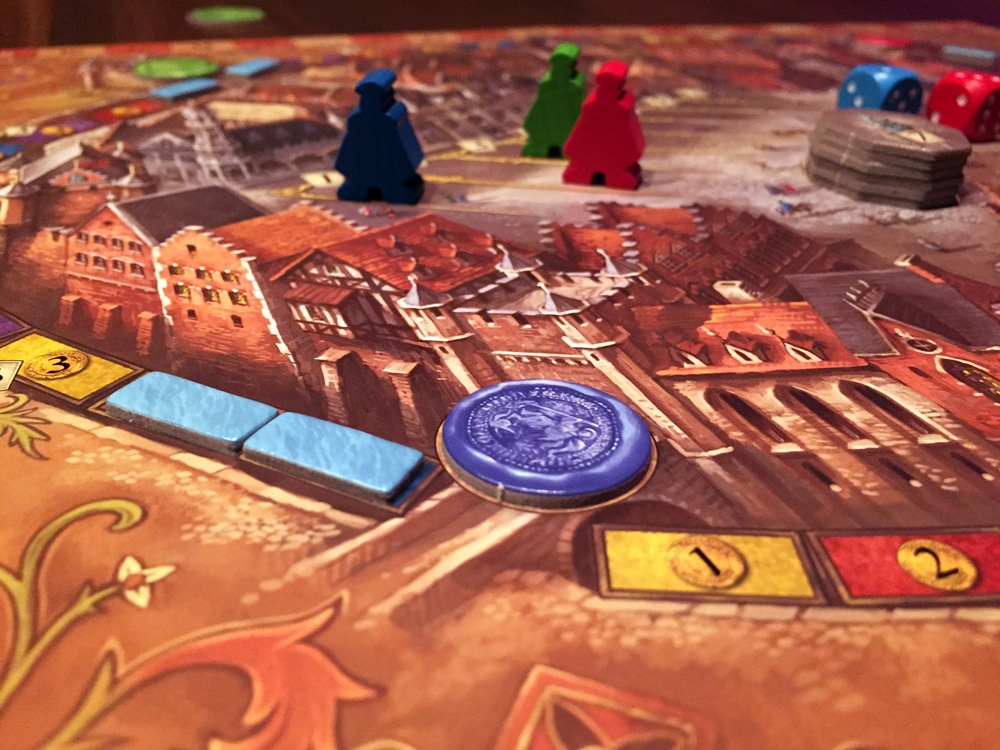
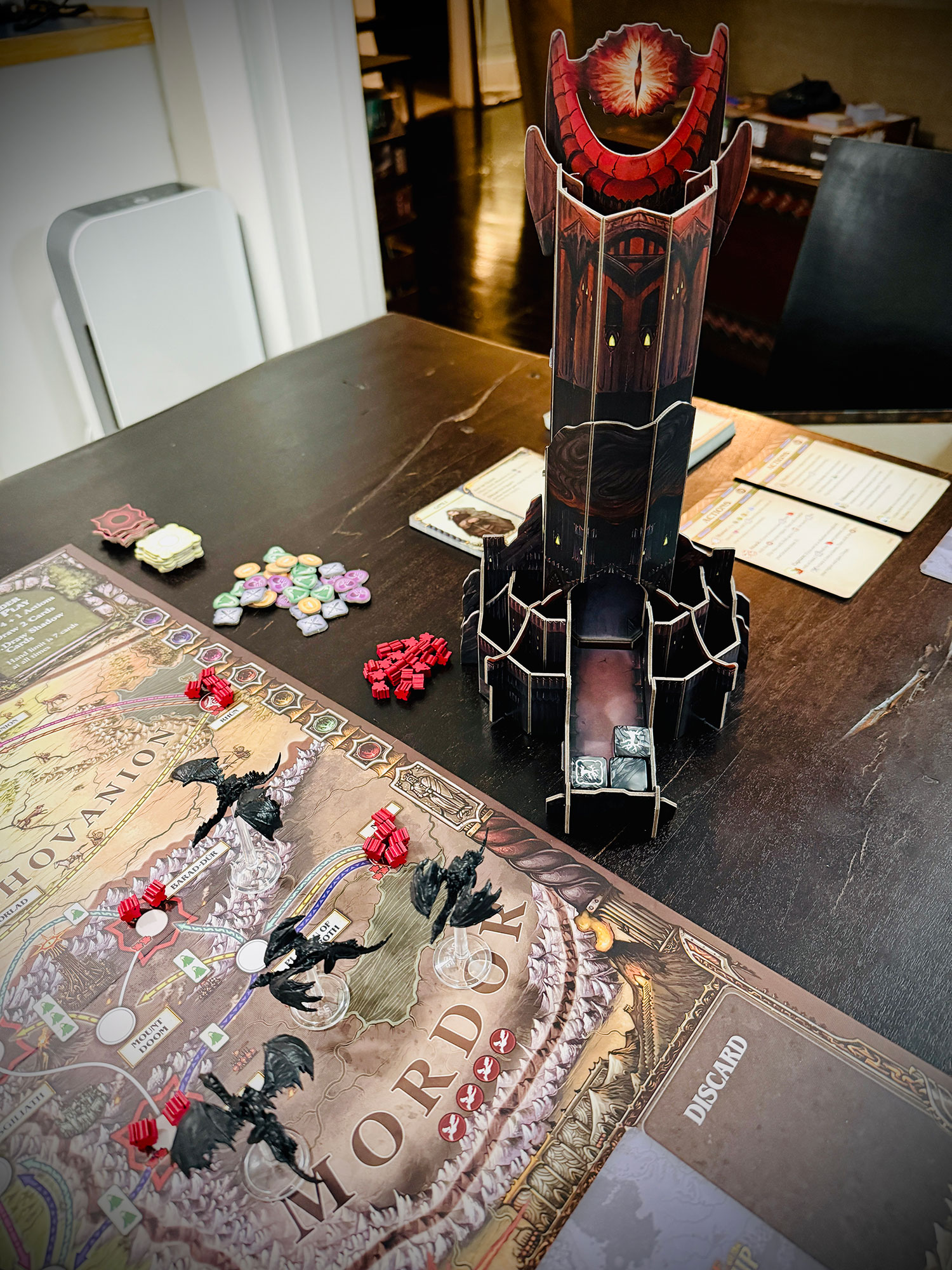
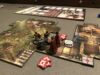
My final mention about gameplay is the actual components. First of note is the massive Barad-dur dice tower that provides a nice touch of table presence, though it is wholly unnecessary. It’s great when showing friends the game for the first time, though. The board itself also takes time to understand. It is quite busy with all the battle lines, paths, and regions spread throughout. This gets easier to parse over time, but is hindered by the final issue I have with the game.
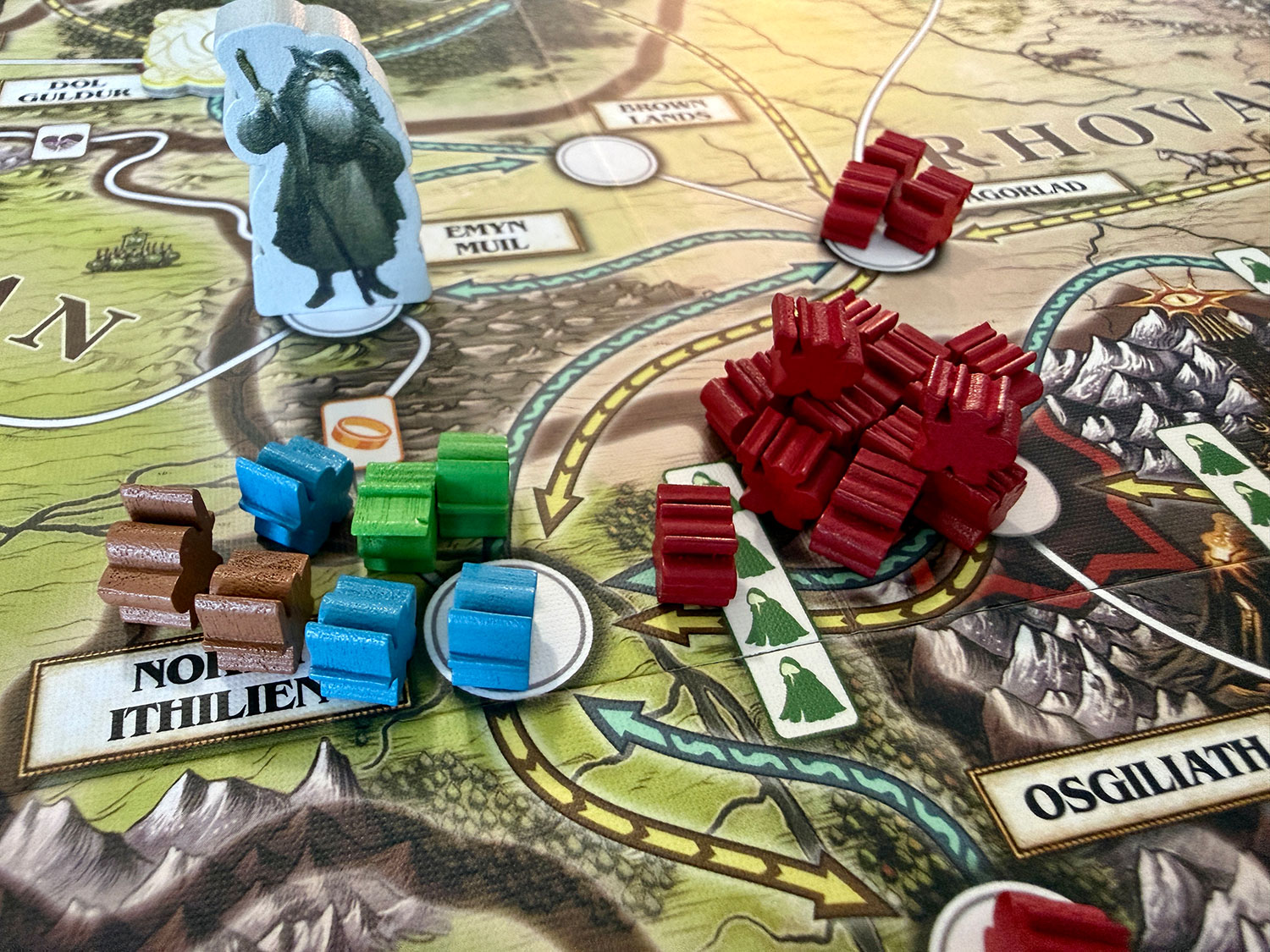
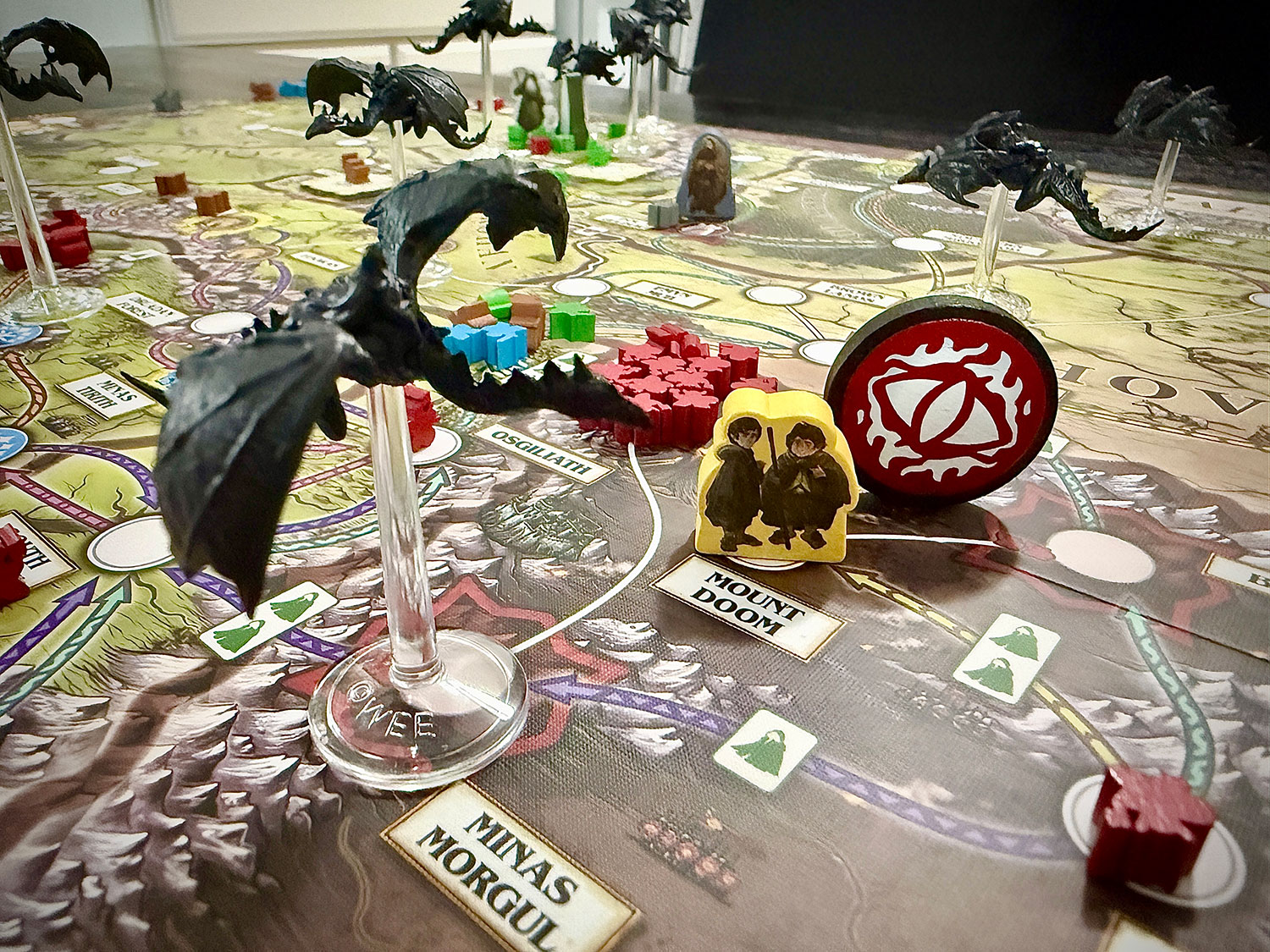
The Nazgul. Oh, the plastic figures that rise off the board with their clear stands and seem to do exactly what they are meant to: be imposing and ready to pounce. And yet, they are a massive hindrance to gameplay. Initially, they are spread around the board. But as Sauron closes in on the ring, so do the Nazgul. Cramming nine of them into a single region is not always fun. Plus, they tip very easily. And with friendly troops, shadow troops, and character figures running around the board, these standees are a nuisance.
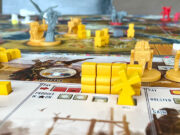
I’ve replaced them with stackable black discs to represent them on the board. A simple (not elegant) solution to a wildly overlooked component issue. With them out of the way, I can forgive the tiny troops (they are almost cube-like, reminiscent of their Pandemic equivalent) that you’ll stop trying to stand up and just let them lie about in whatever position they choose.
Final Thoughts:
For my group, we’ve had some highs and some lows with this system. I’m sitting at a 50% win-rate, which feels pretty good for something that demands a couple of hours of your time. I’ve not dug into the harder difficulties, as the base feels great for the casual cooperative game night. Every hard-fought session has gone down to the wire, with hope dwindling and the draw deck nearly empty. It makes that final attempt to destroy the ring such an epic moment.
As such, Fate of the Fellowship does many things right. And thematically, it is quite wonderful. I do still find fault with its action system, which can pull away from the immersion when your character is just stuck doing nothing. And the component issues are also a thing, though they can be fixed with some clever replacements. The map board requires some getting used to, though.
Imagine the epic nature of the War of the Ring, boiled down to a more manageable state, and shoehorned into the Pandemic system. If that sounds like a journey you and your friends are ready to endure, I’m sure you’ll delight in the thematic elements regardless of my misgivings.
Final Score: 3.5 Stars – You shall not pass up this cooperative opportunity. Though it may not become your precious.
 Hits:
Hits:
• Strong thematic beats
• Resolving shadow cards
• Keeping Sauron distracted
Misses:
• Cramped board
• Inflexibility of actions
• Component choices

Disclosure: The copy of the game was purchased by BGQ and not provided by the publisher. A designer who worked on the rulebook for Fate of the Fellowship also writes for BGQ. He had no influence over the opinions expressed in this review.





I would probably rate the game play ay a 4.5, but the components (EEK!) The miniscule over-busy board, the eeeny-weeny units (both friendly and sauron forces), the ridiculous Nazgul that always get in the way and topple at the most inconvenient moment and the even more ludicrous dice-tower.
The cost of the whole game could’ve been brought down and the board and other components upgraded rather then it being spent on needless bling.
There is aldo a problem if you play with the suggested solo rules. Half the cards become a problem as you cannot swap them for tokens because they are in enemy territory. Plays well two-handed solo however.
I actually replaced the fell beasts to make it easier to move things around the board!