 I am an abstract fanatic. While I certainly haven’t played them all, because as far as I know, my time in life is finite, I have played more than the average bear. But my favorite “rivalry” in the space is seeing how Gigamic’s Classic Series (Quarto, Quoridor, Qawale, etc.) shape up to Project GIPF (GIPH, TZAAR, ZERTZ, etc.). I jumped at the chance to play Qomet, the newest game by Gigamic. So let’s see how it shapes up to the competition (this is a pun, let’s see how it lands once you know the conceit of the game).
Gameplay Overview:
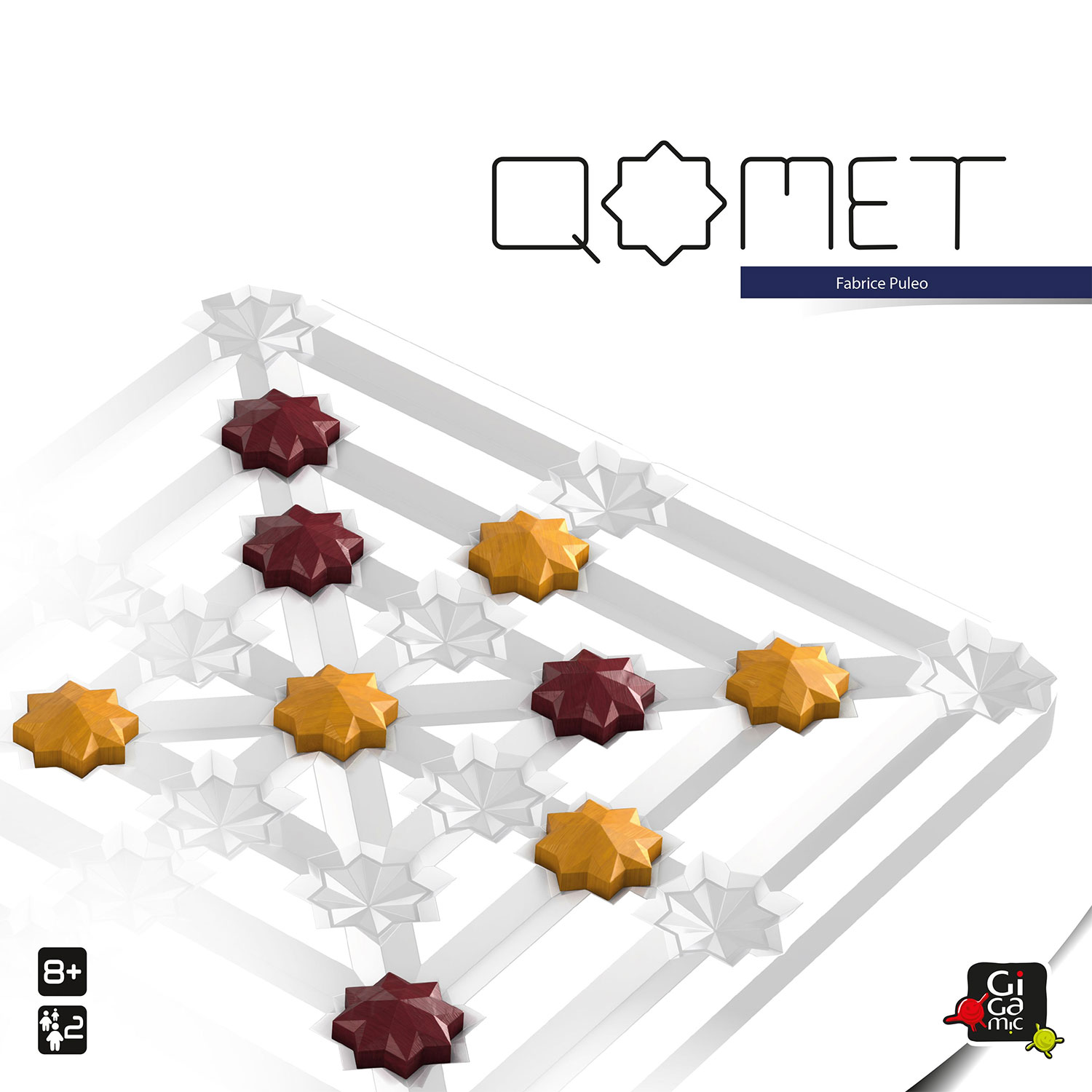
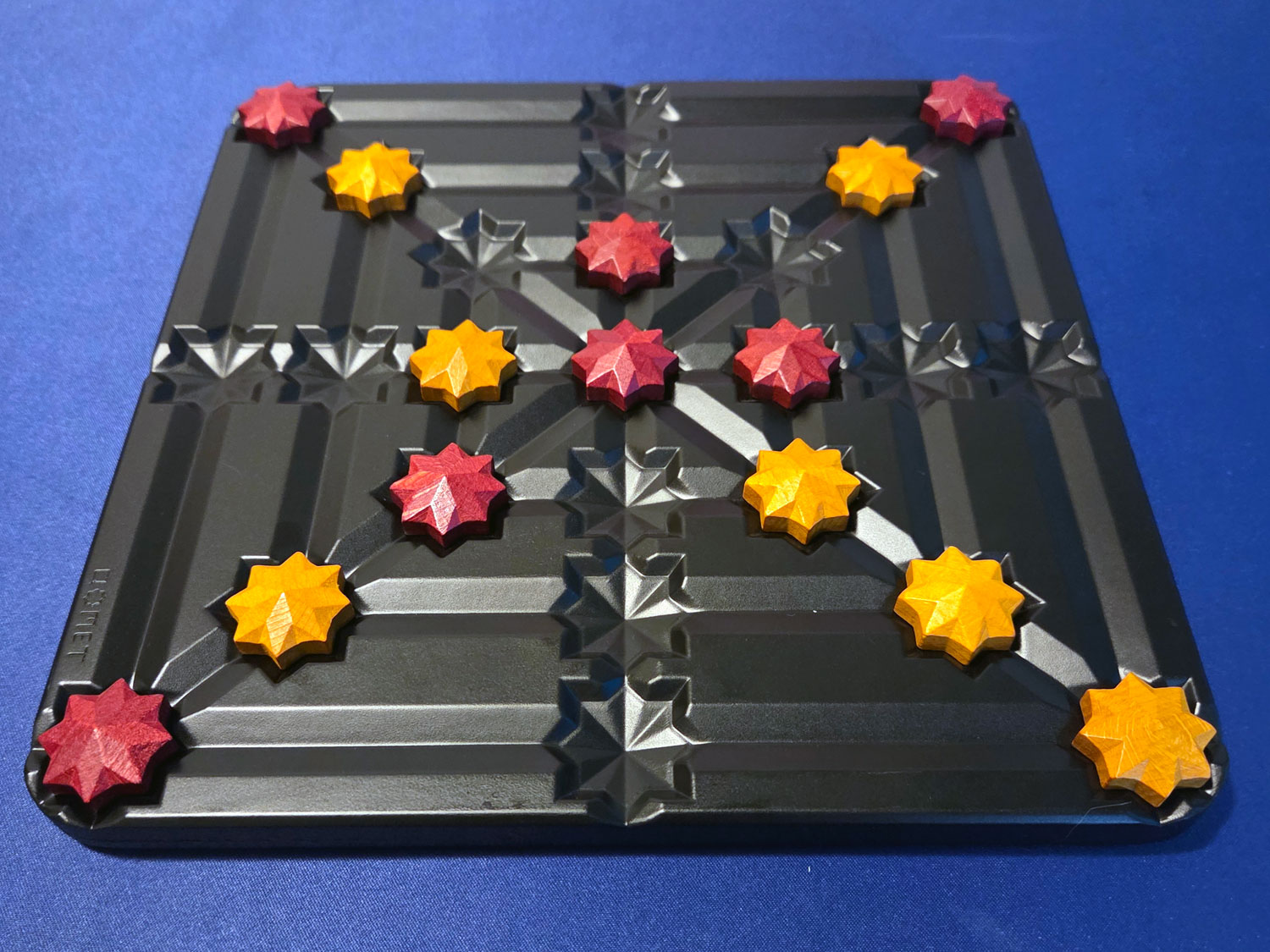
Qomet is a simple two-player abstract. There’s a square board with 25 spaces on it, and each player has seven stars they can place on the board. On a player’s turn, they are either going to place a star onto an open space or move one of their stars on the board to another space adjacent to where they’re currently at. Unlike the classic game Nine Men’s Morris, however, when you move one of your stars, you can “bump” either one of your stars or one of your opponent’s stars, as long as they have a space next to them open. Finally, you can “bump” stars off of the board entirely, as that counts as an “open space” with which to do so.
The goal of the game is to form a square of your stars on the board. This can be a large square encompassing the four corners, or a small, dense square right in the middle of the board, or anywhere in between. The listed playtime per game is 15 minutes, but at the low level my wife and I played at for our dozen or so matches, I’d say it’s closer to 5-10 minutes.
Game Experience:
In my opinion, a successful abstract is one where each game played leaves you with a lesson, while also having moments of pure excitement. Thankfully, Qomet provides both in spades.
Unlike ancient abstracts like Go or Chess, where there are so many moving parts that lessons can be hard to grasp, Qomet gives each player a grand playground in which experimentation is encouraged and rewarded. A major part of this game’s success is that each match gets harder as it goes on instead of simpler (if not easier). On a lark, I started one game by randomly placing my first three stars onto the board, and yet I still won, because each star on the board is so versatile in its function that there’s no bad place for a star to be: it’s all about timing and not limiting your thinking. And while the game board gets filled up, the movement rules and ability to “bump” pieces never leave a player feeling unable to win: it’s all about capitalizing on each opportunity given. I truly feel like after each game, I internalized a new, neat trick to bring into new games.
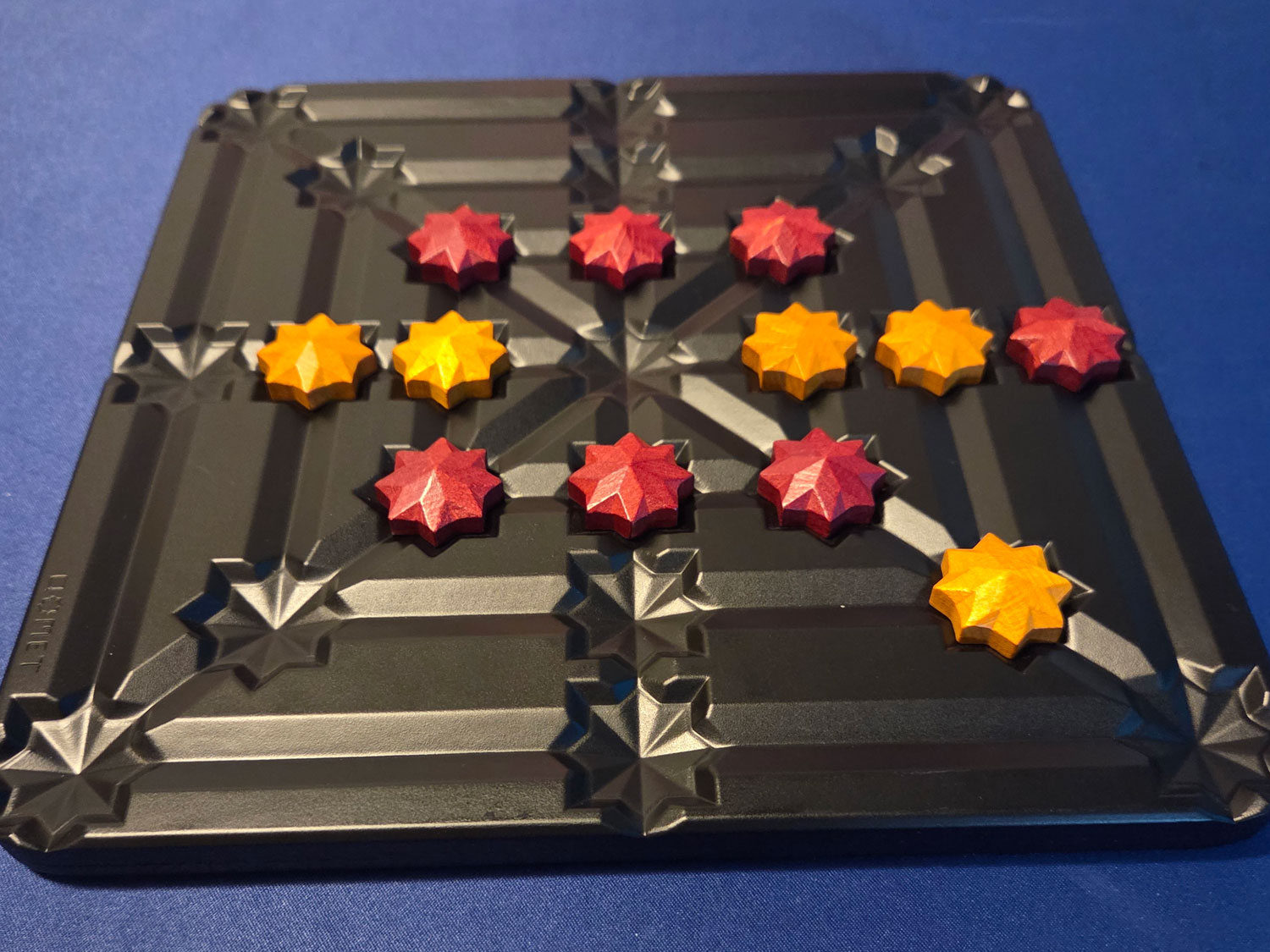
The excitement of the game comes from a balance of how obvious early attempts to complete a square are and how nearly all games will end with some explosive, unseen move. When my opponent starts creating a square, either with two or three stars, it gives me the chance to stake out the best way for me to be defensive (to block their victory) and offensive (how to block their victory yet set myself up for a “bump” towards victory). Even if I can’t scream at the table to reveal my evil schemes, there’s still excitement that builds up, even just a few turns into the game.
But the real explosive moments come from the unseen. With so many moves available on the table at all times, each game was filled with at least one moment of drama where a victory or powerful move was not seen or blocked by the opponent.
As expected from Gigamic at this point, the production is also top-notch. It’s just 14 wooden stars and a wooden game board, but a lesser company would make these pieces plastic and still try to get away with a $40 MSRP. So hats off to them for keeping a consistently high-quality product.
Final Thoughts:
Qomet is another hit from Gigamic and their Classic series. While its inventiveness doesn’t shine like with Qawale and Quoridor, taking the bones of a solved game like Nine Men’s Morris and making a few small tweaks still produces a high-quality adventure. This is not some dry, boring, quiet abstract: each moment feels important, and it’s never possible to feel 100% sure you’ve made the right move. It provides the best of both worlds: attaining the feel of an abstract while not having dips in the excitement of the game.
Final Score: 4.5 Stars – A quintessential, quadrilateral, quizzical quarrel.
 Hits:
Hits:
• Simple, elegant design
• High-quality production
• Not Your Grandpa’s Abstract
Misses:
• Not completely unique territory
• Hard to visualize the victory condition
• Colors of components are drab