

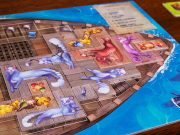
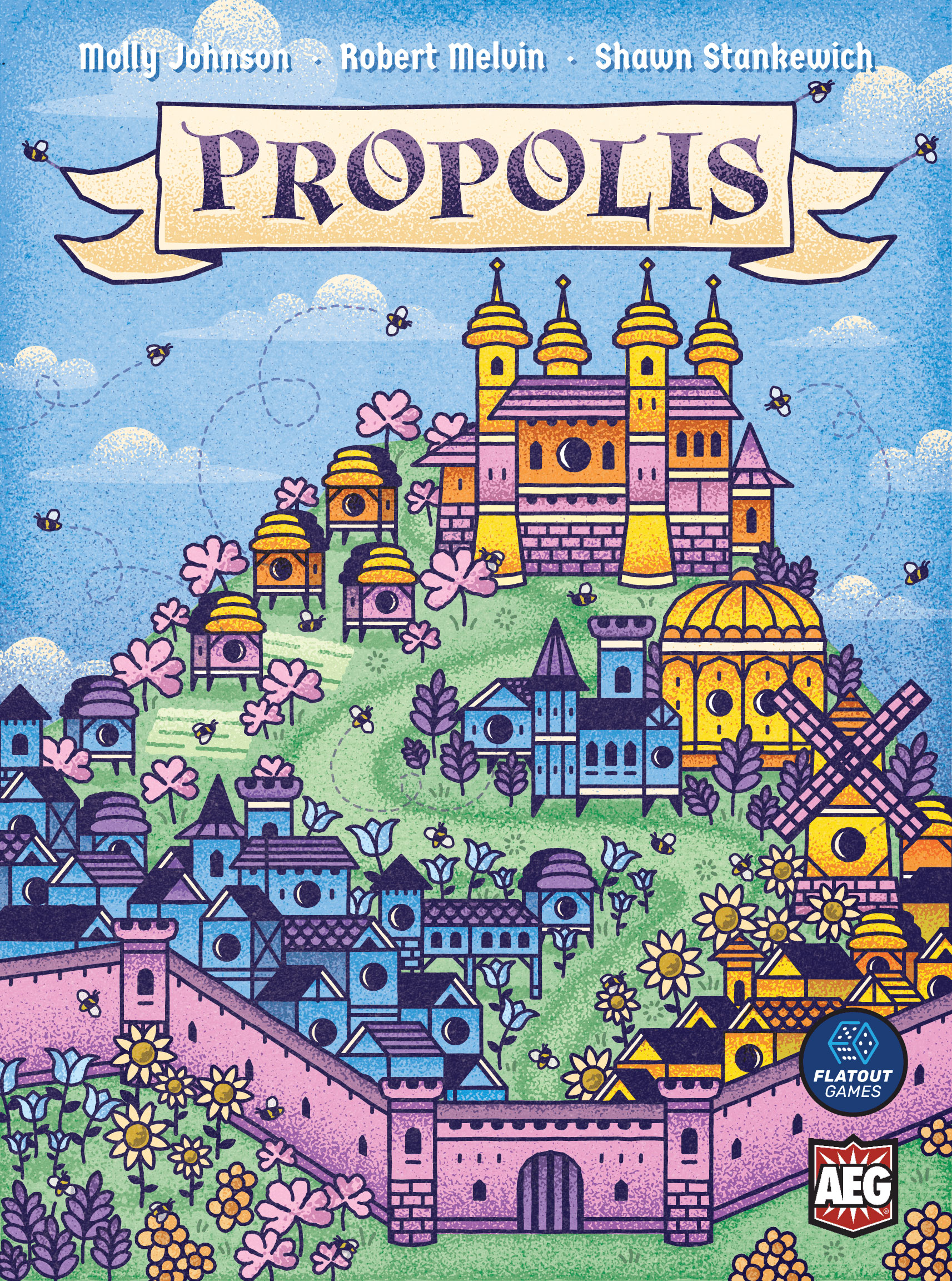
 Sunshine filters delicately through the dew. Edvard Grieg’s Morning Mood babbles softly forth from the nearby brook. Pastels abound. The air vibrates with the gentle buzzing of medieval Worker Beeples as they embark upon their quest to build the most pimped-out Bee Palace.
Propolis, from Molly Johnson, Robert Melvin, and Shawn Stankewich, with art from Dylan Mangini, and published by Flatout Games/AEG, is a 1-4 player game that takes about 40 minutes to play.
Gameplay Overview:
Propolis is a worker-placement, engine-building, area-control, tableau-building game. Or so says the rule book.
Players take one of five actions on their turn, two pairs of which are basically the same action.
- Place Worker Beeples. Pick a resource card, claim spaces with your Worker Beeples, and gain said resources.
- Fortify Worker Beeples. Are you tired of reading it yet? Well, I think it’s adorable, so get used to it, bub. Anyways, fortifying means you lay down your Worker Beeples and gain resources again
- Retreat Worker Beeples. Bring ‘em back to the hive!
- Build a building. Spend the resources your Worker Beeples so diligently collected to build a sweet new pad
- Build a Queen’s Palace. Rub it in your opponent’s faces that your tableau has the right icons to build a decked-out Bee Palace.
The game ends when someone has built their 10th building. Then you score your tableau and resources, and the winner is the player with the most points.
Game Experience:
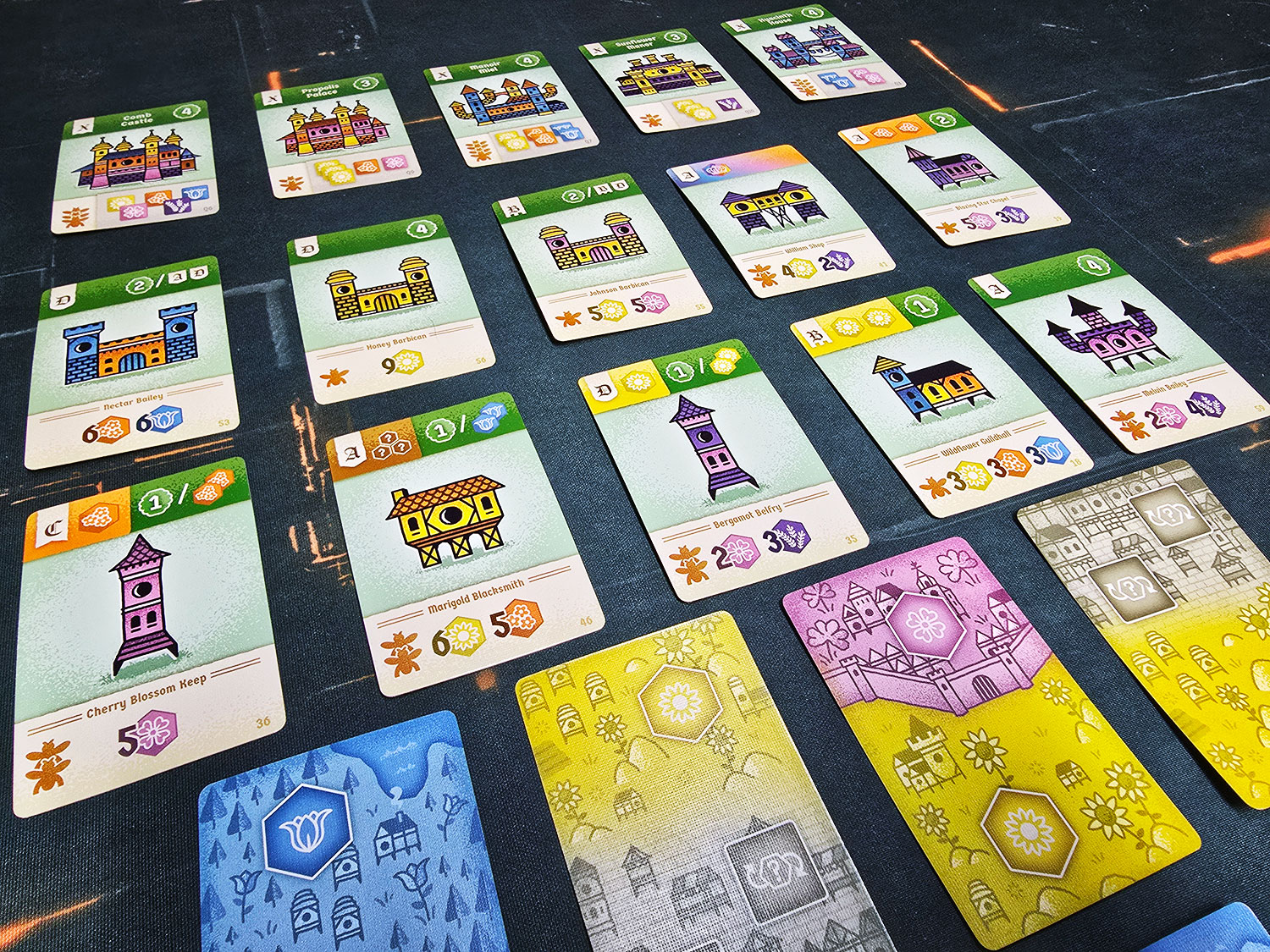
Setup is fairly quick. Grab a player board, Worker Beeples, lay out the landscape cards for resources, the building market, and the Palaces for Sale, and get rolling.
Some of the pastels are shaded closely enough that, in my initial unpacking and sorting of the game, I thought I had 4 extra resource tokens. Nope. I just missed the shading difference between Misty Rose and Cherry Blossom. My bad.
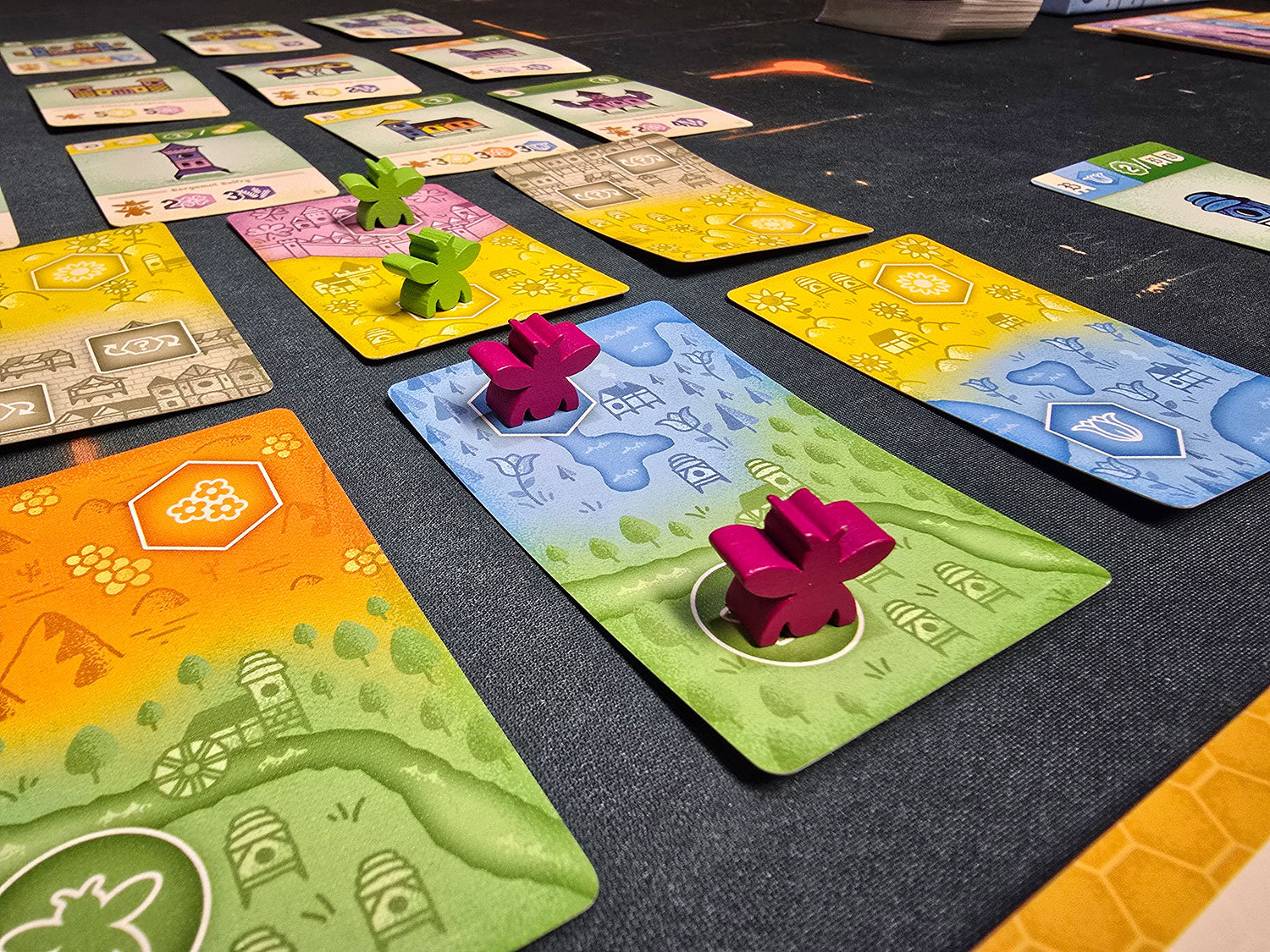
Sitting at the table, you’re presented with this wonderful pastel landscape and arrays of cute buildings. The Worker Beeples are ready for action, and you dive in.
Hey, that looks like a nice spot. Why don’t I nab that pollen for later? Oh, my turn again already? Huh, there are none of the other resource spots available? Guess I’ll… Fortify? To just… gain the… Same… Resource. Coooool.
The gameplay quickly falls flat. The resource gathering is so basic that it’s boring. I’m not asking for a 4-step production chain a la Uwe, but give me an ounce more meat here! OK, fine, they are bees, so they eat pollen sandwiches, whatever.
The point is, there is nothing rewarding in the way the most basic—and most necessary—part of the game is structured. It’s a grind, and that’s it. Well, hang on, if we’re simulating medieval bees, maybe that was their life too? Was this a galaxy brain move from the designers to gamify serfdom?
Nah. Nope. It’s just boring.
The area majority piece is such a weird add-on. Once a row of resource cards is full, players evaluate which Worker Beeples have the most presence. Fortified Beeples count double. The player with the most takes their Beeples back, and if it happened while it was another player’s turn, they get a wild resource too.
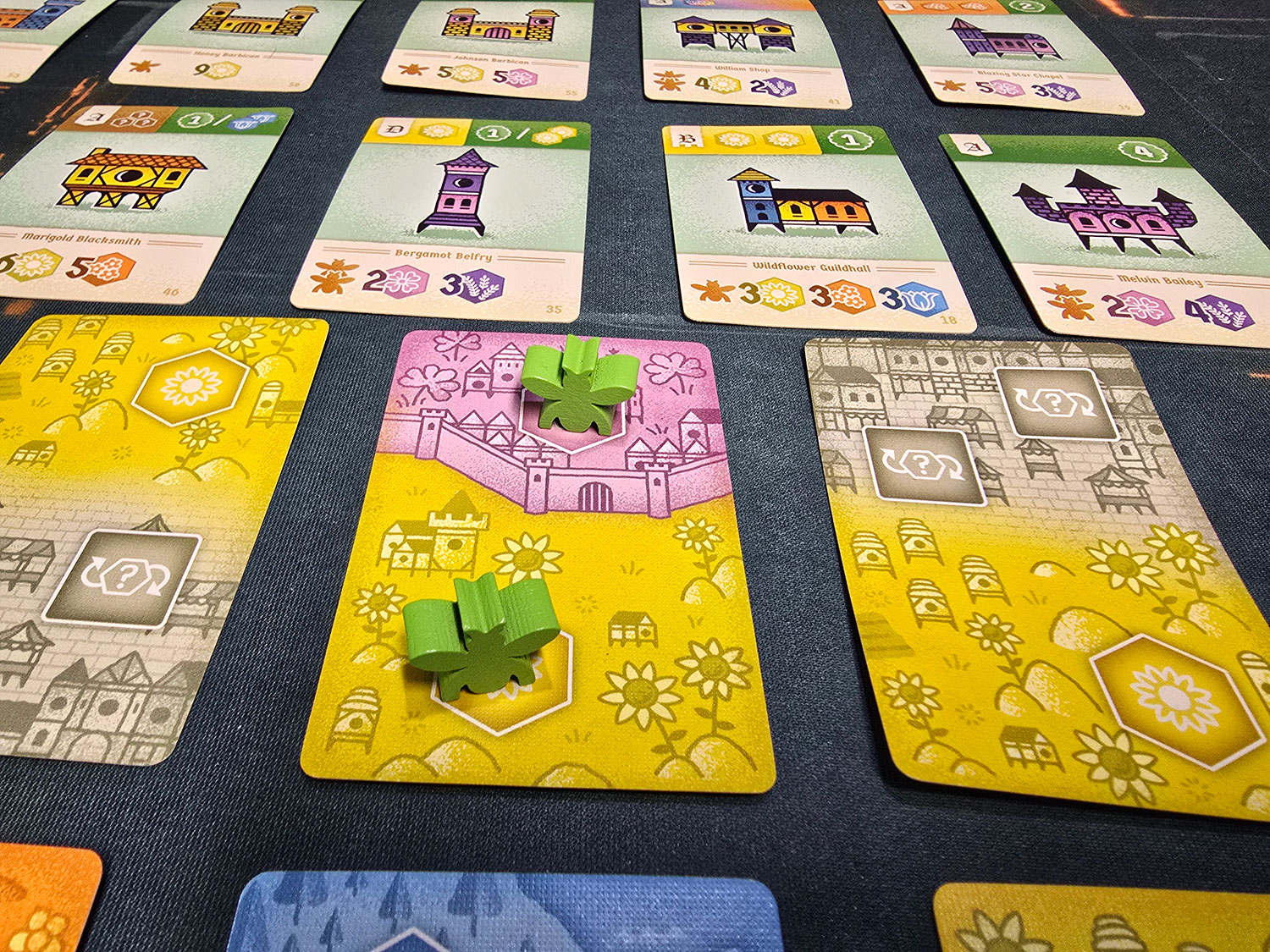
Why? It’s such an unnecessary bit of fiddliness for what amounts to a “workers come home” step. Which, as a reminder, players can also just do. As an action. It was frustrating every time it happened, and we had to constantly remind ourselves about the bonus resource. Another strike against fun. Damnit.
The resource market is also frustrating because of how variable it is. It evolves as cards are removed when the majority scoring occurs. But spaces get blocked so quickly that you can get forced into taking whatever new landscape cards show up.
There is a way to mitigate this. Kind of. There are some resource cards that have trading spaces, meaning you can swap any standard resource for another. Except those also get quickly leapt upon. And you can never place on an already occupied card, so if someone beats you to it, you’re stuck. Again.
When you’ve finally gathered enough resources from the landscape, you can buy a building from the market. Buildings are points and will also have either an immediate benefit or a permanent resource.
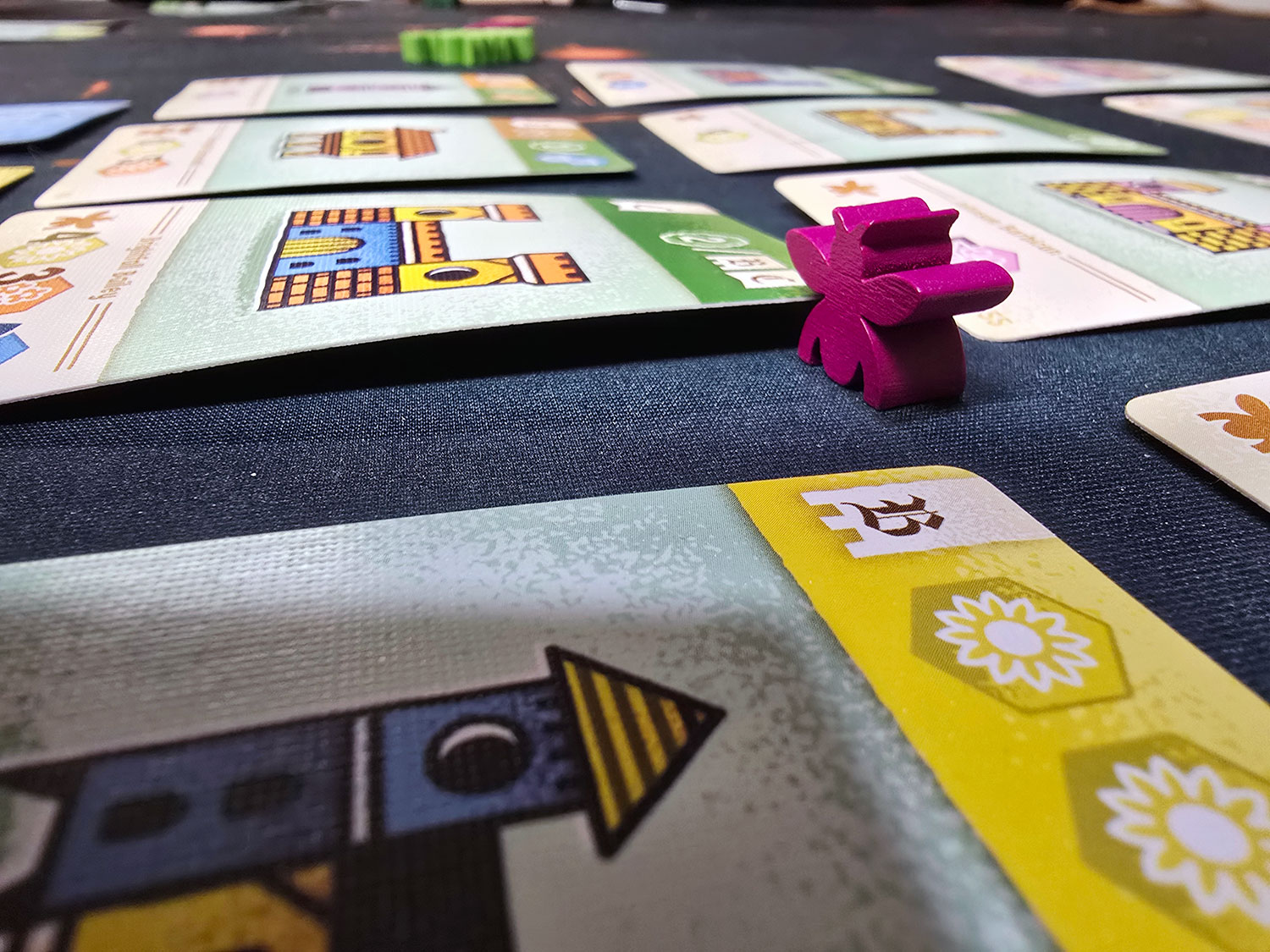
The building is added to your Bee Tableau, and you go right back to gathering resources.
Once you’ve finally got enough matching permanent resource icons in your tableau, you can build your Queen’s Palace. This is also points. And you can only have one per game.
The best part of the game is the race for buildings. It’s often obvious which buildings a player is targeting, so racing to buy them first is fun. This is because players’ starting buildings have a scoring condition on them, so they’ll target A- and D-type buildings. And there is generally an overlap for the buildings players want to target for scoring, or for resource icons.
Otherwise, it’s a very cute, very grindy snoozefest.
Final Thoughts:
I wanted to love Propolis on the strength of its aesthetic and Worker Beeples alone. I could not. The game behind the art is boring and frustrating. The game does include a solo mode, which I did not try.
I also experienced a number of component issues. Some of the Worker Beeples had clearly stuck together, so I had flecks of paint from one color Beeple adhered to another. The cards that came with the game had a maddening amount of warp.
I occasionally get board warping where I live because of the semi-arid climate. The humidity here hovers around 28%. But these were cards themselves warping, not a glued double-layer board. And warping badly! I find that unacceptable.
Finally, why are the bees medieval? What? How does specifying an era of bee-dom add to the game? When was the medieval era for bees? Has it happened yet?? Is this a glimpse into a dystopian future ruled by warring Bee monarchs?
Final Score: 2 Stars – Propolis is so so cute, and so so boring. You may think that’s bees buzzing, but no. It’s all the snoring from around the table.
 Hits:
Hits:
• Pastel paradise
• Worker Beeples!
Misses:
• Gameplay is boring and grindy
• Production issues with components












It’s a shame. Propolis caught my eye mostly due to the artwork. I always love & depend on the reviews at BGQ, and you saved me a few bucks until they (hopefully) make some necessary improvements.
I appreciate the honesty on this review.
My wife and I enjoy Propolis. Is it the best game ever? No, not by a longshot. But your assessment is a little harsh. There are some interesting decisions in the area majority aspects of the game, and the resource gathering is fine.
Not for everyone, I suppose, but i wanted to provide a counterpoint.