


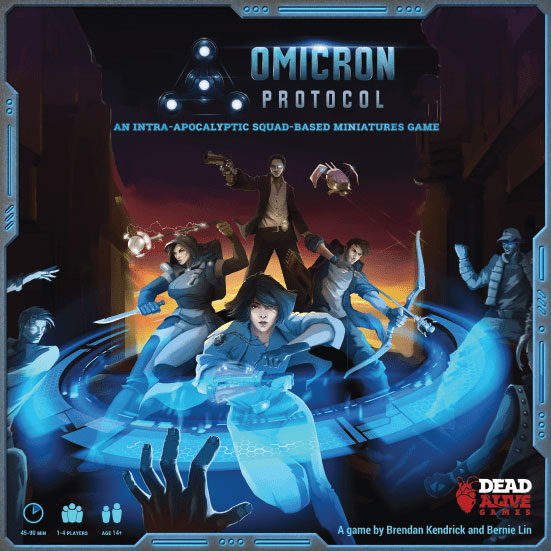
 The year is 2044, and the city of San Lazaro has become the epicenter of the world for cybernetic enhancements. In 2050, a mysterious techno-virus has ravaged most of San Lazaro’s population, and a majority have turned into murderous CyMS (Cyber-Memetic Sociopaths) who attack those not yet infected. The uninfected are trapped in this lawless city, but band together trying to survive and escape before the government neutralizes all within San Lazaro.
This brings us today’s review of Omicron Protocol from Dead Alive Games. This is an intra-apocalyptic, cyberpunk-themed, squad-based tactical game that has two factions battling out in scenarios, trying to survive and eventually escape San Lazaro. Omicron Protocol can be played by 1-4 players and includes different game modes for competitive, cooperative, or solo play, and takes about 45-90 minutes. Does Omicron Protocol sound like a game you would like to play? Read on!
Game Overview:
There’s a lot to cover with Omicron Protocol, so I’m going to do a high-level overview, and for those who want more detail, the rules can be found online at Dead Alive Games: Omicron Protocol. I will be highlighting the base game that includes two factions: Survivalists and Peacemakers, and in competitive mode.
Omicron Protocol is played over 3 rounds, and players will spend action points from their action pool to activate their characters. In the first round, players will have a 5-action point pool, and then that increases by +1 for each of the following rounds. The first player will activate one of their characters, spending action points from the general list of actions as well as abilities from their specific character cards. Some character actions and abilities will generate EM noise that will attract CyMS.
After the first player’s character activation ends, the CyMS will activate and are controlled by the rival player. If a CyMS ends its movement next to a character, then they attack. Otherwise, the second player activates a character, and this repeats until all characters have activated.
The end phase is then triggered, and rivals will roll EM noise dice based on the total generated and place the appropriate number of CyMS in the spawn point of their choice. CyMS activate as noted above. Once CyMS spawning and activation are completed, then players do a general clean-up of abilities or conditions.
Please note: Players will also gain forage cards at the start of the scenario and can also gain these by spending action points throughout the scenario. These give players bonuses either once or throughout the scenario.
Each scenariopo has a uniue end-game trigger, but these are generally related to collecting VPs by KO’ing CyMS, rival characters, or collecting scenario-specific objectives.
Game Experience:
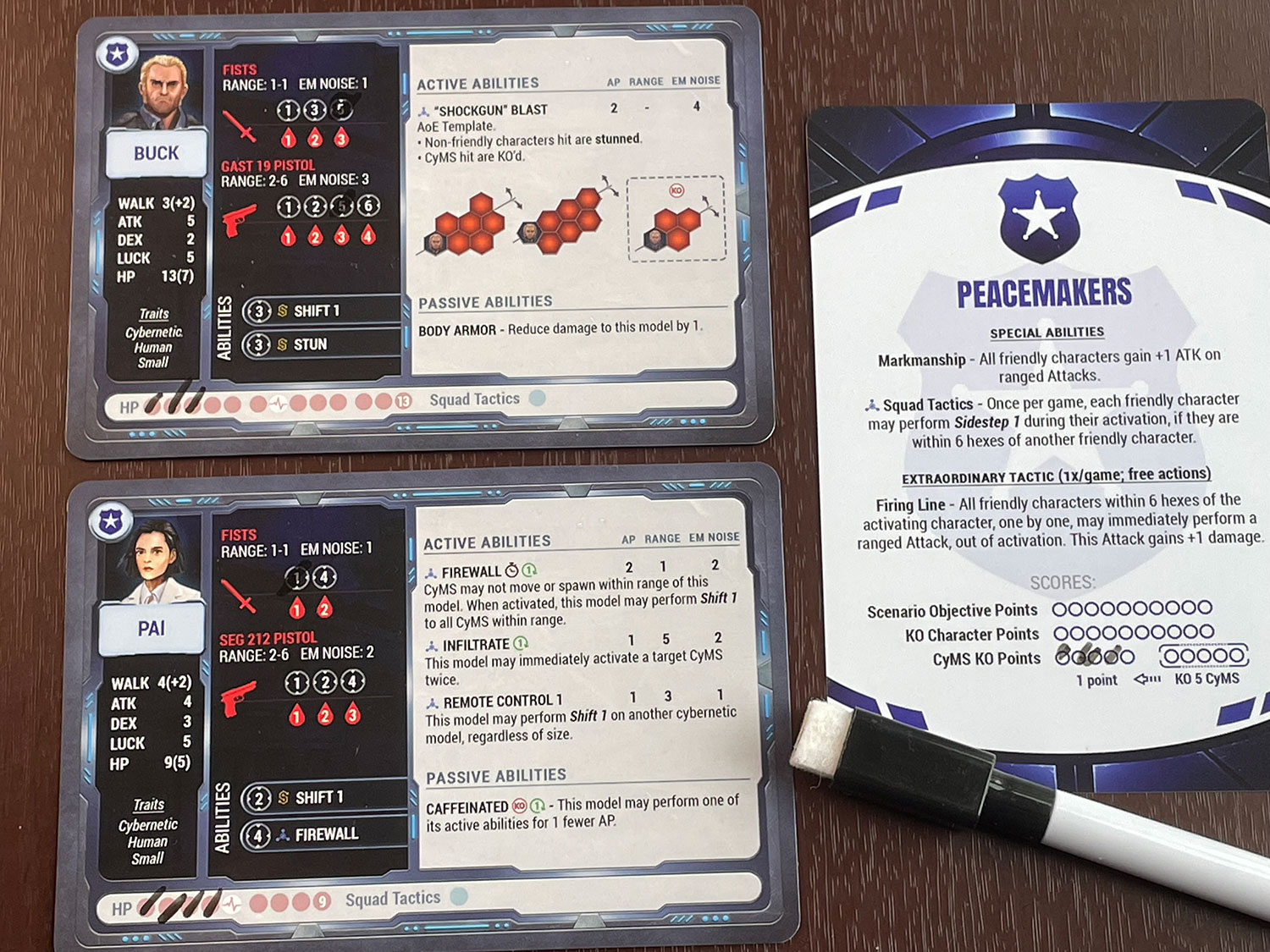
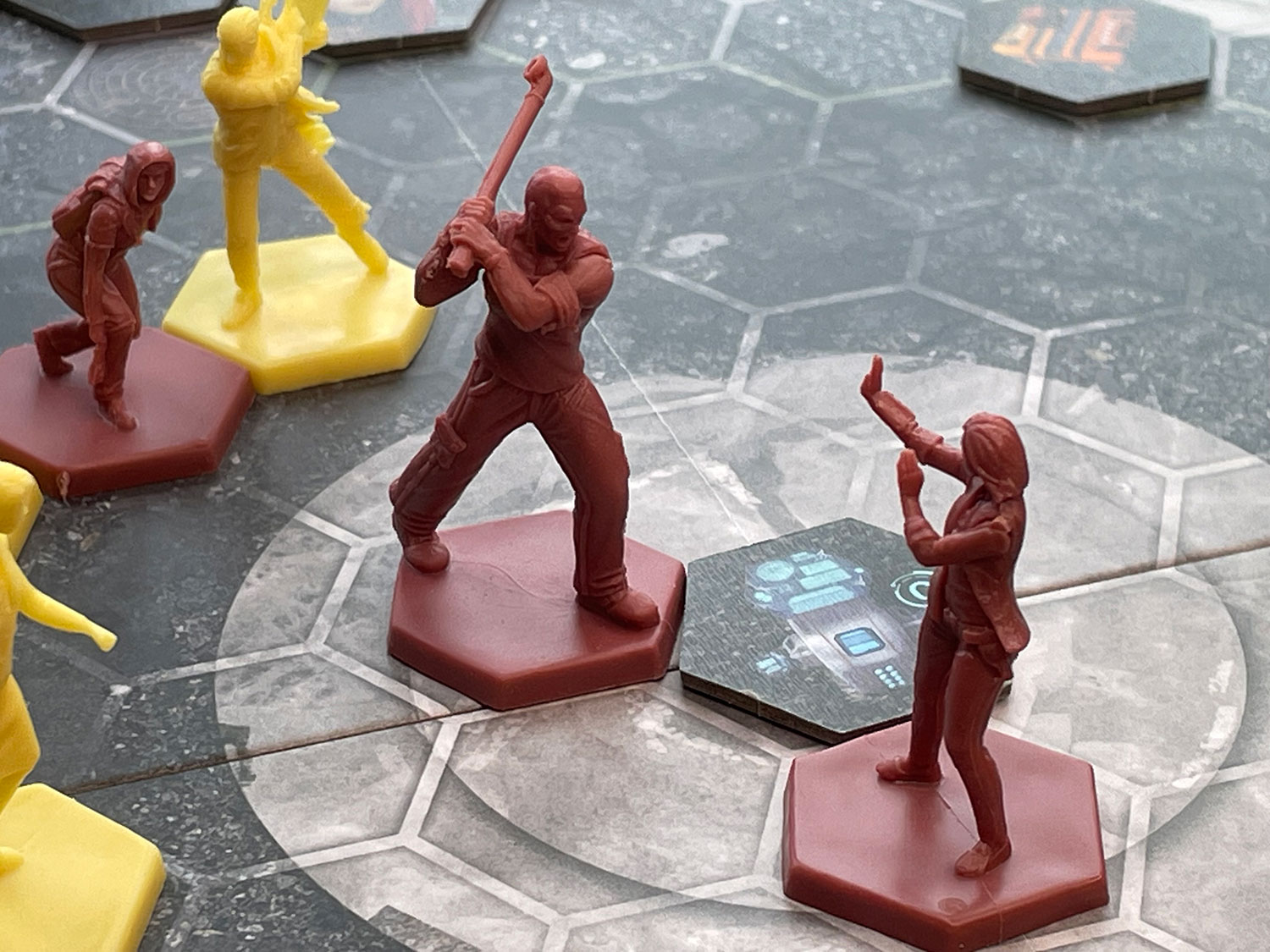
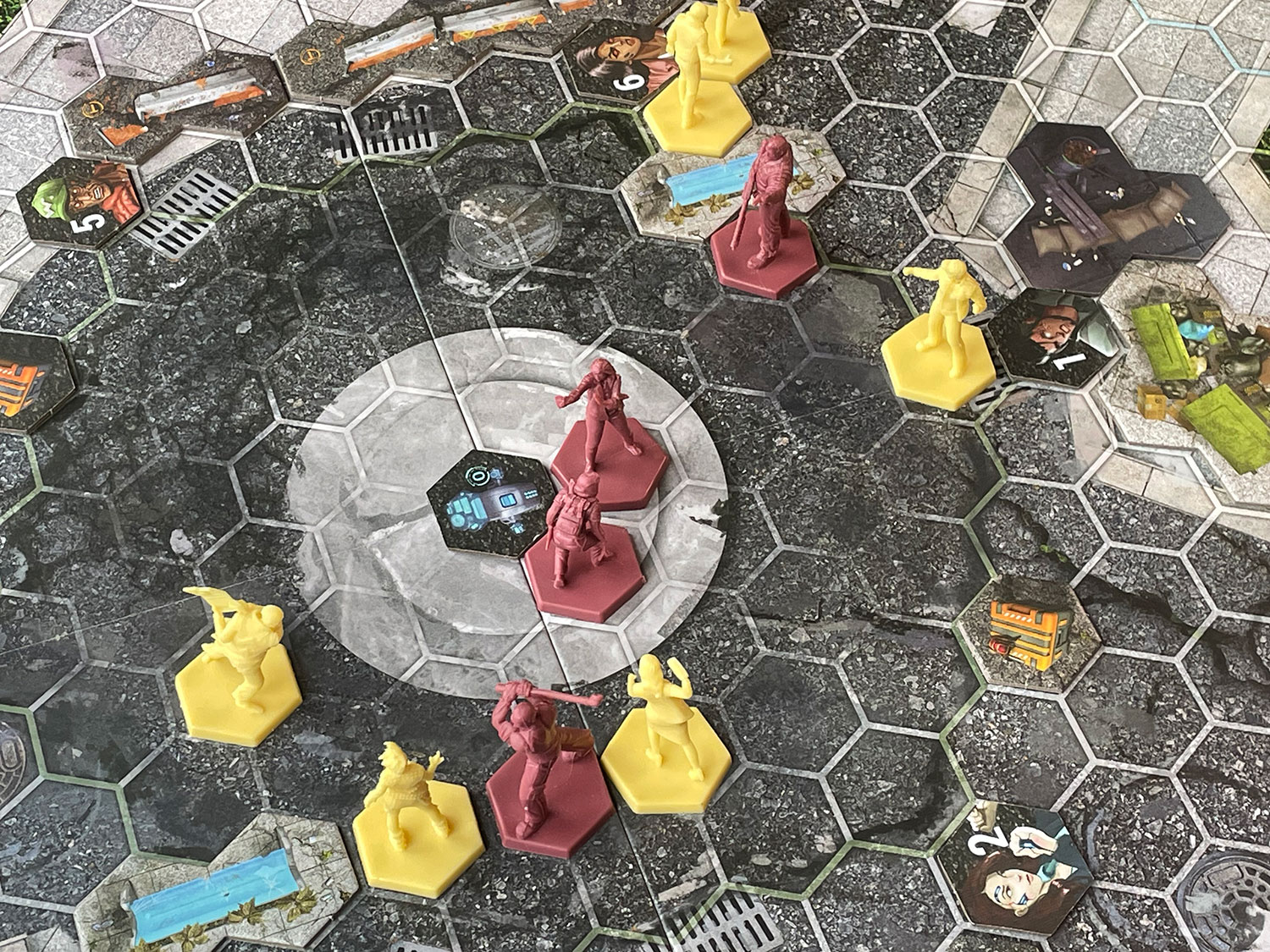
I must admit that I don’t know much about Dead Alive Games, but the production values of Omicron Protocol are great. The miniatures are well sculpted, and the map, cards, and counters are quality. I think my favorite pieces are the faction and character cards that are coated for dry erase to track scoring on the faction cards and EM noise & HP on the characters. This was a smart and effective way for players to note these vital game elements. The multiple player aids are handy tools for players, and the rulebooks are well organized, plus they include art that helps support the overall intra-apocalyptic and cybernetic themes.
I didn’t mention this in the overview, but I did want to highlight the smart action-store mechanic in Omicron Protocol. The action store appears on each character card and shows success and ranges of damage a character can achieve, depending on their die-roll successes for attack actions and performing abilities. A player can decide how to spend their successes when attacking and spread damage around or possibly do max damage to an opponent. The action store gives players a nice amount of variety to choose from on their turns.

Now, when your dice rolls don’t go your way, Omicron Protocol does have a great luck mitigation mechanic. This is in the form of luck tokens that are one-time use and are generally used to add +1 to a die. These can come in handy in any game situation. Players can spend luck tokens equal to their DEX stat to reduce damage, and also spend 3 to remove a condition like stunned. Characters can also generate luck tokens by spending attack or ability dice equal to or higher than their luck stat and gain that many tokens. Again, this is a great mechanic that can help players mitigate bad dice rolls during a scenario.
The scenarios are also great. Each is unique, and this helps add great variety and replay value for Omicron Protocol. The base game comes with 8 scenarios, and each plays differently due to the unique set-up, special rules, and specific objectives. When you play the scenarios in order that are listed in the Rules Reference & Scenario book, it gives players a mini-campaign-style game experience, leading up to the last scenario to escape from San Lazaro. Overall, the scenarios are a great and essential component of the Omicron Protocol for gameplay and player interaction.
Now, Omicron Protocol is described as having a Cyberpunk theme. If that means that some faction characters and CyMS have cybernetics, then yes, that theme fits. But if you were like me and thinking that this game includes some dystopian anti-establishment theme, then we would be wrong. Yes, characters are trying to survive, but it’s not Cyberpunk against mega-corporations, but rather against zombie-like CyMS. There are Cyberpunk thematic elements in Omicron Protocol, but as an overall theme, it’s weak.
Omicron Protocol comes with quick start rules that you need to read first (smart way to teach) before moving on to the actual How-to-Play rules. So, you can get Omicron Protocol to the table quickly, but this is a stripped-down version. The issue is that there’s a long learning curve to fully absorb and master the rules. Again, each scenario is unique, which means a different set of special rules to learn/master, so the first play will likely be the learning game. Like most games with complexity and lots of maintenance, it will take time, and through repetition, you will eventually master the full Omicron Protocol rules set.
Final Thoughts:
If you want to play a game with different play modes against a 3rd party enemy, then Omicron Protocol is definitely worth checking out. The excellent production values and great mechanics, like the action store, set this game apart from other tabletop miniature games. Omicron Protocol also has a great luck mitigation component and includes unique scenarios that add variety and up the replay value.
The only issue with Omicron Protocol was the weak Cyberpunk theme, and that there’s quite a learning curve to grasp all the rules. The theme is not a deal breaker, and be patient when learning and teaching it.
Final Score: 4 Stars – a great table-top miniatures game with different play modes that includes unique scenarios and mechanics.
 Hits:
Hits:
• Production Values
• Action Store
• Luck mitigation
• Scenarios
Misses:
• Weak Cyberpunk theme
• Learning Curve