
 Western theater traces its roots back to Ancient Greece, with famous titles including Antigone, Medea, and Oedipus entertaining audiences with fun plotlines of suicide, infanticide, and incest/murder, respectively. We’ve come oh-so-far since then, with the likes of SpongeBob SquarePants the Musical gracing the most esteemed stages.
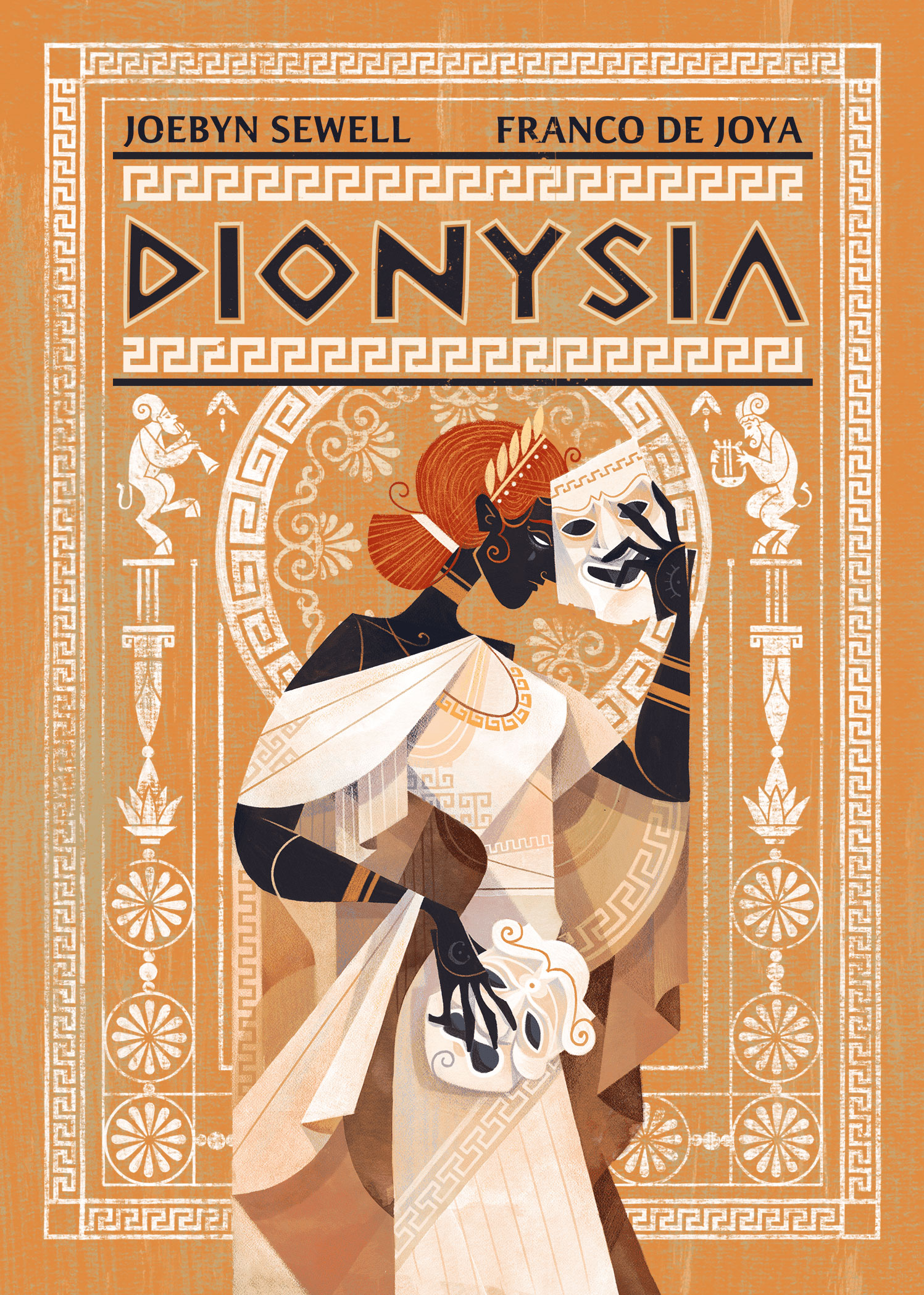
Well, now, dear gamer, it’s your turn to create a unique theatrical masterpiece good enough to please the patron diety of theater, Dionysius himself. In Buttonshy’s 2025 release, Dionysia, 1-2 players will compete to create the most impressive play consisting of a full 3 acts to premiere at the grand theater festival of Dionysia. And you’ll accomplish all this in a mere 10-15 minutes. Do you have the creative chops to pull it off?
Gameplay Overview:
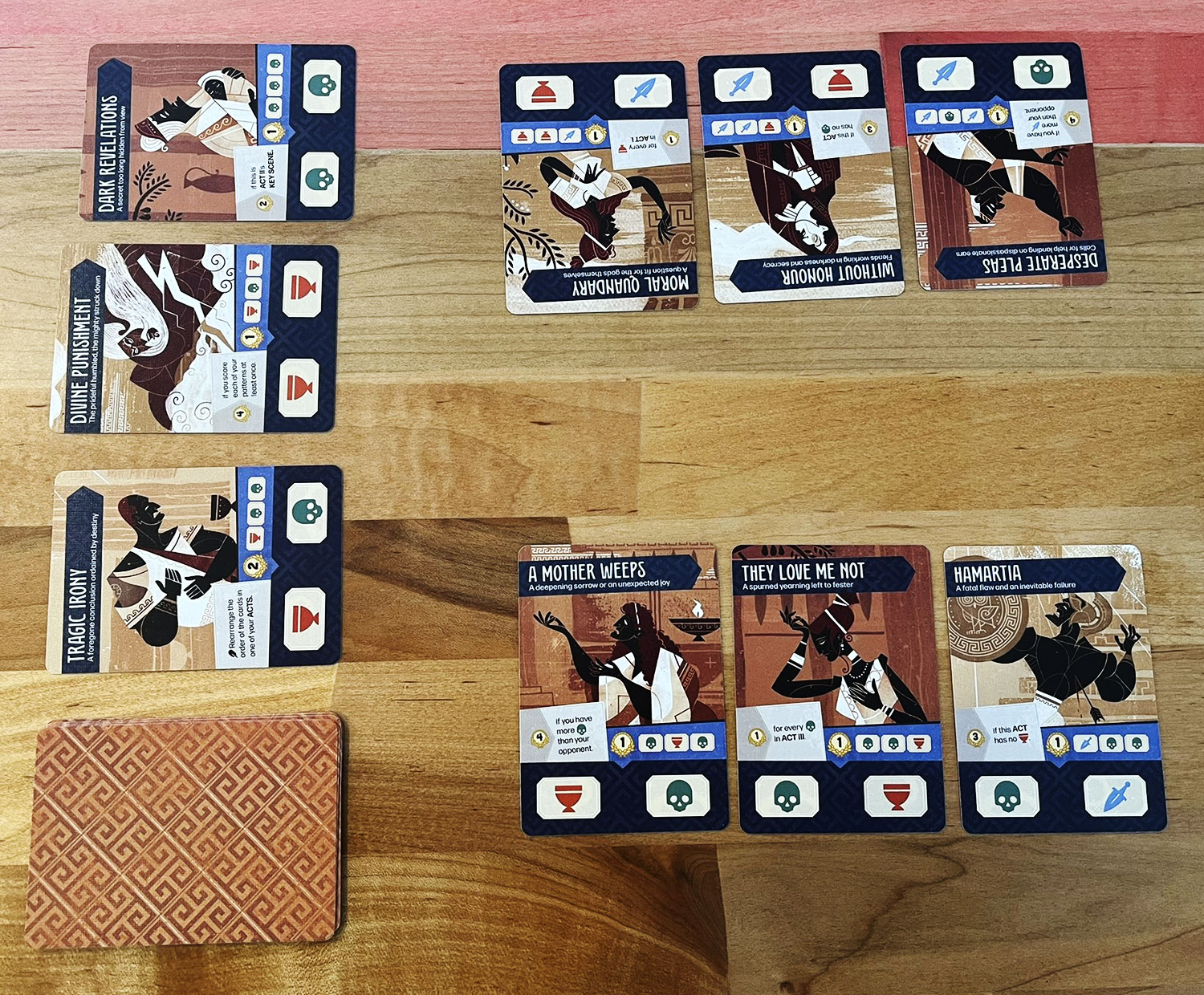
To set up, shuffle the 18-card deck and create a market of 3 face-up cards plus a draw deck. Each card represents a scene, and on their turn, a player will select from those available and add it to an act in their personal theatrical tableau.
Each of 3 acts in a player’s tableau can contain up to 3 scenes. The first scene played is by default to the “top” of its act. Subsequent scenes can be placed on top of the existing scene, below it, or as part of a new scene (that hasn’t been completed).
The goal in arranging the 9 scenes that will ultimately make up your 3-act play is largely an abstract puzzle, as each scene contains 2 theatrical elements at the bottom, depicted as icons. Once all 9 of your scenes are laid out, you’ll have a 6×3 grid of these icons. The top card (key scene) of each act describes a 3-icon pattern desired for scoring, and these patterns can exist across all three acts, both vertically, horizontally, and overlapping, potentially scoring multiple times each.
Additionally, most of the key scenes contain a separate end-game scoring condition worth a certain number of points if achieved.
Once all 18 cards have been claimed between 2 players, the plays are scored.
Game Experience:
With any wallet-sized game, a small footprint is important, and this title is indeed small enough to be played on an airplane tray table, which makes it a promising travel game.
Fortunately, I do think the gameplay is good enough to be worth packing. There is a surprising amount of thinking and forward planning that goes into making your tableau. Players will be tempted to select key scenes straight away and design the remainder of their play such that icon arrangements are optimized to match what is desired; after all, this type of scoring does benefit from some advanced planning.
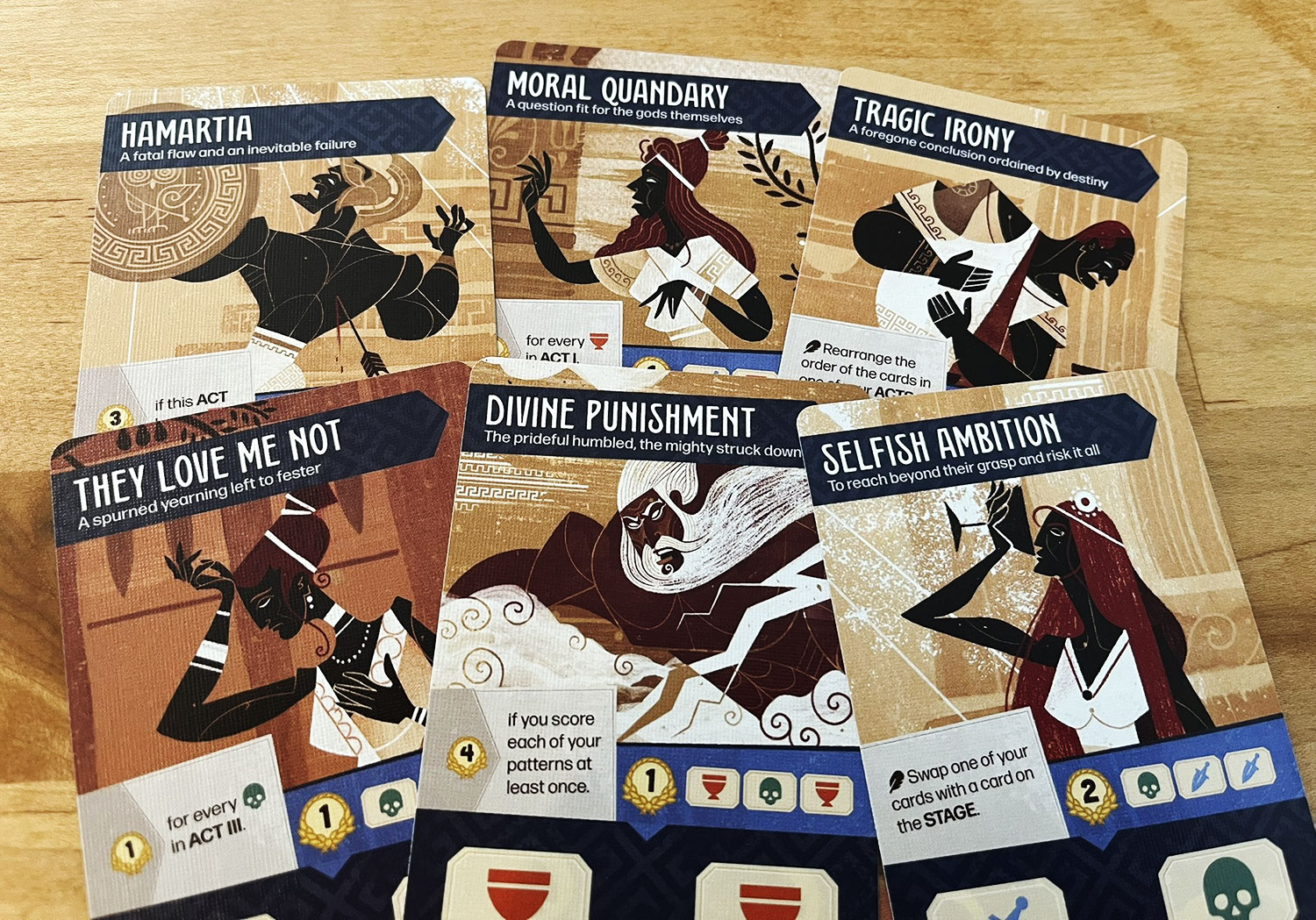
Nonetheless, you may have selected a key scene that wants lots of skulls and then find that your opponent is taking all the scenes with skulls. Sometimes you’re better off pivoting to a new set of scoring conditions, especially if it’s early enough that you can still score well off a new key scene. The game provides some extra room to pivot by including three cards with instant abilities (as opposed to end-game scoring conditions) that activate when played as top cards/key scenes. These special abilities allow such rule-breaking exploits as rearranging cards in an act or swapping an existing scene with one in the market.
The game also has a bit of push-your-luck and competition between players. End-game scoring conditions come in the following flavors:
- Have more of an icon than your opponent (4-points)
- Score each of your patterns at least once (4-points)
- Lack a particular icon in a certain act (3-points)
- Score for being the key scene in a particular act (2-points)
- Score for each of a certain icon in a particular act (0-4 points)
The first 4 of these are all-or-nothing conditions. It’s easy enough to achieve #4 by simply playing the card on top of the appropriate act, assuming it isn’t already full, but the other three depend on which cards come into play later, and to some degree, how your opponent builds their tableau. Scores are oftentimes fairly close, so if you’re not thrilled with any cards available in the market, it may be worthwhile to hate-draft something that would be helpful to your opponent’s goals.
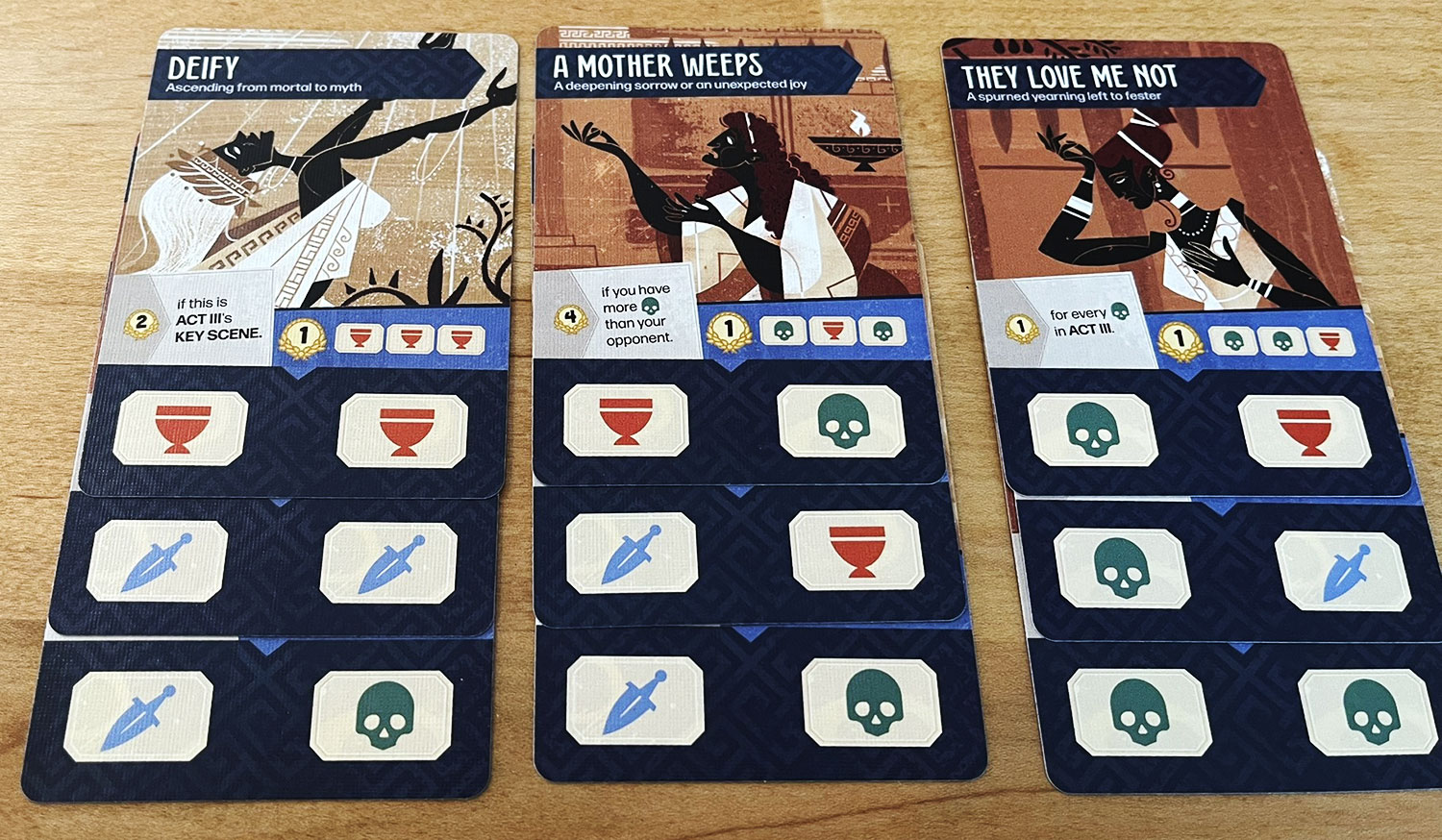
Within the 10-15 minutes of playtime, there is a game arc, which generally involves your decision space becoming progressively more and more restricted. Maybe you’re three cards away from game-end, trying to complete act II with just one more card lacking skulls to satisfy a 4-point condition. If the only available card at present without skulls doesn’t help fulfill any of your desired icon patterns, should you still take it to lock in the 4-points, or hope that a better one becomes available on your last two turns? Sometimes these decisions pan out. And sometimes, for on your last turn or two, you’re left taking cards that don’t help your score at all.
It can also be frustrating when the instant ability cards come out either too early (before you have stuff worth swapping/rearranging) or too late, when most of your tableau has already been optimally arranged for final scoring. Ultimately, Dionysia contains a decent amount of luck with regards to which cards come out when—though this is also what creates some of the tension and replayability. Some may find that the game feels a bit samey from one play to the next, and there may be some truth here, but if you’re only playing it during occasional travel, it’s a consistently fun choice.
Before I conclude, I want to compliment the incorporation of the theme through graphic design by Dan Gartman. Each card has a unique and beautifully rendered artistic depiction of a Greek theatrical scene accompanied by fitting textual descriptions. At game-end, it’s fun to study the cards and imagine the plot of the theatrical masterpiece you’ve just created.
Final Thoughts:
Dionysia is a surprisingly thinky, little abstract game with a small enough footprint to make it a great choice for a travel game. It is possible to get some analysis paralysis in this 18-card game, which is an impressive feat. Viable options become progressively more restricted through the game’s 9 turns per player, with the last few turns frequently turning into some combination of hoping to luck into the right card to salvage your plans or hate-drafting against your opponent. Win or lose, there’s sure to be drama, as every player creates a 3-act play with beautifully thematic illustrations that tell a tumultuous tale. Just remember, however clever Dionysia makes you feel, cleverness is not wisdom.
Final Score: 3 Stars – this thinky theater-themed game contains way more fun in its wallet-sized package than a Greek tragedy
 Hits:
Hits:
• Thinky multi-layered decisions
• Beautifully thematic art
• Small footprint
Misses:
• May feel samey after a few plays
• Late-game turns sometimes overly restrictive
• Card draw is inherently lucky