
 Extraterrestrial settings are popular for board games, possibly because they avoid the potential geopolitical quandary or insensitivity of area control, settlement, and resource/worker exploitation inherent to games of more Earthly environs. Thus, designers are free to escalate conflict without offense, such as in titles like Moon Colony: Bloodbath, Moonrakers, and Skymines.
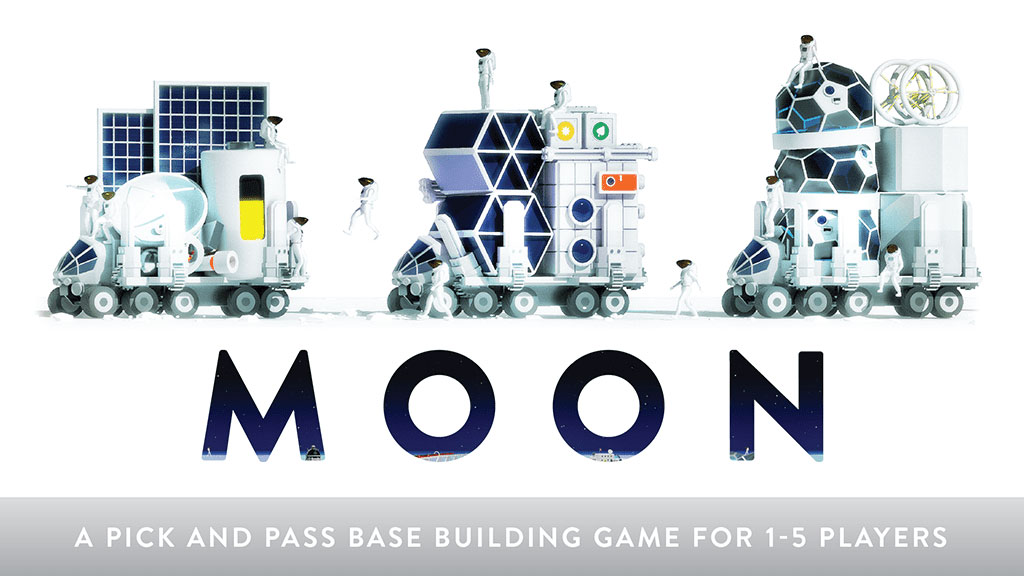
This is where 2023’s Moon takes a different tack; while it encourages players to competitively establish the most attractive moon colonies, there is an element of cooperation as players share resources and icons using an “open” worker placement system. Moon is the third installment of designer/artist Haakon Gaarder’s gaming trilogy, which also includes Villagers and Streets. It features card-drafting akin to 7 Wonders and accommodates 1-5 players over 45-90 minutes.
Gameplay Overview:
Moon is played over 3 rounds, during each of which players will draft and pass around a hand of 6-8 structure cards + a unique expedition card.
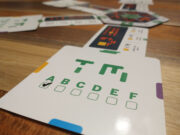
Expedition cards do not get drafted. Rather, each provides players with a temporary bonus or special rule that applies while it is in their hand.
The structure cards do get drafted from player hands, after which they may be:
- Constructed and added to the tableau for a cost
- Discarded for a small one-time bonus
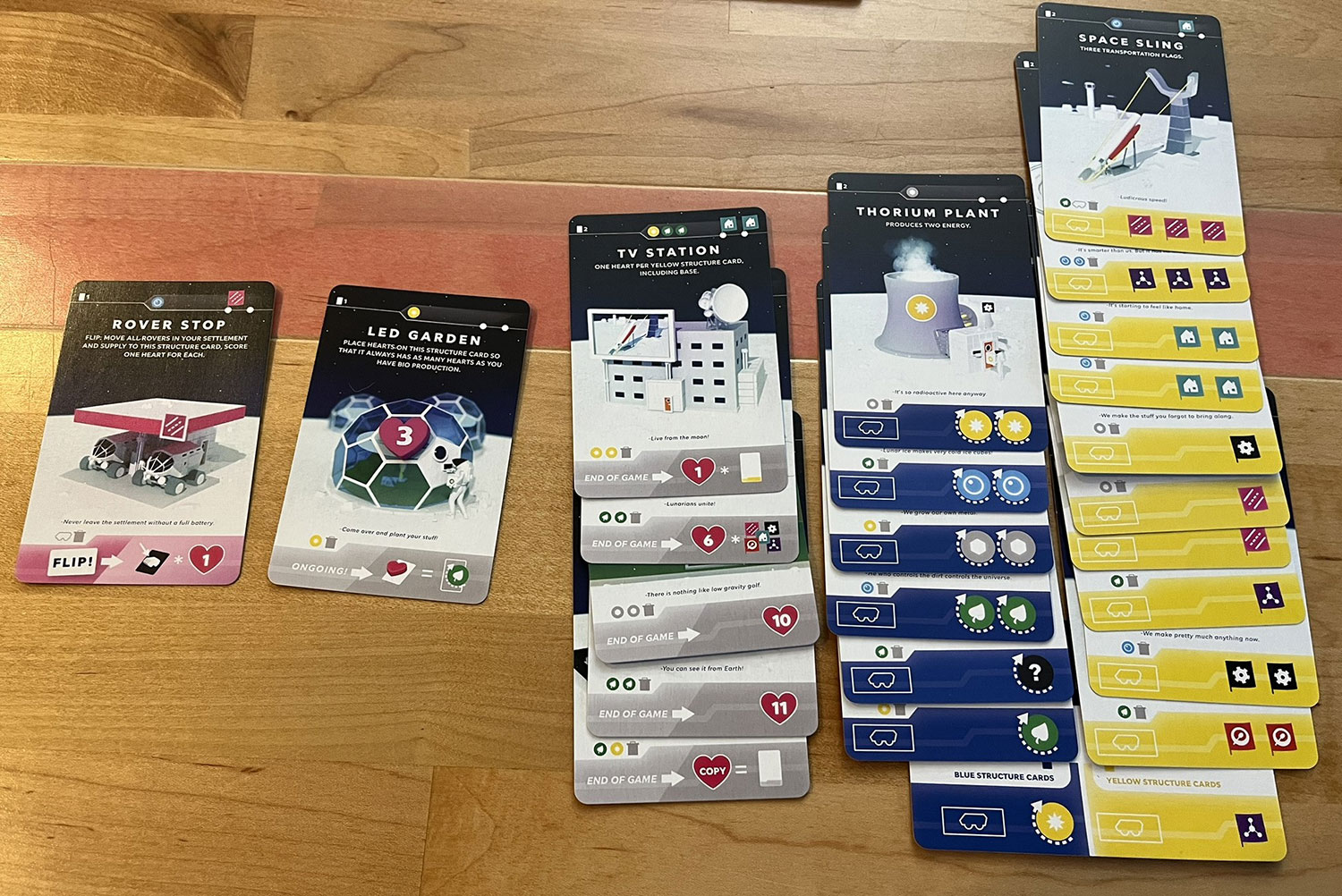
Structure cards come in several general flavors:
- Blue production – generate resources throughout the game
- Yellow cards with flags– at the end of each round, points are awarded for flag majorities among 5 distinct flag types.
- Pink– each may be tapped once per round for a special ability
- Grey scoring cards
- Red cards with various unique effects
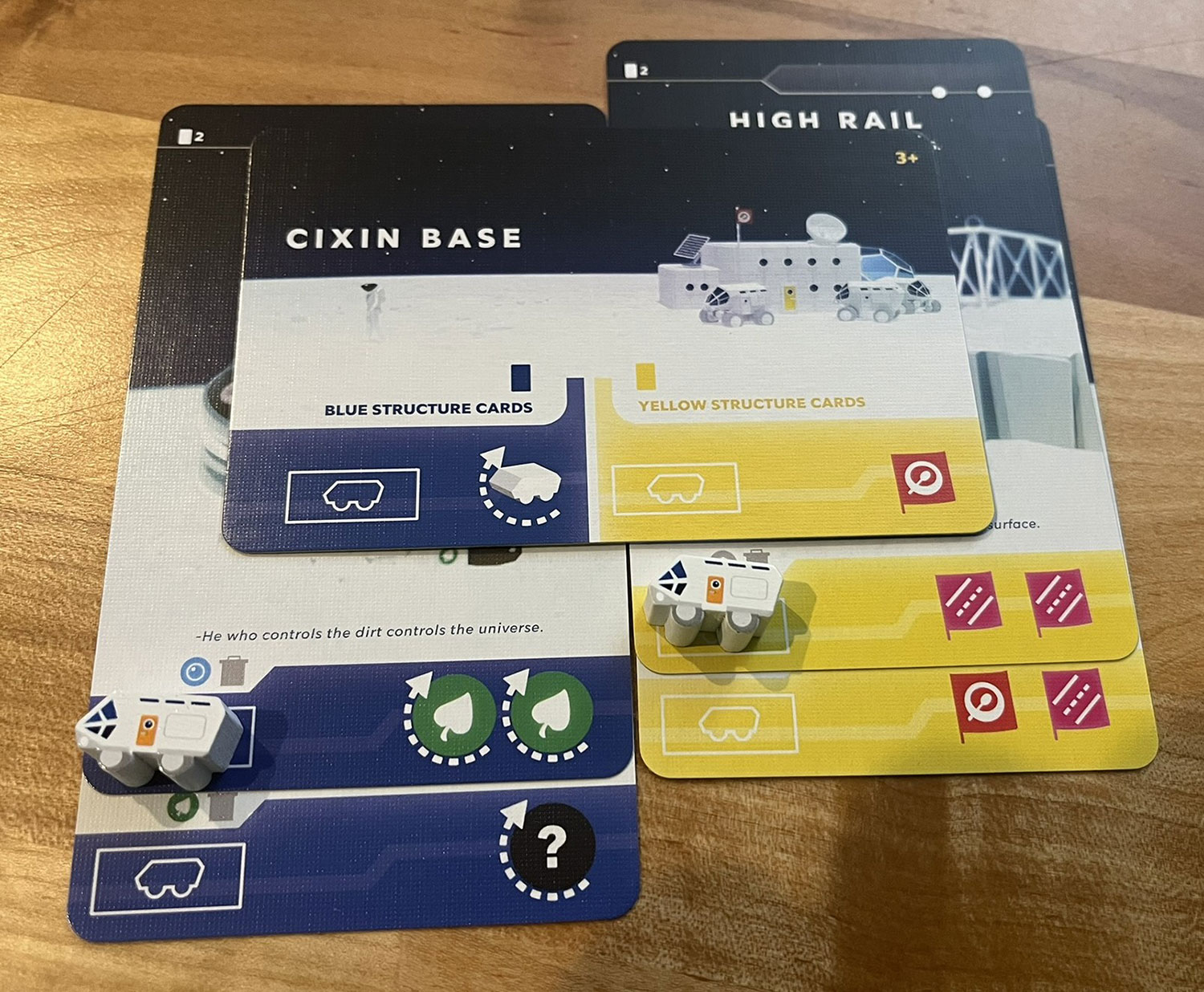
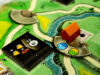
Cards usually have a resource and/or flag prerequisite for entering into play. Each player starts the game with 2 Rovers, and if on any turn they are short a flag or resource, they may park one of their Rovers on a blue production or yellow flag card within ANOTHER PLAYER’S tableau to borrow its ability for the current turn. That rover now belongs to the rival player to use in a future round.
Players will also be racing to achieve a unique set of 9 “reputation” cards in each game that provide various ongoing effects, instant bonuses, and end-game points on a first-come-first-served basis.
After 3 rounds, points are tallied from accumulated in-game points, grey end-game point cards, and points on reputation cards.
The highest score wins.
Game Experience:
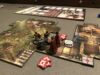
Moon is a perfectly pleasing medium-weight drafting game that may give players a similar feeling to 7 Wonders or It’s a Wonderful World. The central mechanism of draft-and-pass is not entirely new, but owing to the unique features of the Expedition Cards as well as several of the pink cards, Moon probably has some more replay value and unique combos that can be cobbled together compared to It’s a Wonderful World.
It’s important to note, however, that Moon does not involve simultaneous turns, so while players can contemplate which cards of their newly acquired hand seem interesting, they must wait until their turn before acting. Moon contains many interesting decisions and constant tradeoffs, but it is not a particularly complex game, so at the higher playercounts (4+), the downtime can feel like a bit much. More truly simultaneous alternatives like 7 Wonders are probably the better choice for larger player counts.
Moon shines brightest at the 2-3 player count. This is partly because drafting seems less random; you are guaranteed to get your opening hand back in the circular draft 3-4 times, so if you can remember the cards, you can potentially plan for more interesting card combos. A possible combo, for instance, could be specializing in a particular resource, say water. If you possess the Reservoir, which awards 1 point per water token when tapped, you want to generate as much water as possible. Pink card abilities that could be useful in this case include:
- Produce an extra time with an existing structure card
- Exchange any number of resources into one resource type
- Pick a resource and acquire units of it equal to the industry flags in your settlement.
In addition to potentially better card combos, player interaction feels more intense at lower player counts, as it’s easier to keep track of elements of your opponents’ strategies. Hate-drafting can be a powerful tool in this game to stymie your opponents, and there is ample incentive to do so at lower player counts. Flag majorities of 5 types (which award points every round-end) and Reputation cards (first dibs among 9 possibilities) can result in major point accumulations, so especially at 2-player, you probably want to be in serious contention for about half.
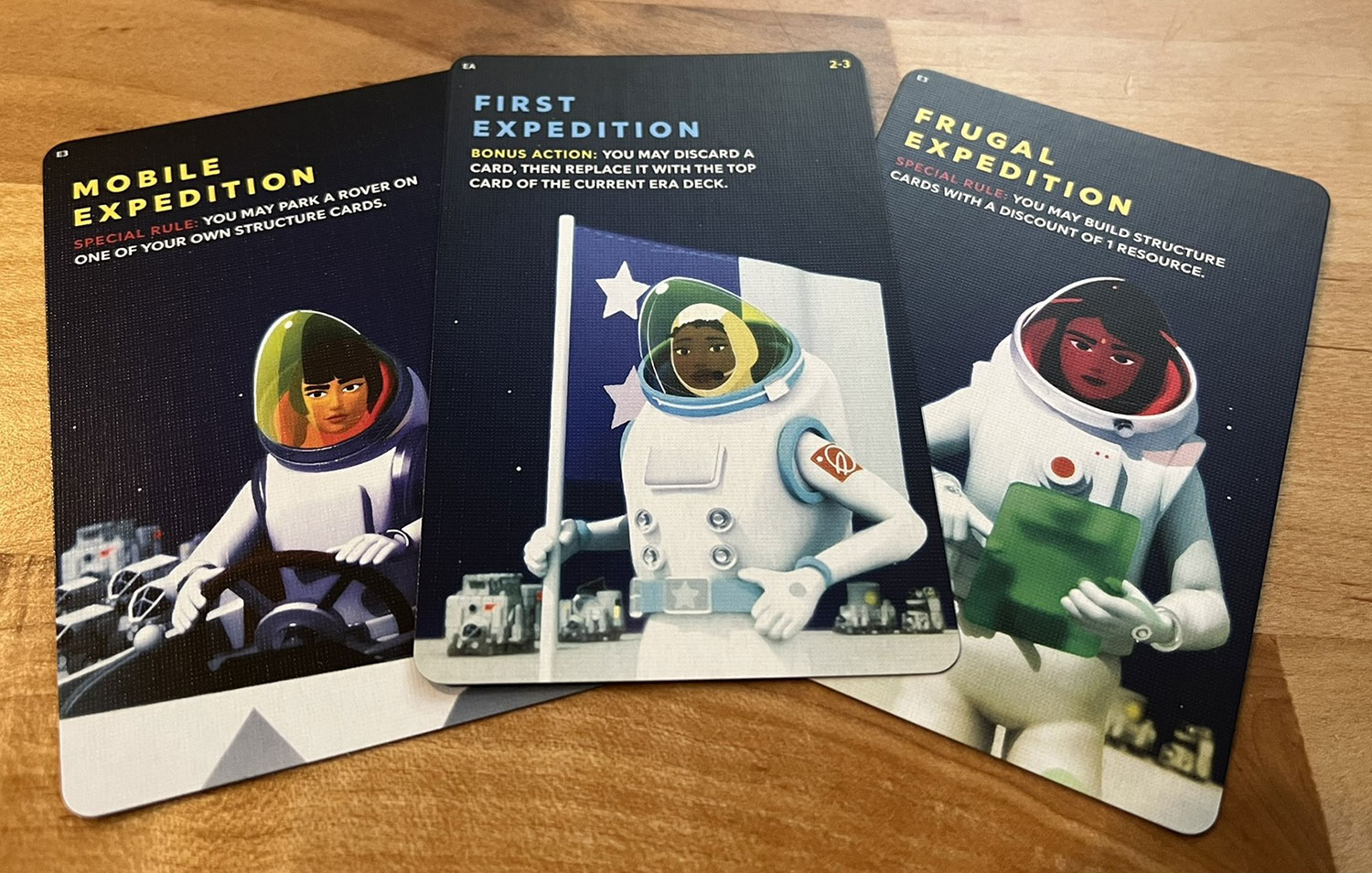
The various non-draftable expedition cards that start in your hand—a unique mechanic in Moon—range in their abilities from very minor (swap one resource for another) to significant enhancements of player interaction. Examples of the latter include allowing players to alter flag majority rewards for that round, and replacing a card in your hand with a random one from the deck—this latter one being a fantastic way of hate-drafting and still acquiring what you want.
The other main advertised novelty of Moon is the use of Rovers to borrow your opponents’ abilities, but this element, surprisingly, felt frequently underutilized. Especially at lower player counts with greater card-count per player, Moon does not possess the tightest economy, so players are typically able to build fairly diverse tableaus without the need for substantial borrowing. The Rover mechanic is fine, but it does not set the game apart from other drafting/tableau-builders. Nonetheless, for players newly breaking into medium-weight games, this mechanic could feel like a nice safety net.
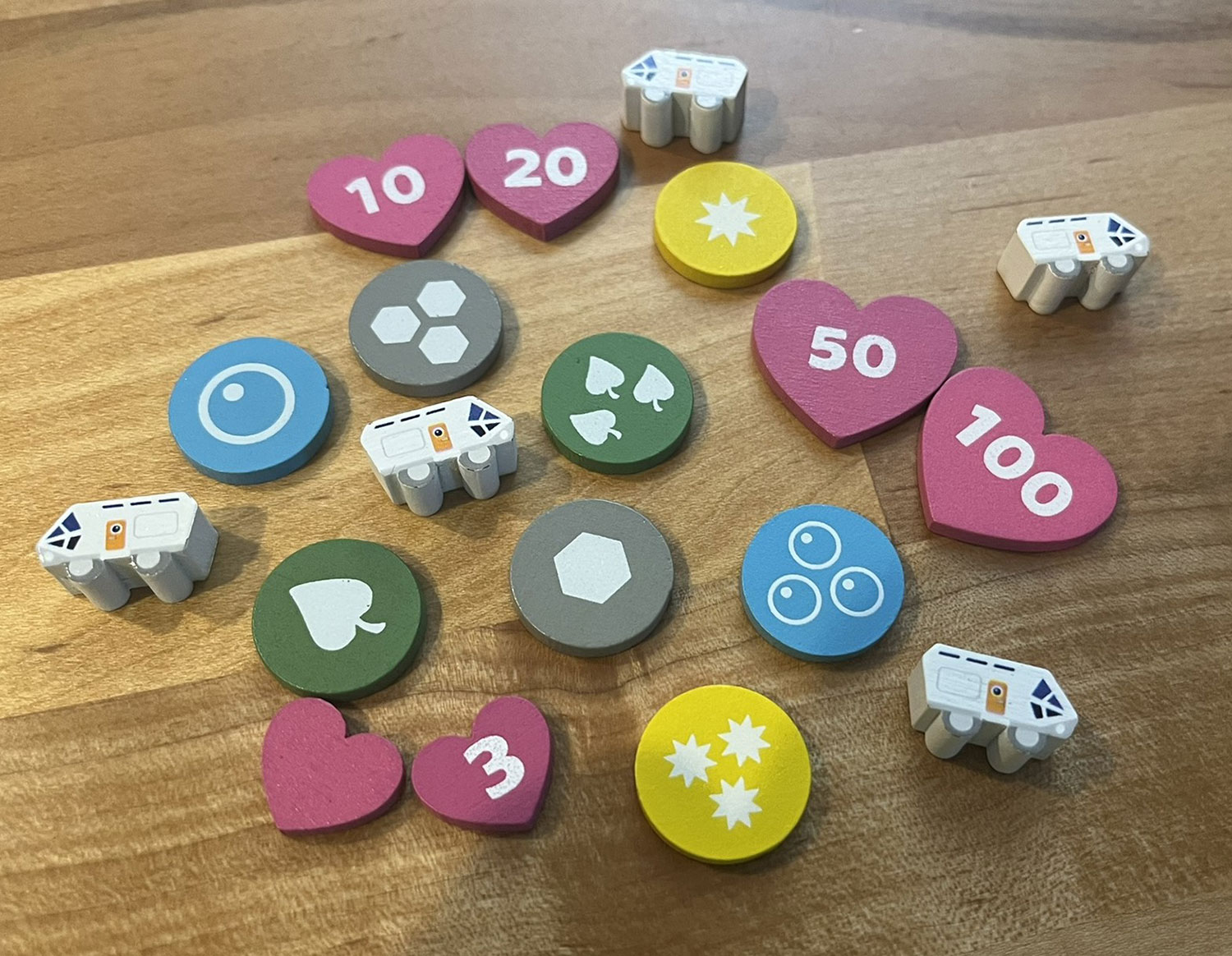
Any actual criticisms? There may be a slight first-player advantage for some of the reputation cards, but with 9 in play total, different players usually strategize around specific options. While the card quality, art, and components are all excellent, the double-sided points/resource tokens can lead to issues if they get accidentally flipped. Finally, a minor quibble, but the non-standard box shape/size packs very tightly, is prone to damaging the rulebook, and may not stack neatly with existing games.
Final Thoughts:
Despite the presence of a borrow-your-opponents’ tableau mechanic, a genre-redefining moonshot this game is not. Nonetheless, it is a solidly designed medium-weight draft-and-pass engine-builder with some area majority elements and opportunities for cool combos. The fun artwork, relatively small box size, and nice production are a further boon to Moon. At the lower playercounts of 2 or 3, Moon is the easy choice over It’s a Wonderful World, as it feels more interactive and tense with greater control of card-combos. At higher playercounts, the downtime can feel excessive, and a more simultaneous pass-and-draft choice like 7 Wonders or even Sushi Go might be preferred.
Final Score: 3.5 Stars – A solid card-drafting tableau-builder where sharing with your neighbor is caring, but you also want to leave them in your moon dust
 Hits:
Hits:
• Ample replay value with unique objectives and a card draft every game
• Moderate positive and negative player-interaction
• Nice production with fun, clean artwork
Misses:
• Excessive downtime at higher player counts
• Dual-sided tokens can cause issues if flipped
• Awkward box shape