


 I’ve exceeded my word count, so no witty intros today for Stonesaga, which is an expansive game that plays one to four players over 60 – 120 minutes per session, according to the box.
Published by Open Owl Studios, Stonesaga is a cooperative survival crafting board game set in a unique and persistent world.
Gameplay Overview
There’s too much to cover every detail, but here’s a brief description of some of the key points from the rulebook and extensive errata. At its core, Stonesaga is a narrative-infused survival exploration and crafting game. You can interact with locations to forage, hunt, fish, and mine to gather food and materials, and then those materials are used to craft items and build structures.
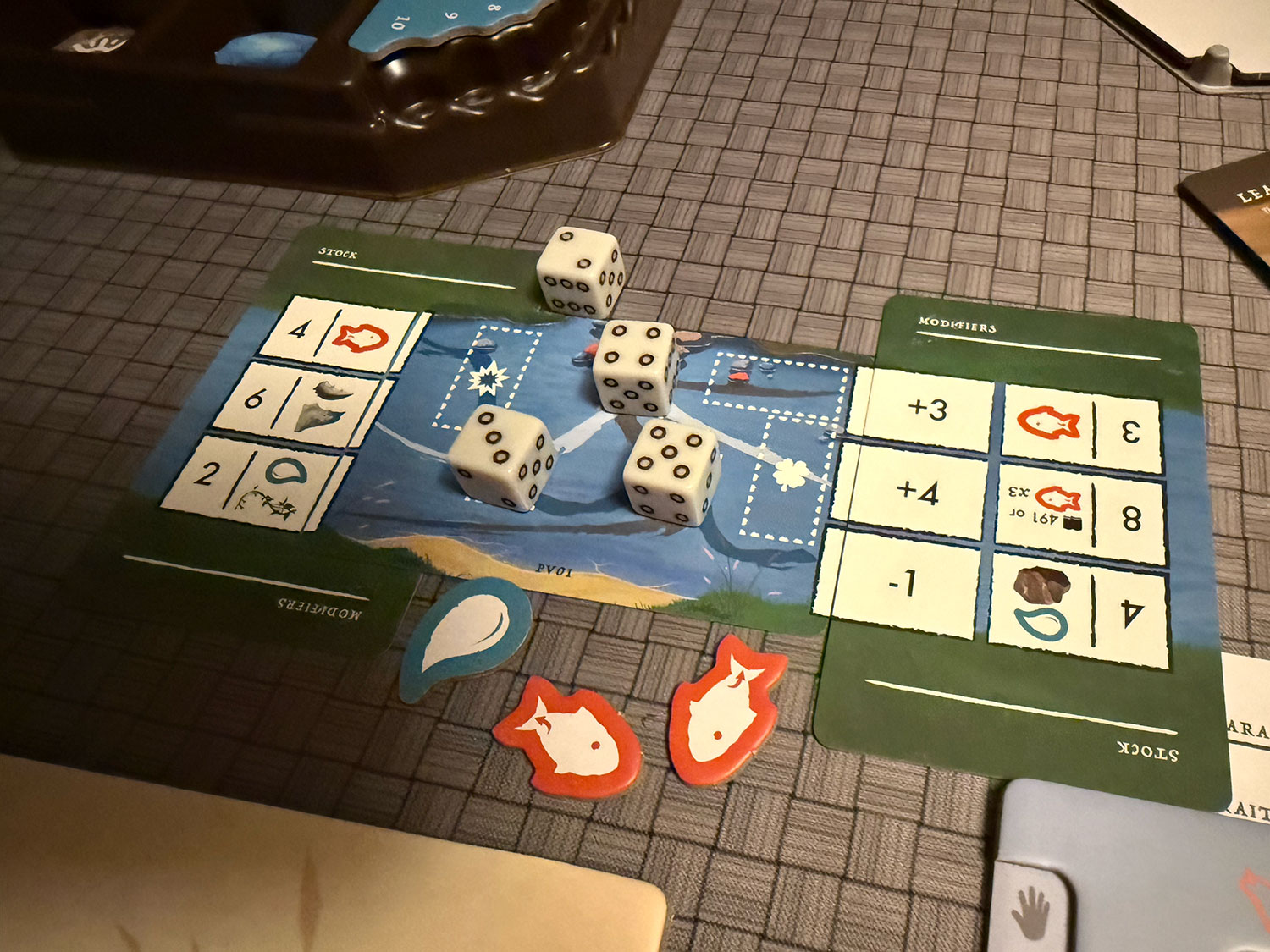
Fishing has you laying out three cards with the left card showing what you may catch with a base score required, the right card shows a modification, and the middle is paths through strike zones where you can play dice. Paths run from left to right, and you’ll roll four dice and try to place them to gather rewards.
Mining has you adding tokens to a bag and drawing three of them to see what you get, and checking to see if any match the current omen, which triggers an event that varies based on location and omen.
Foraging and hunting has you placing forest or prairie cards where you draw two and select one, but you must keep at least one showing a predator. If the predator ends up in the foreground, you’ll have to fight or run. Meanwhile, if you avoid Crabby McMurder Hands, you’ll get to gather resources of a single style.
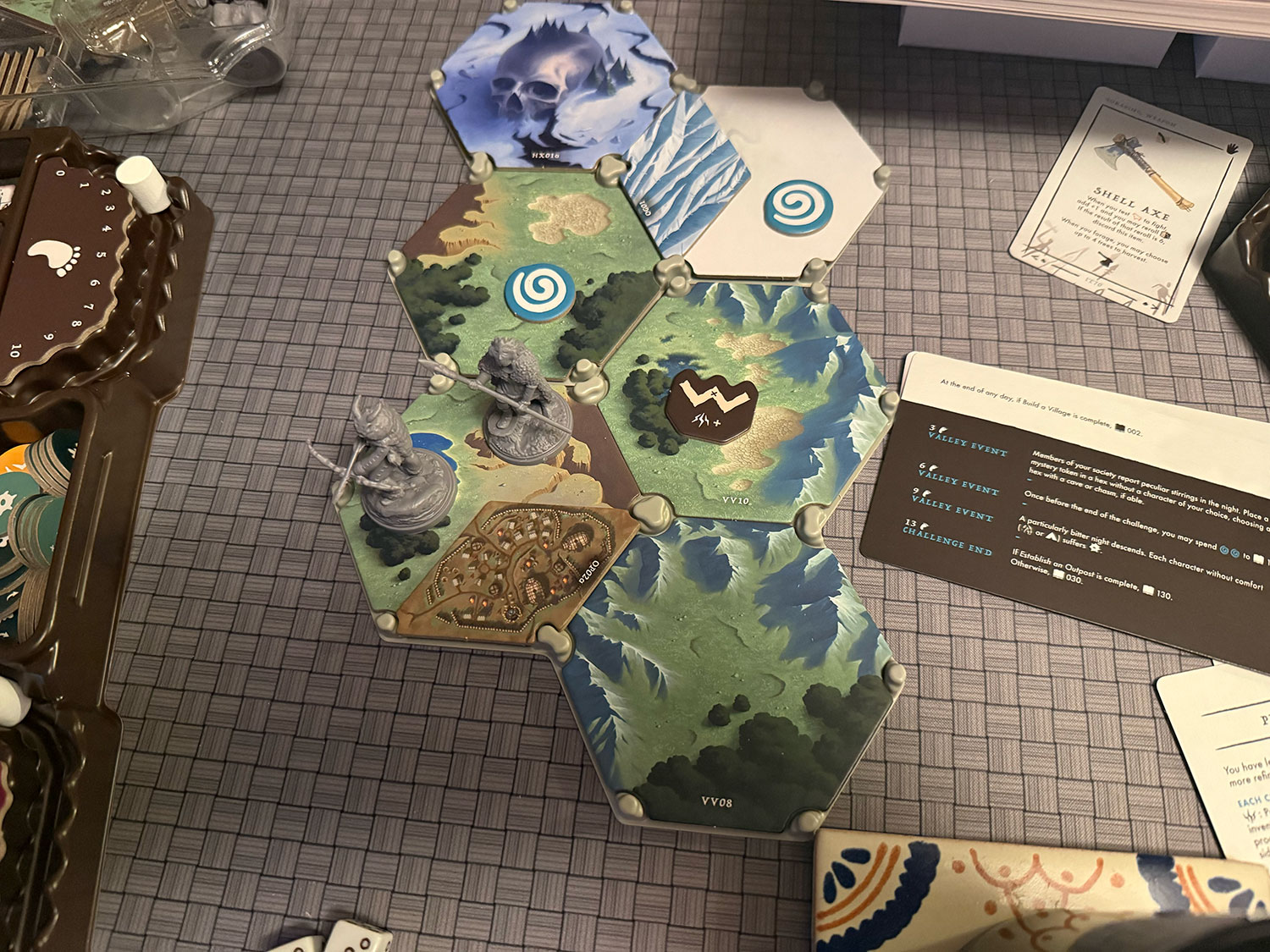
There’s also bonus materials to be found on/near your targeted it like you would find in a hidden object game on a mobile device. When you travel between hexes, you’ll draw a journey card, and each night you’ll draw a night card for each character. Both are filled with narrative, tests, and chances to gain or lose things. Each night, you’ll get to eat, drink, and replenish some energy based on resources and your location.
Over time, you’ll learn to craft items and structures that will give various boosts to tests, most of which are rolling a d6 and adding one of your four ability scores, plus bonuses for traits and/or having items.
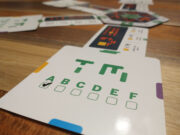
Throughout the game, you’ll have goals, as well as an overarching game session challenge. And during multiple plays, your characters will age and die. You’ll record stories by drawing symbols on a sheet of paper representing a cave wall, and your choices will provide diverging narrative paths.
Game Experience:
There’s a ton going on in this game, and my first three sessions, played two-handed solo, all ran close to three hours each, with a large amount of that time having my nose in either the rulebook, the codex, or a reference sheet, or trying to figure out what different iconography meant. Playing with two players was about the same length as a two-handed solo game. The game supports players dropping in and out, which may give it legs in some groups.
There is quite a bit of bookkeeping in terms of logging mantle powers, crafting recipes, and it was helpful to track what didn’t work out, and some of this is done on cards, paper representing your cave wall, and in the included journal.
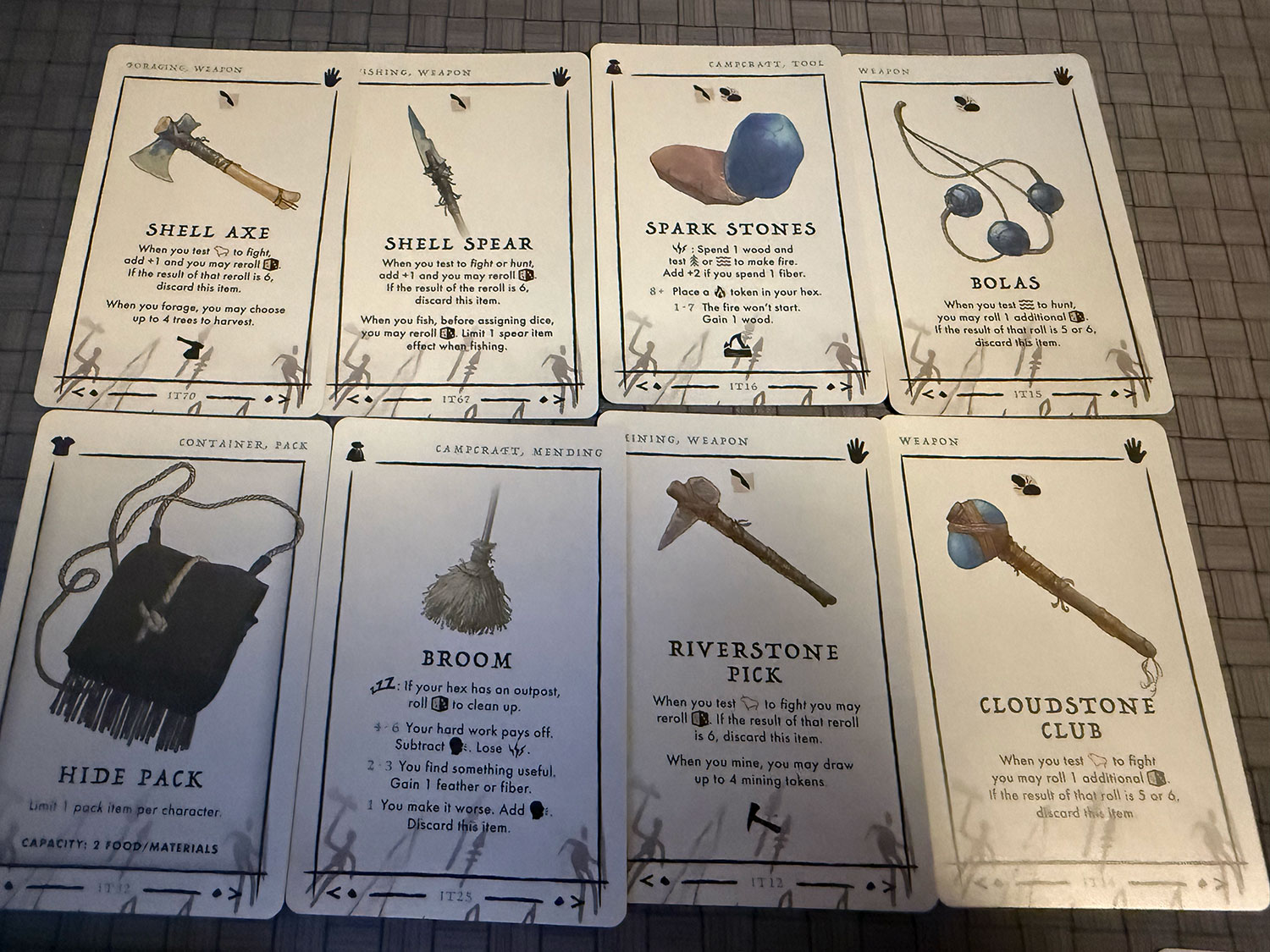
While failing at gathering wasn’t fun, it was a little more frustrating to waste a turn because two materials didn’t work together. Other times, the codex gives hints or a do-over, especially if the materials are close. I felt like a lot of the items were subtle variations of each other, as a cloudstone club wasn’t that different from a riverstone club. One of my favorite parts of the game was creating something new that gave me a cool perk. Once I thought I was going to craft some clothes or a cloak, and instead made a pack that gave me more inventory space, so while it wasn’t what I expected, I was happy with the result. I picture my guy sitting there trying to make a shirt, and either it was too small or didn’t have arm holes, so he just called it a bag to save face.
At least early on, I felt like I had to struggle to get the tools to be able to process materials. Building a workbench removed some of that grind as it gave access to those tools without consuming materials. Not having specific symbols on your tools can prevent you from building outposts on certain terrain, so it’s good to craft some variety, even if you don’t have a lot of control over what you’re making.
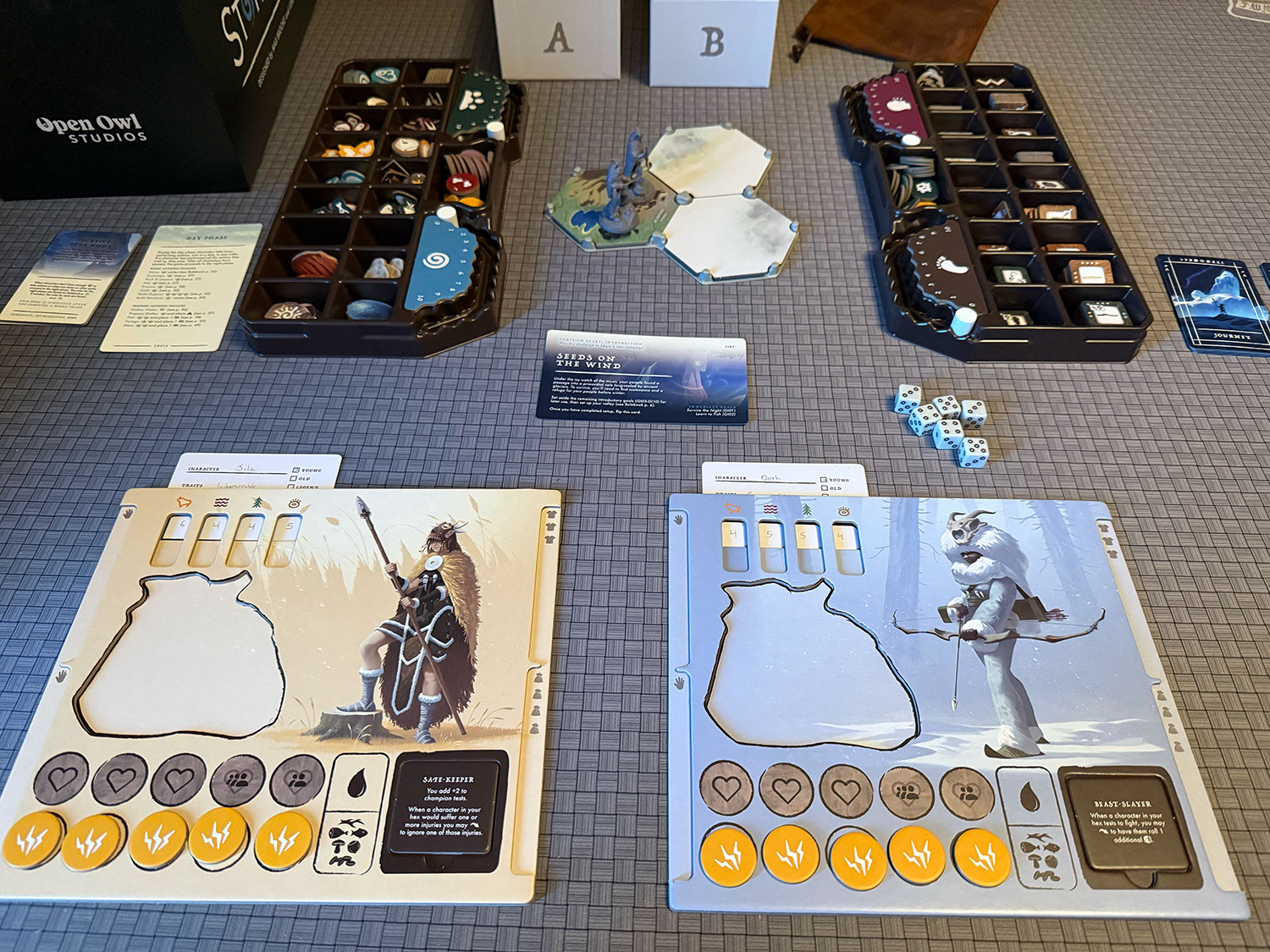
This game has a deliberate pace as you slowly harvest resources and craft items. And with resources getting more expensive if they’ve been foraged recently, movement is all but required. There’s never enough energy to do everything you want, which encourages pushing it in some of the gathering steps or sacrificing a step like gathering food or water to process materials. Meanwhile, multiple players can divide and conquer tasks for the betterment of the community. I missed that food and water can be shared without spending an action, unlike trading materials and items. But even accidentally making it harder on myself, I never felt like I was in danger of losing with growing discontent or running out of population or time. But I wouldn’t be shocked if I was missing a rule here and there.
The challenge for my first behemoth was to encounter it. Because my initial rounds were rebuilding my outpost that had been accidentally, yet rudely, destroyed, I ended up with other options for how to “deal” with it. But when I accomplished that goal, I was unclear if I had successfully completed the overall challenge or not. It felt weird to pacify it only to repeatedly poke it with pointy sticks.
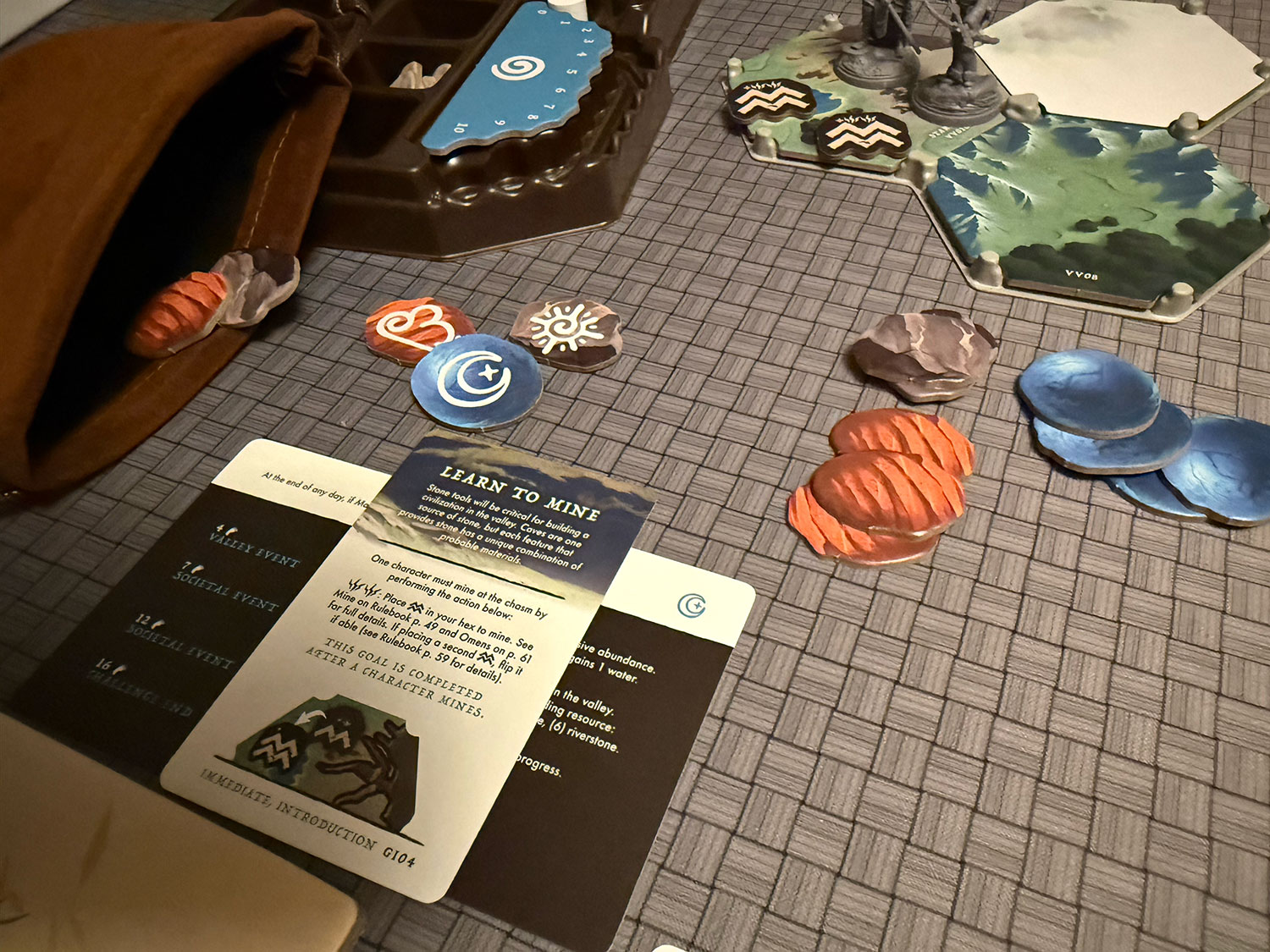
But it’s an example of how the game changes based on your choices. Your choices will lead to branching paths and even a few missions in, I could see a few clear deviations, and, in that regard, there’s a ton of replay value in Stonesaga. Additionally, the world is interesting, and I’m curious about the setting, its history, and wonder if there’s more to it than it seems as I explore the valley and find ruins of past civilization, plus that giant skull off in the distance.
Journey and Night cards introduce snippets of story and random events that are often decided with the roll of a single die and adding a stat. There are times when you roll well and get something cool, but it’s less fun when you realize your stat of two and a six would still have you in the worst condition.
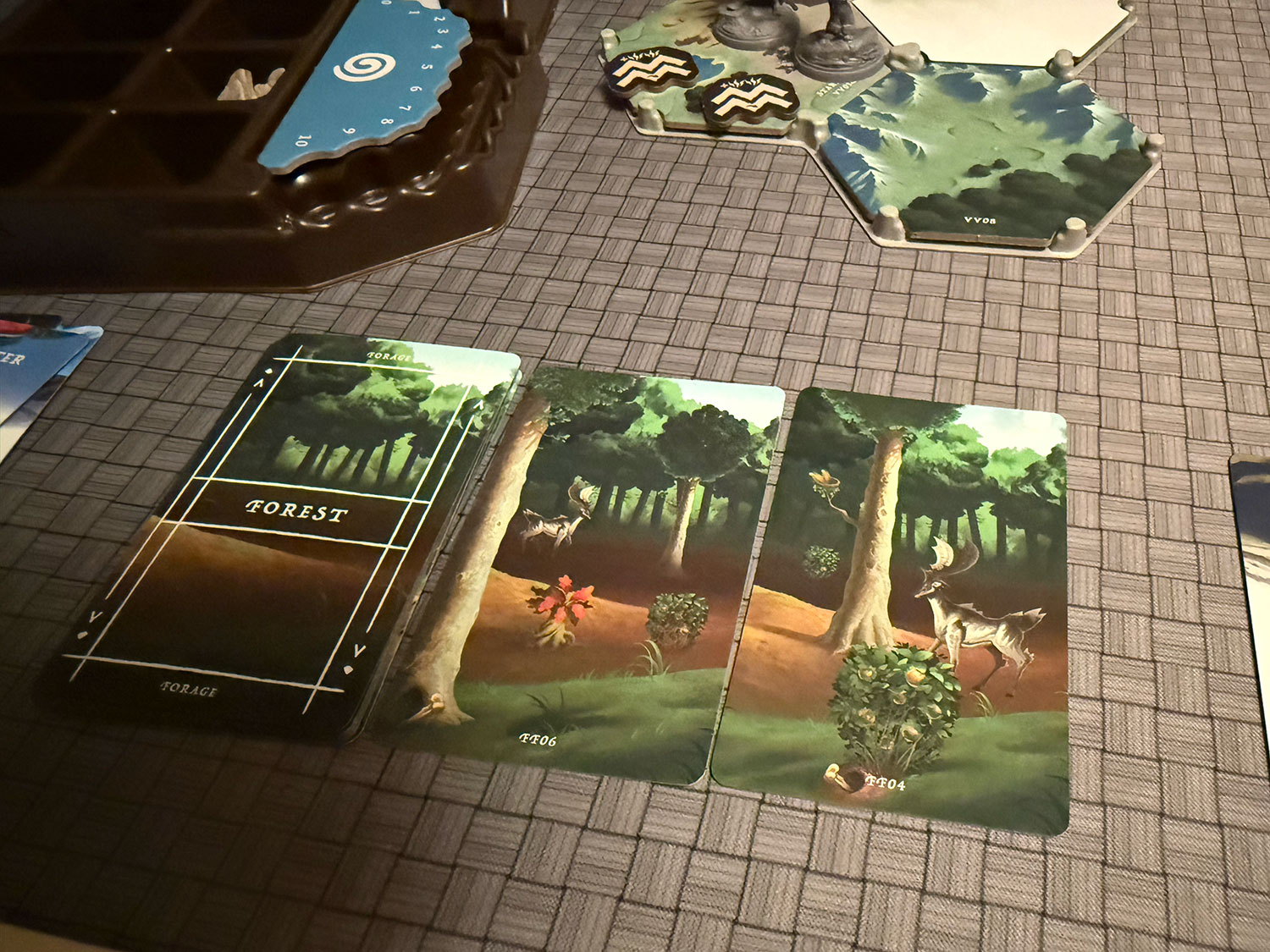
In terms of the user interface, the text on the event cards can be small in places. There are also omen symbols “hidden” on some cards which may be hard for some people to see, especially those who may be color blind or have other vision impairments. Likewise, the foraging mini-game, which, while a cool idea, was a little hard for me to discern what was on the midground and background items. Things like pitch or things at the bases of the plants were particularly hard for me to see.
There are a lot of surface-level similarities between Stonesaga and Valheim as survival crafting games. I culled Valheim as the gathering and combat were too simple, and crafting with a hundred percent confidence wasn’t interesting enough. Meanwhile, Stonesaga is less about the boss fights and more about crafting, and I find it’s the superior game in terms of crafting and survival.
Final Thoughts:
The onboarding experience in Stonesaga is not easy, but there is an interesting and solid game for a patient gamer who will dedicate the time and wants a slow-burning experience. The narrative has me curious to learn more about this weird world. The mini-games give variety, and there seem to be ways of gathering many of the resources in multiple ways, allowing you to pick your own path.
Final Score: 3.5 Stars – Stonesaga gives gamers an immersive open-world survival game in a fascinating setting that begs to be explored. Hits:
Hits:
• Different minigames for foraging
• Crafting system is clever and fun
• The narrative and setting are enthralling
Misses:
• Tons of rules to constantly reference and double-check
• Not the easiest onboarding for new players
• Some gamers may struggle with parts of the user interface











I’ve backed most of what Open Owl has put out and believe that they’ll likely be the first to nail the open-world tabletop gaming experience. Each game has been an iteration closer, but none have quite nailed it yet. I backed Threshold and hope it’s the closest. What we’ve seen of Echobound Adventures looks great too, though. I guess we’ll see!
That open-world exploration was a strength of Stonesaga. If I were to compare it to Arydia, Stonesaga has a lot more replayability. Arydia, I believe, will largely play out the same, but I can see Stonesaga having far more divergent paths.