
 Innovation debuted in 2010, accomplishing the impressive feat of packing an entire interactive civilization game into a mere 105 cards. Its popularity has led to subsequent printings of three other editions, each with slight tweaks to card balance and artwork. Additionally, there have been four expansions that add to and alter the existing gameplay in multiple ways. Now, all the latest and greatest modifications have been packaged together in 2025’s Innovation Ultimate, representing the fourth edition of the base game plus the existing four expansions, as well as a new expansion, all in one box. It’s a lot of gaming content to be sure, so for the purpose of this review, I’ll assume readers are familiar with base Innovation and instead focus on what’s new and my opinions on each individual expansion.
If you already own the base game, what does Innovation Ultimate add?
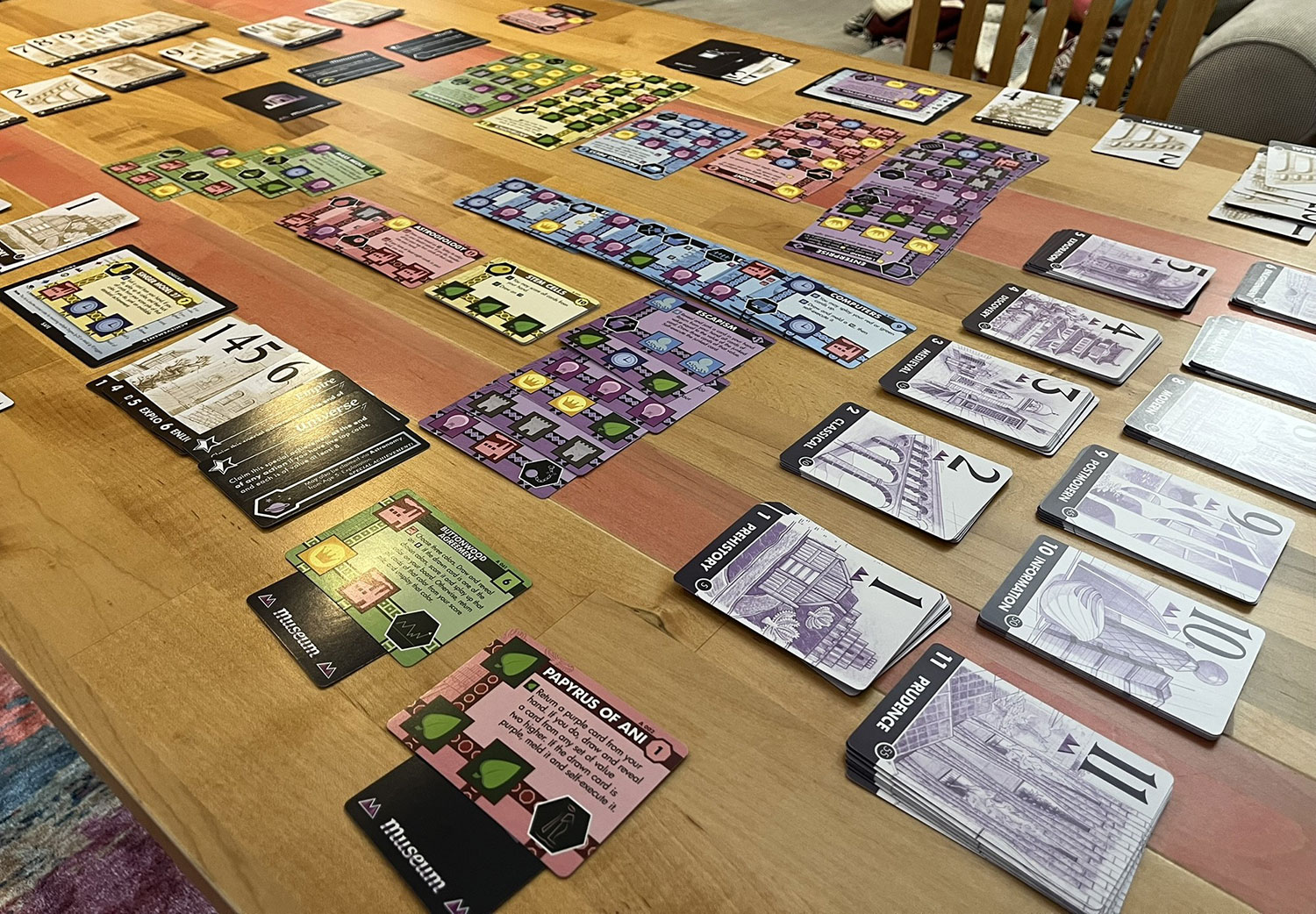
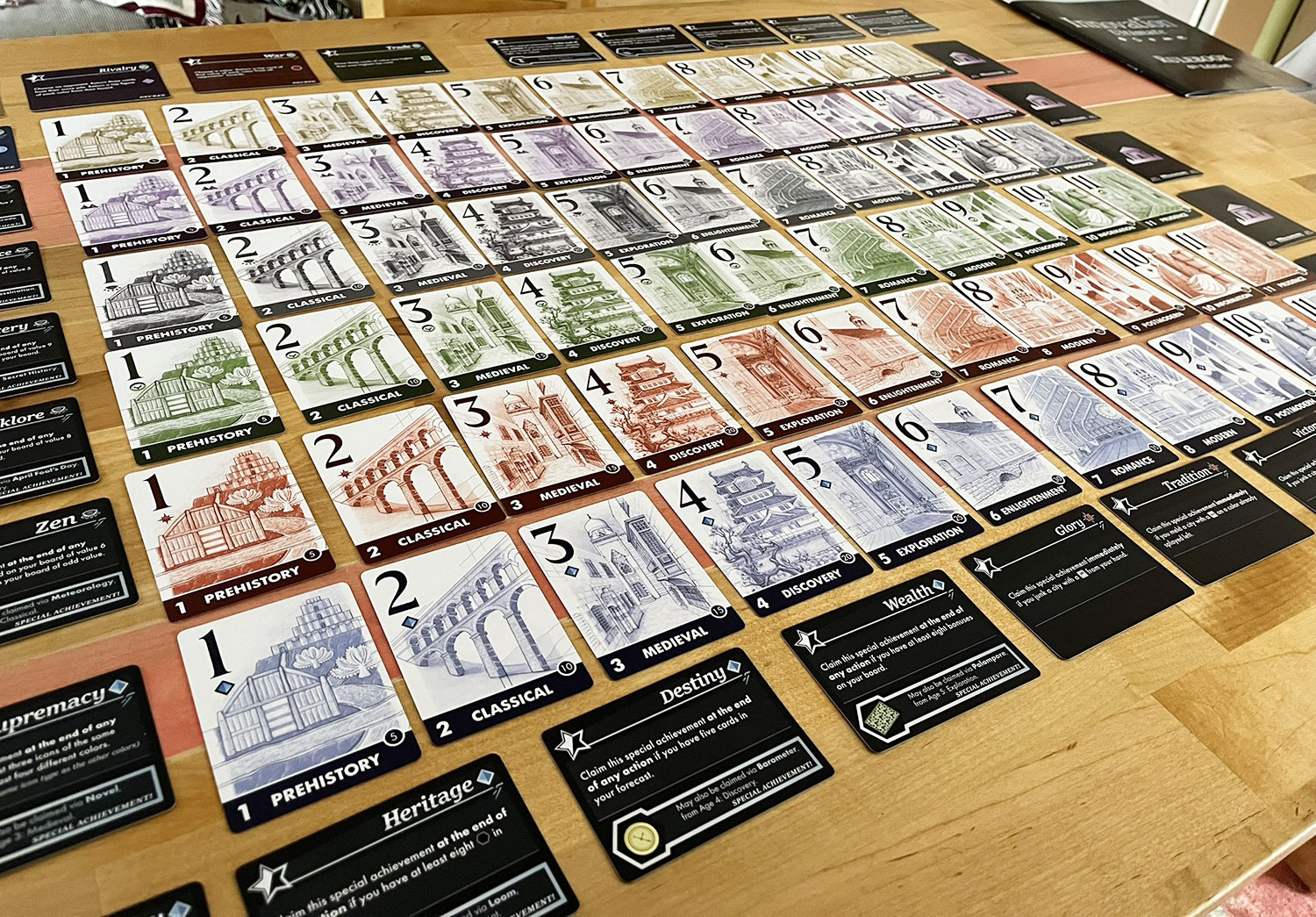
Right out of the gate, the Ultimate edition introduces new and improved artwork, especially with regards to the card backs. The card fronts have also been cleaned up a bit with simpler and larger icons that can be better visualized across the table for multi-player play. That being said, I still consider this to be a 2-player only game, in part because there’s just so many icons to count that it becomes onerous at higher player counts, not to mention the already chaotic gameplay becoming ridiculously chaotic with more players. In terms of gameplay modifications, Ultimate adds an Age 11 deck to the base set as well as to each expansion. Many cards in the base set as well as the expansions have been further modified to make the game more balanced.
There are several general changes to gameplay provided by most of the expansions. The biggest, in my opinion are as follows:
- Each expansion introduces five new options for achievements. Thus, the achievement requirement for victory has been increased.
- Many expansion decks offer “Aslant” (diagonal) as a new premium splay option.
- Bonus icons appear on many cards providing points that count towards your score pile total while remaining in your tableau
How do I rank the expansion?
1) Figures in the Sand
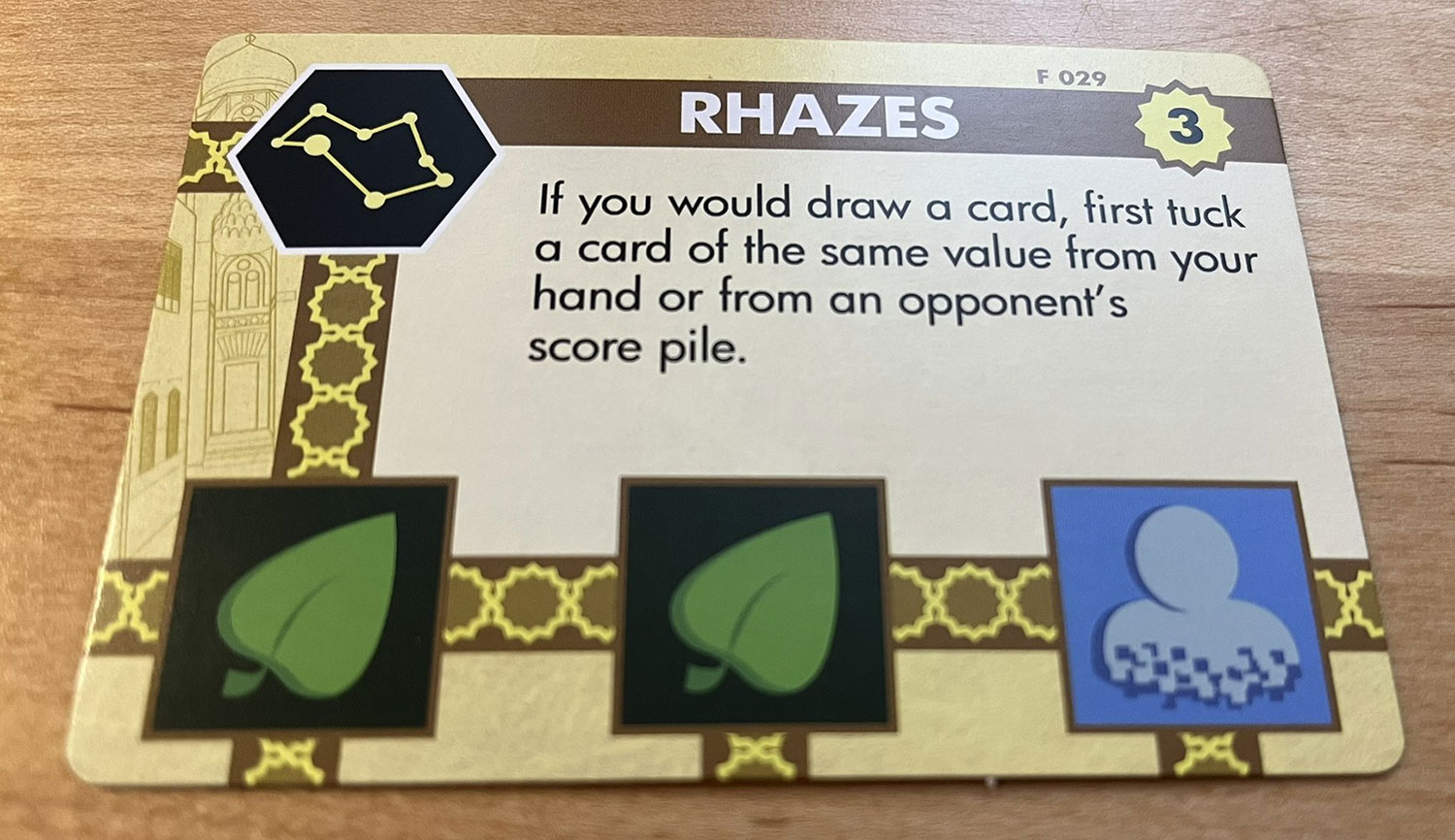
Figures cards represent influential people throughout history, and they can only be drawn when an opponent shares in your dogma action. Once they are melded into play, they provide powerful ongoing effects that can drastically alter gameplay options. For example, one Age 3 figure says, “If you would draw a card, first tuck a card of the same value from your hand or from an opponent’s score pile.” The effects are mostly positive, and their strength roughly correlates with Age. The acquisition requirement of Figure cards means players are incentivized to help their opponents by triggering dogma actions in which their opponents can and will want to share. For a two-player game, that creates a risky dynamic whereby you hope the Figure card you randomly draw is more powerful than whatever effect you just granted your opponent. Players may only possess one top Figure in their tableau at a time; if a second top Figure were to get added, the existing top Figure is retired to your score pile. Thus, players are prevented from having too many powerful effects in play at once.
At the same time, players are encouraged to hoard Figure cards rather than meld them, as they become eligible to earn new achievements called Decrees if they ever junk their entire hand while it contains Figure cards of three different values. Importantly, the five different Decrees offer powerful one-time effects when obtained, such as splaying any one of your colors up or drawing a card of 2 Ages higher than your highest current top card.
This is my favorite of the expansions because it encourages some positive player interaction in a game that otherwise contains plenty of take-that. Furthermore, since the cards are somewhat difficult and/or risky to obtain, they don’t change the core gameplay too drastically.
2) Cities of Destiny
This is the simplest of all the expansions and probably alters the core gameplay to the smallest extent. Cities cards represent important locations throughout time, and they are drawn whenever a meld action adds a new color to your board, or whenever you splay one of your colors in a new direction. Importantly, you may only hold one City card in your hand at a time, so if you want another, you’ll have to get the one currently in your hand into play first.
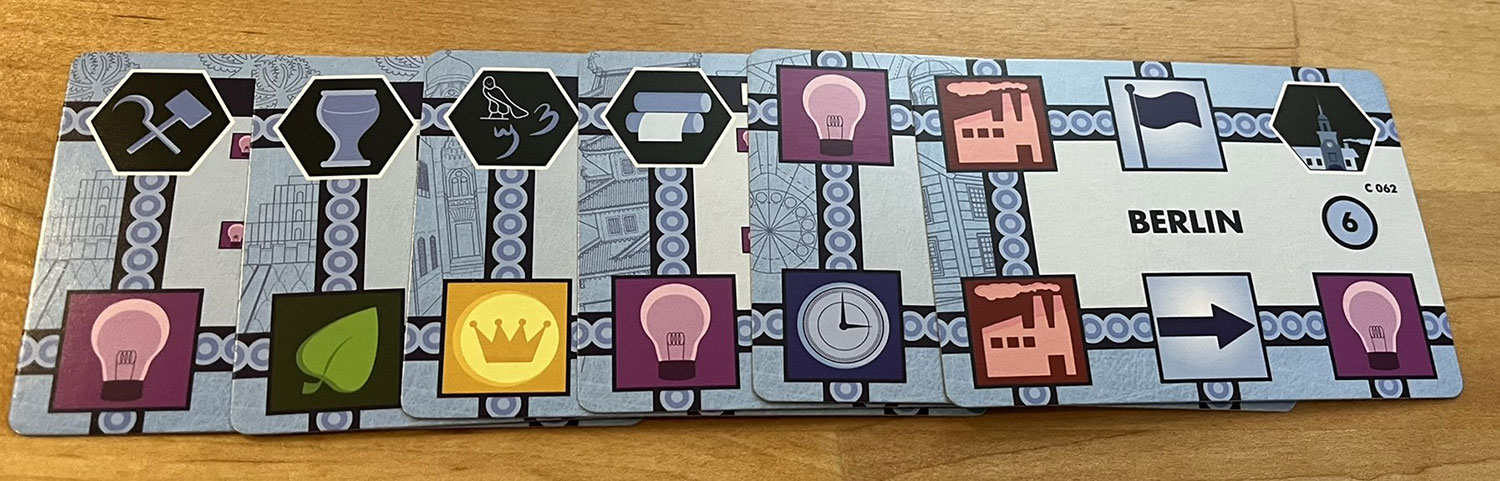
City cards do not contain dogma actions. Rather, they provide one-time instantaneous effects such as splaying your cards in a particular direction, unsplaying your opponents’ cards, drawing a card of value one higher than the city’s age, junking achievements or base decks, and more. Furthermore, while you have a top City card in play, it allows you to “endorse” certain dogma actions (perform them 2X for one action point). Payment for endorsing an action is junking (as opposed to merely tucking in 3rd ed.) a card from your hand.
Since City cards are easiest to draw in the early game when new colors are added into play, the greatest impact of this expansion is that it quickly accelerates the gameplay past the early ages, so greater time is spent with the higher Ages, owing to a combination of junking many of the low-Age decks, and making it easier to draw from higher decks. The City cards also make it easier to splay your various colors. If there’s a skill imbalance, this could create a runaway leader problem, but with evenly matched opponents, it simply means you’ll be counting many more icons much sooner.
The endorse functionality can be quite strong if timed properly, which adds a new layer of strategy. Granted, it can make the game a bit more swingy as players can now maximally exploit super powerful cards.
3) Echoes of the Past
Echoes introduces lingering “echo” actions as well as forecasting of future higher-age cards. Echo cards are drawn whenever you would draw a card, and your tableau currently contains exactly one top card of your highest value (example 3, 2, 2, 1 ). Echo effects are ongoing bonus actions present where icon tags would normally be. Once a melded Echo card is covered, any visible Echo effects visible through a splay may still be activated in the future, any time that color’s dogma action is utilized. It is possible to have 3+ Echo effects associated with a single color, so this Echo feature feels a lot like engine-building and can make individual turns significantly longer than before. These Echo effects can also be powerful enough (ex. a free splay) that players are incentivized to trigger certain dogma actions that are otherwise mediocre because the associated Echo effects are awesome. I love engine builders, so this was mostly a positive for me, though it did feel like the game took a bit longer.
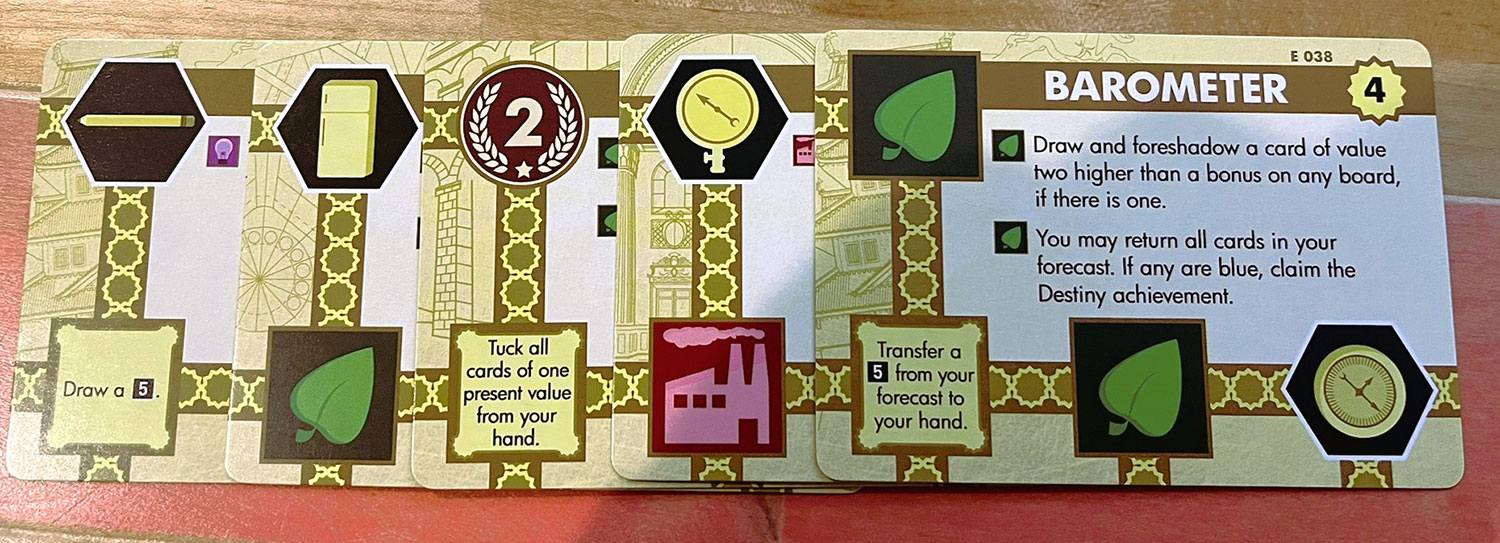
Many Echo cards also allow players to “forecast” higher value cards; these get added to your personal forecast area (not your hand), to be melded (or “promoted”) into play later. Promotion of individual forecast cards automatically occurs when you manage to meld a card of equal or higher value into play. The promoted card MUST be self-executed the moment it enters play, which may or may not be desirable, depending on whether you currently possess the relevant icon majority. Depending on the effects and associated icons of these forecast cards, players might either rush to get them promoted into play or actively avoid playing high-value cards to prevent their opponents from gaining the benefit of their promotion. I enjoyed the new layer of strategy added by this feature.
Additionally, many of the Echo cards contain effects such as, if this card was foreseen, then perform this additional one-time enhanced action, such as “draw and score a value-X card”. Granted, only some Echo cards have these foreseen bonus actions, and among the higher ages (8 and above), several of them essentially constituted auto-wins. I unexpectedly lost one such game to a rather lucky Age-8 Echo card my opponent promoted into play while 2 achievements behind; we both agreed that the game-end felt especially abrupt.
4) Artifacts of History
Artifact cards have a museum theme. They are drawn whenever you meld a card of equal or higher level than the one below, and they automatically go “on display” on top of your reference card. At the beginning of your following turn, you have the option to perform the dogma effect of this displayed artifact as a free action (before any other actions). The usefulness of these displayed cards was rather hit or miss. About 50% of the time, I opted to ignore my artifact as I had no cards in hand to properly activate the effect, or the effect benefited my opponent more than me. There generally wasn’t much opportunity between one turn and the next to prepare for these “free” artifact actions.
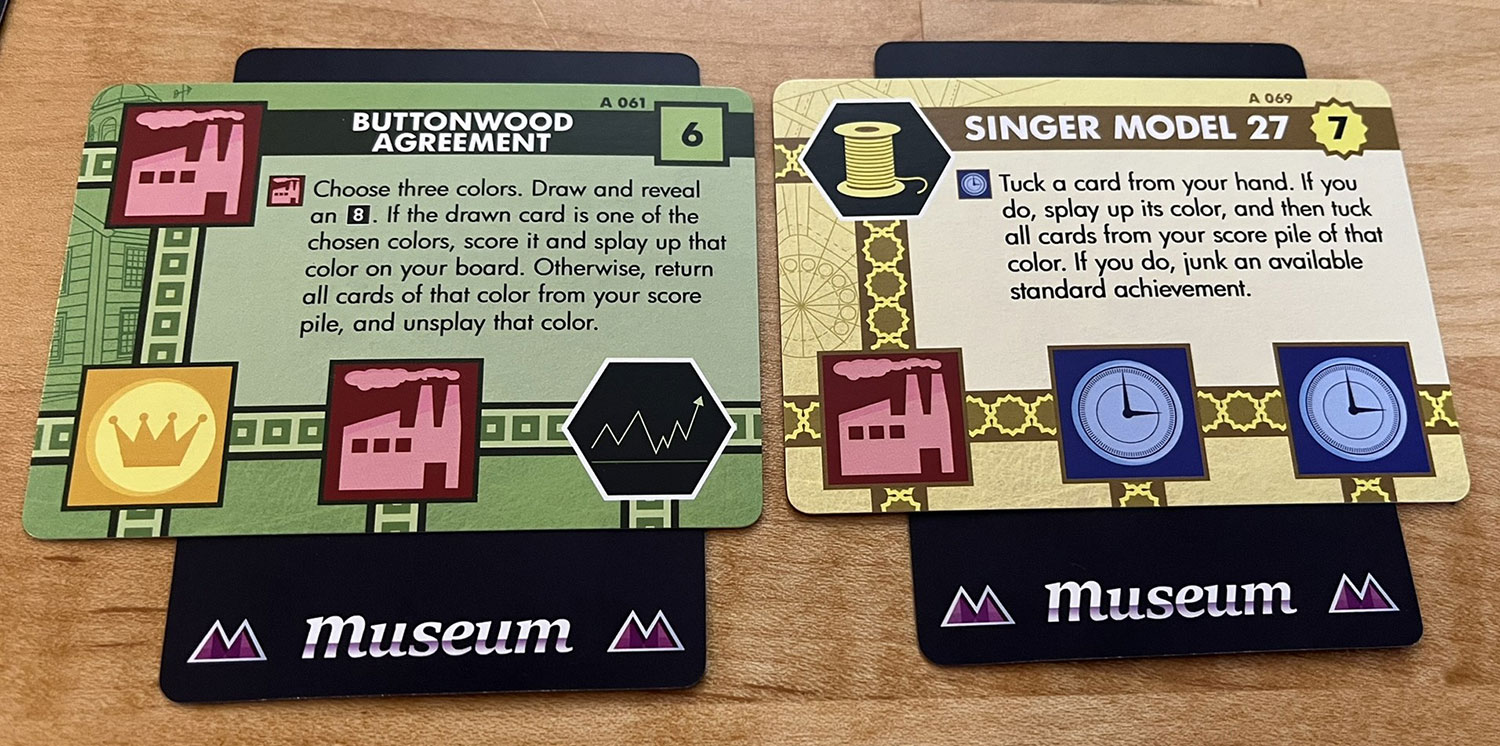
Whether or not you take advantage of your displayed artifact’s effect, it automatically gets transitioned to your museum. Museums are limited to 5, and once they’re all filled with artifacts, a museum majority check takes place with the winner getting to achieve one of the museums. At 2 players, this becomes a relatively easy way to earn an achievement, so you have to carefully plan to keep your museum stores high and/or steal artifacts from your opponent’s museums. I was not a huge fan of this museum dynamic as it pulled a lot of gameplay focus away from what I consider more interesting elements of the game.
My favorite part of Artifacts was the introduction of “I compel” dogma actions. These were generally take-that type actions that only affected opponents with an equal or greater number of icons. It was a nice catch-up mechanic and allowed for a strategy of purposefully letting an opponent surpass your icon count so you could hit them with an “I compel” action.
5) Unseen
Unseen is the newest expansion and so-titled because of that. Unseen cards are drawn the first time any card is drawn on your turn. That’s a pretty low bar for acquisition, and thus, games with this expansion felt like we had more Unseen cards in-hand/in-play at any given moment than base cards. Essentially, it felt like a completely new game—still a good one, but when the base game is already excellent, the major overhaul of the Unseen deck felt like too much.
Unseen also introduces the idea of safes that can be used to sequester scoring achievements just for yourself. However, there were also several cards that force your opponents to empty their safes, making the namesake seem somewhat ironic and weak.
Final Thoughts:
It’s worth mentioning that prior to obtaining Innovation Ultimate, I only had a handful of base Innovation third edition plays under my belt, whereas my husband had previously played quite extensively on BGA to the point that he memorized most of the base deck. This meant that I was rarely able to beat him at the base game. The altered strategy and gameplay elements introduced by each of the expansions in Ultimate brought our win statistics closer to 50/50, which was an overall positive for both of us and serves as proof that even the smaller-impact expansions have an influence on gameplay tactics.
I would therefore recommend one of these expansions or the entire Innovation Ultimate experience, mostly for die-hard fans of the base game looking to mix the gameplay up a bit, or for individuals or groups looking to equalize advantages owing to card familiarity.
As to which expansions you’ll like the most, opinions will definitely vary. Considering that the base game is already fantastic, I tended to prefer expansions like Figures and Cities, which didn’t feel like they drastically altered the main flow of the gameplay as much as the others. I especially liked the positive interaction present in the Figures. Even though the engine-building aspects of Echoes were a lot of fun, the forecasting component was maybe too swingy for my liking.
I will not provide a single overall rating for Innovation Ultimate as it is really several permutations of a game in one box, but know that there is A LOT of content in this box, with much of it containing appropriately innovative ideas that introduce both minor and major changes to what was already an excellent gaming experience.
Hits:
• Each expansion introduces unique changes to gameplay for varied strategies
• Opportunity to mix and match your favorite expansions
• Many cards and rules have been modified for improved balance
Misses:
• Unimpressive cardstock
• Main card artwork looks like Microsoft 2007 clipart