

 Have you ever traveled to a destination city and gone on a city tour like a true tourist? I have when I first visited Philadelphia, Seattle, and Las Vegas. All included landmarks and the city’s history, which was interesting and even shocking. My most memorable travel tour was a Chicago one where my group realized halfway through that the tour guide took us most places just to get his freebies, like 2 cheeseburgers at the Billy Goat Tavern and 2 dozen almond cookies at a Chinatown stop, to name a few… The Chicago Way!
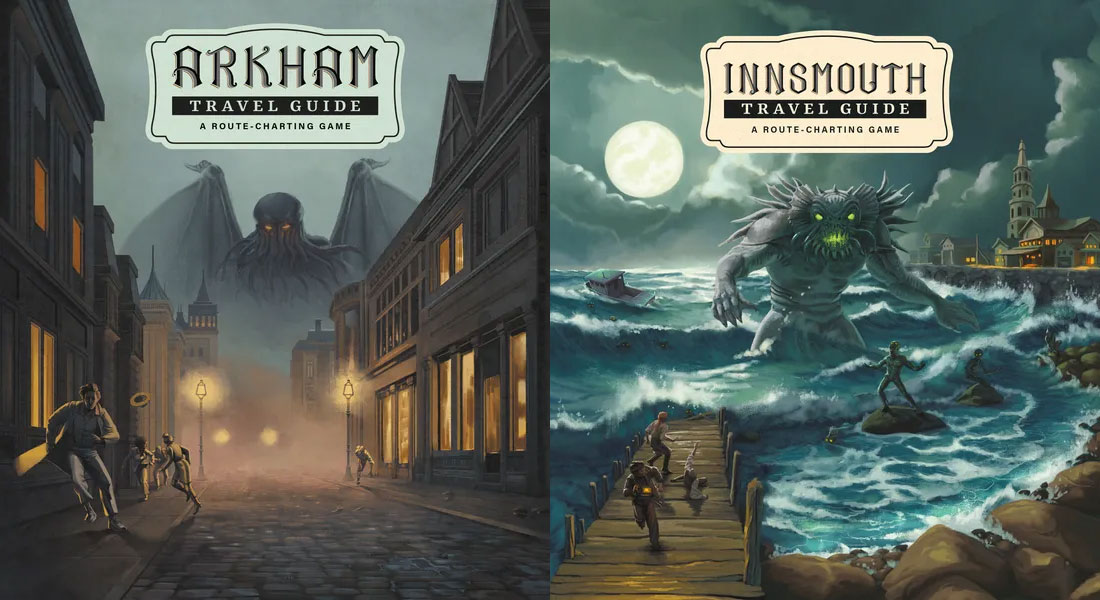
This brings us to today’s review of Arkham Travel Guide and Innsmouth Travel Guide from CrowD Games. These roll-and-writes are set in both infamous Cthulhu Mythos cities, where you are a travel guide trying to plot the best route, trying to add tourists to their preferred spots, and score the most VPs at the end of the game. Arkham Travel Guide and Innsmouth Travel Guide are both for 1-4 players and play in 30-40 minutes.
Game Overview:
The Arkham and Innsmouth Travel Guides follow the same base rules with differences that I will highlight. Players first select their map grid, a dry erase pen, draw an objective card (keeping it secret from other players) for end game scoring, and place the dice selection card in reach of the random first player.
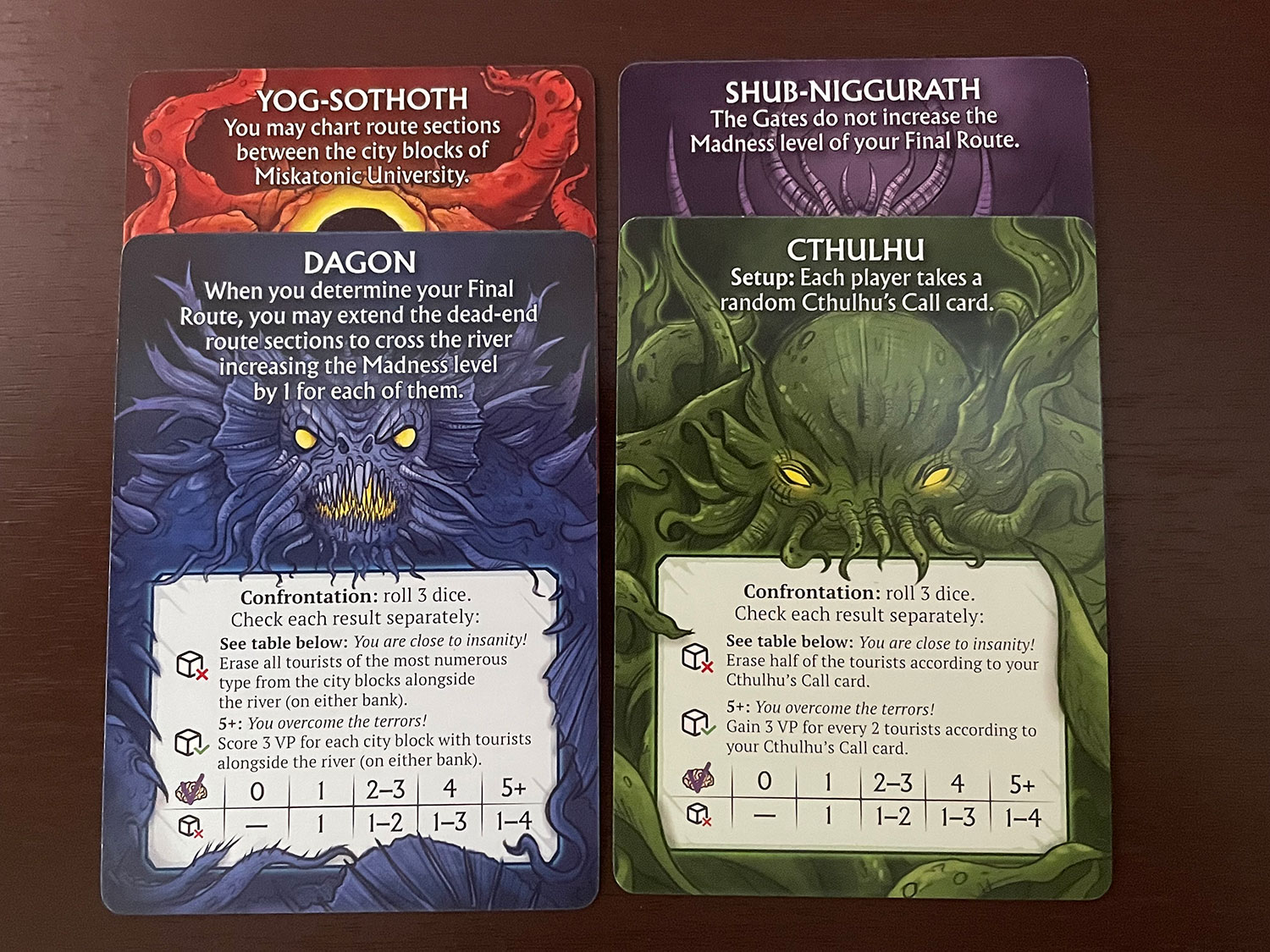
The Arkham Travel Guide has an additional set-up has players choose from 1 of the 4 Great Old Ones cards that list 4 Horrible places to mark on their grid and special game rules. Players will also deal out 2 effect cards and shuffle facedown the curio deck that players may use during the game.
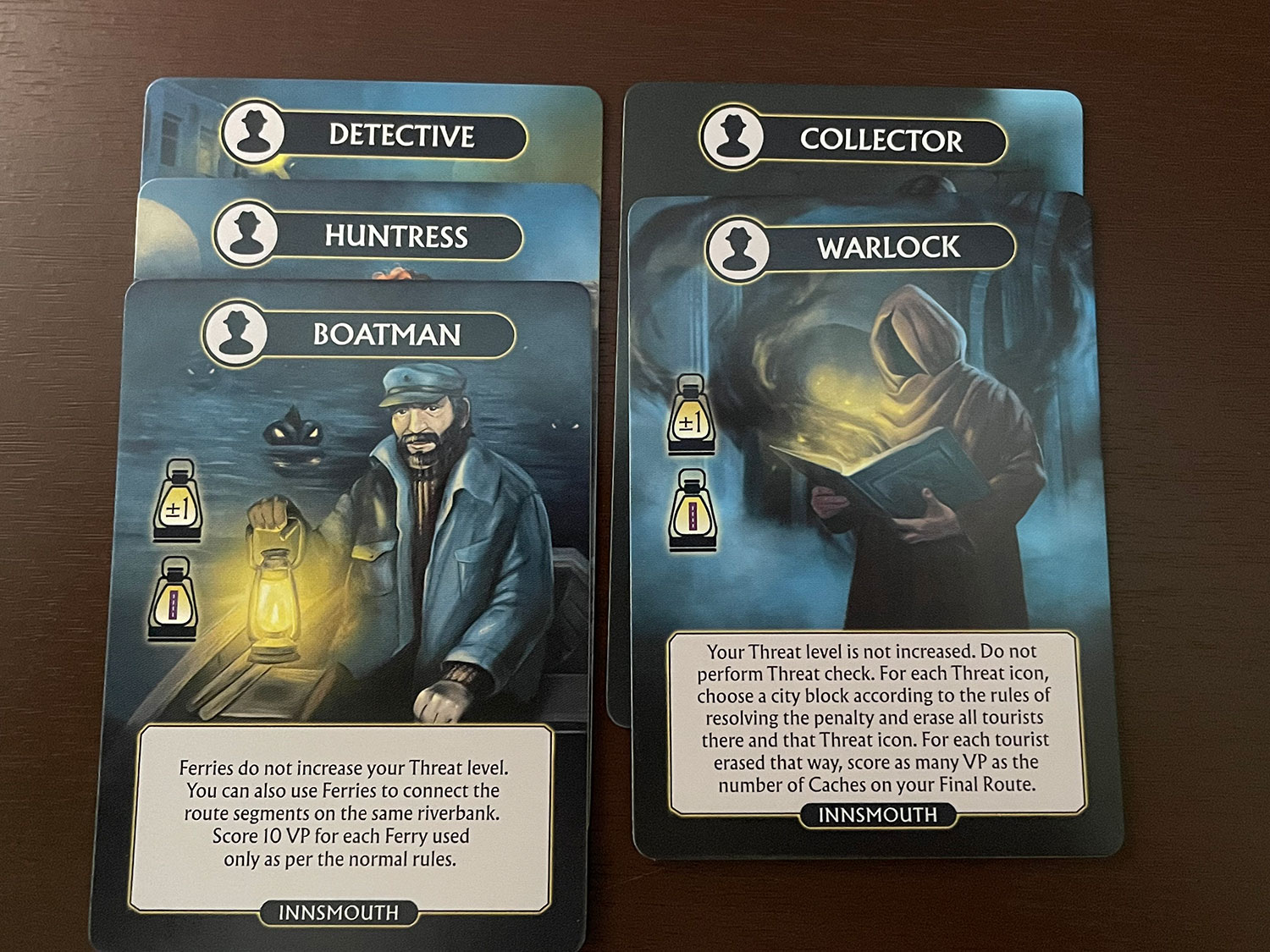
The Innsmouth Travel Guide set-up varies in that players must decide either the Cultist or Deep One side of the round board and choose 1 of the 5 character cards to use throughout the game. Players will also be dealt cache cards that they will add to their grid and shuffle individual artifact decks for each player to use.
The games are made up of 10 rounds, and each round is made up of almost identical phases: Arkham has 6 phases (drawing a curio card as phase 1), and Innsmouth has 5.
The phases are:
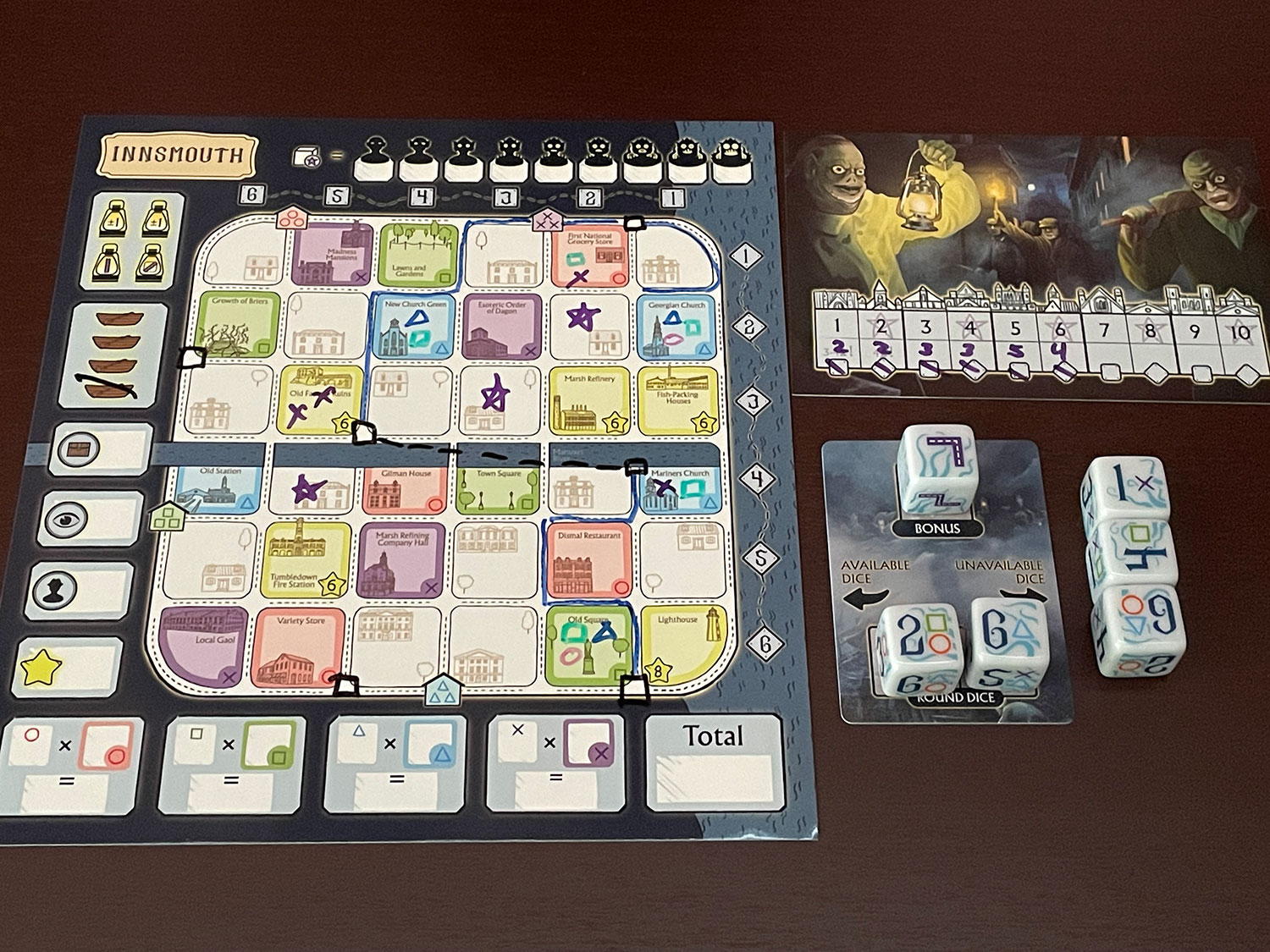
Rolling and choosing the dice for that round: Arkham players roll 5 and only use 2 dice, and Innsmouth players roll 6 and use 2 and a special bonus die (and the last unused die is the destiny die that will determine where Cultists or Deep Ones will appear on players’ grids 5 times throughout the game)
Choosing a city block: all players will check their grids for the dice used to use those numbers as is or reversed. All players then mark that city block with the tourist symbols on the dice used (color-coded and unique symbols on the dice).
All players then mark two routes (dotted lines on the grid) around the chosen city block, and the first line must be around the chosen city block, and the second line must connect but is made away from that block. This ends the round.
All players in Arkham can draw curio cards if their routes pass through or touch, and these cards give bonuses during or for end game, and all Innsmouth players may use the bonus die to add different route options.
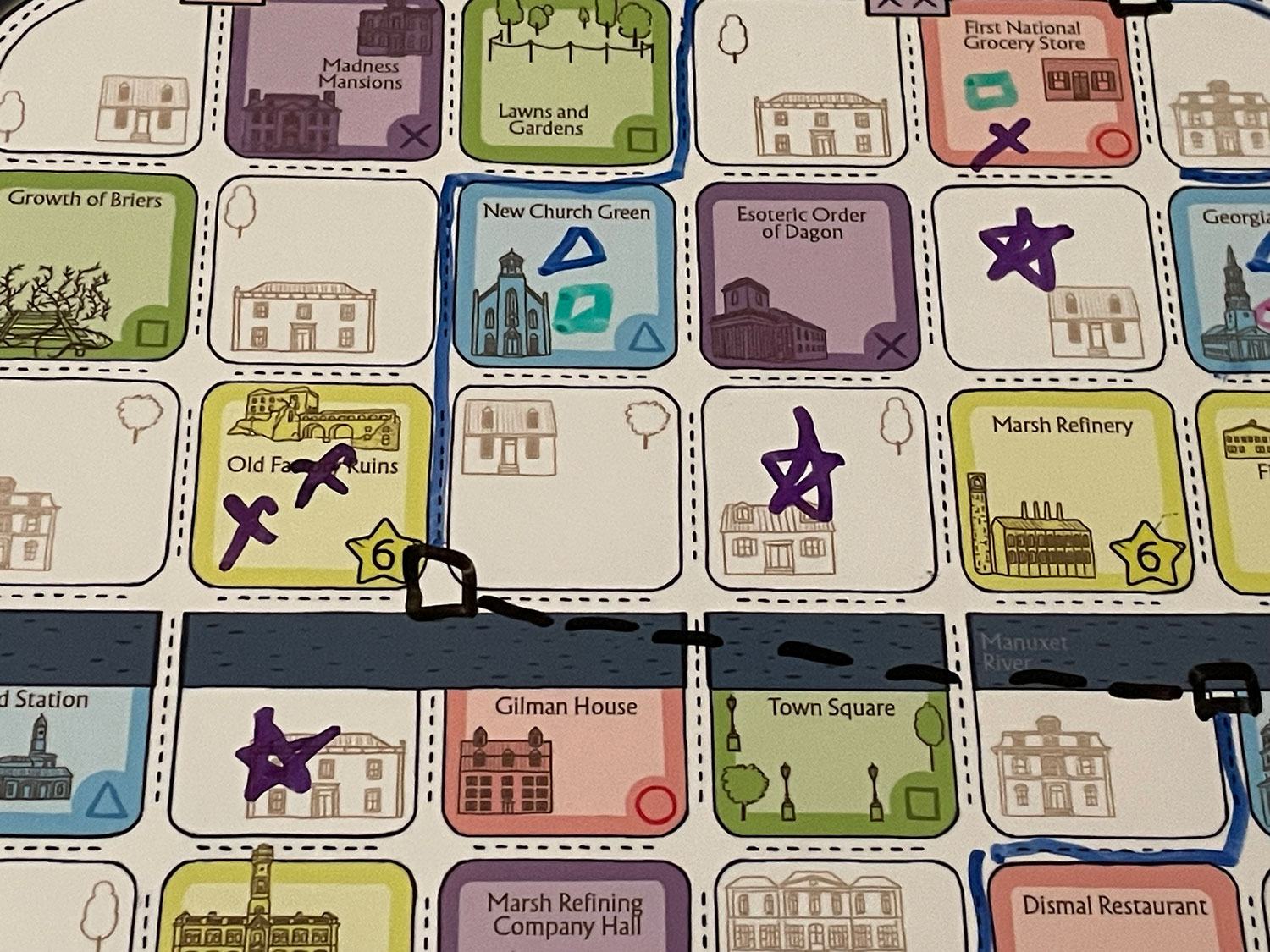
The game continues until the 10 rounds are over, and players will determine their final route, which triggers end-game events and scoring.
Arkham players must now determine their madness level by seeing if their final route touched any horrible places and if they used gates. They will compare their total to the table on the Old One they chose, roll dice, and see if they survive (possibly take penalties) or completely fail and are destroyed. Remaining players tally up by scoring their route bonuses from tourists, starred landmarks, personal objectives, and confrontation points; the player with the most points wins.
Innsmouth players must now determine their threat level by seeing if their final route touched where any Cultist or Deep One appeared, and if players connected their route with ferries. Players will then draw artifact cards for any caches touched by their final route to gain possible bonuses, and they can draw as many or as few as they want for end-game points. Then the threat is rolled, and players either overcome or tourists are removed as a penalty. All players tally up by scoring their route bonuses from tourists, starred landmarks, unused artifact cards, personal objectives, and character points; the player with the most points wins.
Game Experience:
Themes usually don’t make or break a game for me, but they do lure me in, and that was the case for the Arkham and Innsmouth Travel Guides. I mean, the theme is both silly and macabre. You are a travel guide trying to show tourists places that interest them while mapping the best route between these two Cthulhu Mythos cities, especially Innsmouth. You are also trying to avoid losing any for end-game scoring. I mean, what’s the worst that can happen? “Hey kids, look a Great Old One?!”
Both Arkham and Innsmouth Travel Guides have great luck mitigation mechanics to help players out if the dice rolls or map routes are not ideal. Arkham players can benefit from curio cards that can give bonus tourist placement, better route or dice options (and end game bonuses), and portals might cause madness, but these are great options for your final route. Innsmouth players will benefit from being able to use a bonus die each round for more route options, character special actions, ferries, which again generate threat but help your final route, and caches that give you artifacts for end-game bonuses. Both games give players many different ways to change dice rolls and routes.
Another thing that both Arkham and Innsmouth Travel Guides do well is give players unique city maps. This cuts down other roll-and-write games where players might copy each other’s actions, and makes for a less-than-ideal experience and end-game scoring. That will not be the case with either game since each city grid has a different 1-6 numbers X & Y axis, so players cannot copy and end up with similar routes for scoring. The maps are the same, so all players have that balance, but the numbers vary, which is a smart and subtle design.
Overall, the Arkham and Innsmouth Travel Guides materials are great, and the artwork fits the theme and is creepy good. These games do come in blister packaging, which was done to keep manufacturing and consumer costs low, and they’re fine. But, being that this is a roll-and-write, the dry-erase markers included are of poor quality. Drawing routes is not bad, but when you must draw any detail like horrible places or tourists, the markers are blunt, plus the ink does not hold shape, and so most detail turns to unreadable smudges. During our first game, we stopped and grabbed other color markers, and I have never used the ones included again.
While I enjoyed both Arkham and Innsmouth Travel Guides, neither game gives you any sense of who is winning during the game. Unfortunately, the endgame for the Arkham Travel Guide can be punishing. I mean, you try to make the best route and place tourists just to possibly be eliminated by the Old One before you can even score. This happened a few times during our plays and was mainly due to bad dice rolls and not having enough or the right curios to help modify the results. It’s somewhat deflating to lose in that way. So, I tend more towards getting the Innsmouth Travel Guide to the table for that reason.
Final Thoughts:
I love games based upon the Cthulhu Mythos, and the Arkham and Innsmouth Travel Guides are a nice addition to that and the roll-and-write genre. It has a great theme with lots of luck mitigation options to help players. Both games also have unique numbered map grids to eliminate copycat neighbors.
Now, what holds back both games from scoring higher are poor quality dry-erase markers, which are an essential piece to a roll-and-write game. Plus, the Arkham Travel Guide endgame can feel somewhat punishing and deflating if you get eliminated prior to scoring. So, watch your insanity level and try to gather plenty of luck mitigation options.
Final Score: 3 Stars – these are fun & silly thematic roll-and-writes where you try to map the best route in hopes of scoring the most VP while not losing too many tourists along the way.
 Hits:
Hits:
• Theme
• Luck mitigation
• Unique city maps
Misses:
• Poor quality markers
• Punishing end game