


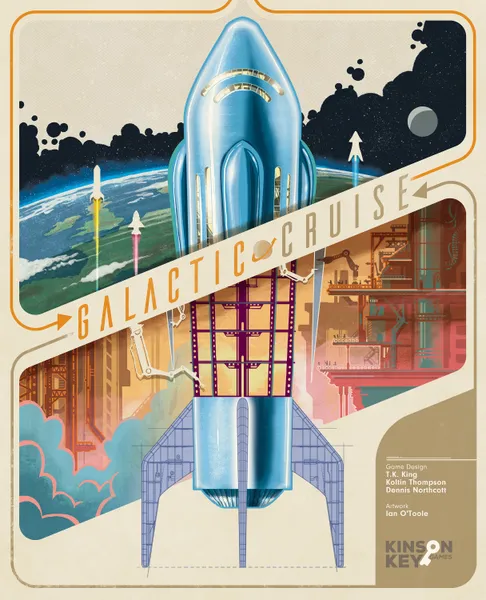
 My wife Melodi’s favorite games blend a mix of looking just a little bit ahead, plus a compelling theme. They tend to be medium-weight. She has had serious game crushes on Isle of Skye (BGG weight = 2.25), Kingdom Builder (2.07), and Wingspan (2.48). Games that drift towards the 3.5 or higher tend to get rejected as being “too much like a spreadsheet with meeples.” Fair enough. And yes, I am working on Spreadsheets With Meeples as my next game. I hope they’ll be able to screen-print green eyeshade visors onto those twee wooden accountants.
Last year, I discovered some real joy in playing Galactic Cruise, a game about managing the complex processes involved in building spaceships and marketing and launching them for the sake of tourism. I kept thinking that, despite its weight (3.97) and its heavy Lacerda-like gameplay, Melodi might like it. A few weekends ago, I agreed to trade Melodi a ratty sweatshirt of mine that she could use as a painting shirt for “please give this game a shot” and Dear Reader, I pleased to say she really liked it. Now my game of the year 2025 is now also a family favorite, and yippee ki-yay, am I excited to keep getting this one tabled chez nous.
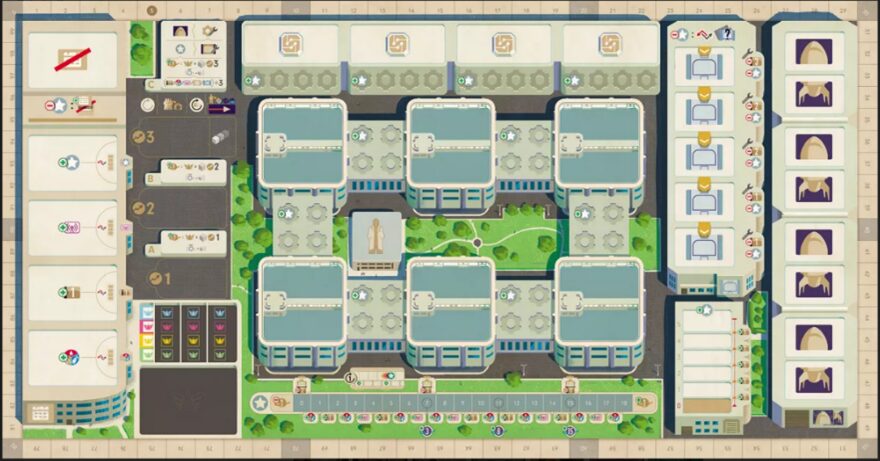
Gameplay Overview:
In Galactic Cruise, players construct fancy interstellar cruise ships, choose among potential space itineraries and market them to customers with different preferences for types of leisure activities, gather together the supplies needed to ensure a safe trip, and then hopefully launch a whole bunch of cruises before the game ends. At the same time, you are in a race with the other players to meet three goals (which change each game), which get more difficult as other players beat you to them.
The game’s end is on a timer such that launching rockets sooner and achieving shared goals faster speeds up the game, but all else equal, players would rather launch larger spaceships for efficiency purposes, so there is a tension between small and speedy ships and trips versus larger ships taking longer cruise routes.Thus, when enough ships have launched and goals have been met, the end-game is triggered and almost all the players moan that it ended just a smidge too soon.
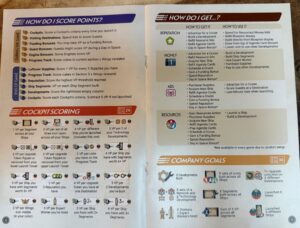
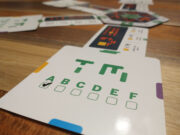
Galactic Cruise’s production is beautiful in a very Ian O’Toole style, which works to capture as much of the theme as can be had while also presenting every rule on the board in a form of space-age hieroglyphics. O’Toole has literally encoded every step of every turn into an admittedly complex iconography so that if you know the rules already, you can refresh yourself without appealing to the rulebook itself. Before you learn the game, of course, it’s really just a jumble of WTF all rolled into a pleasant color scheme. However, Kinson Key Games has taken the great step of providing four copies of an excellent player aid, themed as an employee handbook, which answers almost every question a new player might have, from “how do I get money” to “what does each action do?”
With this guide in hand, you can soon read the board’s symbols directly, allowing you to understand/remember any given step of the process without resorting to the rules.
Game Experience:

At first, when you open the box, you’re presented with a manila envelope that old farts like me used to get as an “interoffice memo” – sort of the analog analogue of an internal company email or Slack or whatever y’all use these days.
The envelope has a little memo on how to put all the pieces back into the box compactly, plus a cute security badge that can double as a first-player marker if you want (though there’s also a big cardboard token if you don’t like wearing a lanyard all game).
Then, as a new player, you are faced with perhaps the game’s biggest challenge, setting up the board, which can be rough, especially if you yourself are new to the game. I played just the other day with two friends, and it took me about 40 minutes to get it all laid out correctly. It’s totally worth it, but yeah, it’s three-to-four pages of careful explanation with schematic diagrams, and you will need to consult them a lot until you know the game well.
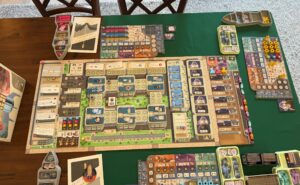
But once that’s done, it’s on to the fun. Turns in Galactic Cruise have two parts to them, though the first part (advancing your ships through space) won’t happen until you’ve managed to launch a ship, so it’s easier to talk about the second phase first. In that second phase, you have a choice of three actions:
- Place a worker onto the board (potentially bumping another worker back to someone’s board and generating a small bonus for being bumped) and do two actions based on the location chosen, or
- Launch a Ship (not possible early on, so let’s talk about this last), or
- “Call a meeting” which brings all your workers back, earns you a small bonus for each worker who attend the meeting, and then do one action (chosen from a subset of all actions based on where your “developments” are on the board.
The way that “call a meeting” works is cool because even when you do need to do the booby prize reset action, you get some income, and you get to do half of a normal turn’s worth of actions. Because other players can bump you, you can sometimes go a long time between meetings, and occasionally, you might even take a meeting earlier than necessary because the income it generates might be worth more than the loss of half a turn’s worth of actions.
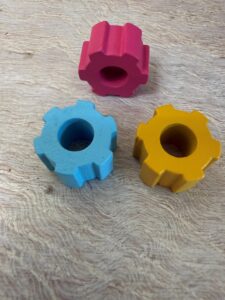
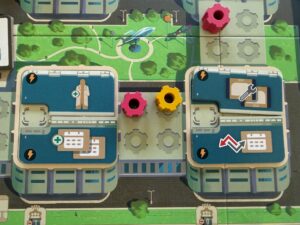
When you aren’t calling a meeting (so that you get two actions), the actions can come from a variety of action spaces on the board. Each worker spot is tied directly to two different actions, but those chunky development gears you (or your opponents) build allow you to perform actions from adjacent spaces on the board – for free if it’s your development linking them together (or if your reputation with your colleagues is excellent) or for a money cost if the gears are owned by your opponents and your reputation isn’t high enough to earn a freebie.
Once you’ve managed to build a large enough spaceship, arrange an itinerary, line up some passengers (though you can also grab travelers at the last minute to save an action at the cost of some reputation & money), and get enough food, oxygen, and fuel to ensure the safe return of the cruise and passengers, you get do the third possible action, which is to launch a ship. This takes your entire turn, and essentially it just resets the board a bit by removing your scheduled cruise from the launch list and replacing it with a new itinerary that you or the other players can now claim for the next launch. The board has a nifty little launch sequence (if you can read the O’Toolecongraphy) to walk you through the countdown to liftoff.

Once you have performed a launch turn, then until that ship returns to earth, your turns will have two phases rather than one. In the first phase, you’ll advance your ship (or ships if you get multiple cruises going at once) to the next stop on its itinerary, and earn some bonuses and possible points. Itineraries have two kinds of stops. You’ll either do a day in space (where you earn bonuses based on the fun stuff you built into your ship and which kind of passengers you attracted) or land on a planet (where you’ll send your passengers on an excursion to earn victory points).
After resolving the “advance ships” phase, you’ll also do a regular turn, choosing between worker placement, calling a meeting, or launching another cruise if you’ve regathered all of the needed materiel to perform another launch.
Besides the points you earn from your launches and itineraries, there are also three scoring assessments through the game, dividing the game into thirds. Every time a player launches a ship or meets the criteria for one of the game’s three achievements, a cube gets placed onto the track that measures the end of each of these three eras. When the first section fills up, players score based on how well they are meeting those achievements goals and launching ships. The same thing happens when the second section fills up, based only on the cubes placed during the middle third of the game. When the third section fills up, the end of the game is triggered and players will get one or two more turns before the final scoring occurs, based on cubes placed during the last third of the game.
Because it takes a lot of stuff to build a spaceship from scratch, to plan a trip, and to line up the needed resources and means of attracting passengers, the game starts off fairly slow. I would wager that in most games, it takes longer to hit the first of the three scoring phases than to fly through the other two-thirds of the game. During that first phase, no one can launch right away, and then even after the first launch, it might take a while for someone else to launch, especially if some of the players are aiming for larger ships and longer itineraries. But once you hit the mid-game, suddenly the game speeds up incredibly fast, and it feels like the second and (especially) the third phase of the game takes almost no time at all in comparison.
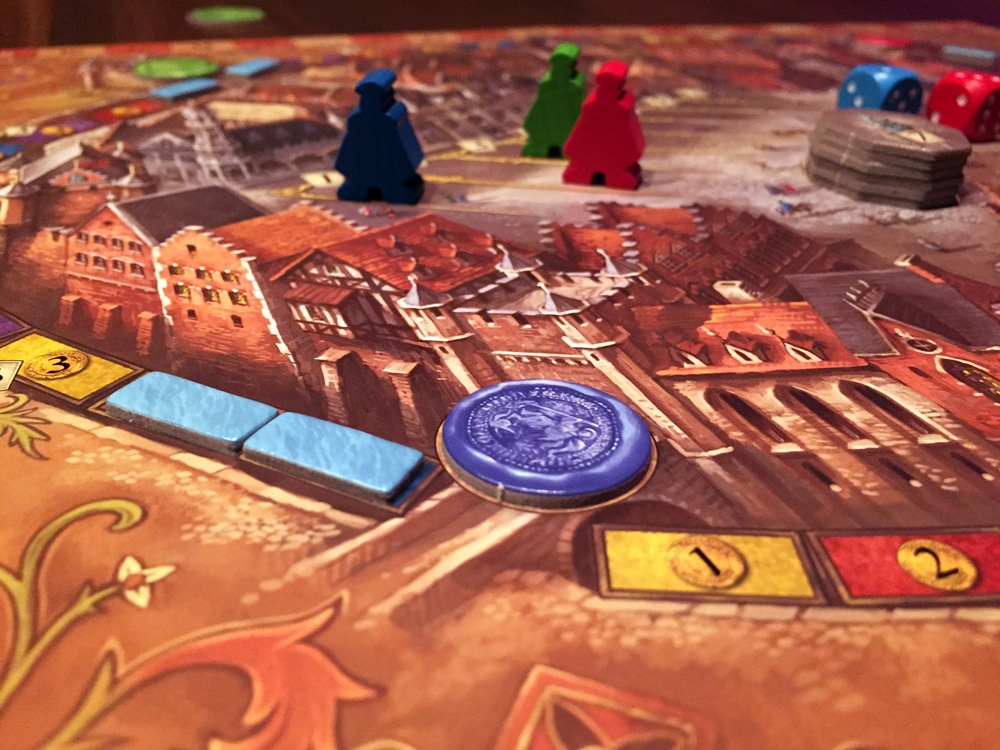
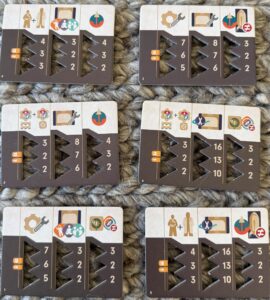
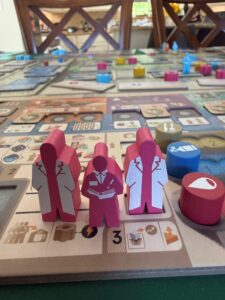
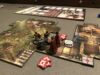
One last thing that really needs to be emphasized is that this game is really visually arresting in person. You may have played on BGA and enjoyed it, but the physical production is fantastic. From the chunky meeples who wear different clothes depending on their level of expertise, to the slickly designed inserts to allow you to fit everything neatly into the box (and a memo explaining how to do it), this is just a fantastic tactile experience.
Final Thoughts:
Ian O’Toole has had a long and fruitful collaborative relationship with Vital Lacerda, and so his artwork often feels synonymous with Lacerda’s style of heavy games with a ton of pre-planning required just to do the main goal of the game. As I discussed in our best of 2025 article from earlier this year, the relative newcomers to the design space who made Galactic Cruise (T.K. King, Dennis Northcott, and Koltin Thompson) and the publisher (Kinson Key Games) made an excellent choice to bring O’Toole in to wrangle this beast of a space opera into a manageable format. What’s kind of amazing is that I think Galactic Cruise is now my favorite “Lacerda,” despite having no other connection to Vital himself other than sharing an artist and a genre.
If imitation is the sincerest form of flattery, then an homage that outdoes its inspiration should be considered high praise indeed.
Final Score: 4.5 Stars: If you like games with a weight of around 4, Galactic Cruise is a 4.5 or more. (If not, it might be more of a delay-tactic snooze).
 Hits:
Hits:
• Satisfyingly complex without overly punishing less than perfect planning
• Thematic if you want it to be, schematic if you don’t
• Great player aids to help you overcome the initial learning curve.
• Melodi enjoyed it despite the 3.97 BGG weight
Misses:
• Setting up a game, especially the first time, is a sizable task.
• There is a lot of iconography to process, especially before you know the rules well.
• Players who don’t love long-term planning might find this to be more work than fun.










How’s the solo mode?