
 Stonemaier Games stands out among board game publishers for prioritizing both deluxe component quality and extensive playtesting, the combo of which produces consistently excellent games beloved by many. Their latest release is a mash-up of two of their popular titles: Wingspan and Viticulture—players will race to get birds drunk on fermented grapes.
I kid.
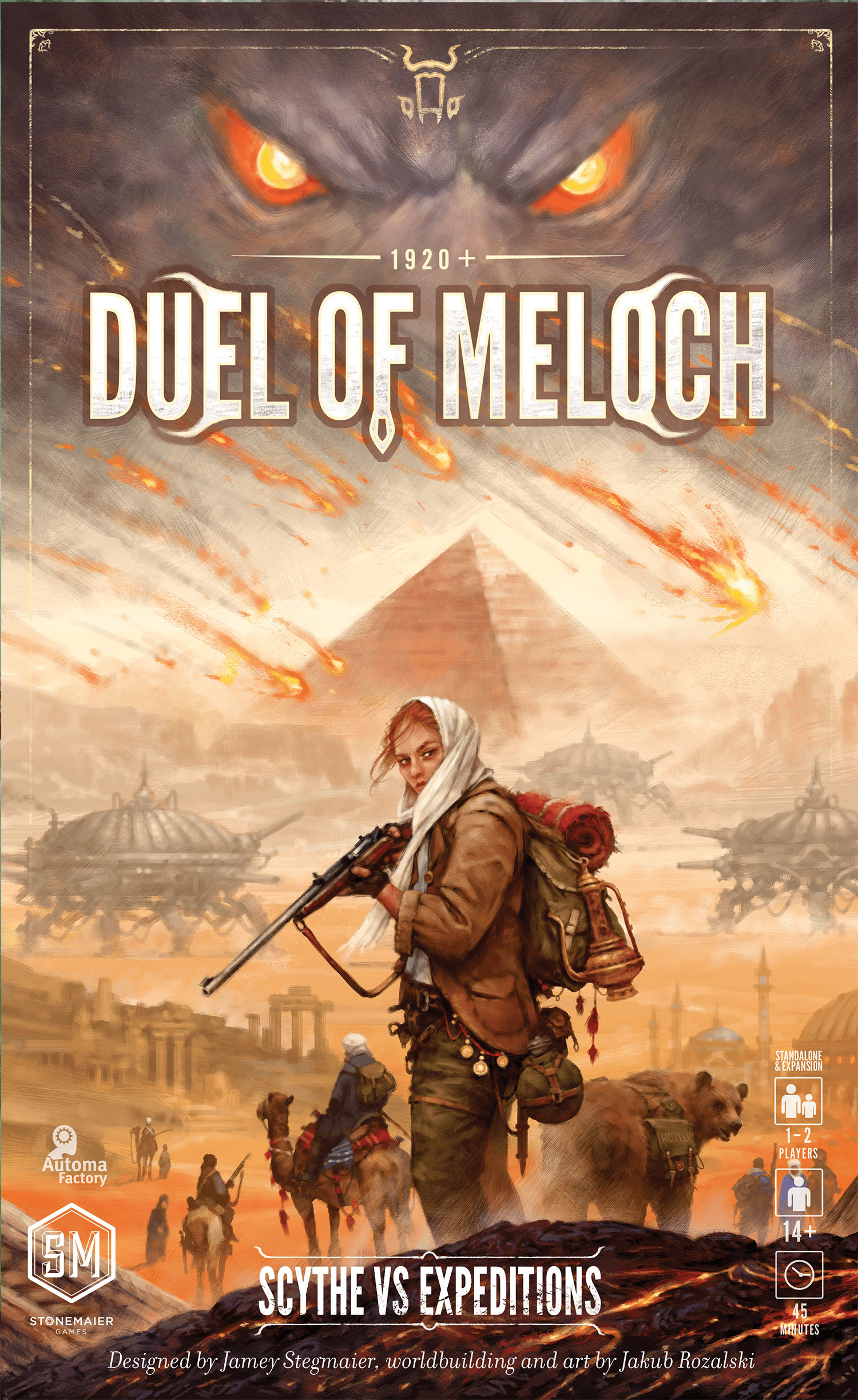
The actual games comprising this dueling mashup for 1-2 players are two of Jamey Steigmaier’s own designs: Scythe and Expeditions. Inspired in part by demographic surveys indicating that 33% of the Stonemaier audience plays primarily at 2 players, this stand-alone title (that’s right, you don’t need to actually own either Scythe or Expeditions), Duel of Meloch, is set in the same universe and has one player employing Expeditions mechanics while the other utilizes Scythe mechanics in a race to four points over 45-60 minutes. It’s the surprise board game baby we weren’t expecting—is the gameplay good enough to celebrate?
Gameplay Overview:
I will assume readers are already familiar with the rules for both Scythe and Expeditions and focus instead on the differences.
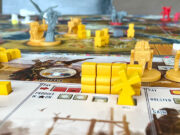
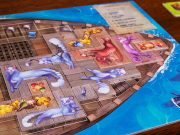
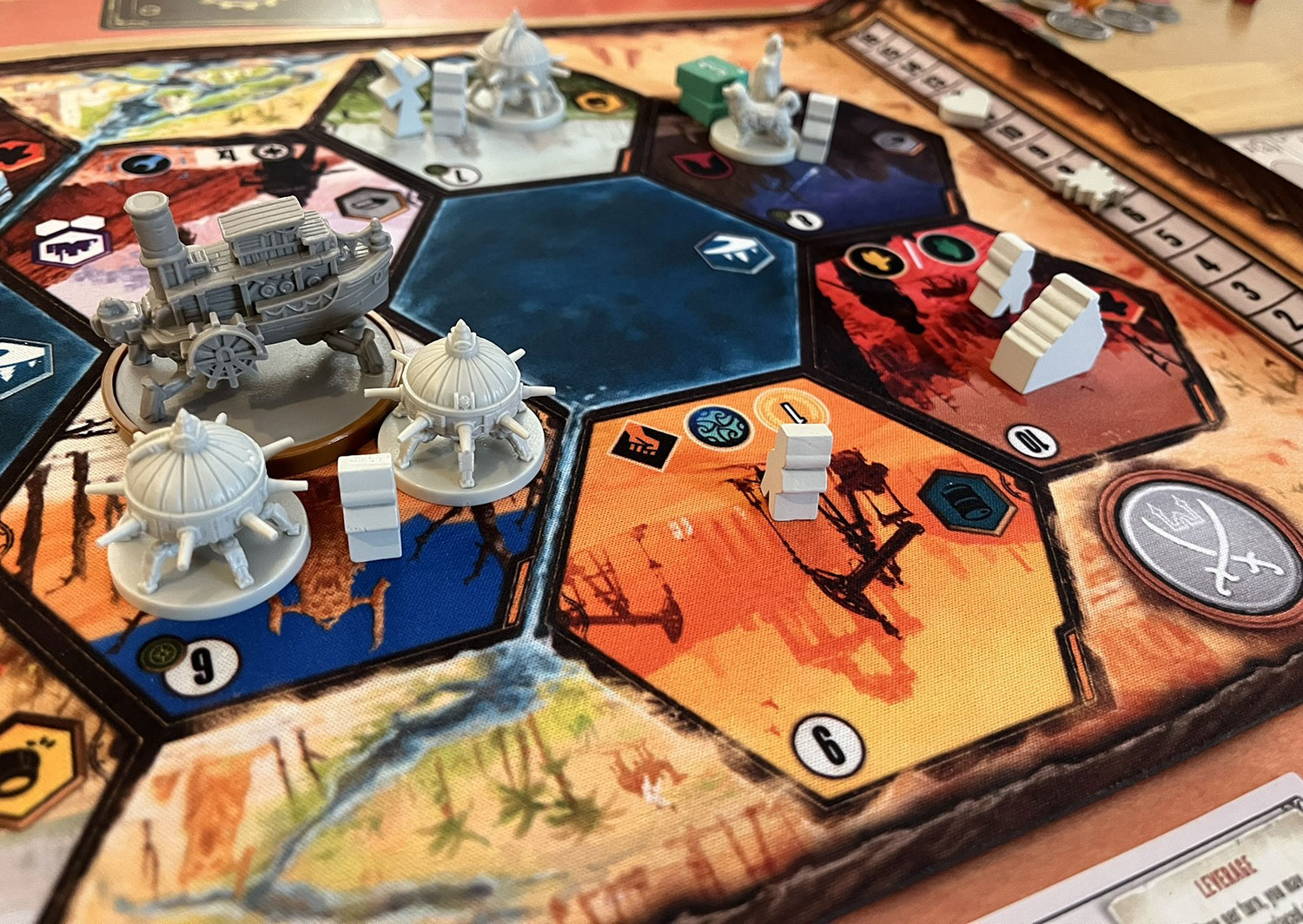
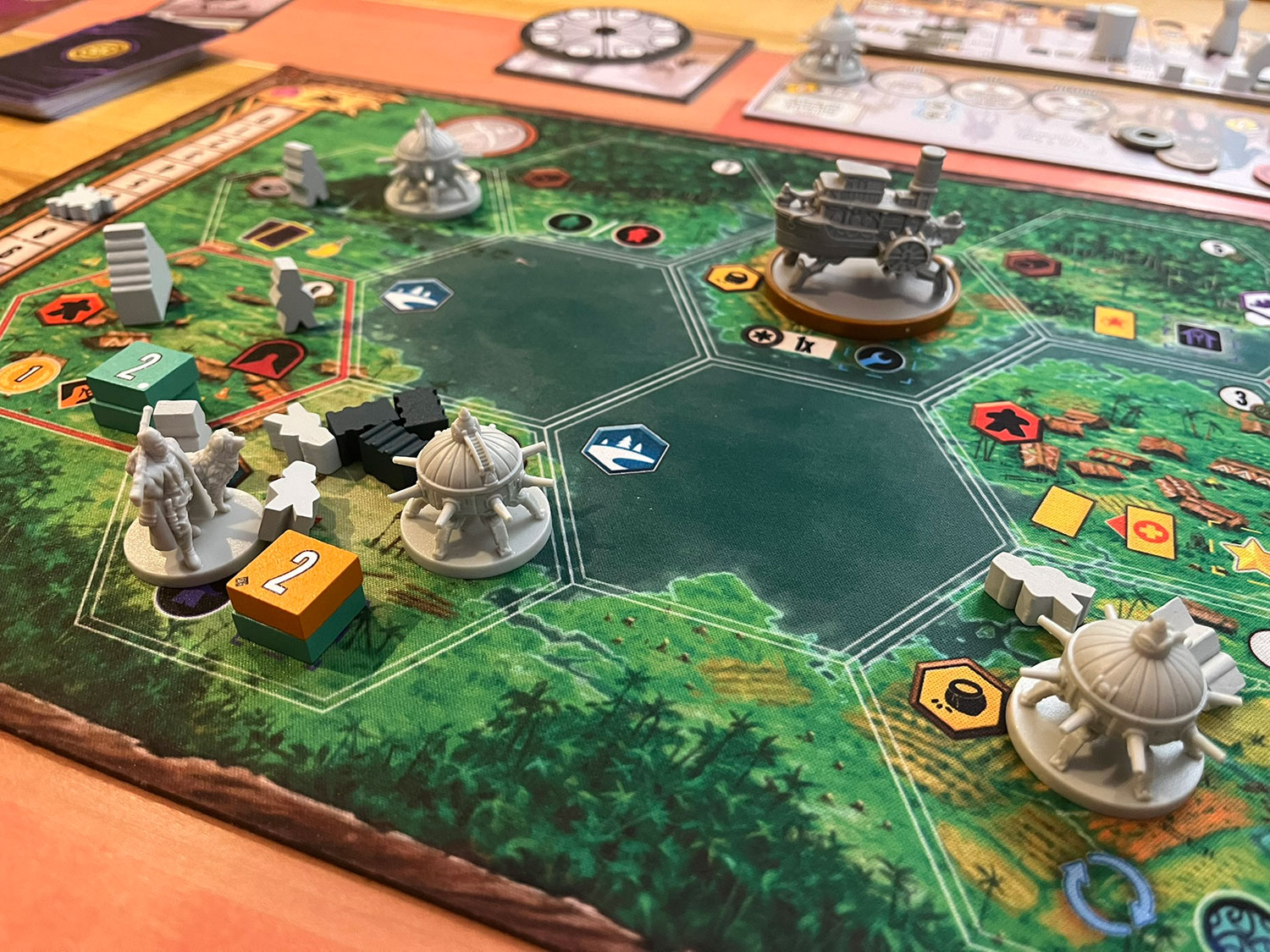
The two included maps are smaller and pre-set on a dual-sided neoprene mat; there is no discovery element like in Expeditions. The included player boards for Expeditions/Scythe are identical in style to those of their respective base games, albeit with novel asymmetric abilities. There are two sets of icons on each map hex: gather actions + numbered locations for Expeditions and resource type for Scythe. Each player only needs to be concerned with the icons for their game.
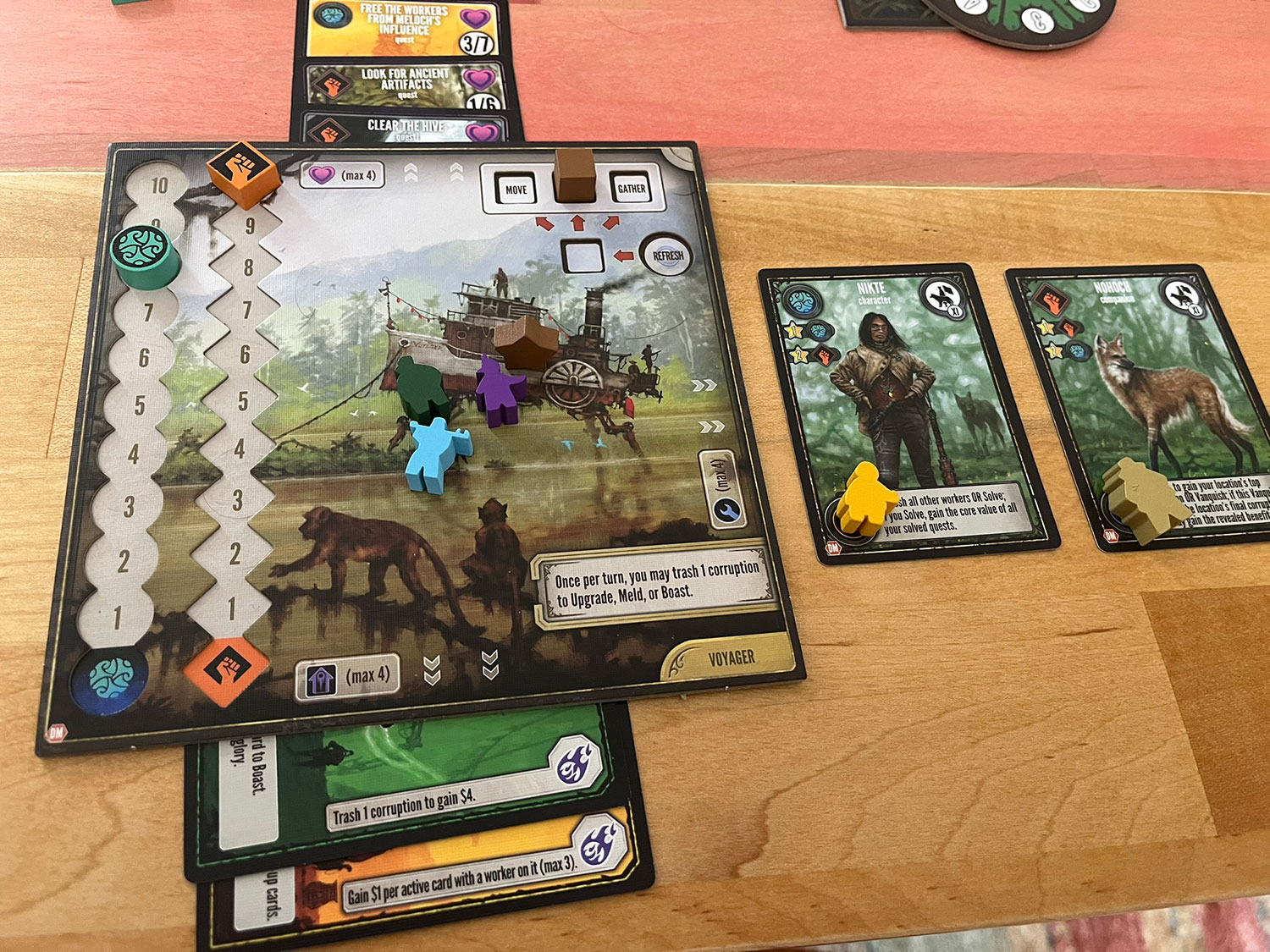
As for the gameplay, the biggest difference is scoring, which has been simplified down to the first to score four objectives. Gone are area control points and popularity multipliers for the Scythe player. Expeditions players will no longer sum points from coins, upgrades, and collected corruption. Instead, each player is presented with a set of 8, mostly asymmetric public objectives, specific to their game. For Expeditions, these include accomplishments such as collecting 7 corruption and accumulating 10 Guile. For Scythe, these include tasks like deploying 4 mechs and controlling 7 territories. Importantly, these objectives are arranged such that each is paired with one for the opponent, and if, say, the Scythe player deploys 4 mechs, the Expeditions player is no longer eligible to achieve the matched objective (3 upgrades).
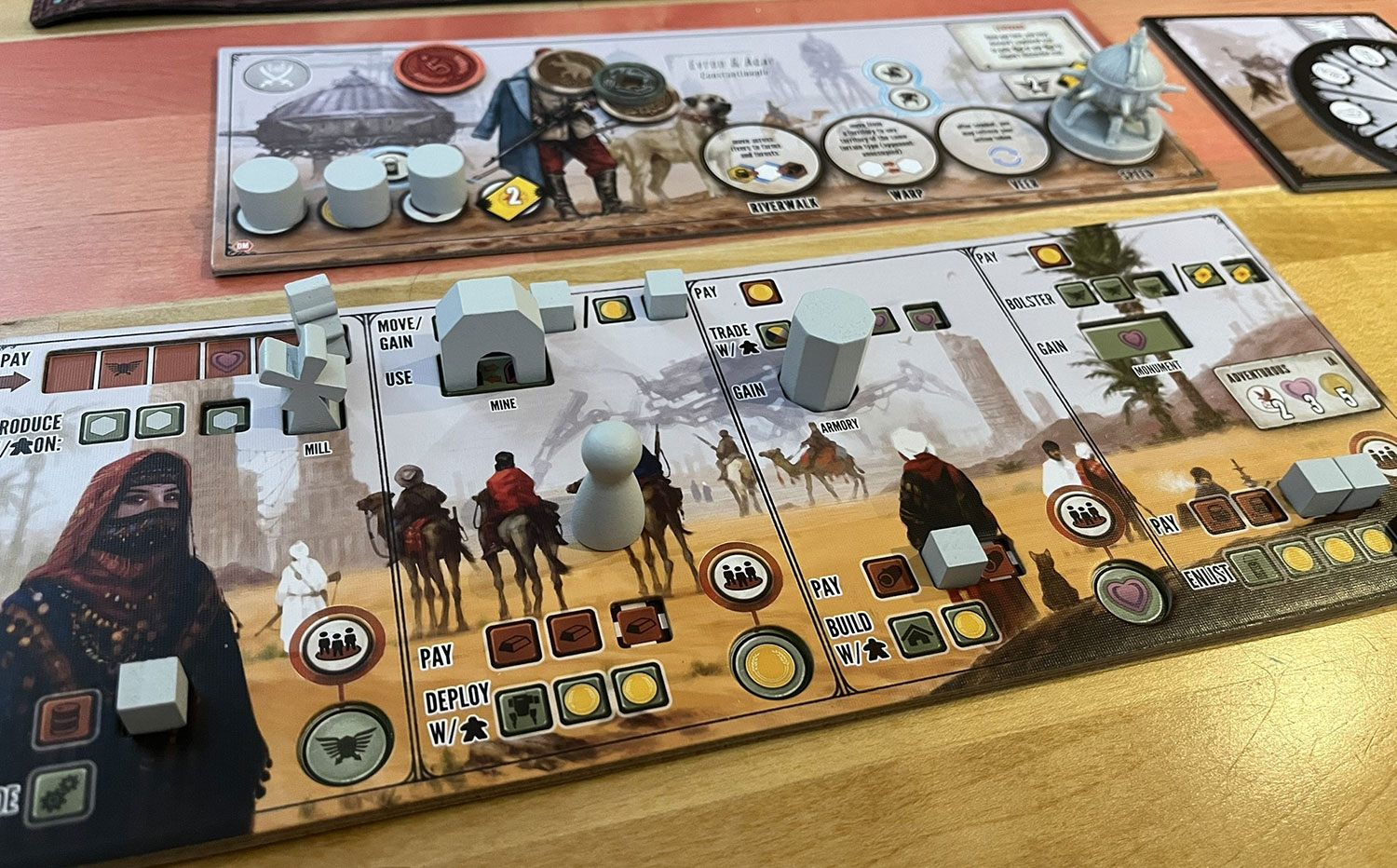
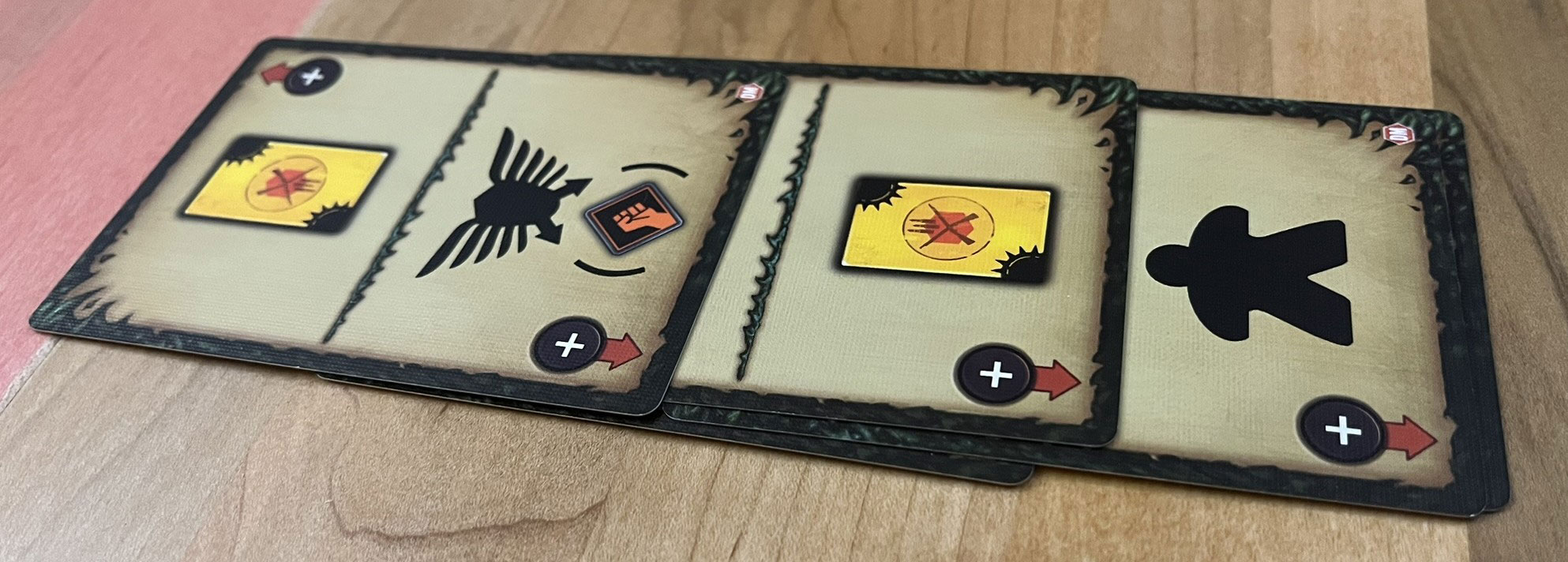
Scythe players may place stars as soon as they achieve objectives, but Expeditions players must first take the “Boast” action. To keep the game tight, there is a new card-based catch-up mechanic in place to boost your opponent’s progress whenever you score a star.
The next biggest difference is how conflict is handled. For the Scythe player, it’s largely the same: end a movement action occupying a space with the Expeditions player. The Expeditions player may choose to initiate battle by “Vanquishing” on a hex containing enemy pieces. Their battle power is derived from combat cards drawn in lieu of or in addition to regular cards according to normal card-draw rules, plus their Power track. Whoever wins the battle instantly gains a star and forces the other player to retreat.
Once one player places their 4th star, they immediately win.
Game Experience:
I am part of that 33% that primarily plays games at 2-players, and thus I wasn’t a huge fan of OG Scythe, which has fairly minimal player interaction at 2-players. It’s also worth mentioning that area control is not my favorite game mechanic, and furthermore, I don’t love the idea of someone being able to steal my stockpile of accumulated resources—which can be important elements of Scythe at the higher player counts where it shines.
Playing Scythe within Duel of Meloch is thus an improvement for me: the Expeditions player has no need for your resources, and unless you’re aiming for the “control 7 territories” objective, area control is no longer a major aspect of the game. The focus is now purely on getting your engine running as quickly as possible so you can score objectives faster than your opponent.
From the Expeditions perspective, it’s worth noting that I adore base Expeditions; it plays wonderfully at 2-players, and trying to cobble together synergistic card combos is a blast. Playing Expeditions within Duel of Meloch is still great, but slightly diminished owing to the loss of some of the point salad scoring, which makes the decision-space somewhat smaller. Card synergies may also be somewhat harder to find, considering the market has been reduced from 5 to 2, and there’s also less card turnover with only 1 Expeditions player claiming them.
The part that has been enhanced for both games is the player interaction, largely owing to the smaller map. Early game, the Expeditions player has much greater mobility (they’re hindered by lakes, but not rivers). Late-game, however, if the Scythe player gets some mechs deployed, they can begin moving faster, teleporting, and positioning their multiple pieces such that they significantly hamper the Expedition player’s movement and/or initiate combat with a greater number of forces in one location. It’s a pretty cool game-arc. Notably, combat is almost guaranteed in Meloch, as it constitutes 1 or 2 of the scoring objectives, depending on which set is used.
The paired scoring objectives are an immense source of tension. Say the Expeditions player is close to accumulating 10 Guile. If you’re the Scythe player, that objective is paired with 3 Enlistments on your side. Maybe you think a different objective is easier to achieve, but if you prioritize the 3 Enlistments and achieve that first, you can effectively block your opponent from getting a star for their Guile accumulation. Timing is also quite important; the Expeditions player probably wants to wait to vanquish too much if they’re aiming to accumulate 10 Guile. The Scythe player probably wants to achieve the 13 battle power before they actually use it in any battles. For this latter example, there’s definitely a viable strategy for the Expeditions player to pick a fight with the Scythe player if they’re getting close to 13 battle power, thus daring them to fight with less than full power or risk losing the battle.
Notably, the game comes with two different sets of 8 paired objectives, so your priorities will always be different. This, combined with the two different map layouts, creates pretty decent replay value, even without having access to additional factions from the base games. The Expeditions player has inherently more variability to their play options based on the cards, so Scythe is probably the game that most warrants additional factions for replay value, and I would have appreciated it if just one more Scythe playerboard were included in the box to truly make it an even stronger stand-alone game.
Nonetheless, considering that the Scythe player must tactically react to objectives that the Expeditions player is pursuing makes their play somewhat variable as well. Swapping in factions from the original games does generally work, but it’s worth noting some special abilities just aren’t as helpful with the rule changes in Meloch.
Importantly, the ample playtesting shows in the game’s final result. Every play I’ve had thus far has been a nailbiter with both players achieving 3 stars and racing to claim a fourth, usually within a single turn of the other.
Final Thoughts:
Duel of Meloch is not simply a cash grab for the existing fandoms of Scythe and Expeditions; it is a legitimately great medium-heavy game design that can stand on its own as well as be enhanced by factions from those other games. For fans of Scythe, I think this will be a big hit, as it feels very similar to Scythe, but with much more player interaction. For fans of Expeditions, the smaller card market in Meloch and elimination of some parts of its point salad make this a different experience, though still thoroughly enjoyable; it’s a great gaming choice if you only have 45 minutes—or limited shelf space. For the uninitiated, Meloch is a fantastic engine-building Eurogame where 2-players race to complete 4 of 8 mutually exclusive objectives in a tug-of-war fashion. It would likely appeal to similar audiences of 7 Wonders Duel from the perspective of multiple balanced routes to victory and needing to ruthlessly cut off your opponent every time they get ahead.
Final Score: 4 stars – this game has the (mech)nology to let you scratch that medium-heavy Eurogame itch in a faster, sleeker, smaller, package than its parent games
 Hits:
Hits:
• Balanced gameplay that makes every play a nail-biter
• Fantastic production
• Compatibility with existing Stonemaier productions enriches replayability
Misses:
• Smaller Expeditions card market can limit viable choices
• Inclusion of one more Scythe player mat for those who don’t have the base game would have been nice
• Rulebook assumes familiarity with both Scythe and Expeditions