

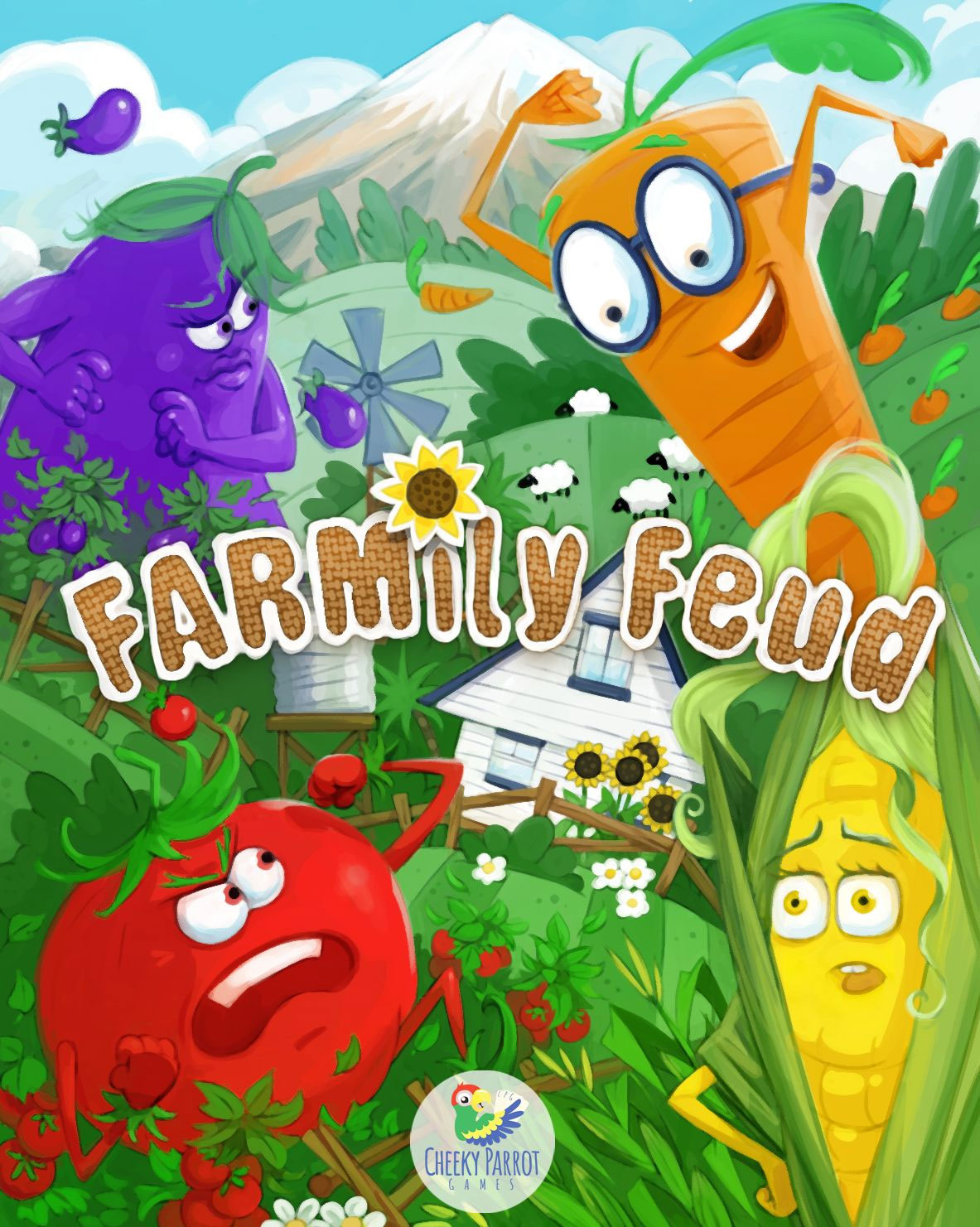
 You were left the family farm, and it’s your life’s dream to take it over and live out your small town dream. It’s the bucolic scenario that kicks off every cozy game of the last ten years. Unfortunately, in this scenario, your headstrong siblings have also been left the farm, and none of you can agree on what to plant.
Gather round the table to duke it out, family style. Carrots, corn, tomatoes, or aubergine, choose your vegetable and prepare for a fight. Cultivate your plants, take over plots, and use your seeds to gain advantages. It’s an all-out feud down on the family farm.
I got to play my first game with the designer and publisher at Cakes and Ladders, an adorable little game cafe here in Auckland city center. Our group (largely strangers) started out friendly, but soon realized that no winner was going to be crowned without splitting a few tomatoes. The last few rounds of that first game devolved into an all-out card brawl, with folks analyzing their placements to cause maximum chaos, resulting in maximum laughs.
Gameplay Overview:
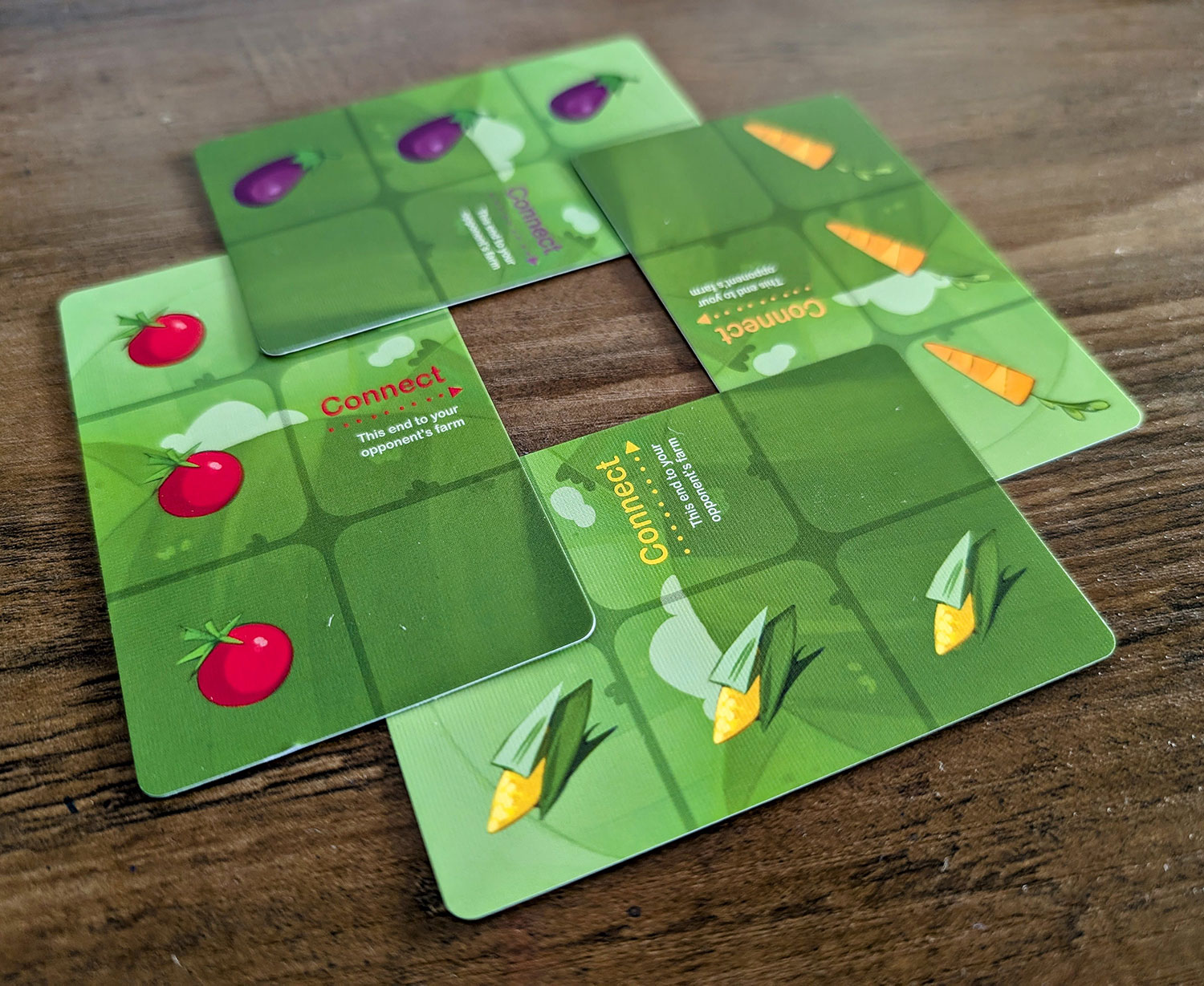
The game consists of four sets of player cards (7 action cards plus a starting farm card), tokens representing each deck, which read ‘even’ and ‘odd’ on the sides, and 28 seed tokens, which will are used to pay for actions but also serve as the score indicator.
Each player chooses one of four vegetables (carrot, tomato, aubergine*, or corn. The objective of the game is to have the most points, scored by creating patterns of plantings and obscuring your neighboring farmers’ fields.
[*Ed Note: You may know this as an eggplant]
Each player places their starting card at the center of the table, laid out in a pattern based on the number of players. From here, there are seven rounds, each with six steps.
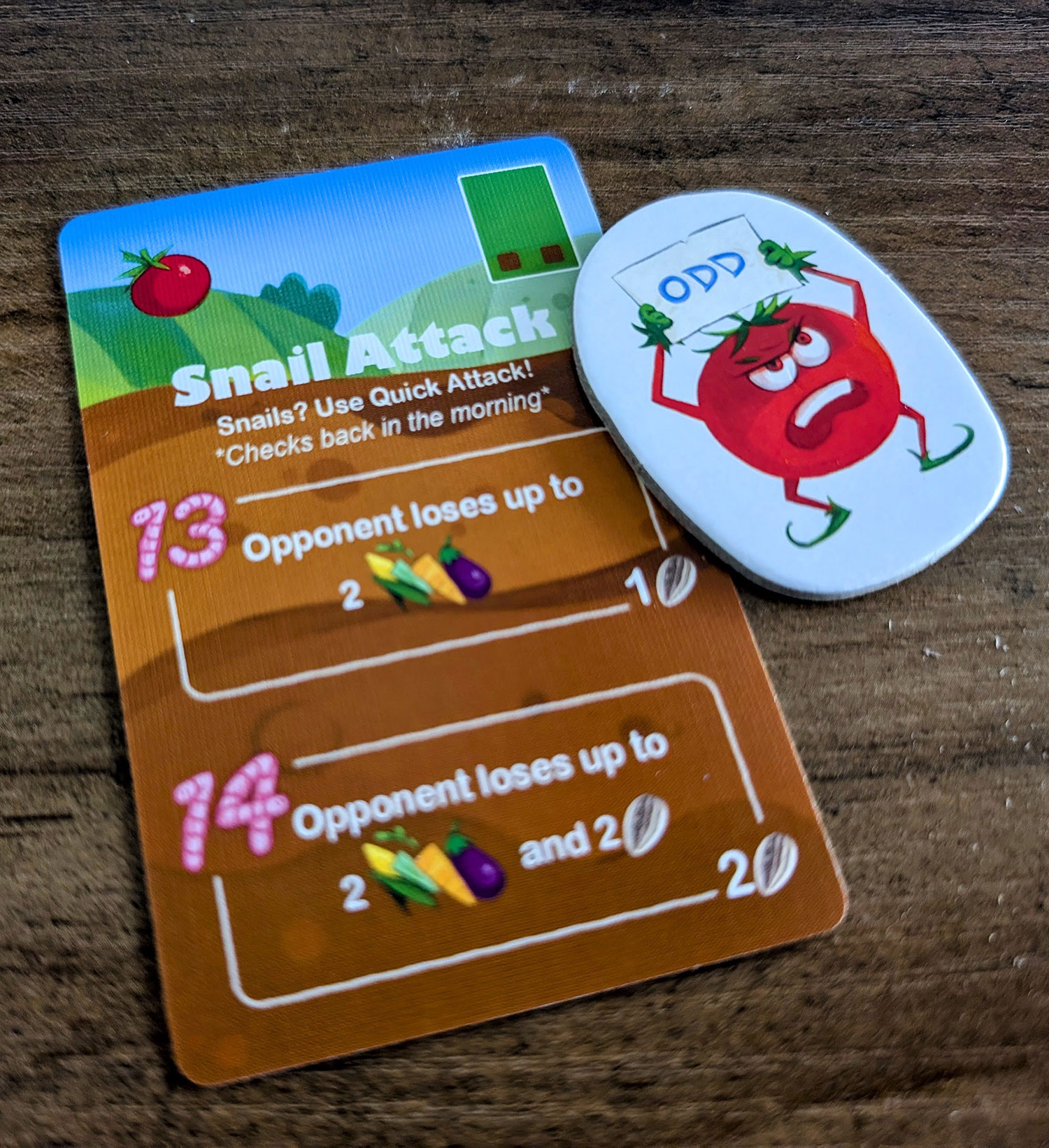
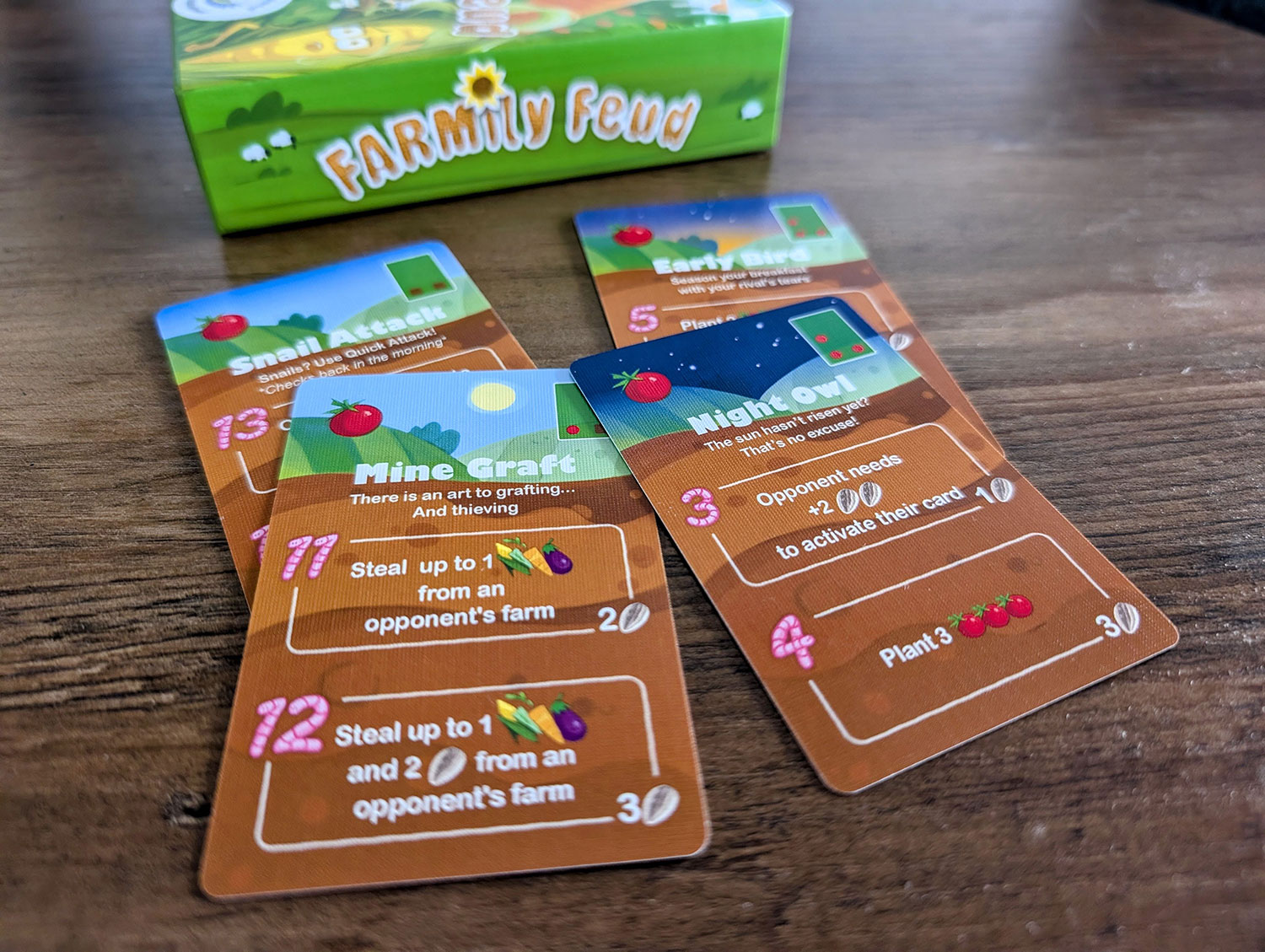
Each card features both a farm effect or a placement (I love multi-use cards; they’re such a great space saver). On a turn, players will secretly choose a card and place their player token in their hand to indicate whether they intend to play the odd (top) card instruction or the even (bottom). Players reveal cards and tokens at the same time. Starting with the lowest number corresponding to the actions, players will fully play their action, spending whatever sunflower seeds are required, and placing the card into the fields or personal discard pile depending on the action taken. Odd actions are generally something that may affect gameplay, the grid, or hinder an opponent, even actions let you plant, adding more plants to your fields.
At the end of each round, players will receive seeds based on the number of vegetables they have planted—one seed for every two plants, rounded up. At the end of the game, they’ll receive one additional payout like this, then gain additional seeds for crop formations (rows and blocks of plantings). Vegetables can be used multiple times, so a row of tomatoes may also be used as a line for a grid of tomatoes. Play only lasts seven rounds, so be creative with your plantings!
Gameplay Experience:
FARMily Feud is a fun, small box family game with easy-to-learn rules and a small size that works well for travel. I tried this out right after its release, at a lovely event organized by publisher Cheeky Parrot at a local game cafe (Cakes and Ladders, if you’re in Auckland—great decaf cappuccino). I was fortunate to get to spend a little time chatting with DeMi Ernst, the designer, who was full of enthusiasm and excitement for the convention that they’d be demoing at that weekend.
Two groups played at once, with DeMi and Cheeky Parrots’ Julia Schiller teaching. Our group immediately fell victim to one of the classic blunders: playing too nicely in a demo group. We spent our first five rounds chatting sweetly and building our little plots and plants, like we were farmers in our own little Stardew Valleys. In a short time, we were all left with our last two cards, both aggressive plot takeovers.
Once the first aubergines were razed, the real war broke out. Optimizing placement is the key to winning this game, and breaking up patterns is the fastest way to destroy all that planning. Particularly if, say, no one had thought of whether their overlapping patterns could be easily destroyed. It was bloodshed. Our little farms were decimated. Each player went even harder on the next as they watched their carefully constructed fields torn asunder by a single card placement. I went from almost 30 points to just a dozen or so. Another player won by a not insignificant amount, and the rest of us were left to lick our wounds. My partner ended up winning a signed copy.
FARMily Feud teaches a number of mechanics that are great for new gamers: tile laying, double-use cards, and simultaneous action selection being the standouts. In particular, family games must be entertaining, but it also helps if they form steps to bigger games. There are few things better than the day you get to pull out your full-sized copy of your favorite game to play with your entirely home-grown gaming group. There’s something FARMily Feud teaches that I think many family games miss, however, and that’s competition. This game can be brutal. You can (and probably will) go from first to last really quickly. A bad card placement can be even more detrimental than another player coming in to take over your tomato farm. You’re sometimes going to be behind, or left without a great choice, or toppled by someone else’s clever move. And that’s ok.
Part of the joy of gaming can be the joy of winning. Within reason, its ok to be frustrated when you don’t do well, or joyful when you do. The best family games take this into account, helping raise good sports who both love to win and can celebrate when others do well. Sometimes, in the quest for kids’ entertainment (or parental respite), we forget that almost everything our kids encounter is a learning moment, even when that learning moment is not to flip the table when all your beautiful row of carrots is destroyed.
Final Thoughts:
FARMily Feud is a light, quick family game. It’s easy to teach, and since actions are performed at largely the same time, guiding someone for a few games is simple to do. This won’t be heavy gamers’ cup of tea, nor will it satisfy folks looking for a wholly new experience, but for a family looking to expand their kids’ understanding of mechanics and gameplay, this is a great fit. Games are even fast enough that you can easily get in two or three between dinner and bedtime, ensuring that no one leaves the table without a few opportunities to win.
Final Score: 3.5 Family fun, great game teaching tool
 Hits:
Hits:
• Multi-use cards
• Super simple to teach
• Quick gameplay will keep kids focused
Misses:
• Not a good choice for heavy game players
• The rulebook could use some polish
• Nothing innovative