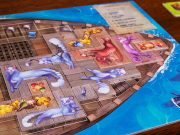
 This hobby uses a lot of common mechanisms and themes, so it’s exciting when someone brings something new to the table. Viking Route does that, not with its theme of Vikings sailing around doing Viking things, but with the use of magnets.
Viking Route is a one- to four-player game that plays in about an hour to ninety minutes. It has your ship represented by a compass and uses magnets around and on the board to adjust where it’s pointing, indicating the direction you’ll move next.
Gameplay Overview:
Viking Route is a scenario-based game where you can play individual scenarios or link them together into a five-scenario campaign, each with its own unique setup and components.
On a turn, a Viking can take three actions which are moving, combat, Drakkar actions, and clan spirit. Each Viking will take a turn before the fate phase.
Move allows your Viking to either move one space on land or to an adjacent zone on the Drakkar (boat), picking up resource tokens if their character card’s bag has available slots. Getting on or off the Drakkar also counts as a move action.
The clan spirit action gives tokens that can be used for each character’s special ability as well as some scenario-based actions.
Combat actions have the Viking roll the number of combat dice shown on their card and are used to manage the Valkyries or the other enemies that swarm your Drakkar. Hits move Valkyries one space while critical hits move them to a Rune space.
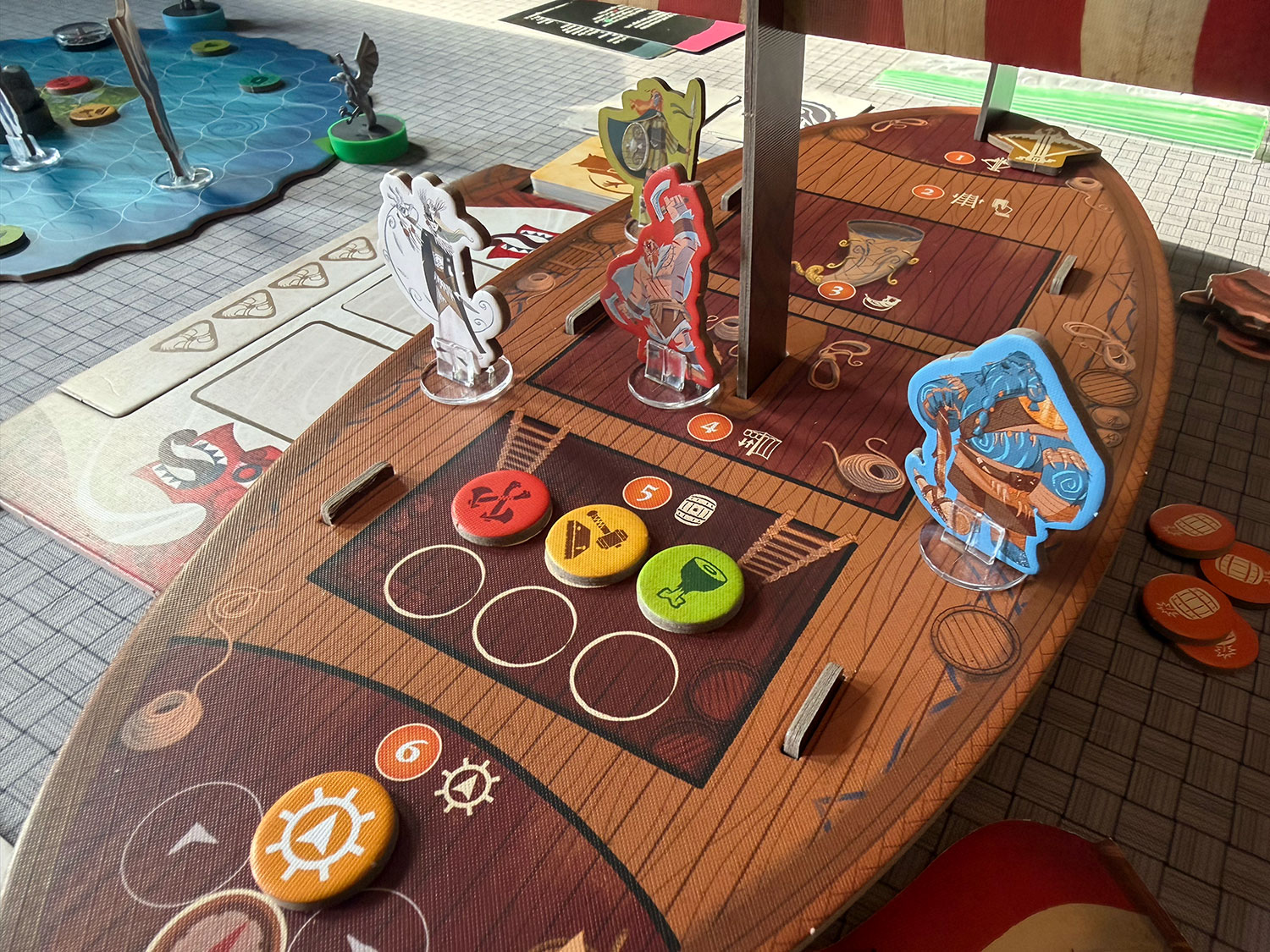
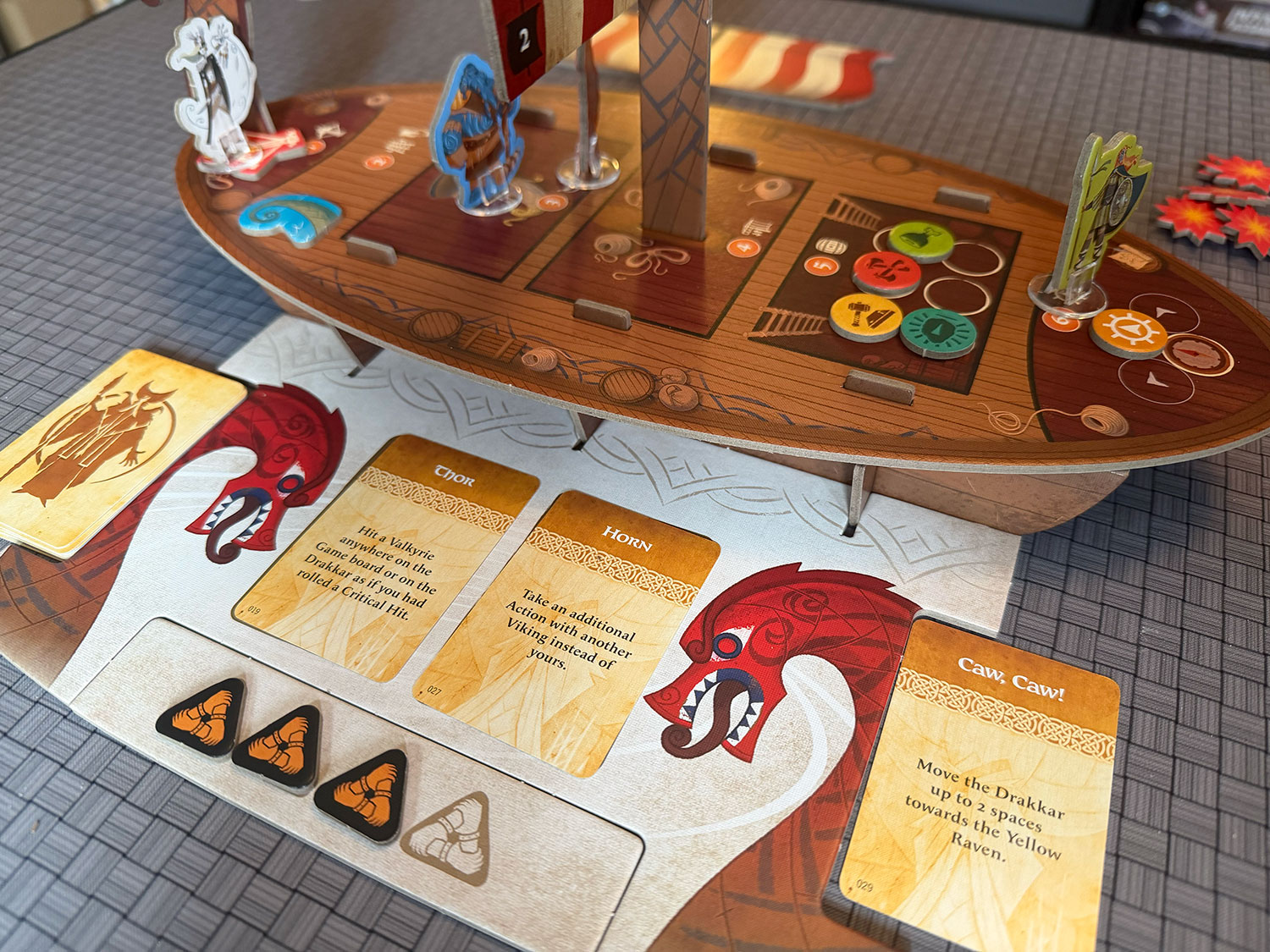
The meat of the game is the Drakkar actions, which are split into zones across the cardboard ship. The zones, and their actions are, as follows:
- Ballista – Shoot the ballista at enemies within 2 spaces of the Drakkar or prepare a fiery bolt. A fiery bolt allows you to change a miss to a critical hit.
- Deck – Location players will use to get on or disembark the Drakkar. Actions spent here can draw God cards, which provide benefits, or use previously drawn cards.
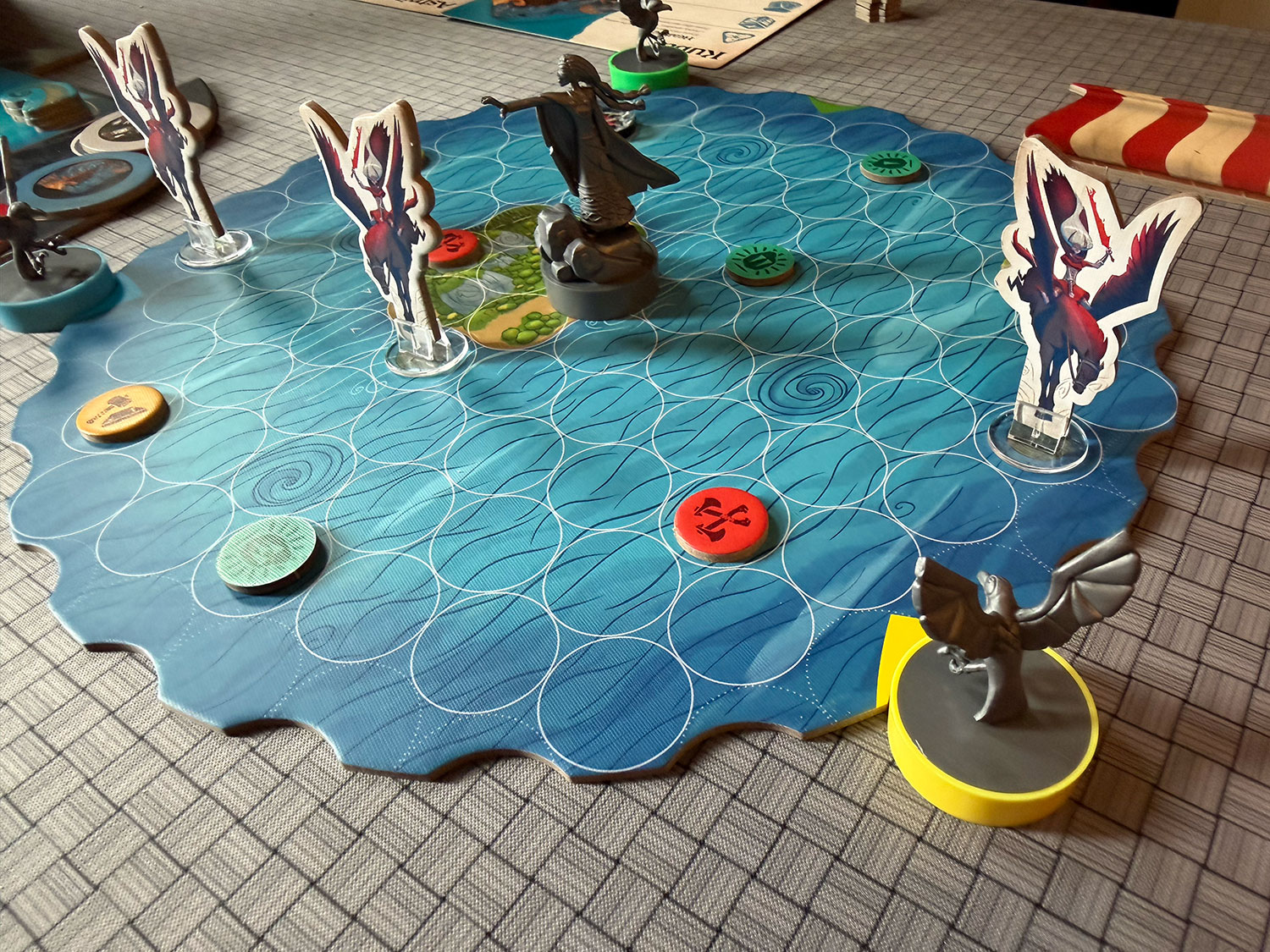
- Lookout – Activate a Raven, which can move it up to two spaces and rotate it, or adjust the wind, which rotates the wind miniature, if the compass is within two spaces of the wind miniature.
- Sail – Adjust the sail between three positions resulting in movement of zero (struck), one (half), or two (full) spaces. Movement happens, or not, during the Fate phase.
- Hold – Storage location for resources and rune stones. Actions spent here can pick up resources and place it in their bag. Resources grant a critical hit, recover one life point, or remove one damage counter from a zone.
- Tiller – This action adjusts the tiller to allow the ship to move to the space left or right of where the compass arrow is pointing.
The Fate phase has you draw a card and do what it says. The ship symbol moves your ship in the direction the compass is pointing, either one or two spaces, with the second space being the next spot the compass points at. Meanwhile, the Valkyries will advance towards you and attack when their symbol is shown, and each scenario behaves differently when the special symbol is shown.
Like most cooperative games, there are a lot of ways to lose and only one way to win. Games last until you’ve been through the Fate deck three times, any Viking has lost all their health, your ship has taken six damage, you fail the scenario, or you complete the scenario.
Game Experience:
The basics of the game are pretty straightforward cooperative game stuff that requires people to work together. Having only three actions requires some coordination and some planning ahead. I found that I liked to keep my Vikings spread out so I could do an action in the space they’re starting in, move somewhere, and take another action.
Where the game gets really interesting is in the movement mechanics. It takes some time to get a handle on how each magnet affects the compass, and sometimes you’ll waste actions trying to adjust a raven only to realize the wind is overpowering whatever change you’re making.
Most of the time, I felt like I barely had enough actions to get what I needed done, which keeps things feeling tense, even if there’s plenty of turns left in the game. Occasionally, I found I just didn’t have anything to do: my sail was set, I had the fiery bolt ready, there was no one to shoot at, and the sail was where I wanted it. Those turns were a little lackluster, and in those cases, I think the game works really well at one and two players, so it’s unlikely all of your Vikings are just twiddling their þumlar.
The scenarios are different, which makes them different puzzles to solve. Hela’s map has fog that makes you cover the compass before the next fate phase, making movement a wild-Æsir guess. The Kraken is much more focused on fighting and keeping your Drakkar afloat, while Fenir has you trying to capture him by anticipating his movements. There is a mode of chaining them together into a campaign, but you can also hit each one as a one-off, which is my preferred way to play.
The biggest drawback is, despite the different maps to play on, most of them start fairly similar, with needing to gather the three rune stones scattered across the board. There are tweaks like tentacles getting in your way or having to deal with fog and your dog-faced healer steering the Drakkar into an island when everyone else said don’t touch the green raven, but he did anyway.
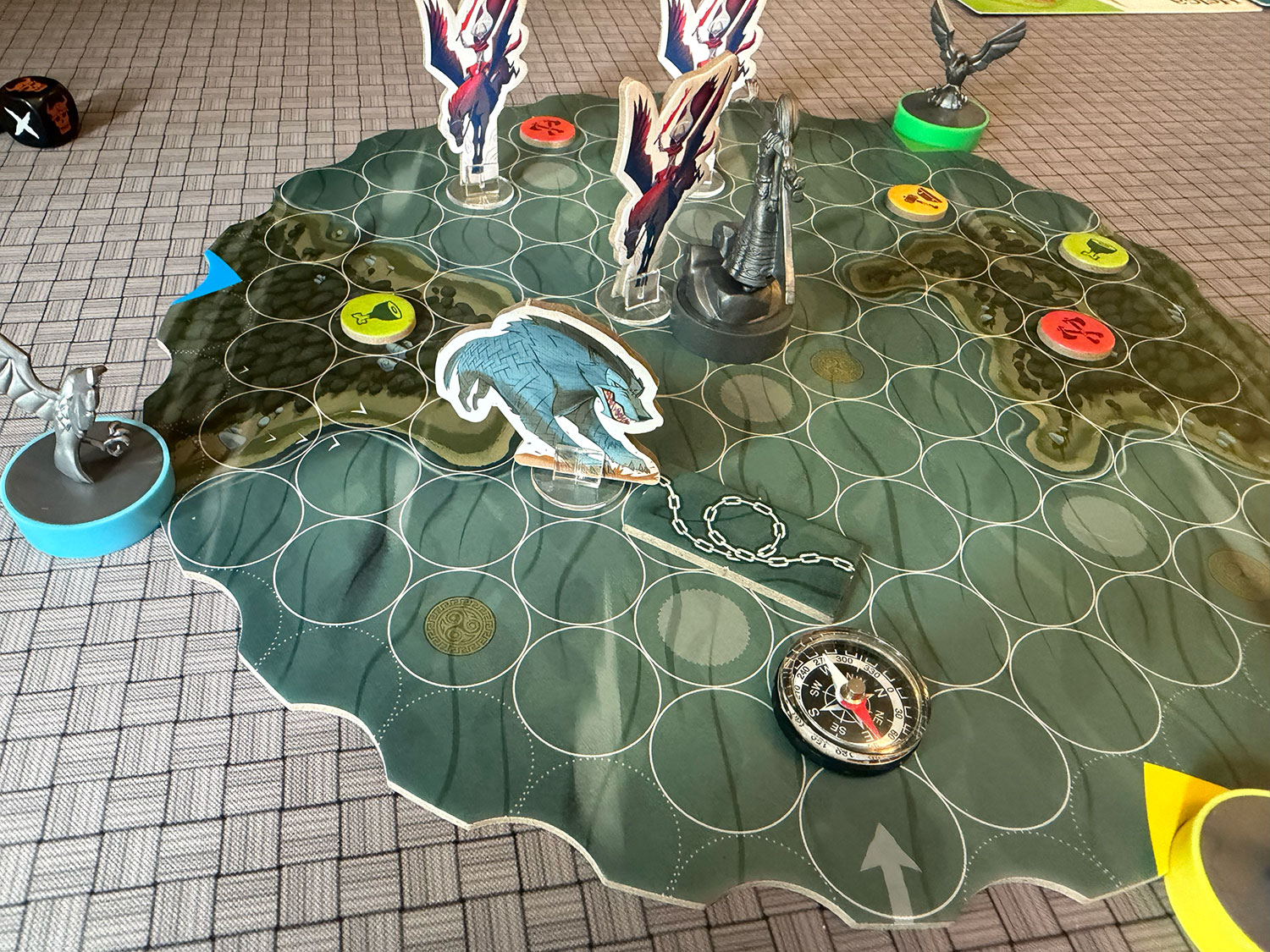
With each game, players should get better at working out how the movement works, which makes the game a bit easier but could also lead to some alpha player syndrome or less experienced players avoiding those actions. My favorite part of the game was playing with the Ravens and wind to adjust the compass. I’d encourage people to let stuff happen. You likely have actions to solve any goof, including striking your sail so you don’t move.
And occasionally, your awesome plan just goes to Helheim as calm water just keeps you dead in the water with nothing happening. But that also gives you a chance to build up your clan spirit, use special abilities, heal, and repair the boat. Meanwhile, it can go from ‘this is fine’ to ‘very not okay’ if you get swarmed by Valkyries because once an area of the ship is damaged, it can’t be used without being repaired. This is where resources come in handy to yeet Valkyries away from you, repair damage, and heal wounds.
Each of the four characters has their own special ability, bag space, health, and combat rating. The differences are subtle, but the abilities and combat rating (which varies from one to two) feel the most impactful. I found I used my one combat die Vikings more for the sail and lookout actions while I kept the ballista and deck fighting reserved for the folks rolling two dice. I wouldn’t mind an expansion with different characters along with some more scenarios to add more variety.
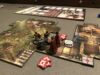
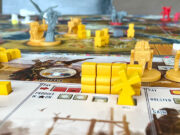
The Drakkar looks great on the table and has some functionality with the various sail settings and fits into the box mostly assembled. A small drawback is the cardboard does get a little beat up by adding and removing the sail during the game and the bow dragon during assembly.
Final Thoughts:
Viking Route brings a gimmick, which despite the negative connotation, really is the best part of an otherwise standard cooperative game. If all the pieces were standard cardboard or plastic, it would be fine, but the added layer of challenge associated with magnetic fields makes me wish I paid more attention in Physics 3.
Final Score: 4 Stars – Viking Route is easily the most fun I’ve had with magnets in a tabletop game.
 Hits:
Hits:
• Clever use of magnets and a compass to determine direction
• Cardboard Drakkar has great table presence
• Scenario variety gives each one a slightly different feel.
Misses:
• Some Viking turns can be dull if things are going well
• Chasing down three rune stones to start most scenarios is uninspired
• Cardboard Darkkar shows signs of wear from use/assembly