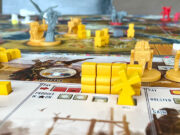

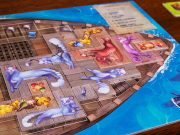

 The Nazi party and individuals therein were responsible for the combined murder of several millions of civilians and prisoners; thus, the term “Nazi” is near universally considered synonymous with evil. Following World War II, just 199 Nazis were put on trial for their crimes at Nuremberg, but many thousands more fled to various corners of the world; Argentina alone is thought to have harbored up to 5000 Nazi fugitives. Many of these Nazis were hunted down by various interested parties in the name of justice, or in many other cases, recruited for their knowledge and/or expertise for scientific advancements or other self-serving goals. In the US alone, at least 1000 ex-Nazis were put on the payrolls of intelligence, military, and other national agencies; in some instances, their family members were provided refuge in the US as well.
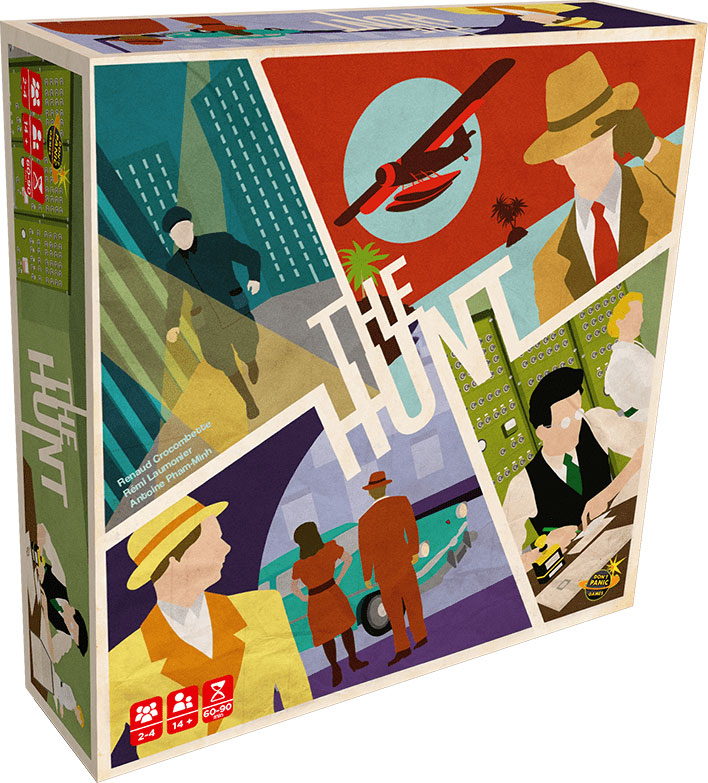
These morally controversial facts form the background of Don’t Panic Games’ 2025 board game titled The Hunt. In the Hunt, 2-4 players take on the roles of asymmetric factions who will competitively hunt down Nazis in an effort to promote varying personal interests. It’s a gateway-level game taking 60-90 minutes, and as the rulebook states, the goal of this game is to “help keep the memory of these tragic historical events alive.”
Gameplay Overview:
The Hunt is played over a series of rounds until one player reaches 12 points.
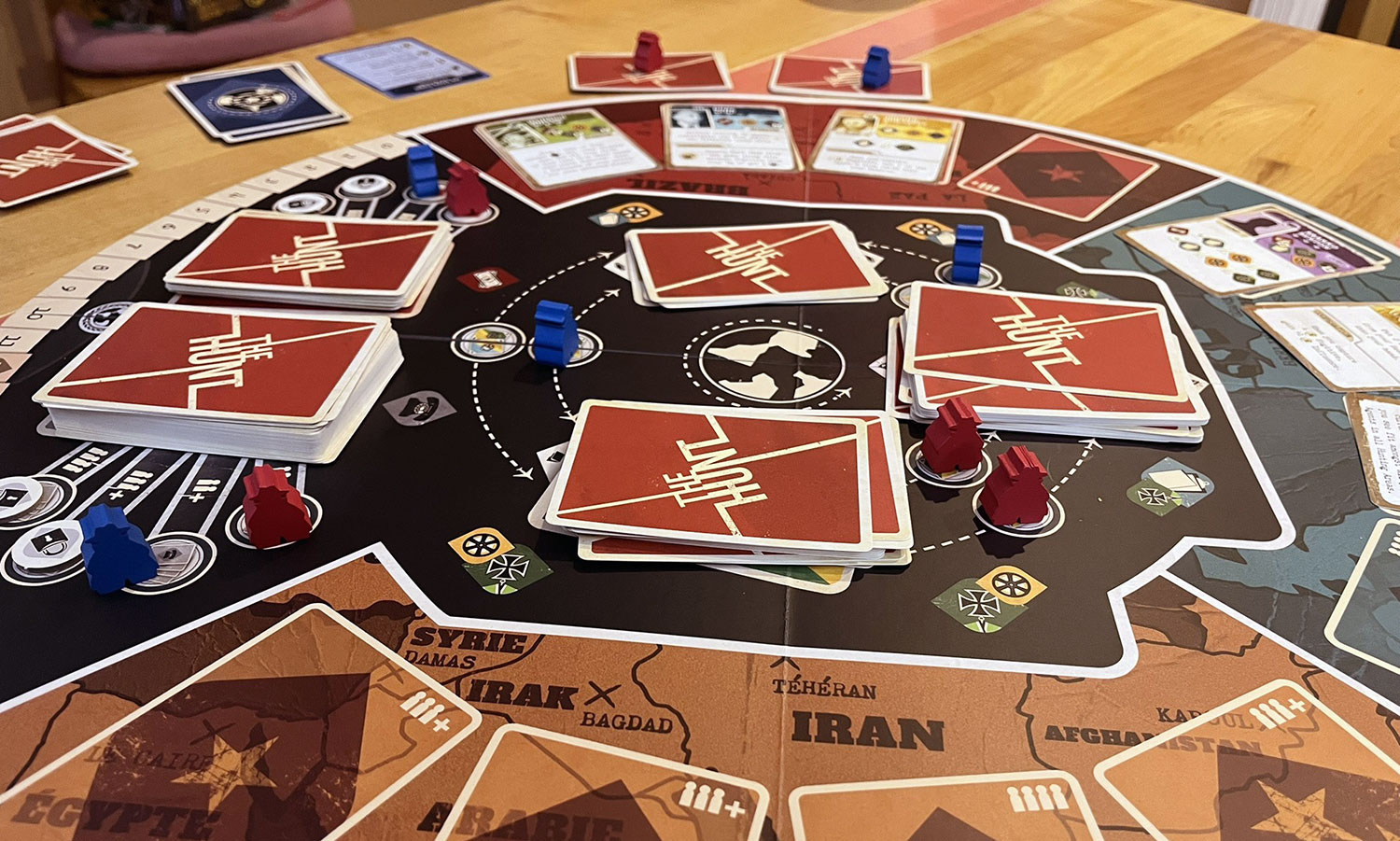
Acquiring these points requires hunting down high-value Nazis, each of which requires a specific combination of evidence for capture, somewhat recipe-fulfillment style. Each Nazi contains a unique ability that can be exploited upon capture.
The main actions of the game include:
- Sending out agents to:
- Collect evidence of 5 different types, worker placement style
- Become field agents in a specific world location harboring Nazis of interest
- Commit previously collected evidence to specific field agents
- Capture a fugitive Nazi using the evidence previously committed to a specific field agent, therefore gaining influence in military, science, or politics
- Exploit a previously captured Nazi for an ongoing, one-time, or repeat ability
- Spend influence of specific types to complete your faction’s asymmetric objectives and score points.
Once 12 points are achieved by one player, the current round is completed, and the player with the highest point total wins.
Game Experience:
The theming of the game is thoroughly integrated into the gameplay. The main types of evidence used to hunt down Nazis include documents, microfilms, and medals. Additional assets are rumors, which are very easy to acquire, and funding, which is the most difficult to acquire.
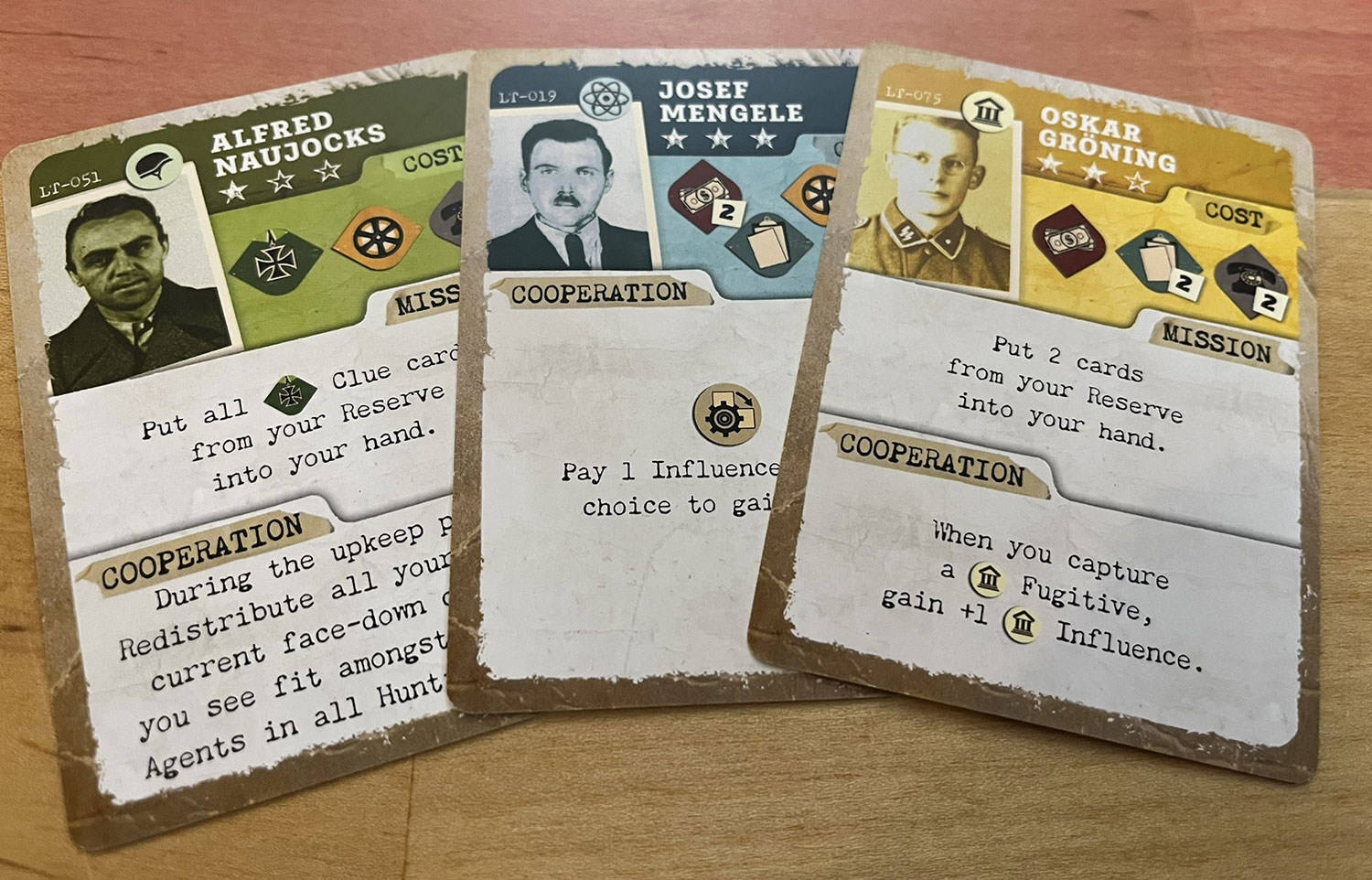
There are 80 unique Nazi fugitive cards in the game, each containing the person’s photograph, an appropriate classification such as scientist or politician, and a star value 1-3 correlating to that person’s level of crime and/or value to hunters. Both Wernher Von Braun and Joseph Mengele are considered 3-star value Nazis. The special ability of the various Nazis once captured usually relates to their identity; for instance, Von Braun makes it easier to capture other scientist Nazis.
The various, mildly asymmetric factions possess objectives in alignment with their true-to-life interests (where applicable), albeit simplified. They include:
- The United States wants to advance the Apollo Space program
- The Soviet Union (CCCP) more generally desires to promote the excellence of communism via bolstering its space program, propaganda campaigns, and supporting worldwide communist revolutions
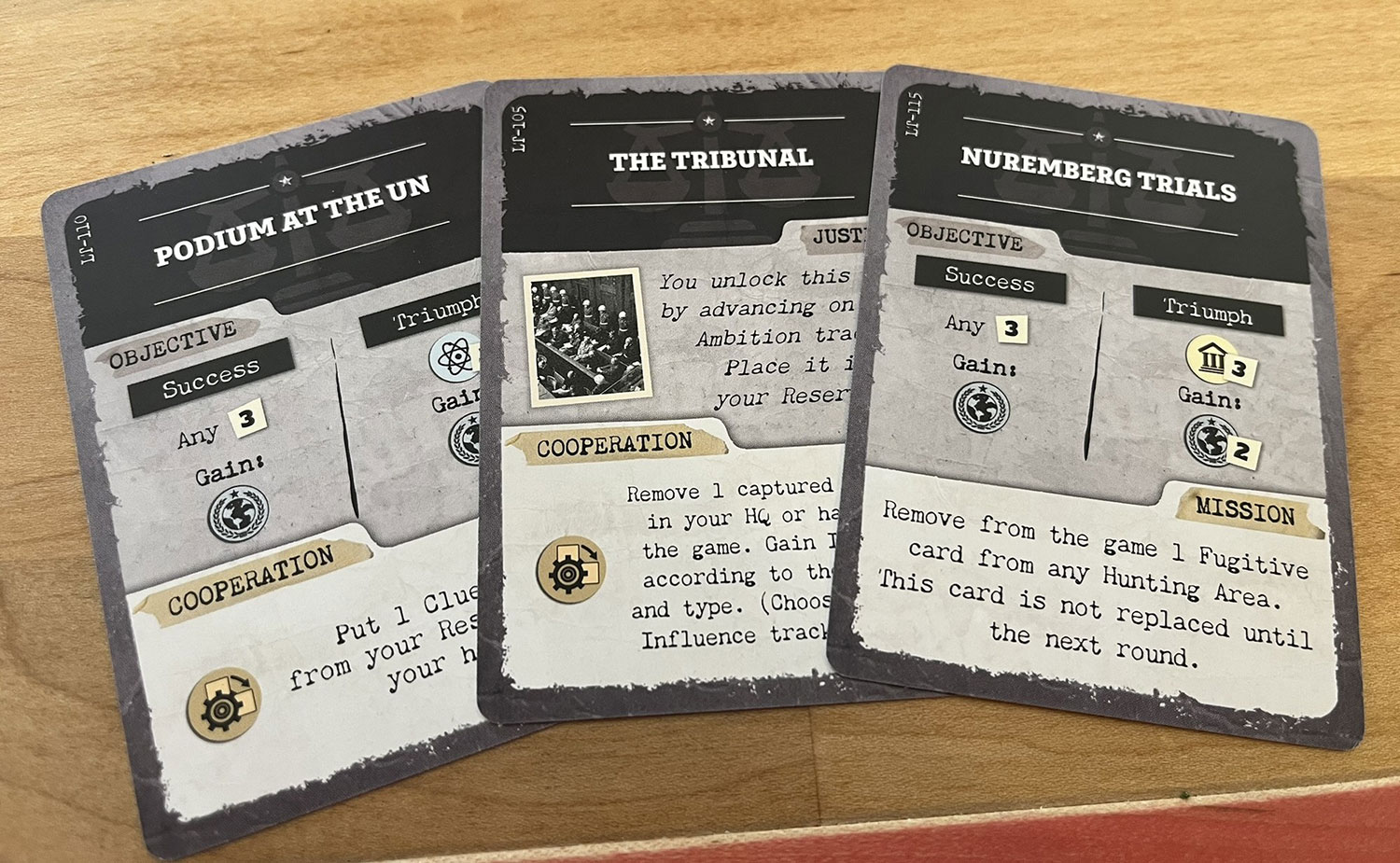
- A fictional Israeli vengeance organization wants justice for the perpetrated atrocities via formalized adjudications. Only this faction can unlock cards representing real-life Nazi Hunters like Simon Wiesenthal and Beate Klarsfeld which boost their hunting capabilities
- A fictional criminal syndicate aims to sow chaos and pull off various self-enriching devious deeds by blackmailing cornered Nazi fugitives who don’t have better options.
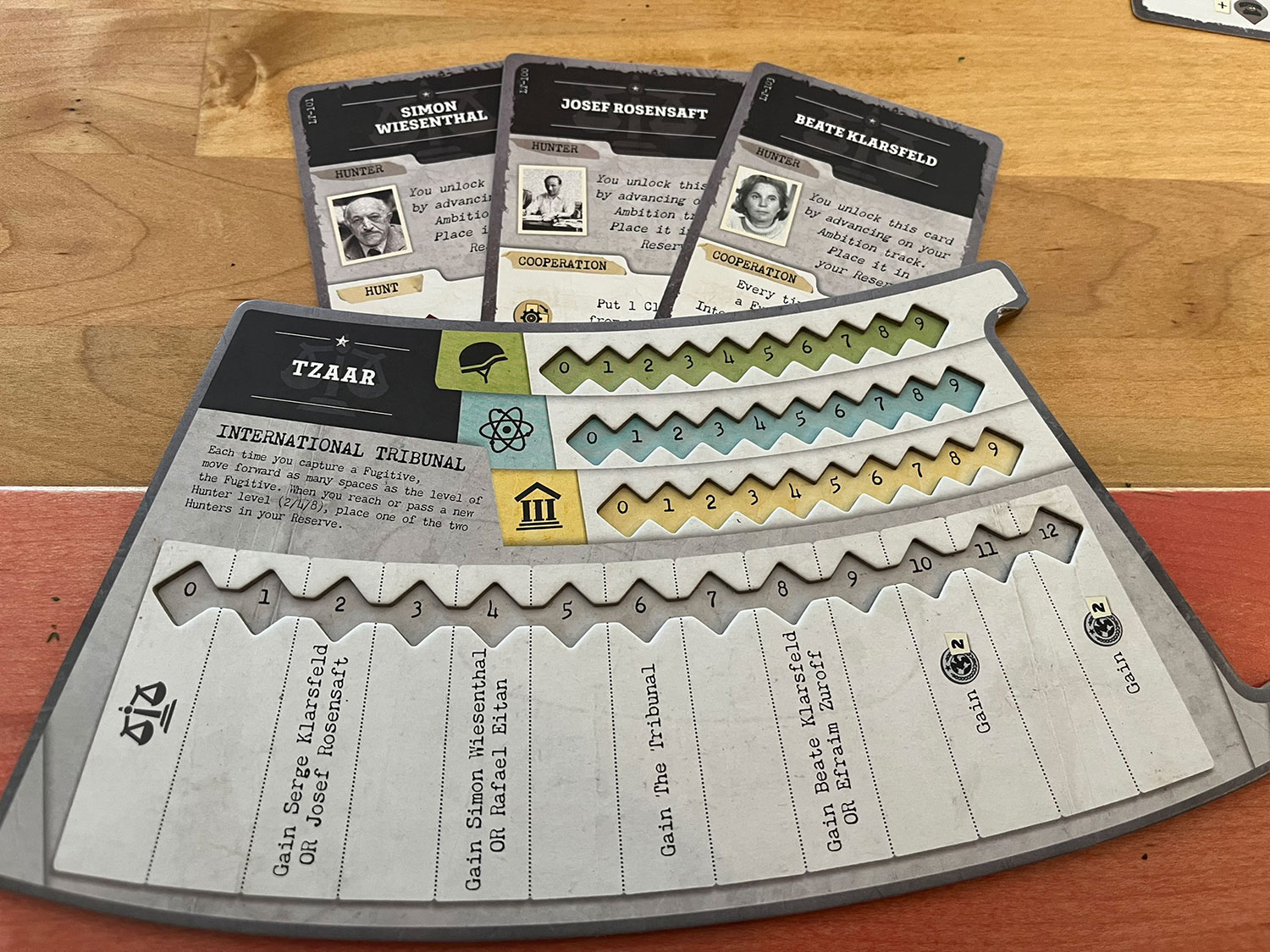
Considering that the stated goal of the game is to keep the memory of these events alive, and as a self-proclaimed history nerd, I was a little disappointed by the complete lack of flavor text on any of the historical figures in the game, including the Israeli Nazi Hunters. As for the Nazi fugitives, I guess I can understand the fear of minimizing their atrocities through brevity, as well as potentially glorifying the names of such infamous actors by explicitly writing out their crimes on their cards.
Would calling out Eduard Roschmann as the “Butcher of Riga” sufficiently villainize him? Nonetheless, as of this writing (June 2026), the anthology of biographies, linked in the rulebook, could not be found on the publisher’s website, so I feel the game falls a bit short of its purported educational goal.
As for the gameplay itself, I’ll admit that I was expecting this title to be a slightly heavier deduction game when I volunteered for it. Rather, it is a relatively straightforward recipe-fulfillment game with some push-your-luck elements and light engine-building once you have some captured Nazis to exploit.
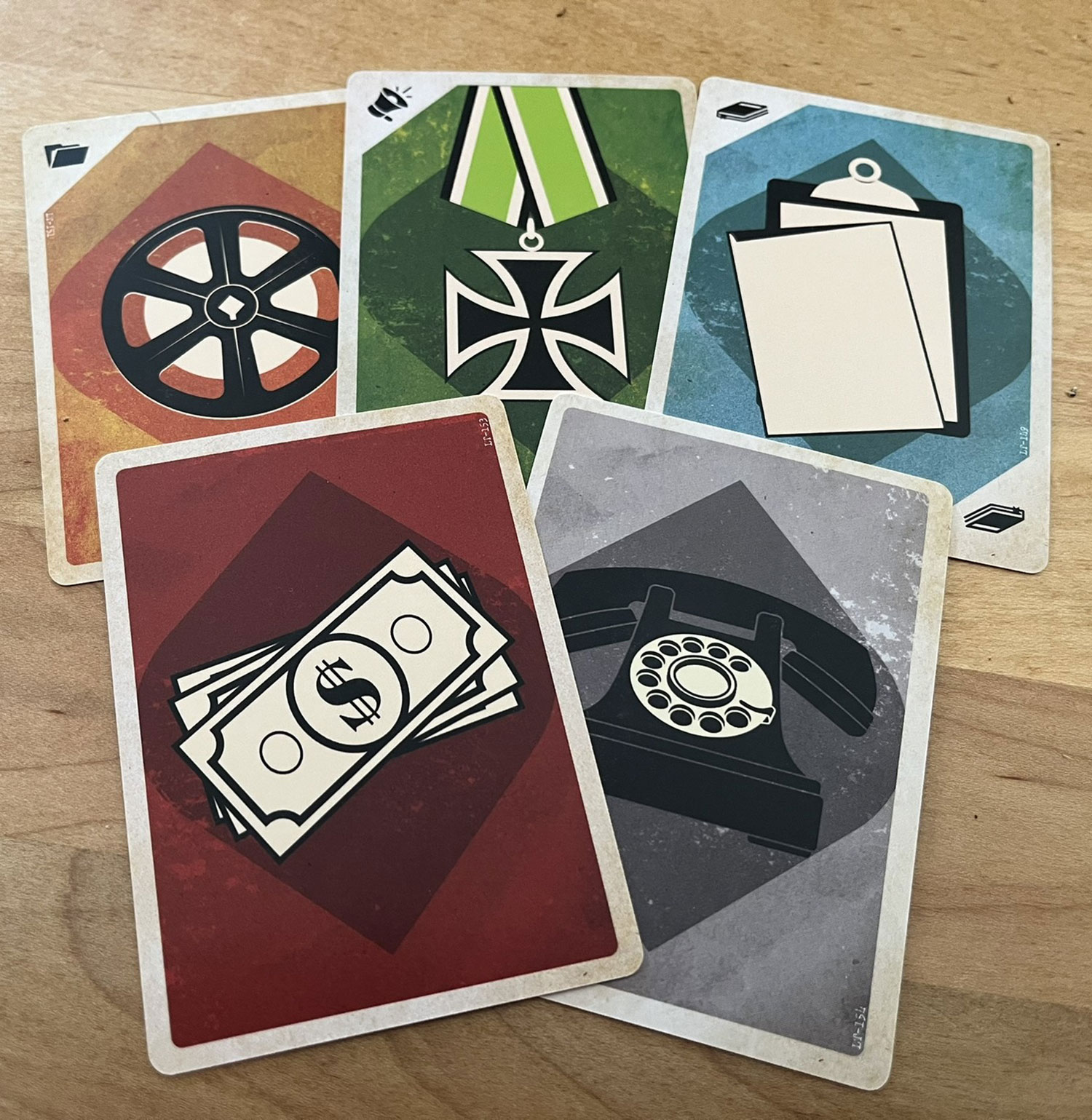
The push-your-luck comes from the fact that evidence cards are organized such that multiple different types are located in the various draw decks. So though you might need microfilm to capture a particular Nazi, you are not guaranteed to collect it in a single evidence-collection turn. There’s also some mystery as to which players are going after which Nazis. There are up to 3 regions in the game, each containing 3-4 Nazis (depending on player count), so if your opponent has an agent deployed to South America, it’s unclear which of the South American fugitives they’re after, and you may or may not be racing to accumulate evidence against the same person—only one player can capture each Nazi. So when you do have unlucky card draws, you need to decide if it’s worth pursuing your plan-A target or pivoting to someone else more attainable.
The other wrinkle to the game is that any time you collect new evidence, it can only be used in the NEXT round (unless a special ability supersedes this). Thus, you need to hope your random starting hand is sufficient to capture any of the Nazi fugitives initially in play. The Nazi fugitive market is refilled in between each round, and it’s only then that you’ll see if the evidence you collected the previous round actually matches the new cards coming into play. Importantly, any evidence supplied to agents in the field stays with them in-between rounds, so it is possible to begin fulfilling a “recipe” in one round and complete it in the next.
The scaling of the game is great (each round always starts with 3 Nazi fugitives per player), so though higher player-counts are more chaotic, there’s always a similar level of choice, and plenty of tense moments wondering if someone else will snag the last finance spot for the round, or if your opponent will capture the same fugitive for which you’ve already spent 4 actions gathering evidence. It is very much a gateway-level game; the rules are straightforward enough that I might recommend it for children as young as 9-10, with the important caveat that adults should think carefully about whether their children have the maturity/reverence for such a serious theme.
Final Thoughts:
The Hunt is a gateway-level game where players race to hunt down Nazi fugitives and potentially exploit them, according to the goals of their asymmetric factions, which can be anything from boosting the Apollo Space program to vengeance to facilitating communist revolution. The gameplay is fairly straightforward recipe fulfillment with some push-your-luck, worker placement, and light engine-building elements.
The gameplay is definitely too light for my personal tastes, but the turns are smooth with some meaningful player interaction and occasional tension. The theming is unique and well-executed, although lacking in easily accessible supplementary educational materials. It nonetheless inspired many a Google search on my part to learn more about the referenced historical figures and events, which was likely the goal of the designers.
Final Score: 3 Stars – Mein Gott! It’s a historically enlightening gateway strategy game, tasking players to hunt down Nazi fugitives
 Hits:
Hits:
• Unique, well-implemented historical theme
• Meaningful player interaction
• Straightforward rules
Misses:
• What age group was this really intended for?
• Greater effort to make the promised relevant didactic materials available on the publisher’s page, if not within the game box