
 I looked down at the sign that hung from my neck. “Playing the Luna Expansion.” What a dumb reason for being incarcerated. But at least I was not alone. My cellmates had similar signs around their necks. “Likes Straight Cornered Cards.” “Played While Eating Doritos.” “Invented the Music Stretch Goal.”
At least it was quiet in here…until I heard a strange noise.
Clink. Clink. Kerchunk.
A small portion of the wall next to me toppled onto the floor. Tony’s head appeared in the vacated space.
“Thank goodness you are here to save me!”
“You wish. Here. Take this.”
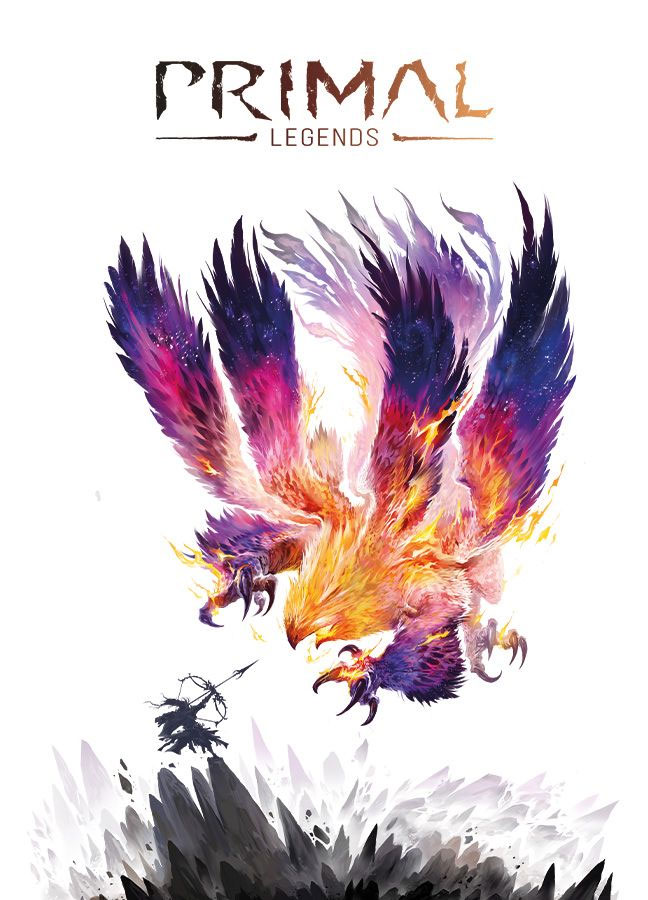
He pushed six small boxes through the hole. In the dim light, I could barely make out the games. Primal..Legends? Well, I did love Primal: The Awakening!
“Those are preproduction copies. We need a review done by the 23rd. I figured you had nothing else to do.” And with that, he disappeared.
“Aren’t you going to save me?” I called after him.
“Don’t hold your breath,” came his fading retort.
This is the true story of how I received my review copy of Primal Legends and wrote my first review in the clink.
Gameplay Overview:
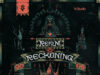
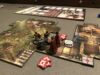
Two notes before I begin the review. First, I received pre-production copies for this review. The GAMEPLAY is FINAL, but the final product may appear different than in the pictures I took. Second, this product, outside of one behavior card per monster that is for the The Awakened deck, is separate from the original and is NOT compatible. There are no new hunters or monsters for the original game.
This review covers the three different boxes that will be available for preorder on September 29th, as well as the playmats that will be for sale as well. The three sets are as follows:
• Voice of the Storm – Rakhan vs. Uhros (Spear)
• Voice of the Flame – Fenerax vs. Vaelara (Bow)
• Voice of the Earth – Tormanthu vs. Nehmor (Halberd)
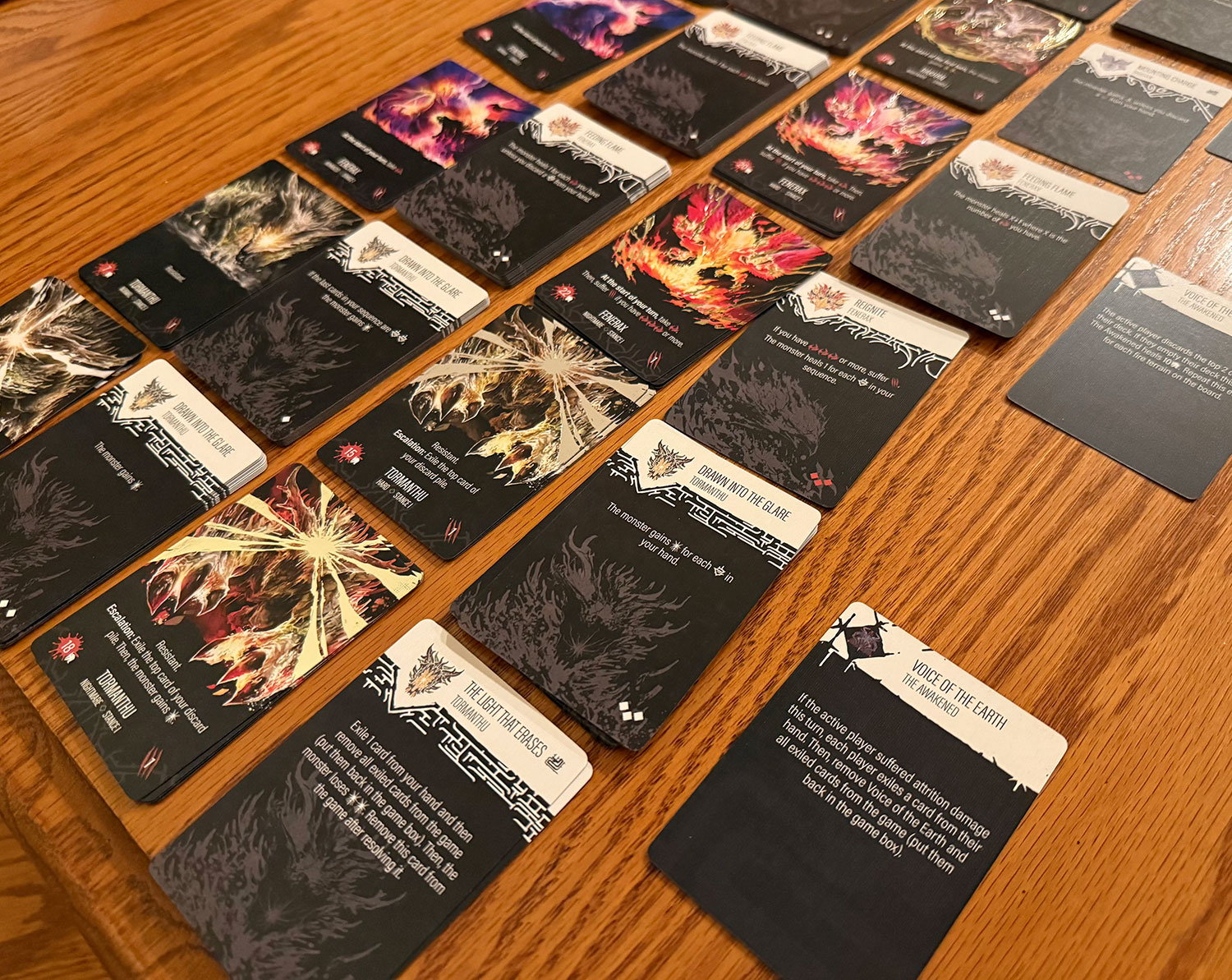
Primal: Legends is a card-driven, cooperative solo boss battler. If you own two of the sets, you can play two players vs. either monster (called Primordials in the game’s lore), and if you own all three, you can play three players against any of the Primordials.
In Primal lore, this is a prequel to Primal: the Awakening. For gameplay purposes, this is its streamlined cousin, sans the minis and the movement puzzle. This game is 100% card-based. It was created to provide a cheaper entry point for those who want to experience Primal without the hefty price tag.
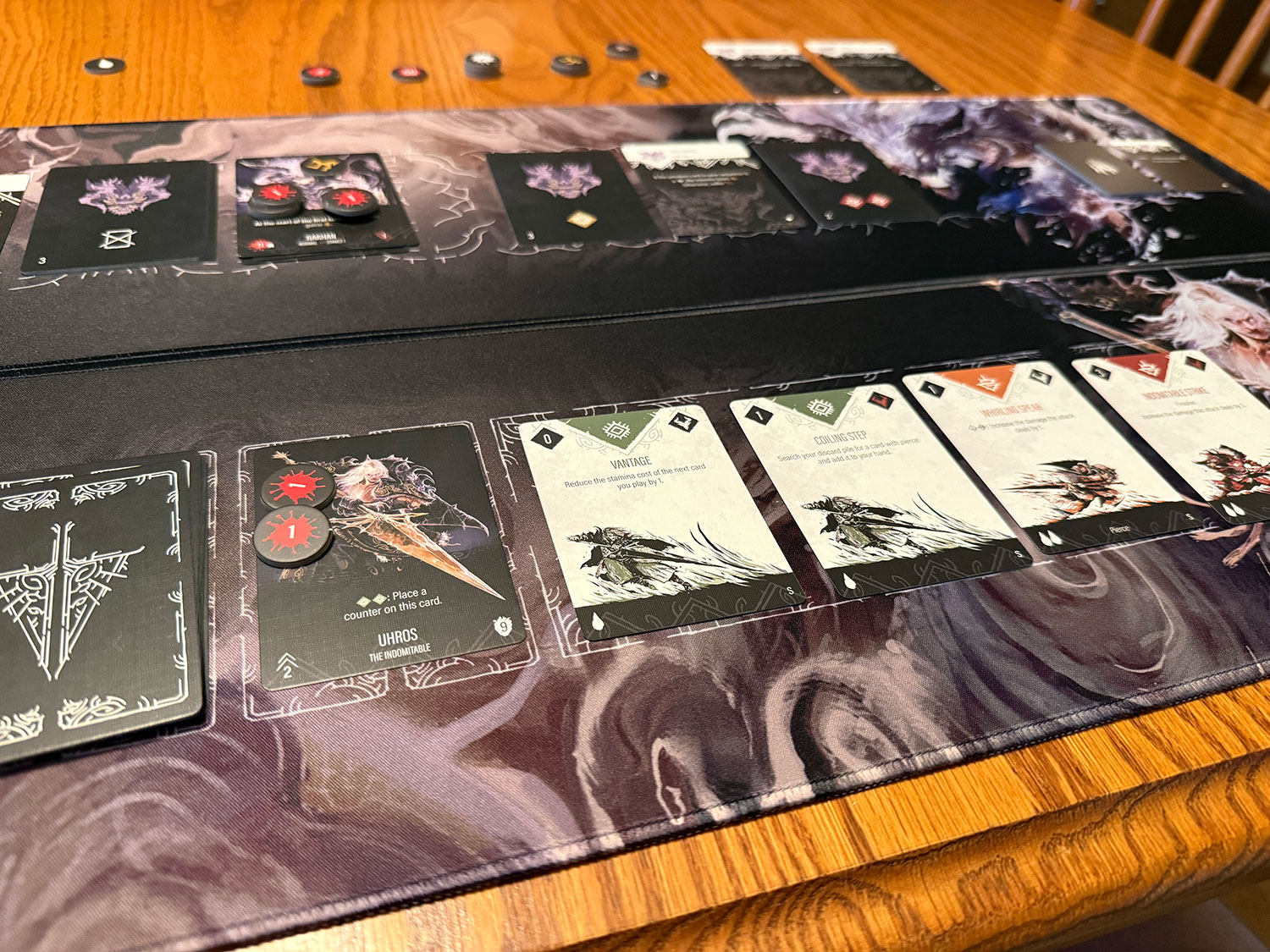
The turn structure is very similar to the original game. The only big changes are the previously discussed lack of movement and facing, aggro changes (to be discussed later), as well as the Monster upkeep phase essentially moving from before player actions to the fourth phase. Primal: Legend’s phase order is as follows:
- Potion Phase – if there is a potion icon at the bottom of a card, it can be discarded to heal three damage.
- Action Phase – play cards from your hand to your sequence to attack the monster or to set up defensive maneuvers to prevent incoming damage.
- Attrition Phase – reveal the Attrition card for the turn and resolve its effect(s).
- End of Turn – discard your sequence, refill your hand, and update the monster’s behaviors
You win if you defeat the monster and lose if you run out of health first and, if in multiplayer, the loss is immediate with the first death. No last person standing heroics for you!
Game Experience:
What made me glad that I was not hauling around a 15-pound box of Primal
Primal:
Legends was designed with the same two mechanisms that make the original card play so great: debating which cards to discard to pay for the cards you want to play and maximizing the impact of the cards you do play by the order in which you play them (called the Sequence). Simultaneously, you must be aware of which actions will trigger monster behaviors, further deepening the puzzle. I still found myself struggling over what to do next. I absolutely LOVE this balancing act, and it is why Primal is one of my favorite boss battlers.
If you purchase all three Legends boxes, you will receive three unique hunters and monsters. Nehmor relies on deck manipulation, while Uhros is the best pure damage dealer. The monsters rely on their elemental powers to provide different challenges. Honestly, I could not pick a favorite box of the three because Uhros was my favorite hunter, while Tormanthu was my favorite monster.
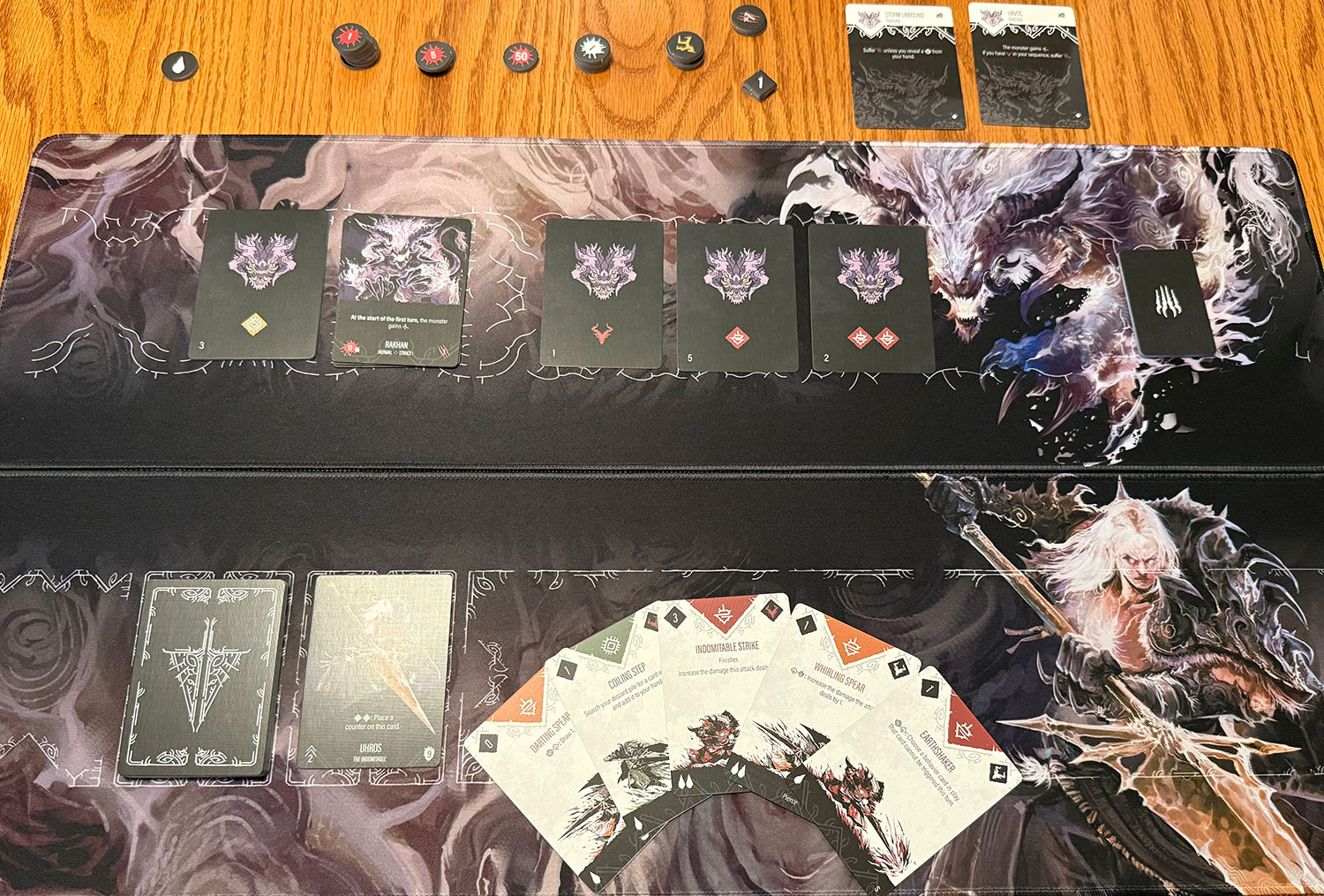
Just as importantly, they streamlined several monster mechanisms. Most importantly, the monster behaviors were reduced from a possible 24 triggers in Awakening to thirteen (Rakhan), sixteen (Fenerax), or nineteen (yes, my favorite, Tormanthu) in Legends. Given the lack of a combat board and movement, it is not surprising; however, any reduction is appreciated. Playing solo, I was glad that movement was removed. It eliminated one more thing for me to track by myself.
As for cooperative play…well, more on that later. Additionally, without movement, the Threatened status was removed (you were threatened if you did not move out of a space you occupied the prior turn). This is a benefit for both solo AND coop play. I understand why it was in the base game, but I hated having to worry about moving EVERY turn.
Finally, the game will be much more affordable than its older brother. Each box will be $25, or $60 if you buy all three together. The playmats (each set includes two mats, one for the hunter and one for the monster) will be $24. There will be an “Everything Bundle,” which will include everything mentioned above as well as a sleeves pack with enough sleeves for all three boxes of cards; however, that price is not known at the time I wrote this review.
What made me wish I was hauling around a 15-pound box of Primal:
Ironically, this game made me go back and play Primal the Awakening. The replay value is not as high as in the base game. I understand comparing them is not fair as one is a big box product and the other is a streamlined offering; however, while the Legend’s battles are fun one-offs, there is a bit of “ok, now what” when you are done. You can try a different hunter or a different monster, but the selection is limited. Hopefully there will be more boxes on the horizon. Also, by streamlining, you are bringing your price point into range of other popular streamlined boss battlers, such as Boss Fighter QR and Leviathan Wilds, both of which have more monsters for about the same price; however, their hunters are nowhere near as complex as in Primal.
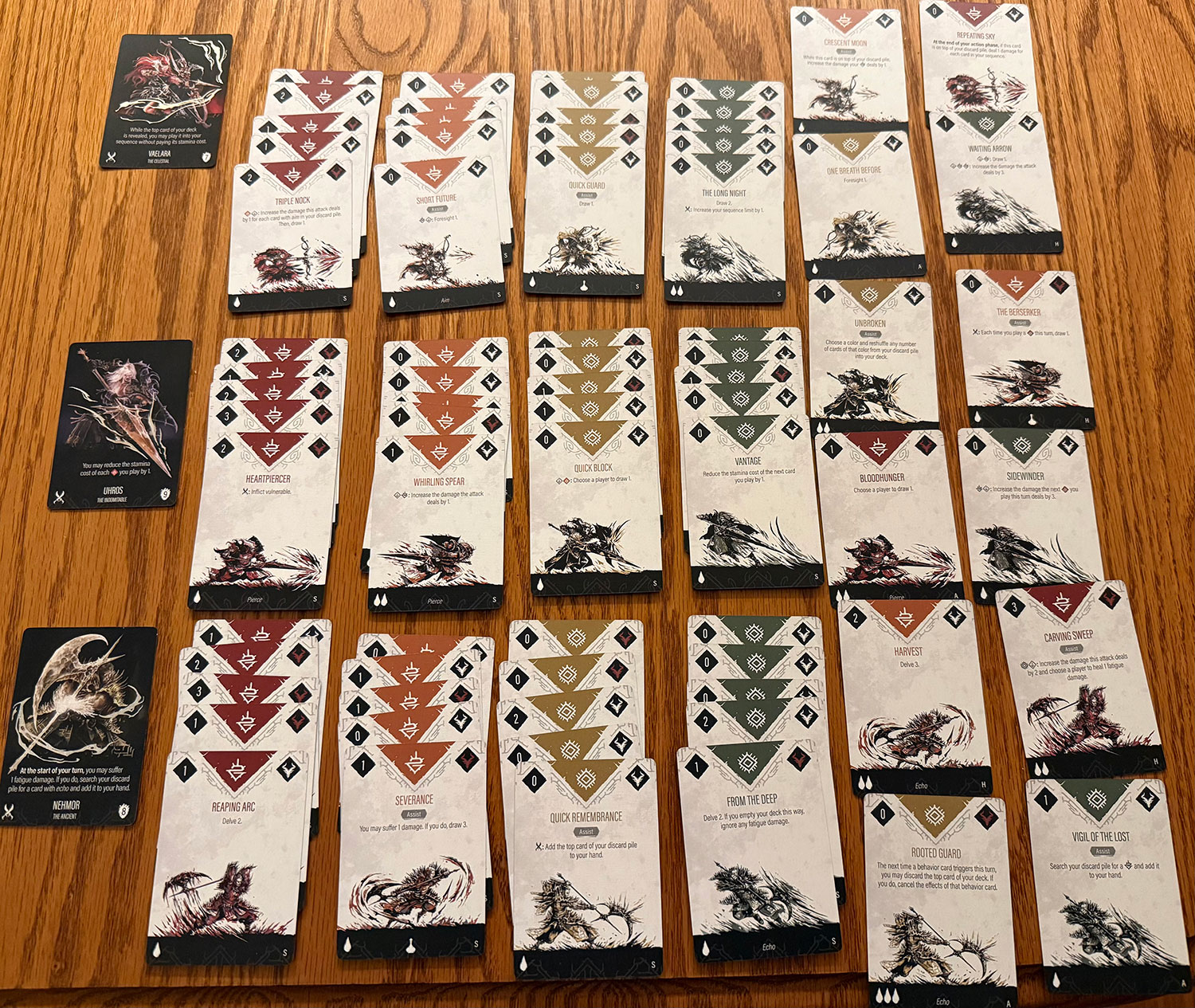
More importantly, there is no crafting or leveling up of your character. I did not realize how much of my Primal enjoyment was more than just the fighting until I was reduced to just the fighting. I loved planning out how to craft my gear, which consumables I would bring to the next fight, and choosing which path my character would pursue. To be fair, there are four difficulties in Primal: Legends (Normal, Advanced, Hard, or Nightmare). For monster difficulty, you change the Stance cards and attrition cards that match the difficulty you want to tackle. For the hunters, two cards are added to your deck for Advanced, and two more for Hard/Nightmare. There is no actual progression or player-driven decisions. Just add the appropriate cards and go.
Finally, the coop is not as interesting. Five cards in each hunter’s deck utilize the keyword Assist. You can ignore these when playing solo. During coop, these can be played during your partner’s turn. These cards, as well as discussion about the current behavior states, are the totality of your cooperation. In the base game, you did have to worry about movement, as well as aggro because whoever had the aggro token went first. In Legends, you simply alternate turns. Also, post-hunt planning for the next hunt was always enjoyable. This obviously does not exist with Legends. Finally, having a second player means four sets of eyes for the monster behaviors and other statuses, so having more complexity is not as big of an issue.
Final Thoughts:
I wanted to love Primal Legends as much as the original and, while I did enjoy it, it did not replace Primal: The Awakening. As previously stated, it encouraged me to play the original again.
I feel like the target audience is for people who either want to dip their toes into the Primal universe at a MUCH more reasonable price point or are looking for a simpler boss battler that they can play a one-shot hunt and be done. I would definitely recommend this game for those two audiences.
If you are a hardcore gamer, or have already played/own Primal and are hoping this will satisfy you, given how much was streamlined out of the game, I would recommend you try before you buy.
Final Score: 3 Stars – A decent boss battler that is not as interesting as its older brother due to its streamlined design.
 Hits:
Hits:
• Card play
• Streamlined Behaviors and Removal of Movement/Threatened Status
• Affordable Primal
Misses:
• Only three monsters and three hunters available
• No campaign/crafting/skill tree
• Coop is not as interesting