
 Imagine arguing with yourself over whether a potato is more emotional or bouncy. The impassioned defense of, well, a potato might bounce a little, right? I mean, everything bounces a little if you throw it right. But are potatoes emotional? Do we ascribe to them joy or anger? Sad potato is a meme, isn’t it? More importantly, does your friend know the sad potato meme? Did they, for some reason, have a misspent youth tossing potatoes around to see if they bounce or trying to read their emotive range?
In Perfect Mismatch, a 2-8 player party game by Red Cat Games, players use a sliding scale with mismatched attributes to try to guess a keyword selected by one player. It’s a party game that pushes your threshold for the bizarre and challenges your ability to read your friend’s mind based on vibes. Can you communicate word associations without any ounce of context, or will you fall apart under the pressure of the mismatch?
Gameplay Overview:
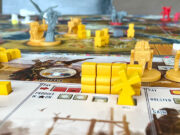
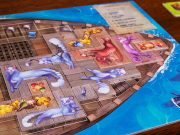
An Explanation Tablet is set in the center of the table and filled with 5 sliding beads in each Voting Track. They fit just snuggly enough that they can be moved back and forth without getting knocked off the track anytime someone bumps the table. There’s also a segmented voting board, with more segments added based on how many people are playing. Each player gets five Voting tokens in a particular color and one Afterthought token. Shuffle the two separate decks, Attributes and Tasks, and set a pile of victory point tokens by the side of the Voting Track.

The game proceeds in rounds, one round if there are only 3-4 players and two rounds for 5-8 players. A round consists of each player taking a turn being the leader. The leader takes ten Attribute cards and randomly places them in each slot of the Explanation track. Then they take one Task card and place it at the top of the track. They shuffle their own voting tokens, secretly draw one at random, and compare the number on the token to the numbered word on the Task card.
That will be their keyword for the turn. If they draw their five token, and the fifth word down is potato, that is the word they will have to get the other players to guess. With that word in mind, the leader moves the sliding beads towards the attributes they most think the word matches. Is a potato sweeter than expensive? More fun than it is loud? Equally as bouncy as it is emotional? The five beads can be distributed along the sliding scale however, the leader thinks it is appropriate.
The players watch these deliberations carefully, and put the Voting token that’s number matches the word onto the Voting Track face down. The faster they choose, the higher on the voting track they’ll be able to place and the more points they’ll earn if they’re correct. If the player changes their mind before the answer is revealed, they have a single-use Afterthought token that they can put down instead.
Once all the voting slots are taken, the leader reveals which voting token they drew, indicating the correct word choice. The leader gets points for each player who guessed the word correctly, with a bonus point if everyone guessed correctly. If no one did, they lose a point. The players each get points based on how quickly they guessed, listed on the side of the Voting Track. If a player is wrong, they get taken off the track, and everyone below them moves up a spot.
Play passes to the next player clockwise. The attribute cards are flipped over to their other side, the double-ended task card gets rotated around, and the new leader shuffles their vote tokens.
Whoever has the most points at the end of the allotted number of rounds wins!

Game Experience:
Perfect Mismatch strikes an interesting middle ground between the ambiguity of Dixit and the word associations of Codenames. If you’ve played your fill of both of those at party game nights, this game is a natural next step. What it offers that differs from the others is a slightly more challenging push-your-luck scoring system. If you want to earn the most points, you’ll have to balance how quickly you make your guesses. Guessing sooner will put you higher on the scoring track, but a mistake will earn you zero points. Unlike Dixit, the game rewards leaders for giving the best guidance possible, but there is so much room for interpretation that even a well-intentioned leader can’t provide perfect information.

If, after the leader has set the first two beads on the Explanation Tablet, you think you’ve got it, you’re welcome to put your guess in. The consequences of being wrong are heavy, though. Getting zero points in a round can knock you out of the running for the winner if all the other players are consistently guessing well, and there’s no coming back from that unless another player also makes a misstep. The Afterthought token can save you from a rash decision, but only once, and only if you use it quickly.
The game paces itself well, keeping the turns moving quickly and limiting the number of rounds played. If a card combo is truly miserable and the group is struggling with it, you know that you won’t be stuck there for too long. Play refreshes quickly so that everyone can move on. Both card decks are generously sized, so you won’t run into the same words too frequently, and the game would lend itself well to themed expansions.
There isn’t a lot of skill required to play, but in our experience, some people are just better at it, and some people never really develop the vibe-reading knack. The variety of the types of information in other guessing-based party games means that it might lean one player’s way one round, and another player’s another round.

If in Dixit, someone gives a clue related to movies and you’re a cinephile, you may be at an advantage. In Codenames, you might have a shuffle of words that work well together, making their associations easier to draw. The attributes in Perfect Mismatch are all words that are so similar in how disconnected they are that if you don’t succeed initially with the skill of making vague associations, you likely aren’t going to have a lucky turn or get better at it as you go.
The base mechanics of the game can feel repetitive. Either you’re someone who likes word associations or you’re not. It’s the kind of game that doesn’t have a lot of middle ground. One kind of player will always want to bring to the table, and the kind of player will groan whenever you see it in your hands.
Final Thoughts:
We found a lot of enjoyment in Perfect Mismatch. The turns move quickly, the limited round numbers keep it from dragging on for too long, and there are enough cards in each deck that you’re not running into the same words every time you play. It has a place on my shelf for more casual party game nights, and for playing with games that don’t mind spending their evening ruminating on the emotional capacity of a potato.
Final Score: 3.5 Stars – A quick playing party game that is both silly and fun.
 Hits:
Hits:
• Quick to learn and easy to reach
• Good material quality, especially the explanation tablet and beads
• Competitive scoring system
Misses:
• Repetitive gameplay
• Hard to make up points if you fall behind