

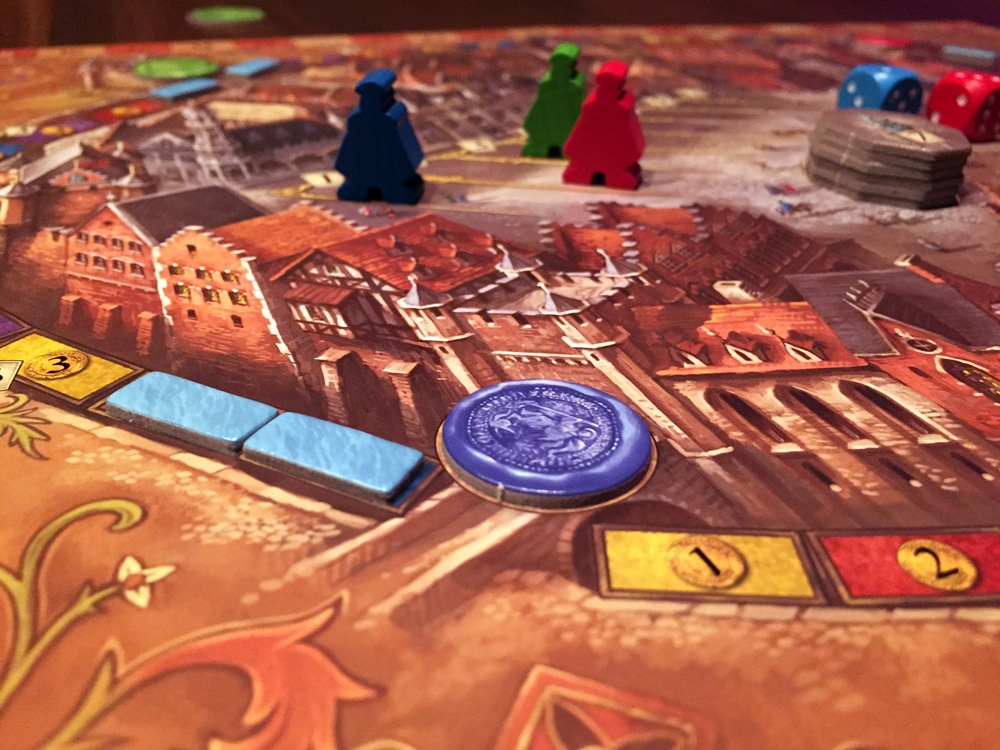


 Contrary to many in the boardgaming hobby, I do not bling out my games, in part because I am better able to rationalize my next, totally unnecessary, board game purchase if I know I passed on the metal coins for my last Gamefound pledge. Thus, I have monitored the recent trend of classic Eurogame deluxification—including that of Puerto Rico and Agricola—with mostly bemusement. So long as the gameplay is good, I’m happy to play my beige-colored thin cardboard titles any day.
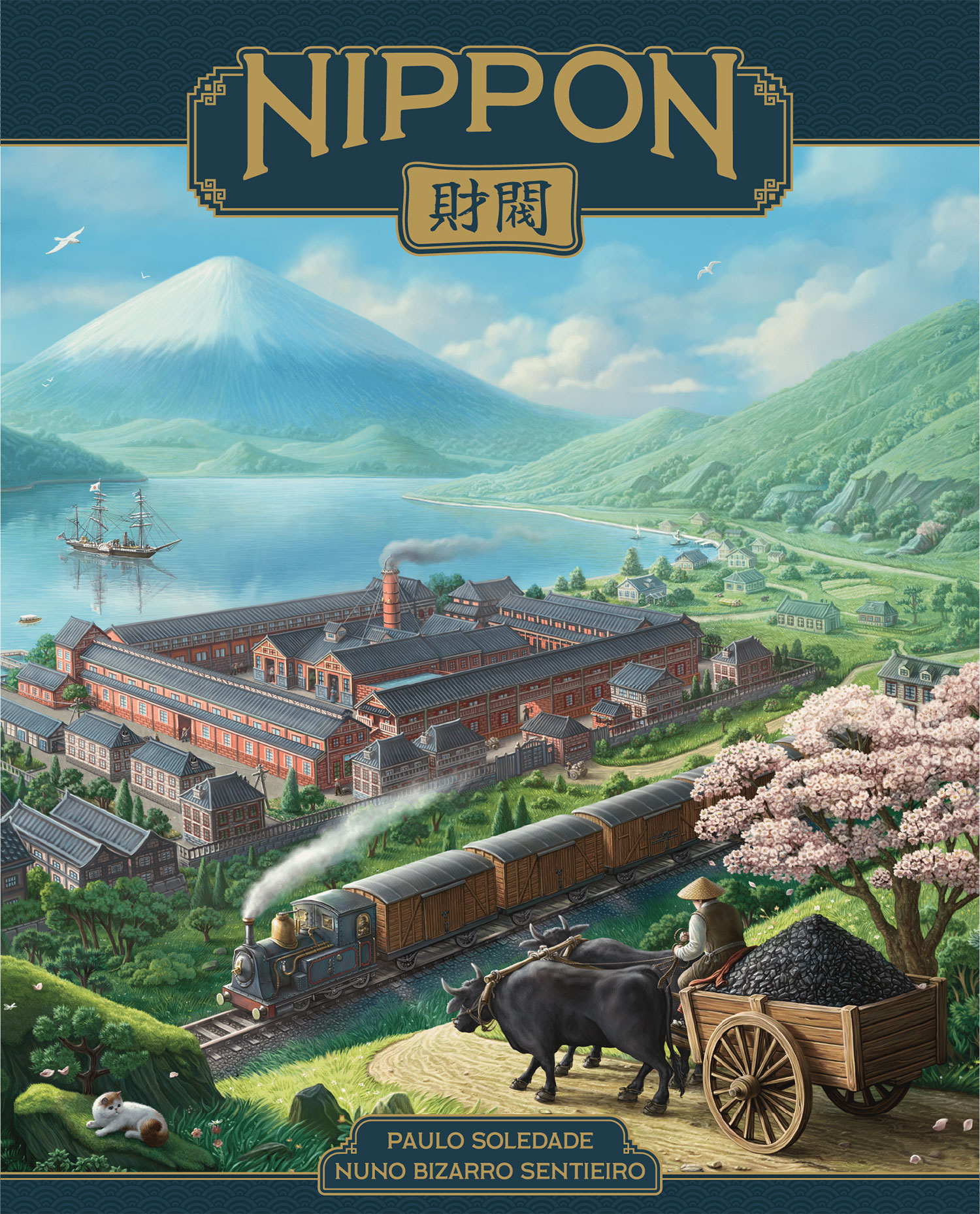
But then I heard about the new edition of 2015’s Nippon, excitingly titled Nippon: Zaibatsu. It’s not just a fancy dual-layered reprint, but a redesign of a respected and underhyped economic title that adds new variety, asymmetric abilities, and some extra wrinkles to the already unique action-selection mechanic. Nippon: Zaibatsu is a competitive medium-weight Eurogame designed for 1-4 players over 60-120 minutes. The promise of interesting mechanics made this stingy reviewer spring for the deluxe edition. Read on to see if it was worth it.
Gameplay Overview:
Nippon: Zaibatsu is an area-control game at its core. On their turn, players have the option of taking a single action or refreshing.
Actions are grouped as follows:
To produce goods, players will need to:
- Build factories by spending money
- Produce goods on said factories by spending coal
Enhance goods production by investing in the following:
- Automation to enhance factory output
- R&D to enhance your eligibility to acquire better factory types
- Mining to increase coal production so more factories can be activated at once
Utilize goods to:
- Fulfill contracts for one-time rewards or monetary income track bumps
- Deliver to local markets, thus participating in the area control element of the game
Build:
- Trains for more area control scoring
- Ships to boost income during refresh phases
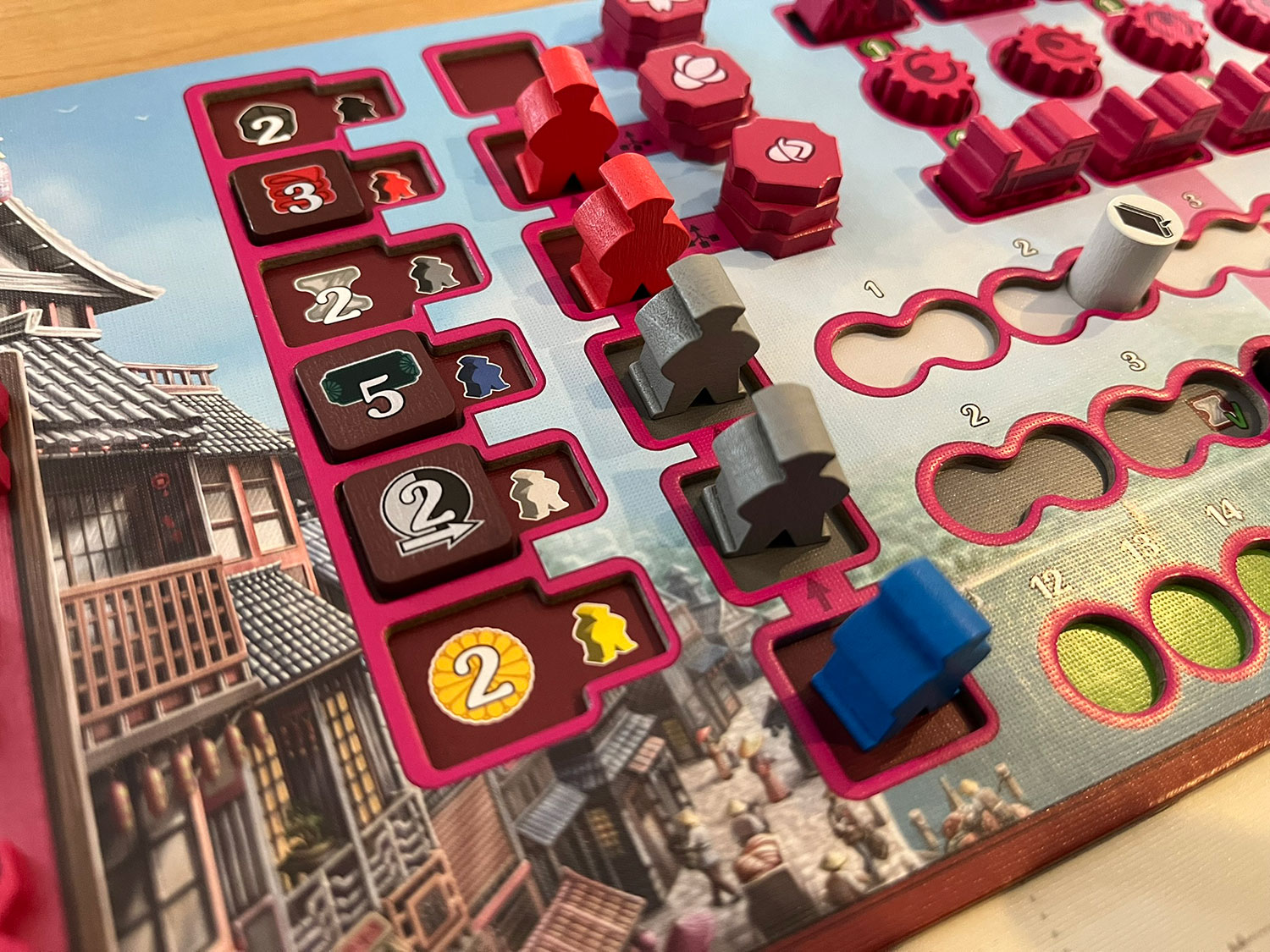
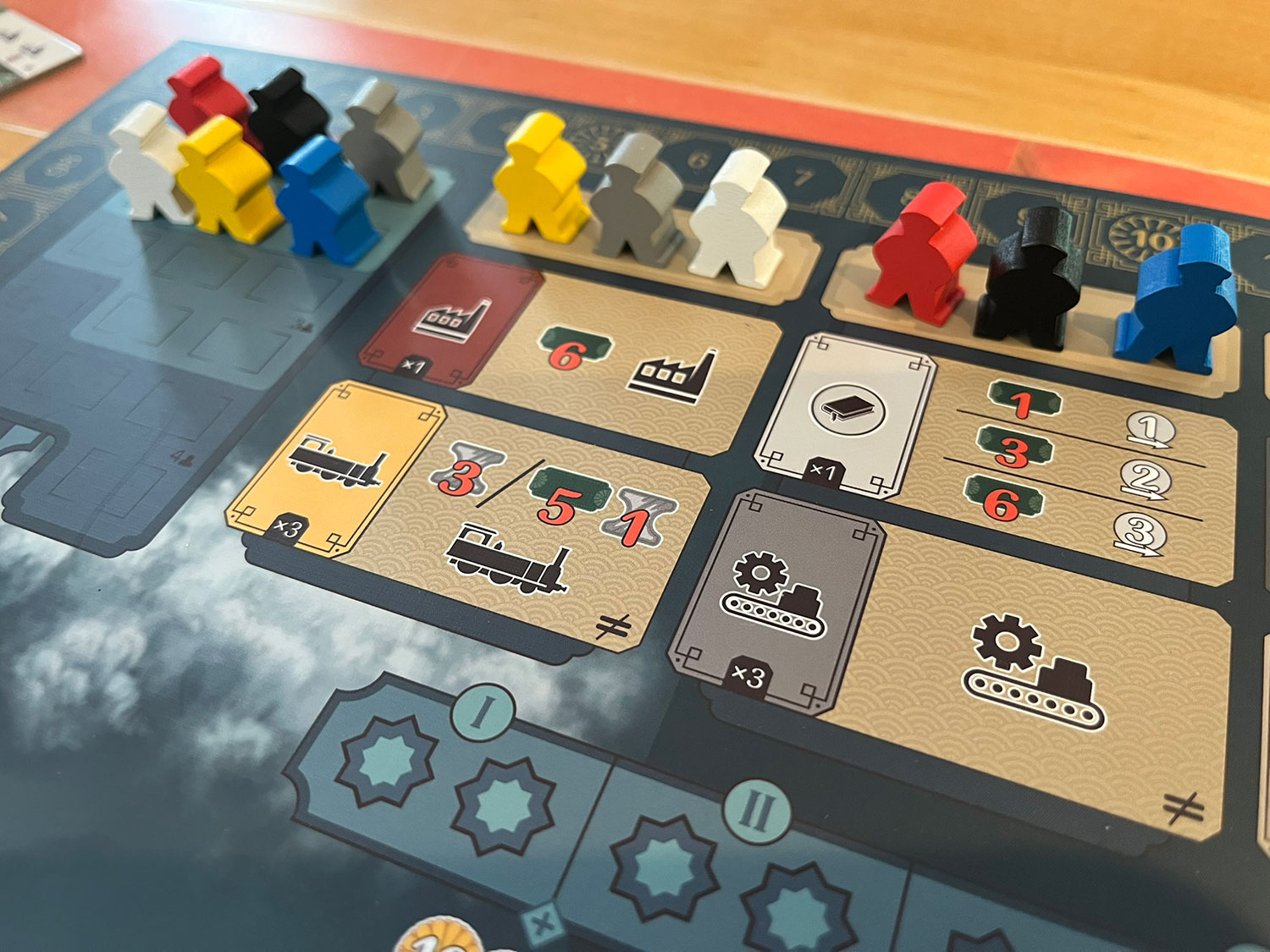
The novelty of the game is the action-selection system. The 9 actions are grouped and divided into five regions, and each region starts with 3 randomly placed workers of 6 different color types. On a turn, a player must claim a worker from the region they’d like to activate and line it up on their personal playerboard, which can contain at most 6 workers. Alternatively, players may refresh (clear all workers) anytime they’ve collected 1-6 workers on their playerboard, keeping in mind that:
- Special resource income is granted according to the color of your first worker
- Monetary income is determined by your personal monetary income track MINUS ($3000 times the number of unique worker colors on your board)
- If you refresh with at least 4 workers, then
- Additional resource income may be granted according to the color of your last worker
- You may place an end-game scoring marker in 1 of 8 unclaimed locations on your playerboard – these markers award points based on how well you’ve excelled in various aspects of the game
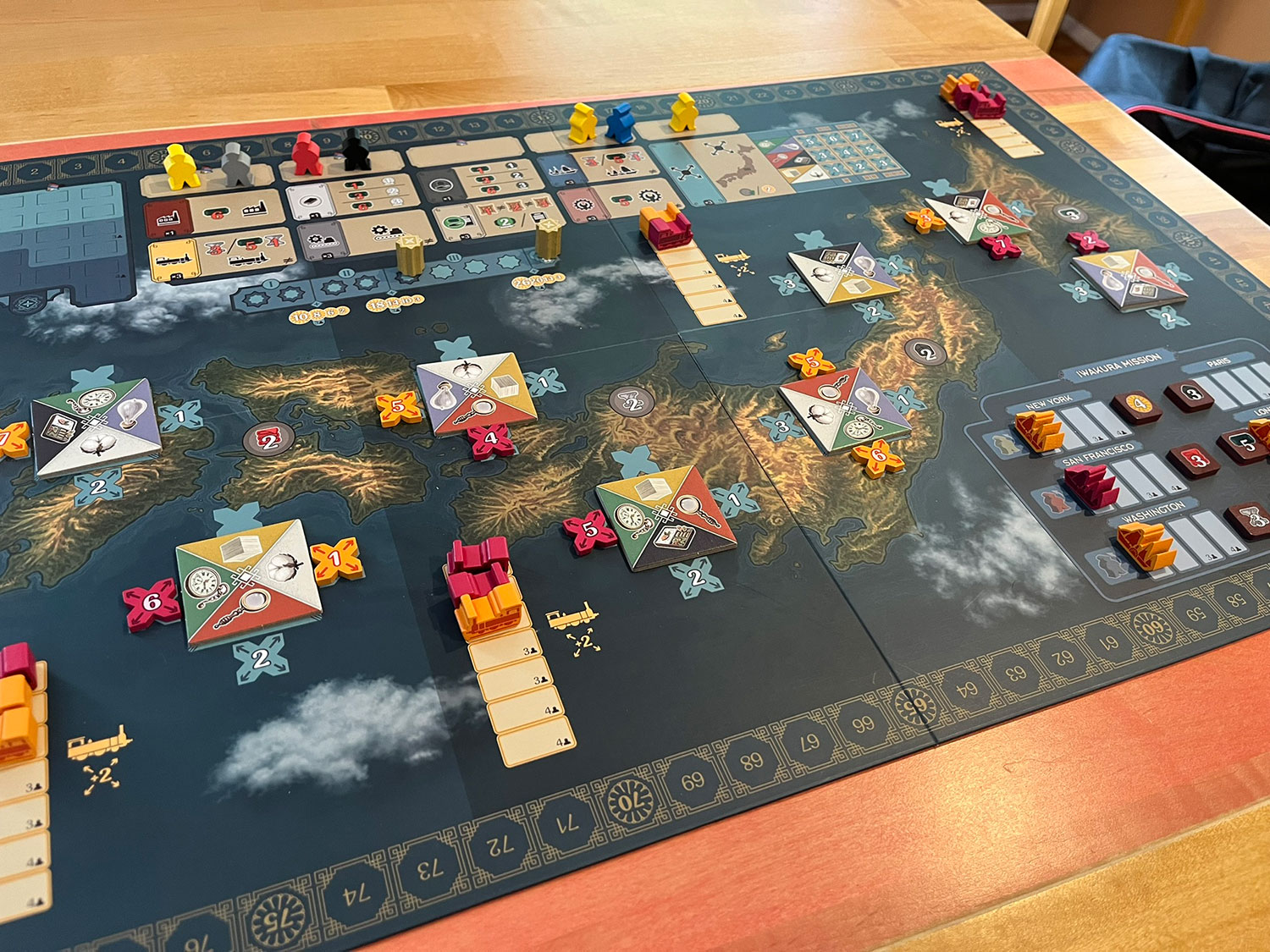
When workers are emptied from the various regions of the board and can no longer be refilled, it triggers an area-control check on the shared map of Japan. After 3 area-control checks of increasing point values, the game end is triggered.
The most points from area-control, in-game bonuses, and end-game scoring markers wins.
Game Experience:
The novel, multi-faceted action selection mechanic is what really makes this game shine. Nippon is rather tight on money (income track starts at $12K), so at $3K salary per unique worker color, you must pay close attention to worker diversity, or next-round income will be paltry. Thus even though the general game loop of build/enhance factories –> produce –> utilize goods seems straightforward enough, you also need to consider how you can accomplish these tasks efficiently using worker colors you don’t think other players will take, and which still provide helpful resource boosts. At the same time, players are incentivized to delay refreshing until they have at least 4 workers since this releases an end-game scoring marker whose value increases further with 5 or 6 refreshed workers; of course, more workers make color homogeneity challenging.
There are also ample trade-offs between efficiency and proper timing. All leftover coal and money disappear during a refresh, so you generally want to spend it all before refreshing, while being careful to still take efficient turns. Most actions can be taken up to 3X in a single turn (ex. building 3 boats at once), so if you can save up enough resources for a jumbo action, it can be quite satisfying. However, boats boost your resource production during refreshes, so you may not want to wait so long to build them. Additionally, players have to pay close attention to when area control scoring might take place, based on the dwindling supply of workers. Say you have just one good available for delivery at present. You would love to automate a factory, do a production, and then carry out a triple delivery to the area control map for maximum efficiency over your next three turns. But what if area control scoring is triggered in your next 1 or 2 turns? You may very well be better off delivering that one measly good to lock in at least some area control points in the short term.
Players very much have control over the pacing of the game and when scoring events will be triggered, making this a special Eurogame that not only contains tracks but also has meaningful player interaction. Beyond timing, the area control element can be fierce, as there are only so many spots per region, adjusted for player count, and players can eliminate previously delivered control markers if they deliver certain goods of greater value. There are benefits to delivering to a region first and forcing your opponents to waste more resources to push you out, as well as going late, when you have ultimate control of the power balance in a particular region. Notably, there are pre-printed control values in each region, so even at 2-players, it requires some effort to earn an outright majority in any given region. Ultimately, the game plays well at all player counts. At 2 players, it can be a bit of a meaner zero-sum competition. At 4-players, planning your worker-color diversity as well as predicting when area-control scoring will be triggered is more of a challenge.
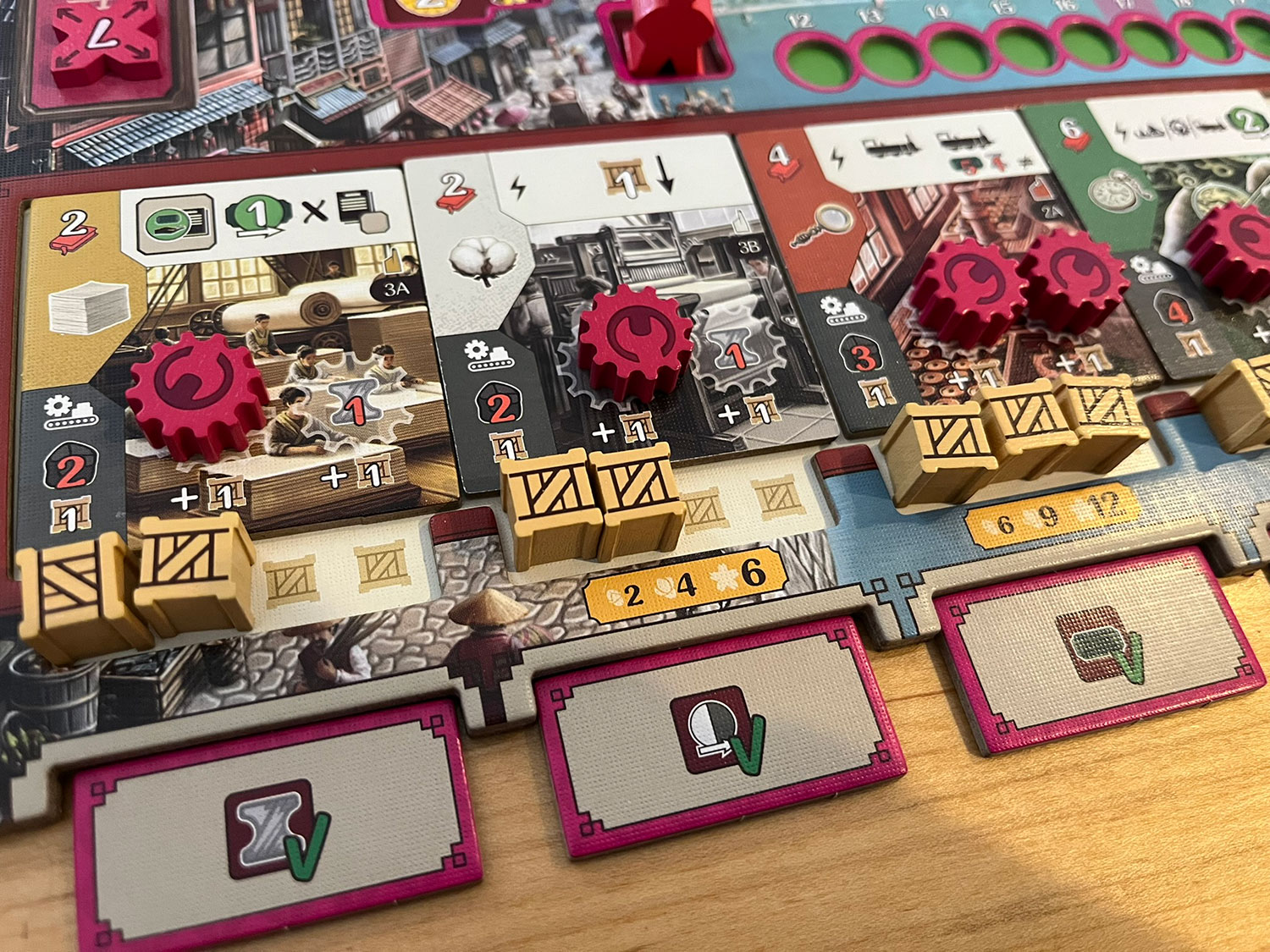
As for replay value, workers always come out randomly, which is a significant part of the game puzzle. The factories in the deluxe edition are double-sided, meaning there’s some variety of special bonuses and abilities to design your strategy around. There are also asymmetric starting abilities that push early gameplay in different directions. While factory abilities seem fairly balanced, some of the asymmetric starting abilities do seem stronger than others, and the consolation points offered for the weak ones don’t quite seem high enough. Even with all this, some players may still find the gameplay a bit samey.
As for other critiques, the theme of Japanese industrialization is not particularly inventive, and while the production with wooden tokens, dual-layer boards, and thick cardboard tiles is exceptional, the artwork is totally blah, though it is clean and functional.
Final Thoughts:
Nippon: Zaibatsu is a medium-weight Eurogame that sees players vying for area-control-style dominance in various parts of Japan. While the production is wonderful, the theming and artwork do not draw me to this title. Rather, the multi-layered action-selection mechanic combined with nuanced player-interaction makes this game truly special. It’s a really interesting puzzle to find workers linked with actions you desire, knowing that the color and number of workers dictate income, resources, and end-game scoring opportunities during each refresh.
Though Nippon: Zaibatsu also contains classic Euro mechanics like engine-building track-bumps, which can be linked to end-game scoring, the majority of points come from more player-interactive elements like area control on the central map and strategizing to properly time the scoring thereof. Altogether, it’s an elegantly designed, smooth-playing gem of a game that is likely to impress a wide swath of Eurogamers, including the stingy ones like myself.
Final Score: 4.5 Stars—Choo choo choose your workers carefully in this train-themed economic game, as they have a lot of power
 Hits:
Hits:
• Cool multi-factorial action selection mechanic
• Ample player-interaction through area-control scoring
• Scales well with different challenges at 2-4 players
Misses:
• Theming and artwork are nothing special
• Asymmetric abilities may not be fully balanced
• Some may find gameplay a bit samey from play to play












I was a backer of Nippon but I had too many other games to play ahead of it when it arrived a while ago. It was more of a case I didn’t have time to learn the rules despite anyone saying it’s simple or streamlined. It might be, but that doesn’t help me when I haven’t played the original. You broke the rules down nicely and I now have confidence to sit down and learn it. Thank you very much!
I’m glad you found my rules breakdown helpful. It’s a tedious section to write, and it’s great to know that at least some people read the “gameplay overview” section rather than skipping straight down to final thoughts! Thanks for the comment, and I hope you end up enjoying the game.