 “Oh, cool, a new racing game,” you say, innocently clicking into this review. “I wonder if it’s like Heat?”
This must be how Christina Aguilera feels. Oh wow, it’s Britney Sp– oh no, it’s the other one.
This ain’t Heat. And it’s not trying to be.
Dirt & Dust, from Petr Čáslava, with art by Jakub Politzer, and published by Albi, is a 1-4 player Euro racing game that takes about 90 minutes to play. It is a multiplayer solitaire experience.
Gameplay Overview:
Dirt & Dust is a rally racing game, and rally racing is always one car against the clock (says the guy who has never participated in anything having to do with Rally Racing beyond watching Top Gear once. If I’m wrong, I’m sure the internet will let me know). Racers aren’t trying to pass others on a track. They are simply trying to be the fastest around it.
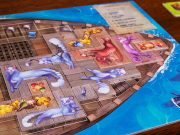
Dirt & Dust accomplishes this rally sim in a very clever way, with a shared track board to show the race course, and individual deckbuilding and action selection to drive your rally car.

The game takes place over 10 rounds, with each round broken into 4 phases. In multiplayer, turns are taken simultaneously.
- Roll dice: Each player rolls their driver dice and hazard dice, and places them on the board. “But wait!” you cry. “Dice in a Euro Game?? Is that even legal?” Yes. Stefan Feld and his henchmen from Chessex heard that, so you’d better pipe down about it lest there be consequences.
- Driving phase: Each player plays and activates cards, buys new cards, moves their car, and more
- Stage evaluation: The stage cards all shift down one position, and the one that was pushed off the board is resolved for points
- Preparation phase: Each player shifts all their played cards down one position and draws back up to five cards
At the end of the 10th round, points are tallied, and the player with the most Speed Points is the winner.

Game Experience:
At its heart, Dirt & Dust is a resource management game (see? I told you it was a Euro). The player who can most efficiently use their resources to improve their deck and dice actions will be the quickest around the track.
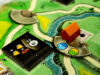
Resources are tracked on the player board. Each driver gets a board which shows available resources (wrenches for your team prowess, and traction for your navigation and steering abilities), where your car is on the road, and how beat up your car is.

Wrenches are used to purchase new cards for your deck, and traction is used to plot your course and actually score points. Both are hard to come by, so your efficient resource management is the key to the game.
There are four drivers included in the game, and each has 5 unique cards in their starter deck, which changes how each driver should be played. The other 5 starter cards are identical between each deck. Cards can be added from a common market, and drivers can have multiple copies of cards.
Each player also has a personal player board, the Racing Team board, where you play cards from your hand into slots labeled 1 through 6. When you roll the dice, you’ll slot them into the matching numbered slot and use them to activate the card in that slot.
The most popular player gets the popularity die, which is (sometimes) placed on another action slot that can be activated. There are blank faces on that die, so you’re not guaranteed to get a boost.
Drivers may also have damaged their cars and be forced to roll a damage die (or three). These dice cause even more damage to your car, which gives drivers debuffs like being forced to move further on the road when turning, or reducing their hand limit. But, they also grant popularity because the sickos in the crowd love nothing more than to watch pieces of your precious Rallymobile fly off in mid-race.

The meat of Dirt & Dust is this dice + card interaction. Each card has 3 actions on it, split into Left and Right halves on the card. The Left half is an unconditional effect—you get to activate it (or not, your choice) when you use a die to activate the card in the first place. The Right half is the conditional side; you can only activate the action matching whether your car is accelerating or decelerating.
Some cards have passive effects. These are left-half effects that you can activate even if they are in a slot with no dice to activate the card, but can only be used once per turn.
The puzzle of the game is in which effects you activate, and when. Because in the driving phase, you can do more than just activate cards. You can spend resources to buy cards or scout locations on the map, move your car to another space on the road, or take special actions. The driving phase is wide open, and just like in Rally racing, timing is everything.
Each round in the Stage Evaluation, drivers who have mapped the location of the stage will score points based on where their car is on the road. If you’re decelerating, you score less than if you’re accelerating. And if you’re too far to either side of the road, you score Popularity instead of points because the crowd loves that you are crashing into them (???), but you aren’t careening down the middle of the road like any respectable, and actually fast rally racer should be.
At the end of each round, you slide each card on your board down one space (with the 1 slot shunting into the discard pile). Then, you draw back up to five cards and do it all again.
At the end of the game, you take your Speed score, add or subtract any speed points from cards you purchased, factor in the popularity bonus, and the driver with the most points wins.
Solo Mode

The solo mode of Dirt & Dust is called the Ghost Driver. Using another color of player dice and 3 extra hazard dice, you roll these to start the dice phase and put them on the included Ghost Driver card. The damage pips on the hazard dice indicate how many points the bot will score. The popularity pips are how much popularity is granted to the bot.
These scores can be mitigated if you place one of your dice on a matching bot die of the same value.
I found the solo mode frustrating at best. Having to waste a precious die just to block points from the Ghost Driver felt icky, especially if the ghost car rolled a lot of points. In the solo games I played, I either spent the whole game mitigating ghost car points—leading to low scores for both of us—or I spent the game ignoring the ghost car and getting blown away in final scoring.
This solo is especially odd because in the multiplayer game, there is zero player interaction. I find no gameplay reason why I should spend my actions blocking when this would never come into play in a multiplayer game.
Personally, I would prefer a Beat-Your-Own-Score solo for a game like this, where I can focus only on my game plan and see how I fared afterwards.
Final Thoughts:
Dirt & Dust does a great job of taking the technical planning of Rally Racing and combining it with the random mishaps of the road to make an excellent optimization puzzle. Resources are tight, and making progress can feel slow, especially if you are playing the solo game.
The components are well-made and look and feel nice. However, the car meeple on your player board faces away from the player, so all you see is this odd chunky car butt staring at you all game.
Playing simultaneously in multiplayer is an odd experience. Despite knowing that this is a rally racing game and that it’s intended as a solo puzzle, I found myself wanting to somehow impact my fellow drivers. That option just isn’t there. The card market is plentiful, and there is nothing one player can do to change the course setup or add obstacles for the other players.
Additionally, the simultaneous play leaves me feeling uncomfortable. I want to know how the other players got from A to B. Watching others pet cardboard in real time and then declare the results of said petting feels incomplete to me.
Final Score: 3 Stars – Dirt & Dust is an excellent optimization puzzle that loses some of its luster via a frustrating solo mode, and a lack of player interaction.
 Hits:
Hits:
• Great puzzle
• Quick playtime
• Variable setup gives good replayability
Misses:
• Solo mode is inexplicably interactive
• Multiplayer solitaire means you and your friends are playing different games, together
• Dice rolls can be frustrating (#eurogamerproblems)