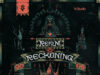

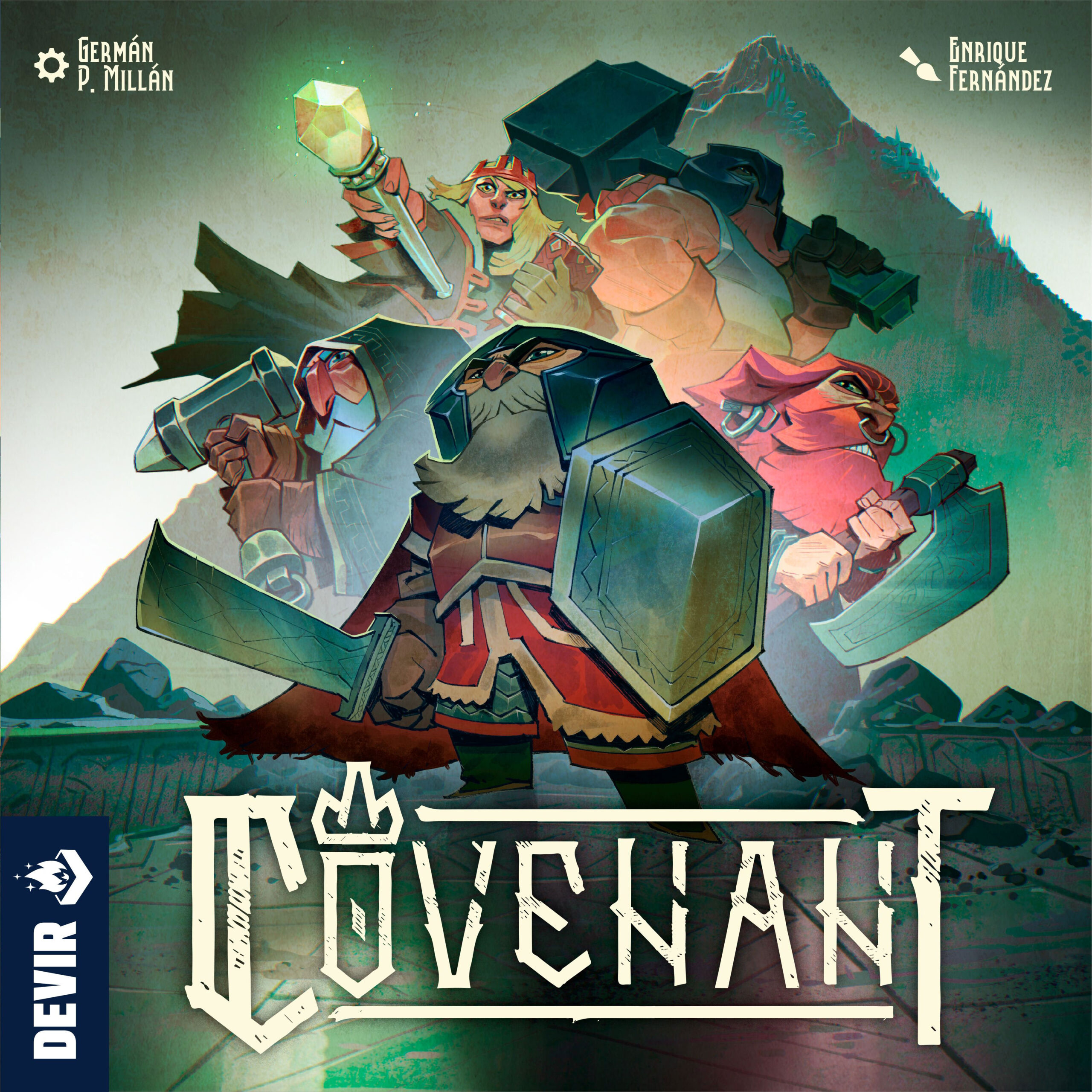
 Great things come in small packages. I’ve strived to internalize this message as someone who is height-challenged. It’s also why the Dwarves are my favorite of the Middle-earth species. Despite their short stature, they’re renowned for their toughness and craftsmanship, this latter trait exemplified by the impressive labyrinth that is the Mines of Moria in The Lord of the Rings. German Millan discussed in his designer diary how the Mines of Moria were his inspiration for his latest heavy Eurogame, Covenant, even though it is not officially associated with the LoTR IP. In Covenant, 1-4 players will have the opportunity to help Dwarves reclaim their abandoned mountain city. Over 100 minutes, they will compete to excavate tunnels, uncover gemstone treasures, fight off lurking monsters, and rebuild their sacred mountain home.
Gameplay Overview:
Covenant is played over 3 rounds, and in each round, players alternate taking a total of 4 actions using Dwarves who start at strength 1, representing “action power.” Dwarves may be permanently upgraded to a maximum of strength 4 throughout the game, and additionally, their power may be temporarily boosted for individual actions through beer tokens.
The main actions come in 4 flavors:
- Dig—excavate the shared mountain map, collecting mining resources in the process
- Transport—Contribute mining resources towards the crafting of various structures
- Build—Add structures (of 4 unlocked types) to already excavated regions of the map, obtaining benefits associated with their location
- Skirmish—Clear monsters from regions of the map (in a zero-luck, mathematical manner)
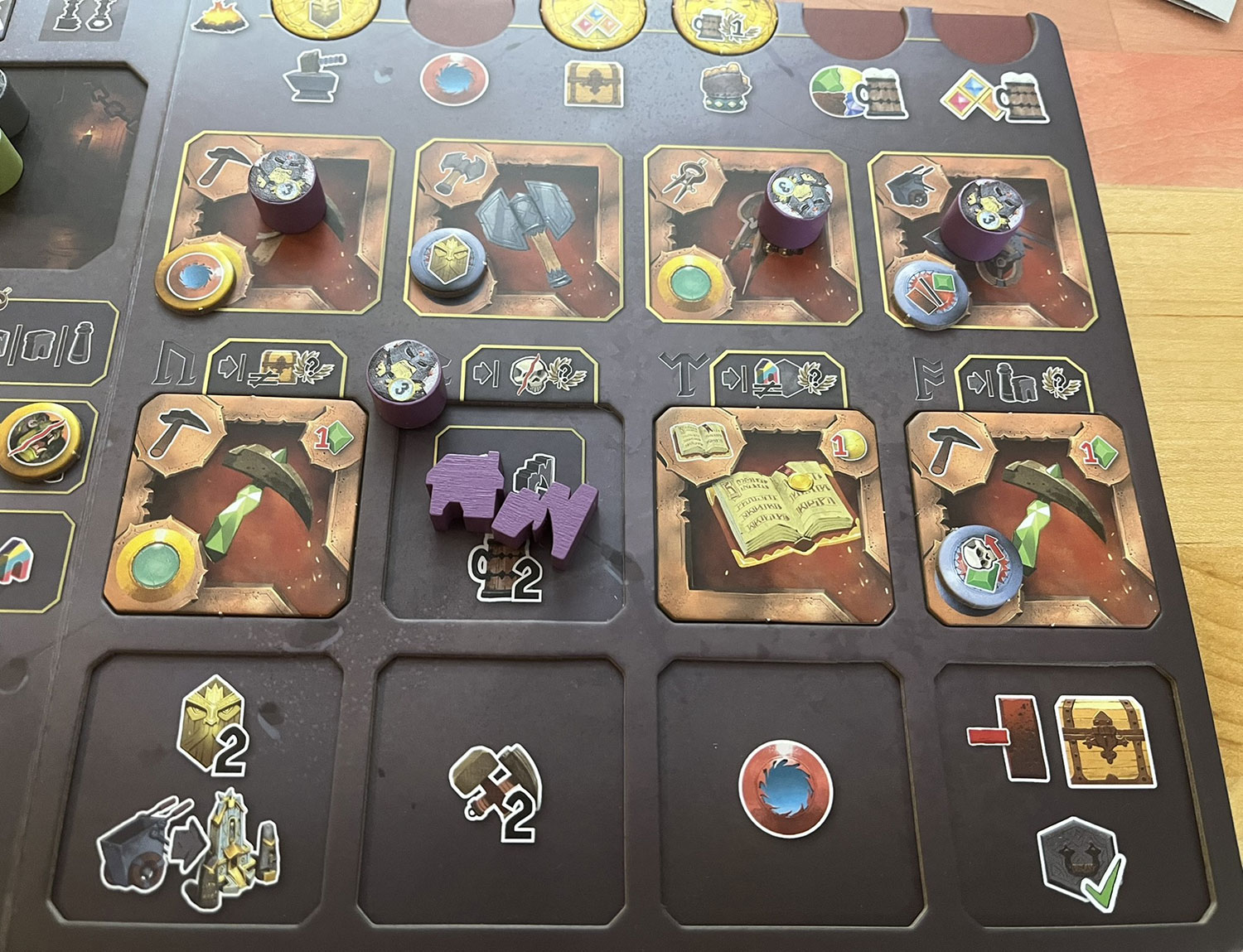
Each of the above actions is associated with track bumps and various one-time bonuses that provide engine-building capabilities and other in-game combos and perks, including points.
Final scores will ultimately be composed of:
- Personal objectives drafted at game start
- In-game points
- End-of-round shared objectives related to building on the map
- Up to 4 player-board objectives that must be unlocked and relate to building accomplishments, captured monsters, and acquired treasure
- Area control related to transport actions
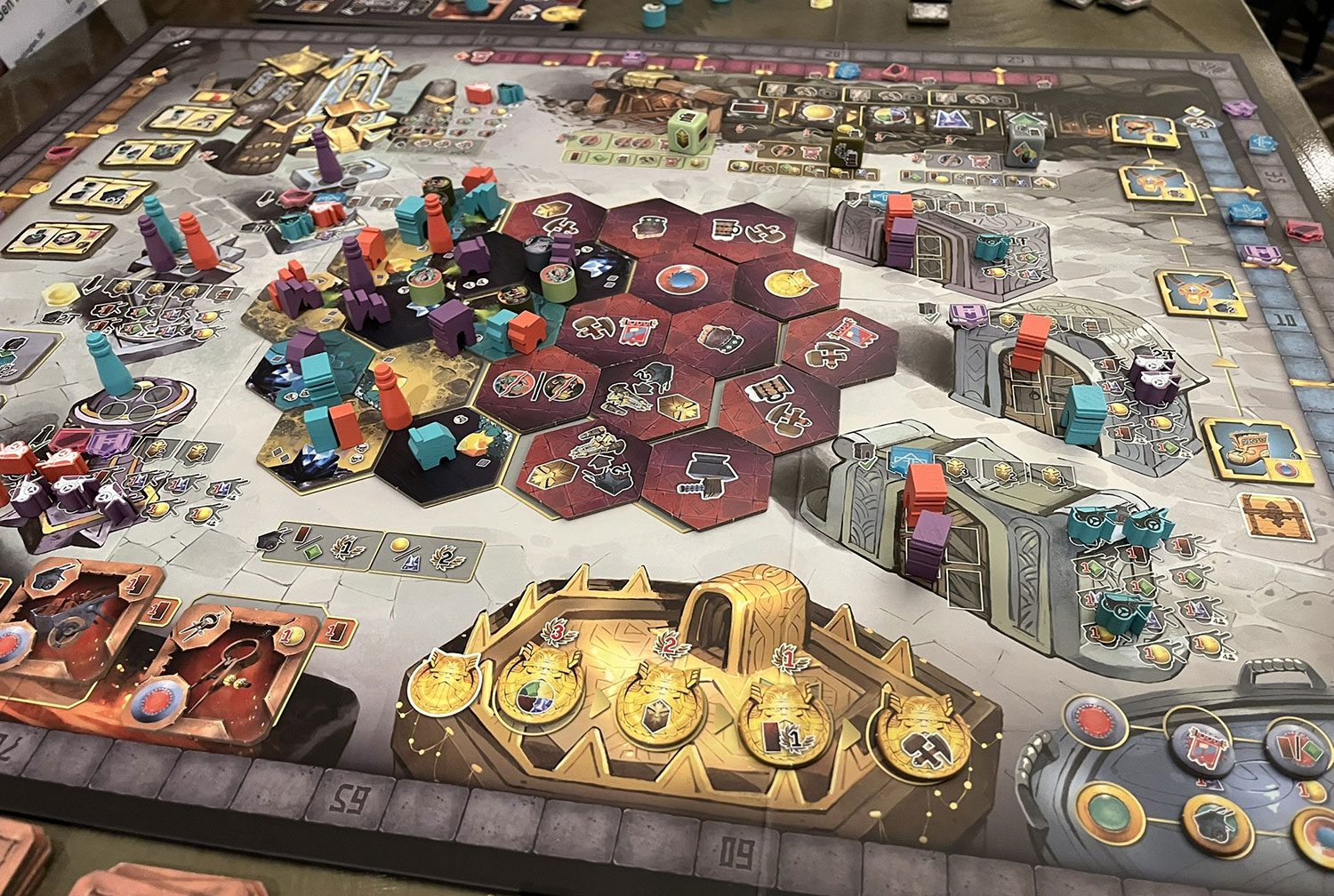
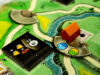
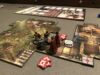
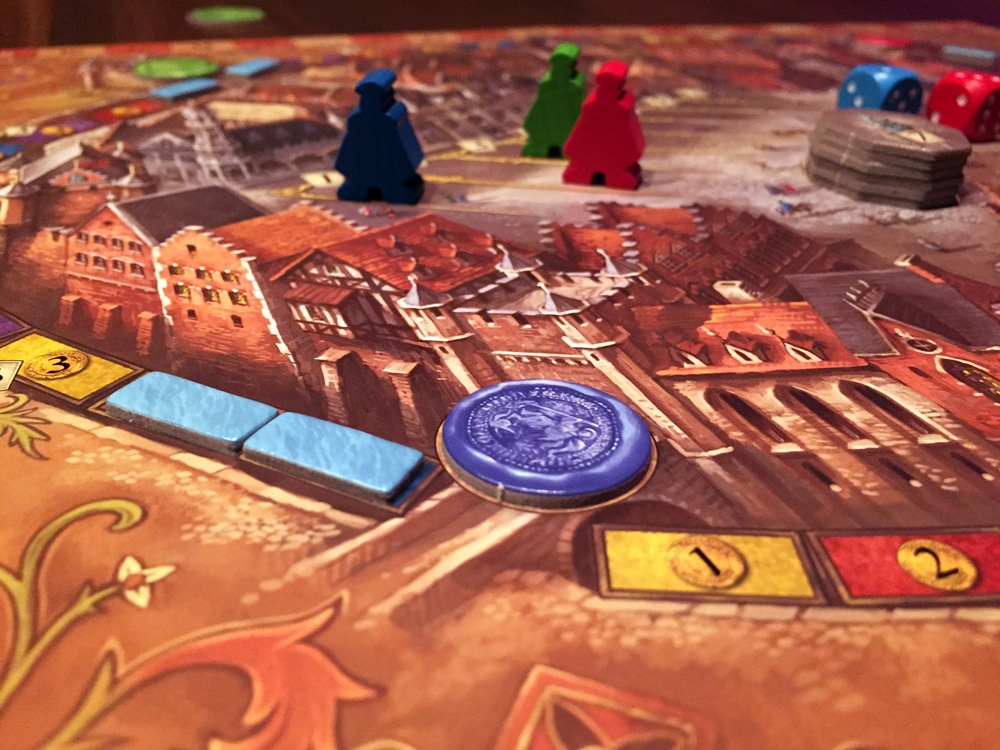
The central board contains the mountain city in the middle with tracks and shared market places around the edges.
Game Experience:
There is no single element of Covenant that feels completely novel, but the game sure does cobble together some fun mechanics in a way that leads to crunchy, combo-tastic gameplay. A core feature is that the actions can be taken at different power levels. We’ve seen this before with Teotihuacan, Yokohama, and Ark Nova. With each of these, I’ve loved the engine-building element of getting stronger, as well as the extra decision space required to determine which actions require more strength and how to optimally sequence actions. Covenant provides extra flexibility with this mechanic as you can freely choose where to assign your various-strength Dwarves each round, as well as when to boost them with limited beer.
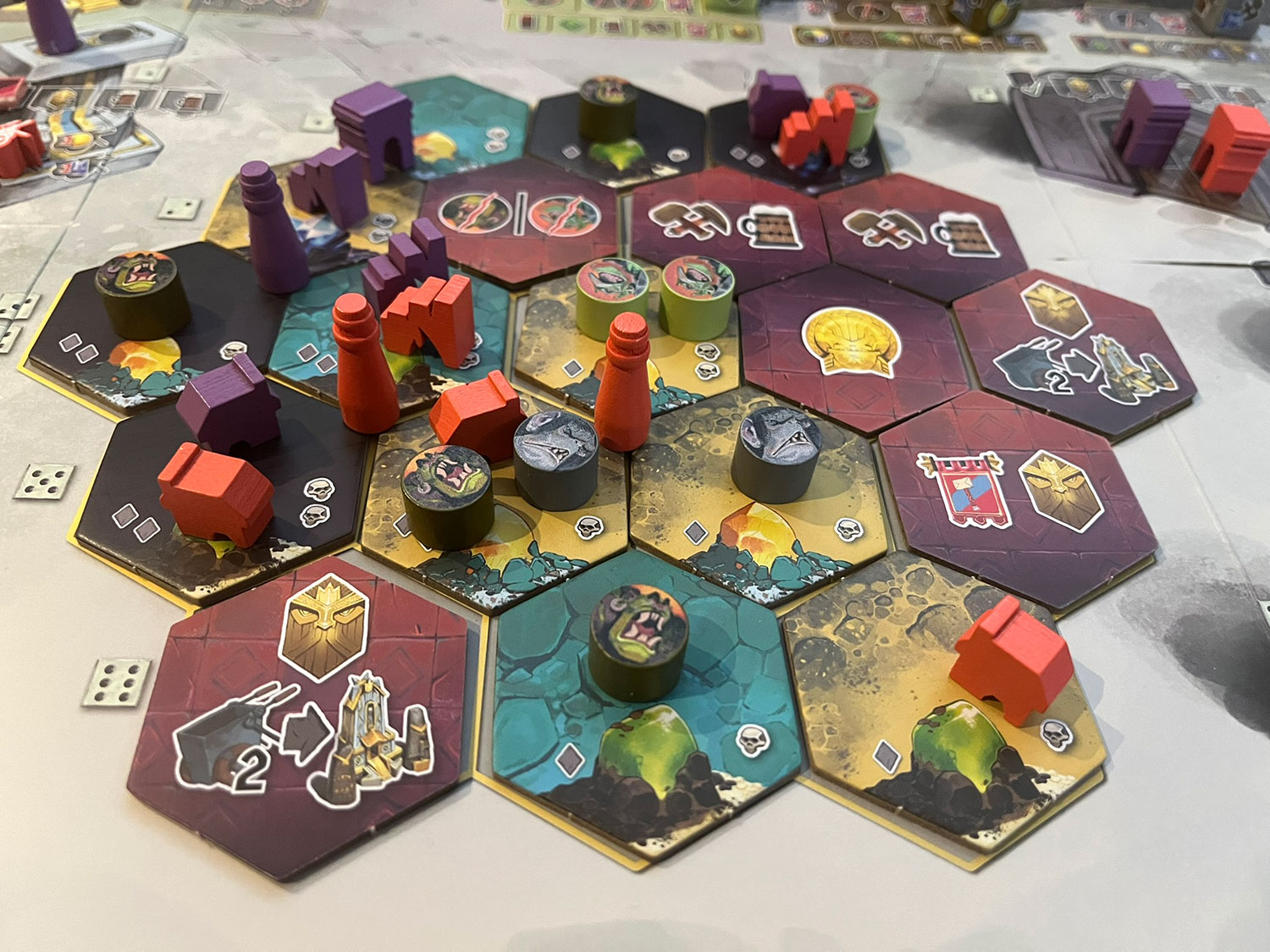
There’s also an exploratory element on the shared map where players can excavate one tile at a time to expand the map. We’ve seen this before in games like Vindication and Revive/Recall. The key difference in those other games is that players can take 2-3 different actions per turn, and thus they can claim first dibs on any exciting new locations that get discovered. With Covenant, exploration is a more risky proposition, as players can generally only do one type of action per turn, so if you find something good, the next player can potentially capitalize on it—if they have the actions and resources ready to do so.
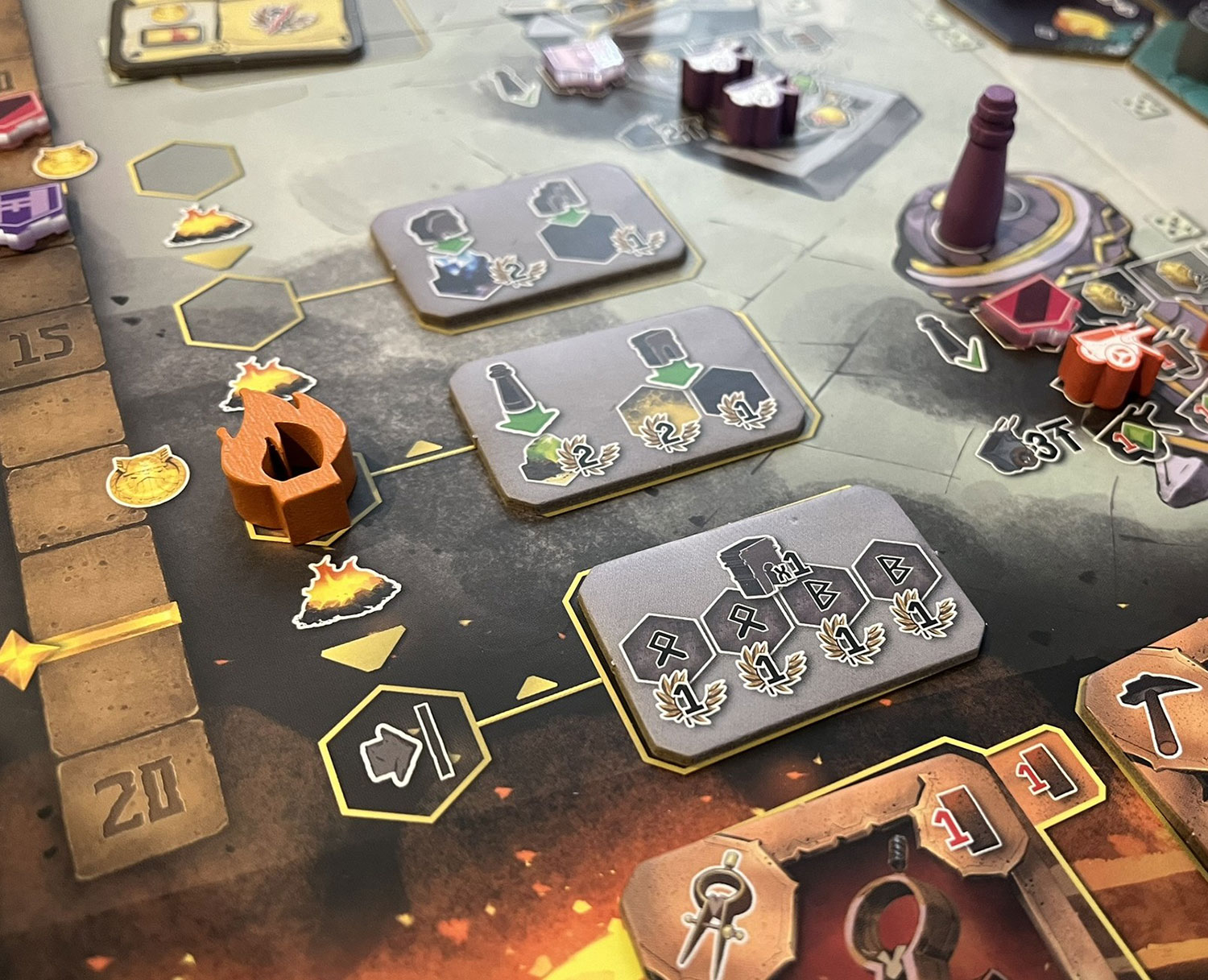
Another pervasive mechanic is the triggering of one-time bonuses from all sorts of places—icons on the main map, personal playerboard, and at various thresholds on the three tracks. Forestry, Barcelona, and Tiletum likewise offer many such combo-tastic bonuses. In Covenant, many of these bonuses allow acquiring or purchasing important items from various shared-market offerings, which are immediately updated. For better or worse, some of these market offerings may be more appealing than others, and once again, the next player in turn order can potentially capitalize on this.
So while Covenant is not hugely interactive—it’s action selection on your playerboard vs worker placement—the race for the best marketplace offerings, best building locations on the shared map, and fighting/moving monsters such that only your opponents get negative points on their properties creates some meaningful tension. Players will generally want to do a little of each of the 4 main actions, but they can upgrade their asymmetric playerboards with additional action spots, allowing specialization in certain actions. This, combined with unique rule-breaking abilities (players start with 1 and can gain up to 4, among 36 total), unique personal objectives (2 each game, among 12 total), and 3 unique end-round shared objectives (among 18), pushes players in different directions each game.
Despite all the combo-tastic engine-building goodness, I do have some complaints. First, two of the 4 asymmetric playerboards offer more ability/scoring synergies than others, which creates balance issues at playercounts 3+. Secondly, the lack of market-offering turnover at 2-player can be problematic. Finally, the game is quite tight on both resources and action economy, somewhat punishingly so. You may feel like your engine hasn’t really begun to run by the time the game ends. And I don’t think I’m the only one who feels this way. The BGG discussion for Covenant as of May 2026 has 3 threads discussing adding a fourth round (for 2-players), 1 thread discussing increasing the strength of your starting Dwarves, and 3 threads discussing how anyone ever scores over 100 points. I’ll admit that I implemented some house-rule modifications for a slightly stronger start after playing a few times, and it transformed the game from merely good to great. Alas, this review must reflect the rules as written.
Final Thoughts:
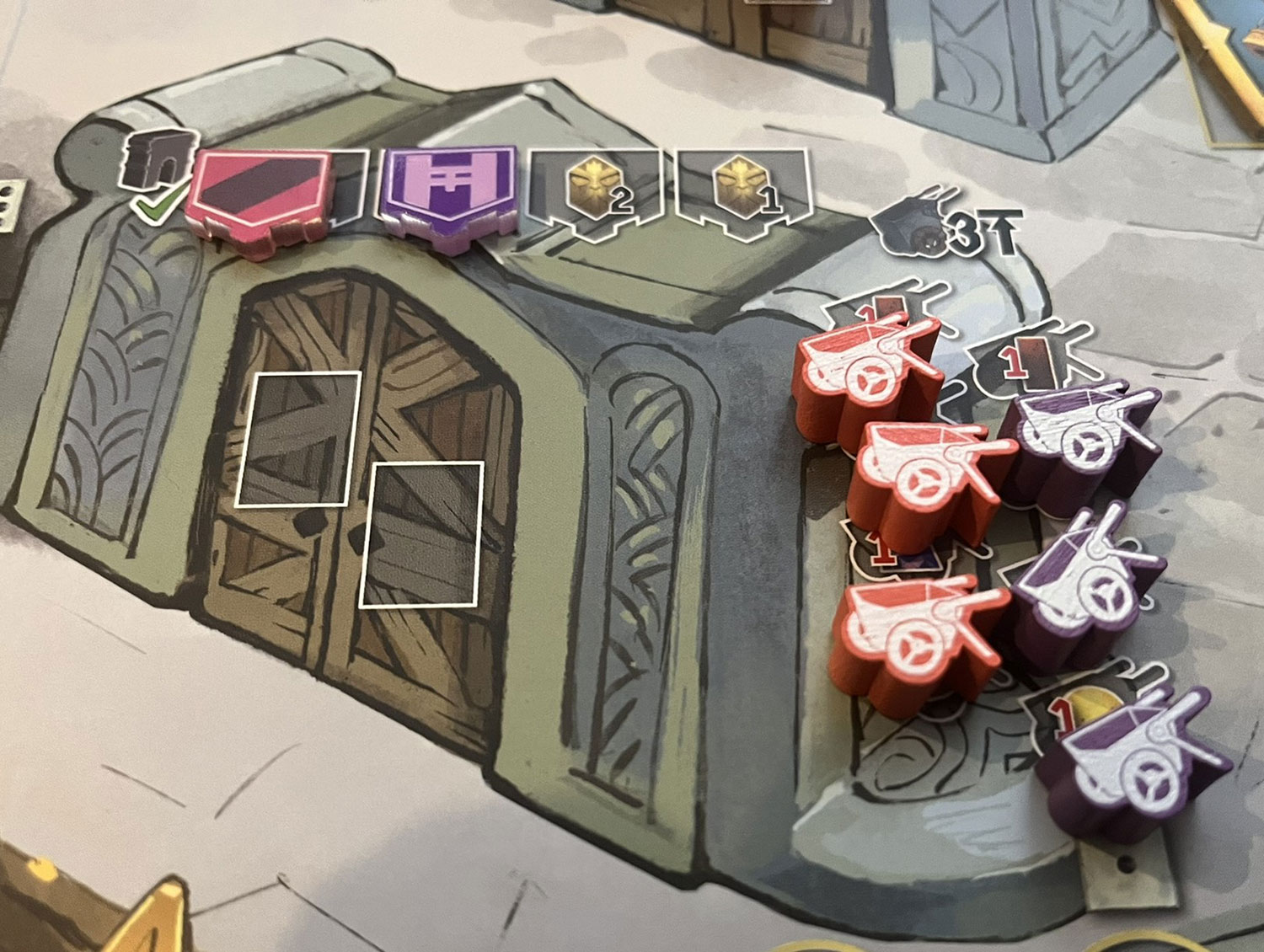
Covenant is a heavy, combo-tastic, engine-building Eurogame that casts players as Dwarves attempting to explore, rebuild, and de-monsterfy their ancestral mountain city. It’s by the same designer as Men Nefer and Bitoku, and it similarly requires ample planning ahead to capitalize on synergies of multiple overlapping thematic foci—in this case, digging, transporting, building, and skirmishing. There’s no single mechanic that jumps out as entirely unique, but the game works well as a tight Euro puzzle. For this reviewer, I would rank the above-mentioned games in the following order: Men Nefer > Covenant > Bitoku.
Player interaction in Covenant is probably the lowest of the three, existing mostly on the shared map and jumping on market opportunities revealed by your opponents. My biggest complaint is that the game might be a tad too tight, and house rules might be required if you really want to see your engine run before the game ends. Just like its Dwarven heroes, Covenant is a finely crafted production, it’s filled with a treasure-trove of challenging decisions, and it’s relatively short (at least compared to Millan’s other heavy designs).
Final Score: 3.5 Stars—Rise beyond your Dwarven stature to build a mountain sanctuary in this heavy, combo-tastic Eurogame
 Hits:
Hits:
• Variable-power workers that can be upgraded
• Crunchy, combo-tastic Eurogame goodness
• Great production
Misses:
• Gameplay possibly too tight
• Player interaction may be too light for some
• Some luck in market refresh opportunities