

 It actually felt like summer for a few days in the Midwest. I could finally stand outside without melting into a pile of vaguely human-shaped goo. Nothing was falling from the sky; no torrents of water coming through convention hall roofs, no hunks of ice breaking windshields or skulls. A gentle breeze instead of a swirling vortex of death aiming to uproot trees, relocate trucks, or drop houses on unsuspecting witches.
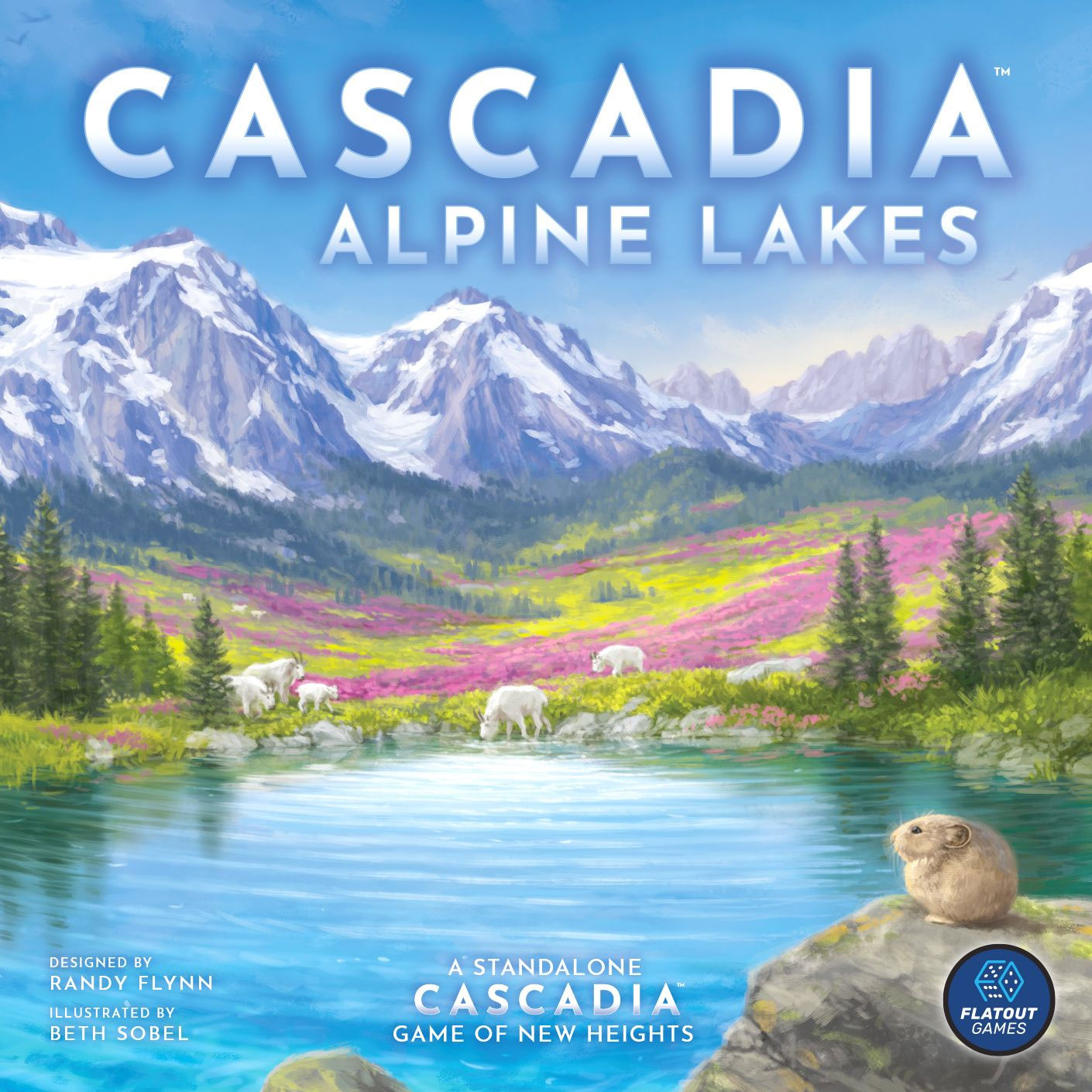
With Mother Nature reminding us that she is beautiful (when she’s not terrifying), I turned my attention to some soothing outdoor time. Perhaps a hike up a mountainside with wildlife watching and a pause lakeside to relax. By this I mean, of course, that I sat inside and opened Cascadia: Alpine Lakes. Let’s hang lakeside and see what you think.
Soundtrack for this game session: Open windows. Birdsong, breeze, and cicadas—all 100% natural, no AI!
Gameplay Overview:
This is not an expansion for Cascadia; it’s a standalone game with the same mechanics and overall theme. If you know how to play Cascadia, you know how to play Cascadia: Alpine Lakes. This rules overview is for those who may not have played the original.
Each player starts with a four-hex grid starter habitat with three habitat types represented (meadow, forest, and glacier). The habitats each have a wildlife icon or icons printed on them. Habitat goal cards are selected; these display a pattern of wildlife on the different habitats you must create to score points. There are four habitat goal cards, one for each habitat and one for lakes; lakes appear on some of the habitat tiles. Four habitat tiles (double hexes), each with a wildlife token (randomly selected), are laid out in a communal display.
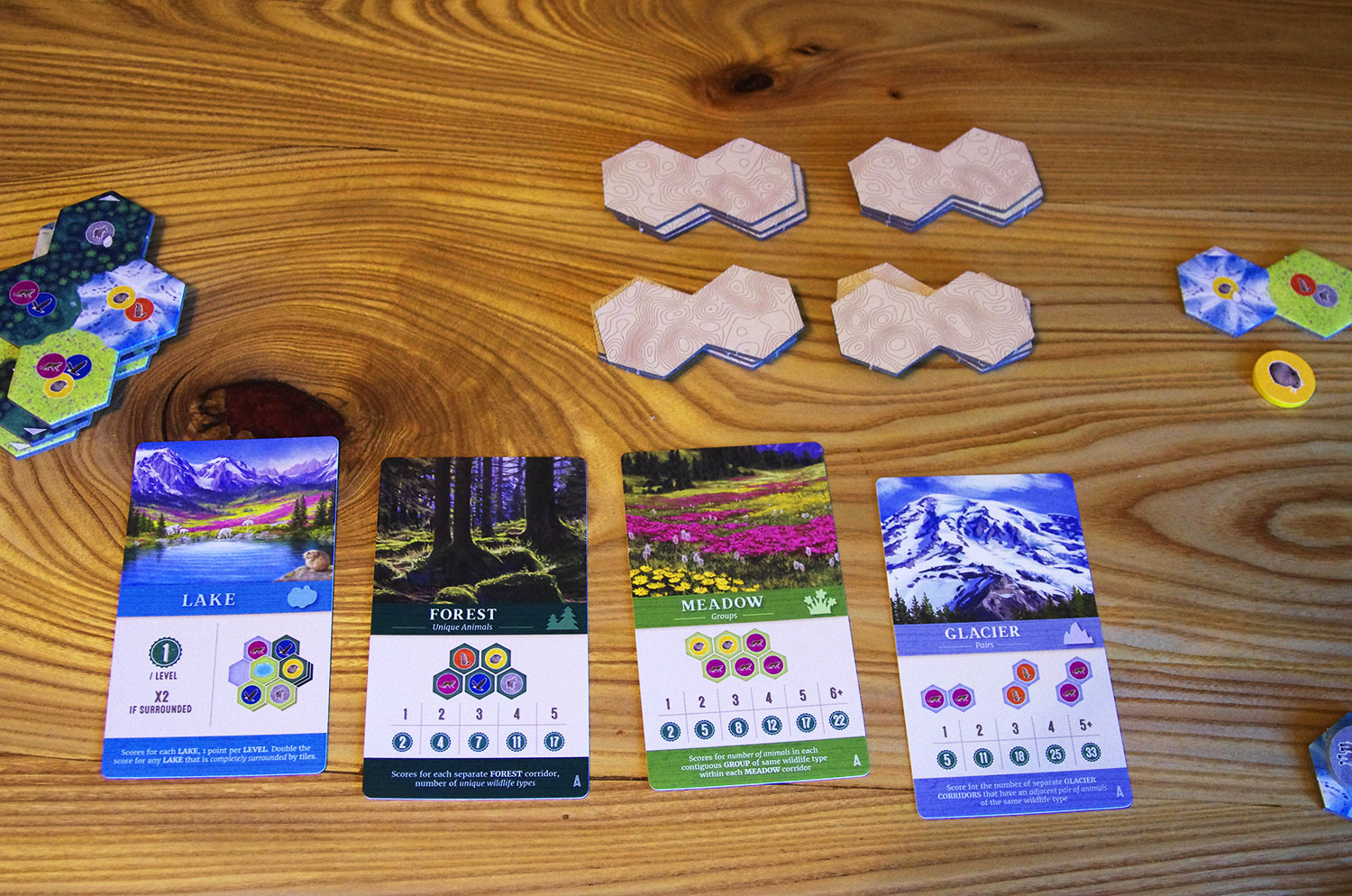
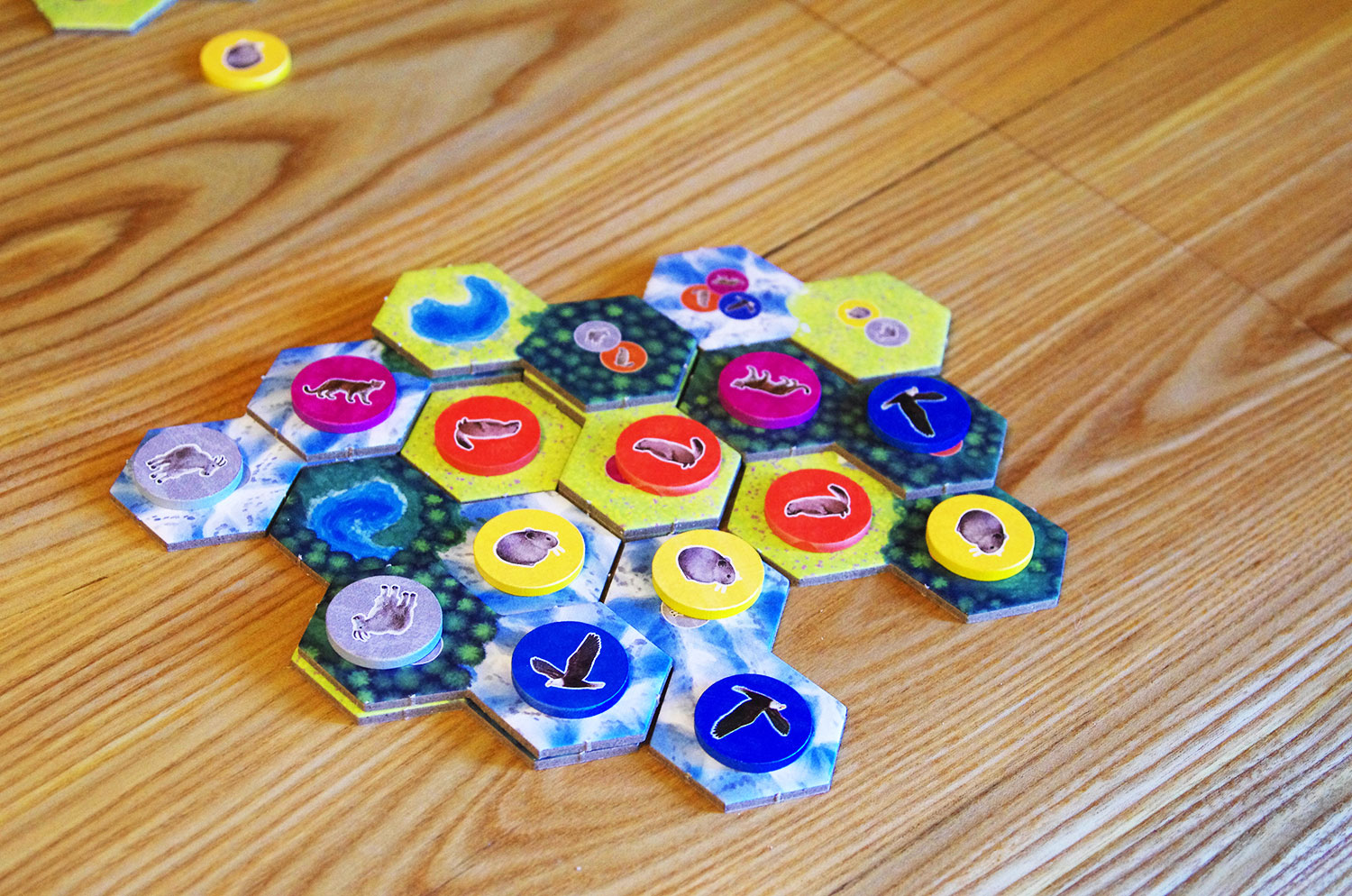
Each turn, select one tile and token pair, and place it in your tableau. The habitats do not need to match up, but you must be able to place the wildlife token somewhere in your tableau. The wildlife tokens (pikas, marmots, eagles, cougars, and mountain goats) can only be placed on a tile with their icon. Your tableau can be built vertically as well as horizontally. In order to stack, you must be no higher than one layer above tiles on at least one side of the hex. If a wildlife token is already on a tile, you can still layer another on top, but the new tile must also support that type of wildlife.
Play continues this way for 22 rounds. At the conclusion of 22 rounds, you score your tableau. The number of times you have achieved the pattern of wildlife on the different habitats earns points, as does the total number of animals at level 3 or higher. Lakes score based on level and whether they are surrounded or not. Highest score wins. You can adjust difficulty with Environment scoring cards chosen at the start of the game. These are optional and add more complex scoring goals.
Game Experience:
This review is based on solo play only.
When I opened up this game, I thought it was Cascadia with new cute animals and a stacking element. Read through the rules, played, scored (abysmally), and then re-read the rules. Played again. That’s when I realized this is not Cascadia with a stacking element; this is Cascadia that is All. About. Stacking.
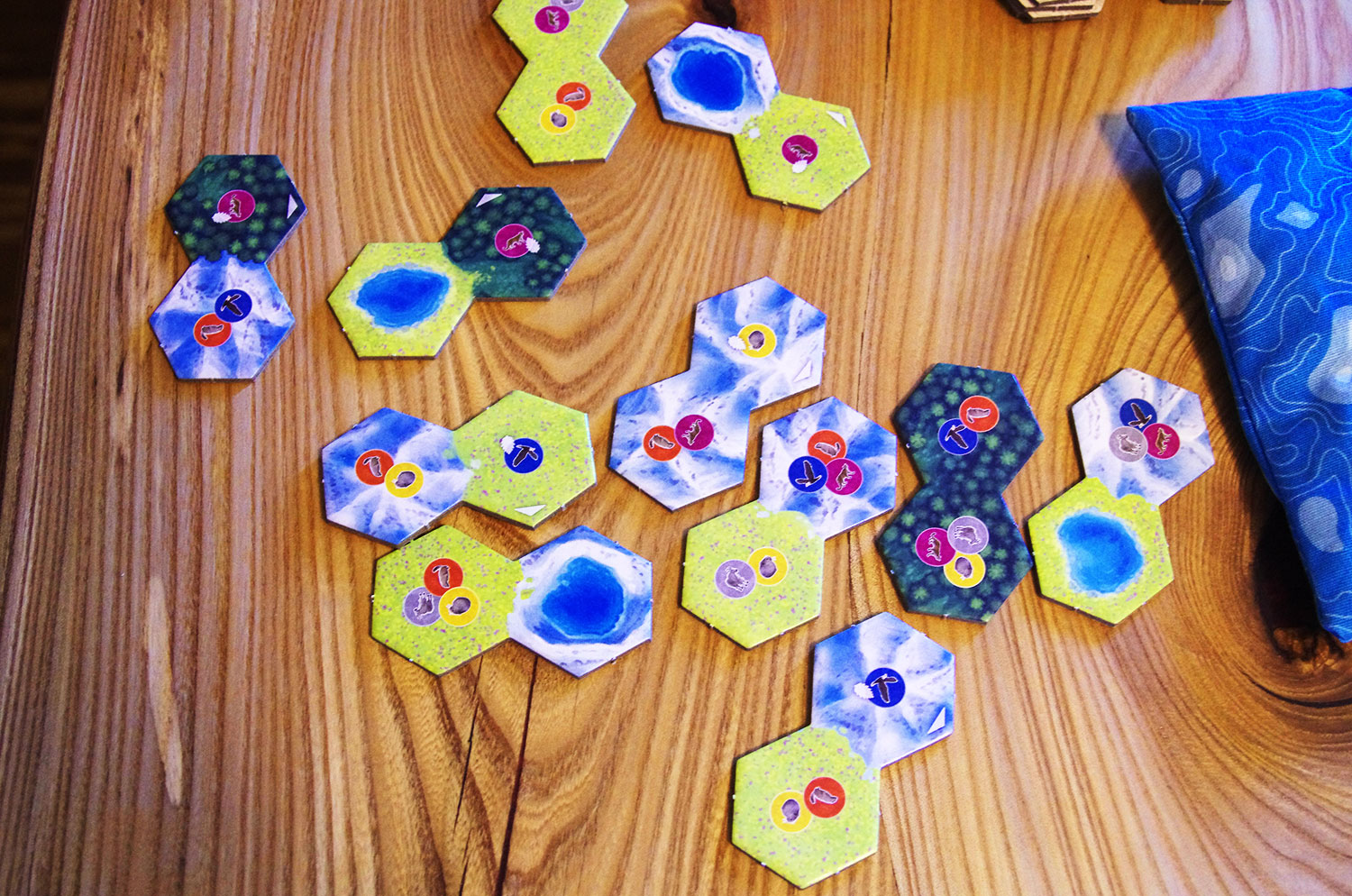
It doesn’t sound like a big change, but it adds a surprising level of complexity to your decision-making. You need a habitat that has enough hexes to create the animal pattern you need. That means you need a base of at least that many tiles; you can stack different habitats on top of each other, and the pattern can be on multiple levels. You can’t just endlessly stack though; you need to build stepwise. You score individual animals. Great! I got eight pikas in my meadow. These only score if they are Level 3 or above. Read that again. Your cute little pikas, no matter how many you lovingly added to your habitat, only score if they are on Level 3 or above. I lost a lot of points there. Similarly, your lakes are worth more points at higher elevations.
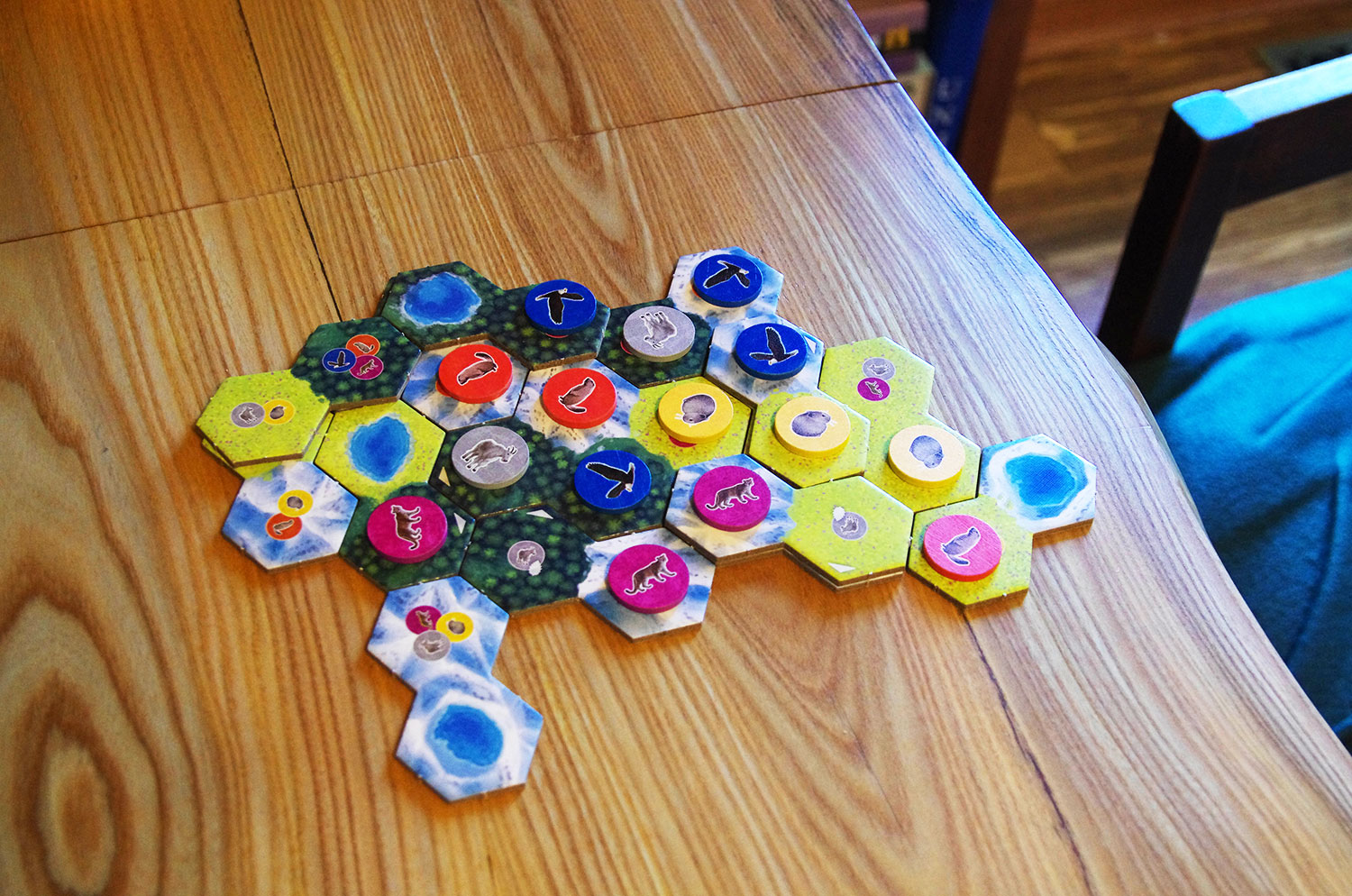
This is, at its heart, a pattern-building puzzle game. The stacking adds a literal additional dimension to the puzzle. I enjoyed Cascadia, but found that it felt rather samey pretty quickly. I do not get that feel with Cascadia: Alpine Lakes. Once it does start to feel like I’ve figured it out, I can start adding more complexity with those bonus scoring cards to see if I can not only make the required pattern but also force myself to consider spatial relations (no more than two instances of cougars on level 2, for example). That can burn your brain a bit. If I want still more challenge, they also have a list of achievements to try and meet and even mini scenarios with specific scorecard combinations to complete. I am anxious to give that a try because I adore that kind of thing. (Scenarios and achievements were also in the first Cascadia, but I forgot about them). This can also be used as a mini-expansion to Cascadia, giving you a reason to own both. Nice touch.
Final Thoughts:
Cascadia: Alpine Lakes is a game that presents as low intensity and yet is deceptively thinky. It has a quick-to-learn rule set and multiple options that will keep you coming back for more plays. It’s a beautiful setting, and the game art is simple but elegant. Definitely a game that will hit my table when I am craving the outdoors this winter and want to get the gray matter working.
Final Score: 4 Stars – Worthwhile addition to both the Cascadia family and my game collection
 Hits:
Hits:
• Quick learn
• No changes to gameplay between multi and solo
• Multiple options to adjust difficulty
Misses:
• I wish all my marmots scored – not just level 3 marmots
• May not need two Cascadias in a collection