

 As I’ve written before, my first gaming love was RPGs like Dungeons and Dragons, and I rediscovered board games as another way to experience that type of exploration and adventure. Many RPG-adjacent dungeon crawlers are crowdfunded, and while these games were nailing combat-heavy dungeon crawling and leveling up, other RPG-elements were often missing. Crowdfunded board games are also best known for being over-produced games that often miss their delivery date.
Today’s review is about Arydia: The Paths We Dare Tread, a crowdfunded game that offered lavish production, was late to deliver, and looked like a semi-open world RPG.
Gameplay Overview:
There’s a lot going on in Aryida, so there’s no way to delve into the details of the whole game. This overview will only cover highlights of the game mechanics.
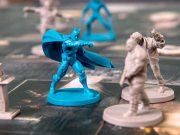
Each player will select a character path, which is their profession or class, and a race. Each path has its own pre-painted miniature, and each race has a different head along with player boards that hold all of your active skills and carried equipment. The story of the game is that you and your fellow players are Exiles looking to earn Squills by helping others to rejoin society, and you’ll learn a bit about your personal background as the game progresses.

You travel between regions on an overland map where you flip hexagon tiles to show the new location, which may be empty or have a town or some other interaction. As you adventure, you’ll explore more areas, find quests, battle enemies, and continue to level up until you finish the campaign.
Sometimes, you’ll be on a map tile showing a town or other location and can interact with NPCs, icons, and locations. Each NPC has a card that has prompts for what they’ll answer questions about, info about appearances, and small quirks. Roleplaying is encouraged with certain dialog choices, granting RP points which can be used to boost future attribute checks. Points of interest are similar to cards that provide guidance that may unlock new areas, a clue, or a new quest. Some icons on map tiles will have you add additional map tiles as you enter buildings, go upstairs, or enter a basement.
Combat takes place on these various map tiles, during which each character gets two actions and a minor action. Some minor actions grant focus, which can be used to trigger some abilities. Meanwhile, enemies will generate threat, which determines their next activation, which allows you to be proactive with your defense.
Combat uses a d20 system where values of typically 2+ hit the target, but higher values will be more impactful. Each weapon, skill, and spell will affect enemies in a pattern where you may attack a direction, such as sideways or diagonal, and then apply that to an enemy card, placing crystals to represent damage. These enemies may have armor that absorbs the first hit in some locations, while some abilities can bypass armor. Enemies roll different colored attack dice that hit locations, and your armor may absorb hits (or not once it’s damaged).
You’ll keep adventuring around the world, exploring, talking, and fighting until you finish the campaign.

Game Experience:
I’m only about halfway through the campaign at two players, but I felt like I’ve seen enough to share my thoughts. Arydia, as noted in the introduction, was late to arrive, but it was worth the wait. It’s easily one of the most impressive game productions I’ve seen, and each gameplay element is well thought out, and every session has been extremely satisfying.
The world feels alive as you have encounters and then meet the same people later and learn of their continuing story. Each NPC could offer a meaningless conversation, be a vendor, be a clue giver for a quest you don’t have, or be the start or end of a side quest. And this game is all about the side quests—in fact, the main storyline is essentially “go forth and do good” with an emergent narrative built around the side quests you do. Each character has their own quest to do, but essentially, if you replay the campaign, you’re likely to see a lot of the same content in that second play-through for both quests and puzzles.

Gaining loot and abilities is fun. Loot because you get to pull tokens out of a little chest, and abilities because you have to do a specific thing to master the ability to use it, which adds a fun RPG element as you master new abilities instead of suddenly being more powerful. And some of the abilities really do feel powerful. Each character has their own strengths and weaknesses and has unique cards that explain all of their abilities in their tuck boxes.
Leveling up gives you a lot of flexibility as you choose between upping your health, stamina, or mana, and an ability score. These values are set when you level up, allowing jumps in ability scores. Many skill checks use different ability scores, so there’s some advantage to having a decent number of different ability scores leveled up across the characters instead of being a one-stat pony.

Each interaction with an NPC, even without the players adding roleplaying to it, shows more about this world and really gives a feel for exploration and wonder. My son was really interested in getting to a particular hex, as part of a personal quest he had, and it was fun trying to figure out how to get there. I love it when someone we befriended crosses our paths, and it’s equally fun when we bump into recurring antagonists.
Decks of cards for travel events and combat are routinely being updated as you add and remove cards based on actions taken in the game. These could be one-time positive or negative effects in combat, while travel cards often trigger something based on your previous actions. NPC and location cards are often swapped from an A card to a B card as the game progresses, ensuring that your actions are remembered.

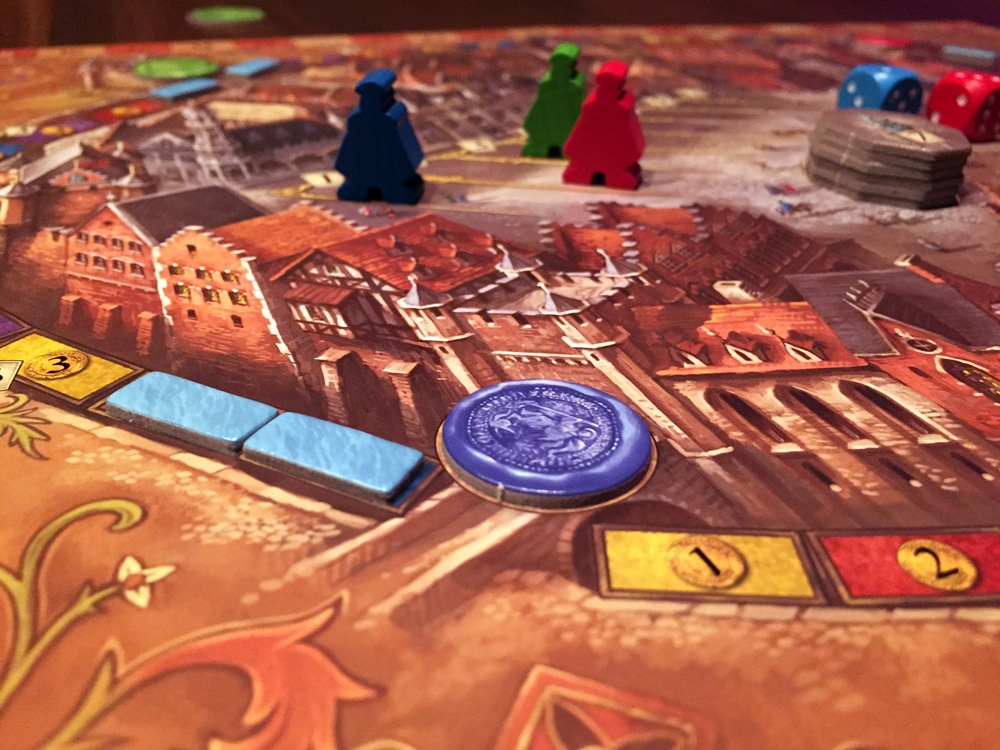
The production of the game is top-tier. Highlights include the pre-painted miniatures for heroes and all monsters, the gorgeous artwork on cards and maps, the dual-layered boards for the characters, and three boxes of cards for all NPCs, enemies, travel events, and more, which makes setup and teardown fast for such a big game.
Lastly, I have a few small nits to pick with the game. The first is that the tabs on the map holders are getting bent over and damaged both during use and storage. Additionally, they are a tight fit, making getting the cards back in frustrating. Lastly, the game can be a little fiddly as you fish for the next map, NPC cards, combatant cards, etc… There will be a point where you’ll have to pause to clean up piles of cards, and sometimes there’s a lot of cards, tiles, and stuff that just sprawl everywhere.
Final Thoughts:
If you love cooperative adventure, PRG’s, and dungeon crawl games, then Arydia: The Paths We Dare Tread is a must-buy if you can afford the hefty price tag. I do question the replay value, as noted earlier, it’s essentially all side quests, but I see this as a game that might be worth playing through more than once if enough time passes between campaigns, which is what I’m planning to do (resetting the game will be a time sink). But, since nothing is destroyed, you can also play it and then resell it.
I’ve backed too many games, and this is easily one of the best gaming experiences I’ve had. Maybe there will be a grind later that affects my enjoyment, or the ending won’t be satisfying, but as it stands today, I regret nothing, and Arydia was worth the wait.
Final Score: 5 Stars– Arydia sets the bar for cooperative RPG-like adventure tabletop games with a lavish production, clever mechanics, and extensive world building.
 Hits:
Hits:
• Overall production is *chef kiss*
• Combat system is tactical and rewarding
• Expansive world building leads to a real sense of exploration
• The world is detailed down to NPC quirks that bring it all to life
Misses:
• Replay value may be somewhat limited
• Game can be fiddly with cards and maps for days. Many days. So many days.
• Map storage is a little tight, and the tabs on the holders are getting damaged.









I never heard about this game before, thank you for the review.
Thus game is uniquely special and perfect to play as a family—love it!