
 Martin Wallace’s educational background in history has naturally lent towards his creation of some stereotypically “masculine” board game themes including that of warfare, trains, and industrialization. His latest design tackles what some may view as the most stereotypically masculine theme of them all: the Roman Empire. So for any men seeking to reach their daily quota of Roman history pondering—or history buffs of any gender—Aeterna may be the game for them.
Aeterna is a medium-weight area control game where 2-4 players embody Roman families attempting to increase their prestige through 1000 years of history (conveniently condensed here to 60-200 minutes) by ruling over territories, constructing buildings, and managing the unrest of citizens. To further appease history enthusiasts and obviate the need for a Wikipedia search, Aeterna’s appendix contains descriptions of every location, monument, and person in the game.
Gameplay Overview:

Aeterna takes place over three eras (rounds), and each era contains three phases: card drafting, actions, and scoring. Card drafting ensures each player starts with a hand of 4 cards plus a common pool of leftovers. Main actions typically cost citizens or other resources and include the following:
- Influence a hill of Rome by placing a citizen there, contributing towards its area control, and gaining an instant location-specific reward
- Play a card from your hand or the common pool, paying costs. Each card represents either:
- (A) Provinces that you’ve helped conquer.
- (B) Monuments built by your family. Monument cards usually provide an instant, ongoing, or once-per-round effect
- Pay a historical personality a high fee for a special one-time favor.
- Construct a building on a specific hill, influencing its output of points, food, and/or unrest for the remainder of the game.
- Pass for the round—gain points and priority for turn order preference for the next round, the earlier you do so
Scoring for each round begins by ascertaining area majorities on each hill. Players who control the various hills are awarded points as well as other rewards, as dictated by constructed buildings. They also incur unrest for controlling any hill experiencing overcrowding.
Players must then re-collect and feed all their citizens on the board, incurring unrest if any go hungry. Anytime a player’s unrest reaches certain benchmarks at end-round, they must pay hefty resource penalties and/or acquire doom tokens. At game-end, each player’s final position on the unrest track, modified by doom tokens, results in a deduction of anywhere from 0-17 points. Highest score wins.

Game Experience:
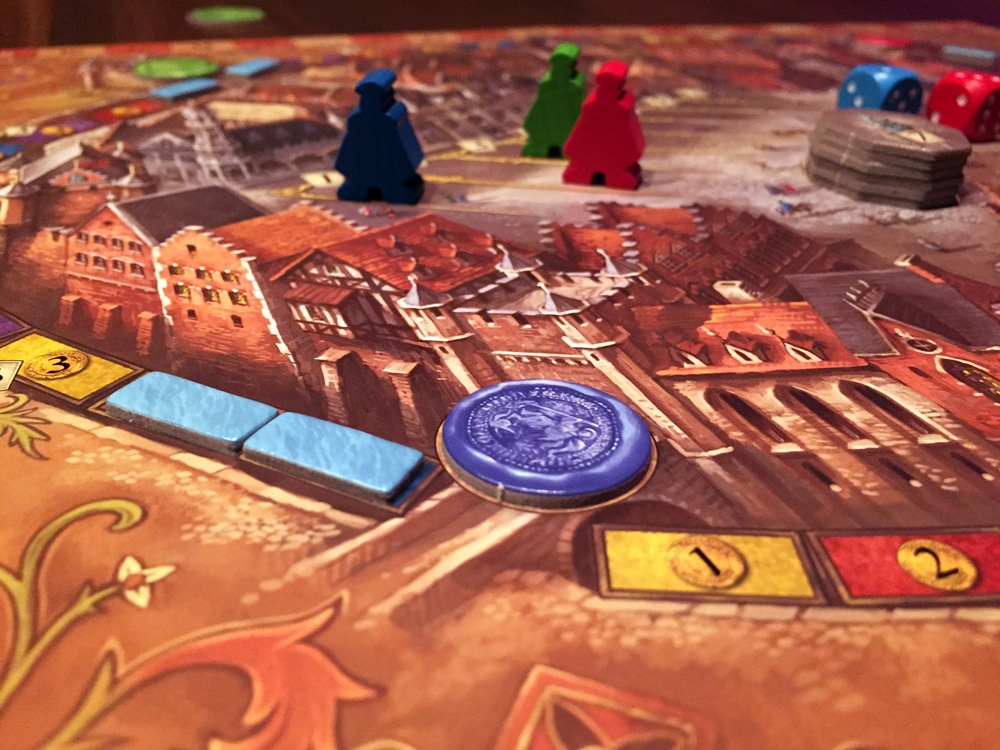
Aeterna is an elegantly designed Eurogame with a quick teach and highly interactive gameplay where the timing and cost of every action matter. Each hill is worth varying amounts of points and is associated with three unique instant rewards. It is tempting to rush to lay claim to a hill with a useful reward, or worth high point-value to both block others from that reward, and also because stealing control will require two of an opponent’s citizens.

Stalling to place citizens later is also a viable strategy to dictate the final control and over-crowding status of hills without opponents being able to respond. It is also tempting to rush to construct buildings on hills you think you’ll control by round end, as they boost hill control rewards (points, food, and/or unrest reduction), and only one building of each type can be built per round. But construct a building too early, and you may have just incentivized your opponents to steal control. At the same time, players are incentivized to pass for the round early, as this begets points and priority in choosing turn order for the next round.
The card play is also exciting and interactive. There are 1-2 personality cards and 2-4 monument/province cards (depending on player count) in a common pool available on a first dibs basis. Personality cards are expensive but can be worth big rewards if timed correctly; most of their rewards are based on the board state or card tableau status. You’ll want to delay purchasing them until you can maximize the reward, without waiting too long and losing out to someone else. The monument/province cards in your personal hand must often be timed appropriately owing to their synergistic cost/effect. Province cards cost citizens but usually provide money, stone, and unrest. Monument cards cost money and/or stone but usually provide new citizens and negative unrest. You’ll often want to play these cards in pairs, keeping in mind to save at least some resources to also participate in those time-sensitive area-control battles and construction of buildings.

Unrest is a unique game element that also factors heavily into decisions. At the end of each round, the top few hills most crowded with citizens will result in 2 unrest for the controlling player, as well as a reduction in point value of that hill for subsequent rounds. Unrest on the same hill twice means it may only be worth 1 point in the final round, and second-place control gets no points. The combination of buildings getting added and hill point values decreasing over time creates an interesting game arc. Ultimately, accumulating too much unrest can result in heavy resource and/or points penalties, so you’ll need to keep it in check. As a relatively risk-averse player, this is one of my least favorite elements of Aeterna; while you can predictably control unrest that occurs through cardplay and ensuring you have sufficient food for your people, the actions of other players can easily result in you unexpectedly gaining unrest or losing out on an opportunity to mitigate it.

As for player count, Aeterna shines at 3-4 players, but notably, every monument/province card gets used at 4 players in every game, which could limit replay value. The game still works very well at 2 players, although it tends to be a meaner zero-sum experience. The costly personality cards may also be less worthwhile, since most depend on a game-state that provides better rewards at higher player-counts.
My final note is that Aeterna can feel punishing. While players may build card tableaus that grant income and other helpful rewards, the costs of playing cards (both money and citizens) drastically increase in each era. Between that, having to feed your people, and worrying about unrest, the game may feel less emotionally satisfying to those who would rather focus on building as opposed to mitigating penalties.
Final Thoughts:
Aeterna has a lot to love: elegant design, great production, intense player interaction, and a delicate balance of resources and timing. It works very well at 2 players but truly shines at the higher player counts. The game possesses a robust arc as the valuation for controlling various hills changes with each round, depending on overpopulation and building constructions. For those seeking a combotastic engine-building experience, however, this is not it.
Aeterna is principally area control with card drafting and resource management, as well as some punishing elements like feeding your citizens and mitigating unrest that is not totally in your control. The balance of building influence versus mitigating penalties—all while attempting to force penalties on your opponents—is an interesting challenge but may not be a perfect fit for all. It’s nonetheless a beautifully illustrated and artfully designed game that will appeal to many history aficionados.
Final Score: 3.5 Stars – an elegantly designed medium-weight area control Eurogame that requires a balance of building, crowd-control, and brutality that may have some players questioning, “Am I not entertained?”
 Hits:
Hits:
• Elegant design
• Highly player-interactive
• Beautiful production filled with historical facts
Misses:
• Some may find it too punishing
• Personality cards tend to be less powerful at 2-player
• Limited card variability at 4 players