
 The Game of Life is a classic American childhood game that fills its players with excitement for the future as they imagine themselves getting a job, getting married, buying a house, and then having 1-4 kids, quite possibly all within a handful of successive, relatively effortless turns. The message: adult life is easy, fun, and filled with opportunities to win the lottery and/or casually drop $25K on an art auction.
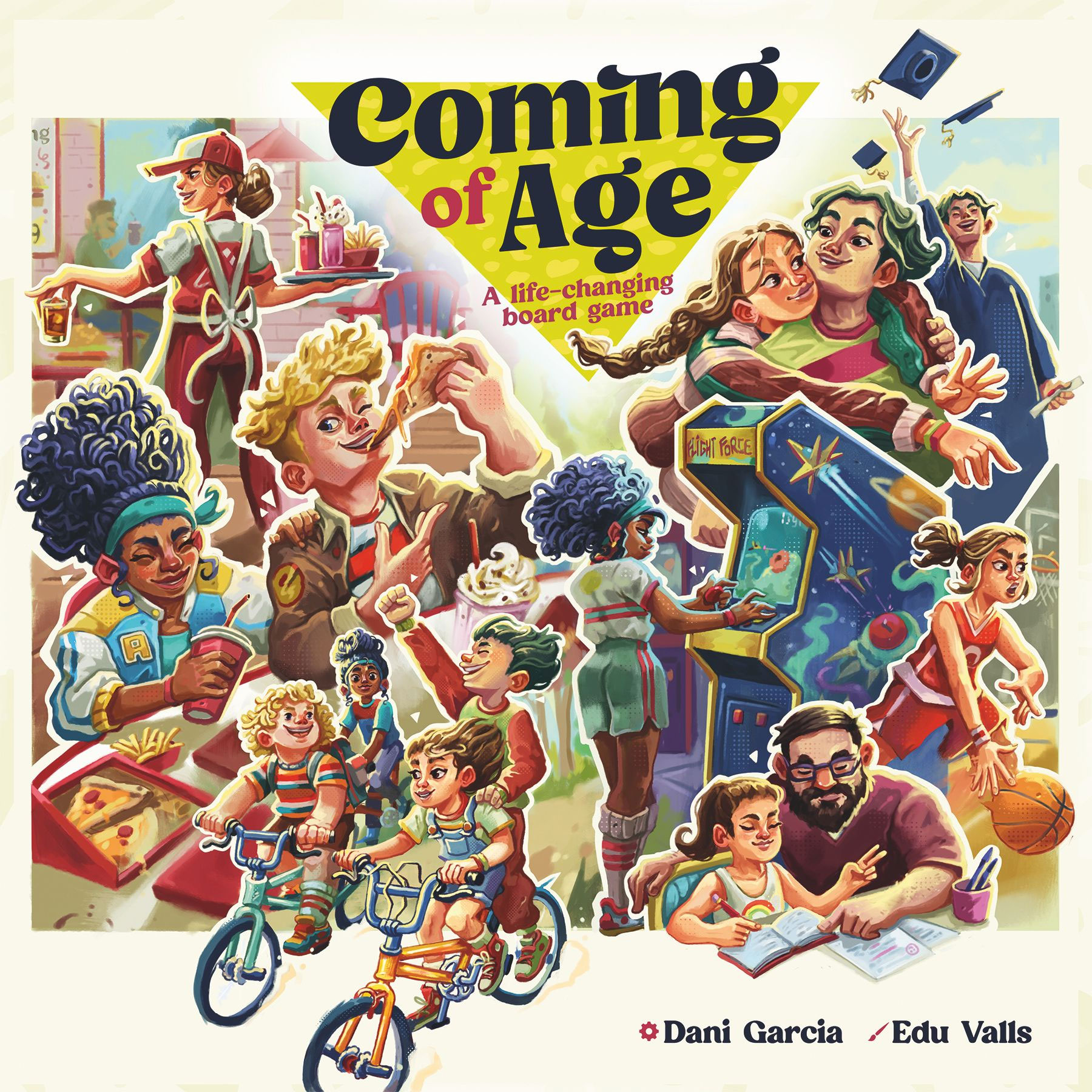
Pursuit of Happiness (2015) is probably the most recent/popular example of a Eurogame attempting to tackle this theme, containing gameplay that acknowledges working overtime causes stress, salads make you sad, and having children eats up all of your free time. Now comes Dani Garcia’s heavier Eurogame title, Coming of Age, which focuses on how foundational childhood experiences create adult personalities. It’s more like Inside Out, the board game, aimed at a medium-heavy gaming audience, allowing 1-4 players to compete over 40-80 minutes to raise the most well-adjusted young adults.
Gameplay Overview:
Coming of Age is played over 9 turns, with actions largely taking place simultaneously.
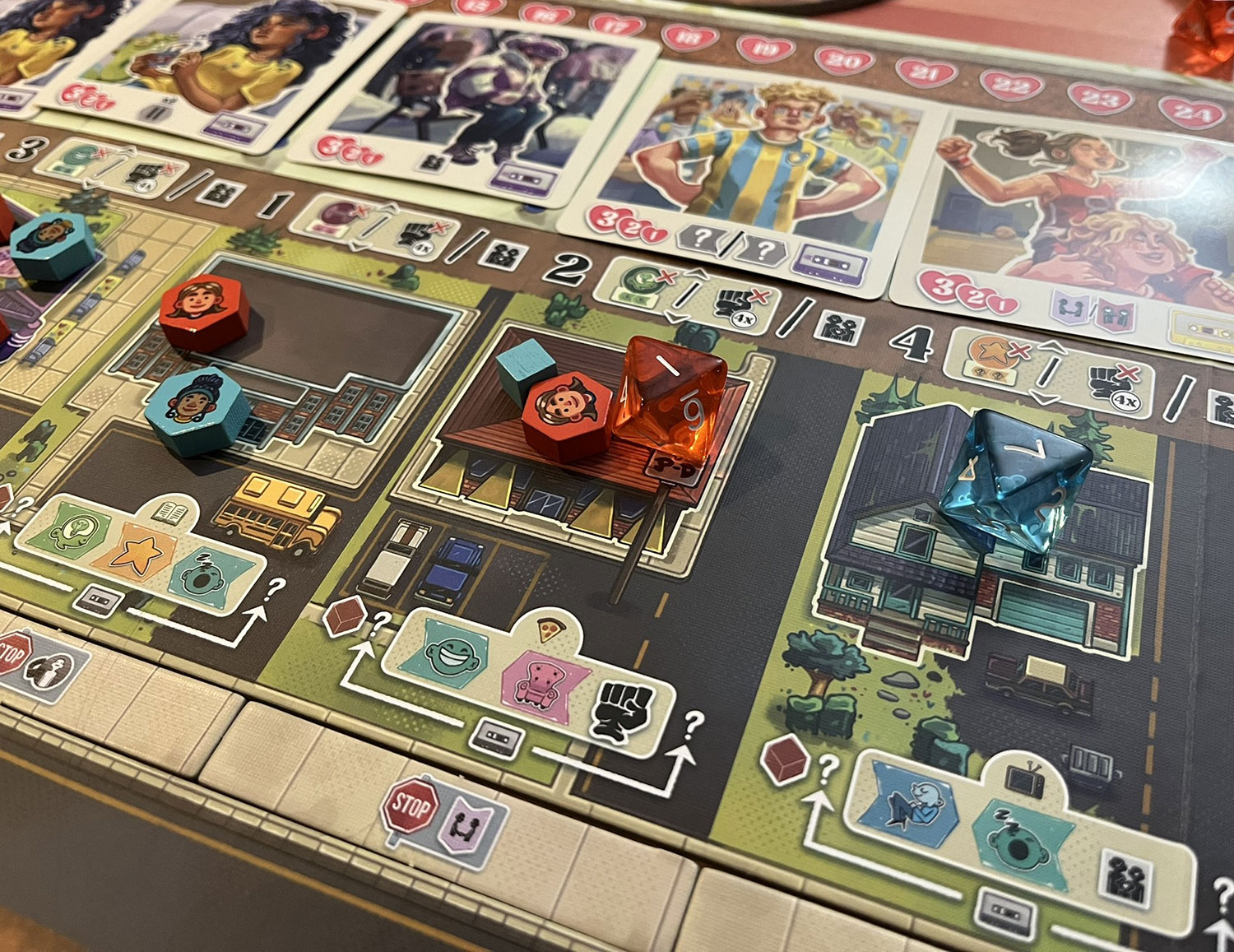
On each turn, players will roll 1-3 dice (depending on the turn), and the dice dictate numerically-linked locations/experiences available to them. In early turns, only age-appropriate locations/experiences like school/home are available. In later turns, more mature locations like the movie theater and train station become available.
Players will ultimately choose one location to experience each turn, acquiring frustration tokens if they choose a location outside of their dice rolls. Experiencing a location typically involves adjusting a specific set of mood counters on their personal character board, corresponding to such features as happiness, intellect, athleticism, sociability, and stress. Each mood counter can be adjusted upwards or downwards, with various rewards associated with any given movement.
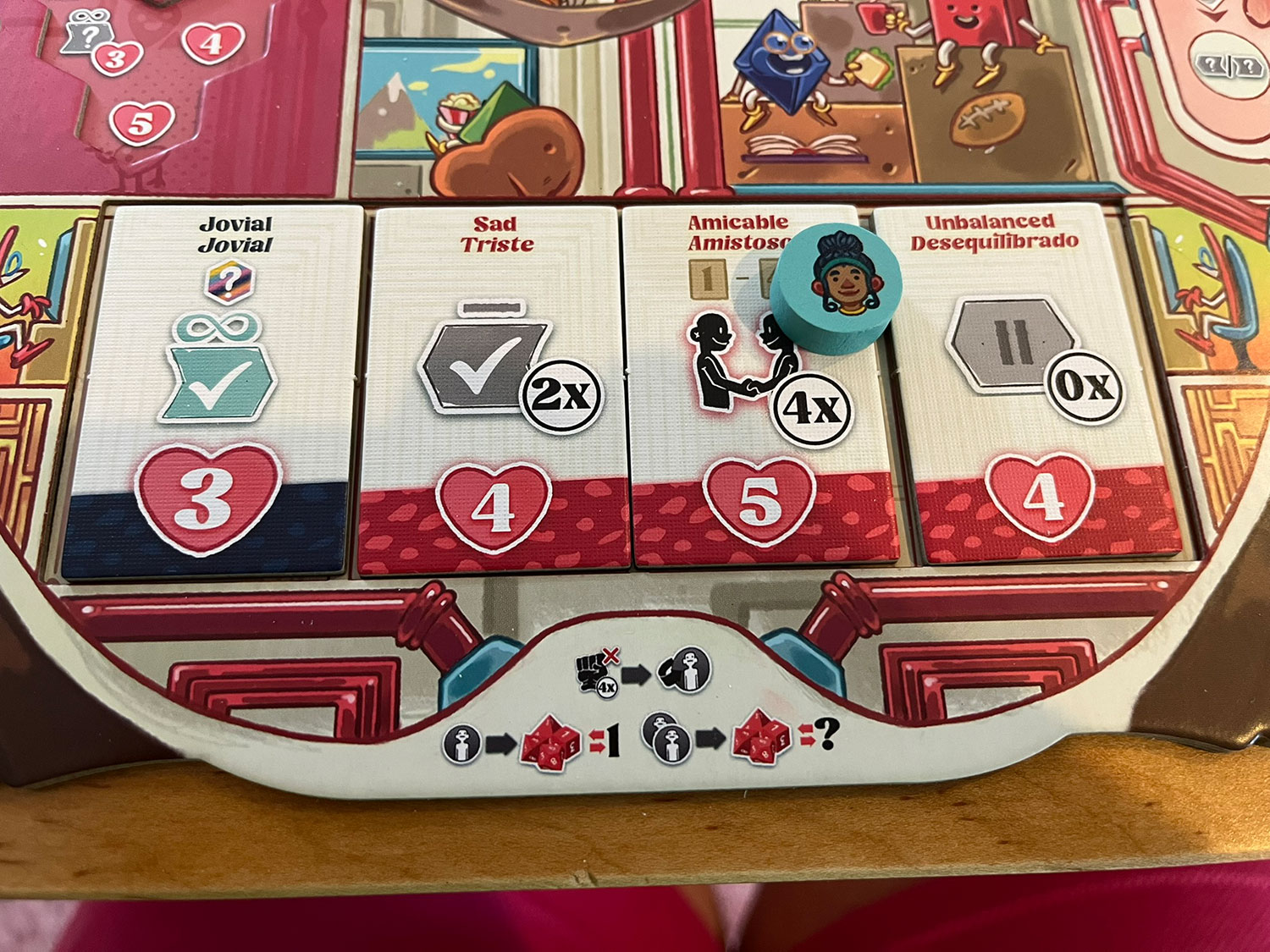
Other major elements include forming friendships with other characters, becoming a “regular” at certain locations, developing specific personality traits, creating powerful memories, and overcoming frustration, all of which contribute to your final score, along with 4 personal goals distributed at game start.
Game Experience:
Coming of Age is a unique Eurogame that has generated some divisive opinions. I can understand why; it is not obvious how to do well on your first play, and it is tempting to simply go where the dice tell you and subsequently feel like the game was a luck-fest that played you rather than the other way around. My husband and I are both heavy gamers, and we weren’t sure how we felt after our first play. I am so glad we had an opportunity to delve into the game some more and discover how truly wonderful it is.
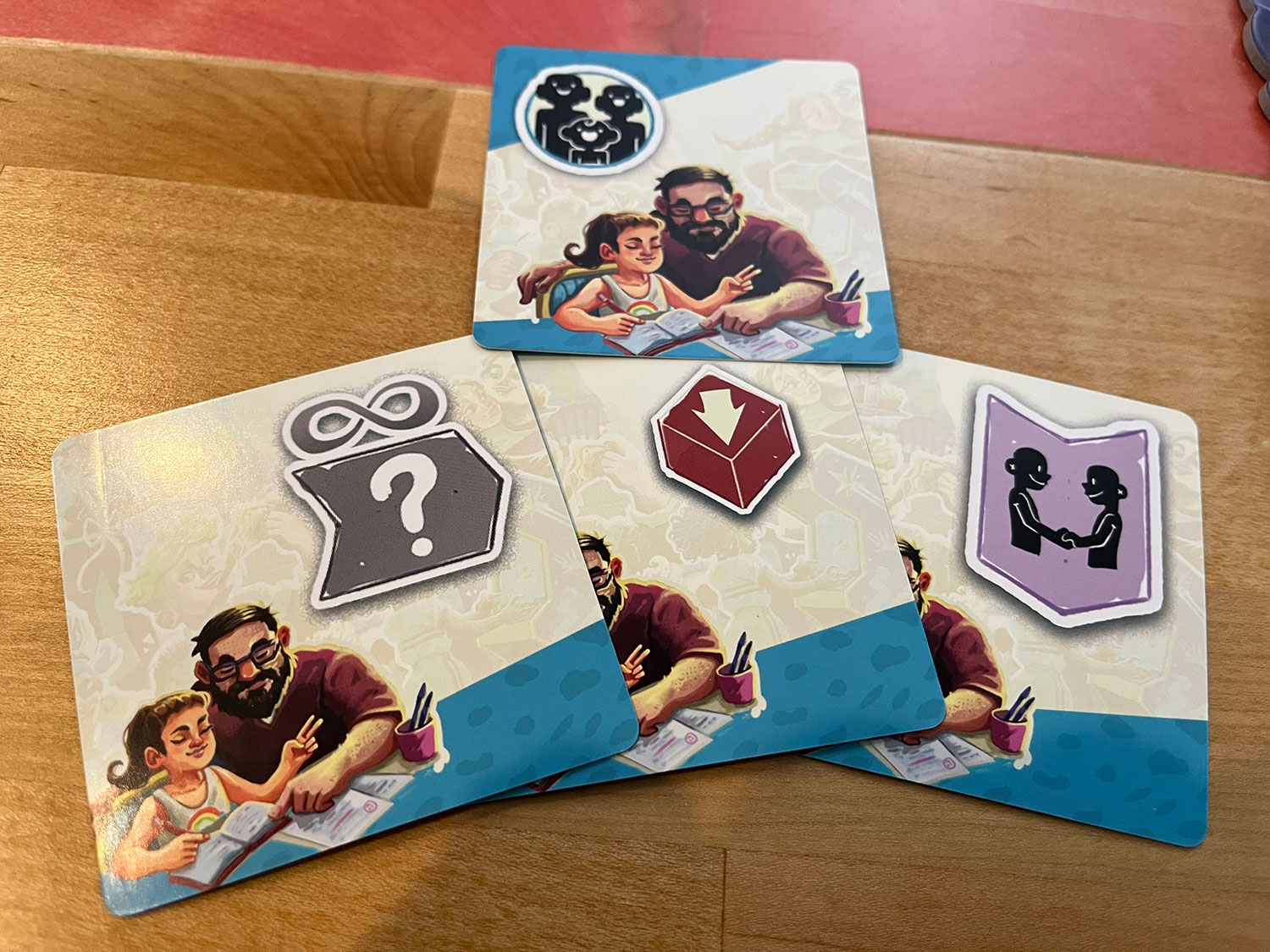
Once you understand the gameplay better, you’ll realize it’s actually quite tight if you’re hoping to fulfill as many private objectives and personality traits as you can. In a game of so few turns, every action matters, as well as the timing. Players must carefully exploit the various bonuses on tracks and elsewhere to tactically and strategically trigger specific combos and maneuver towards desired board states. So yes, there are some standard Eurogame elements, but there is more that makes Coming of Age stand out from the Eurogame crowd.
The tracks really are unique, including Bi-Directional and multi-token triggering
Most Eurogames have unidirectional tracks that are generally better in one direction than the other. The five main mood tracks of Coming of Age are short (only 5 steps each), and depending on game-state, you might want to be on the far right or left of any given one. Reaching the far right confers special ongoing rule-breaking abilities (unique to each track) that are essential for accomplishing certain tasks. Go to the far left of any track, however, and there are powerful one-time bonuses and an opportunity to overcome frustration if you bump the left edge. If you manage to overcome enough frustration, it can potentially make up ~20% of your score. Having to take frustration tokens is the “penalty” for changing your dice locations, and granted, it is possible to take too many, but ultimately, overcoming frustration is a key source of points in the game. It’s a really cool puzzle to properly time your movements both up and down these five tracks to maximize rewards.
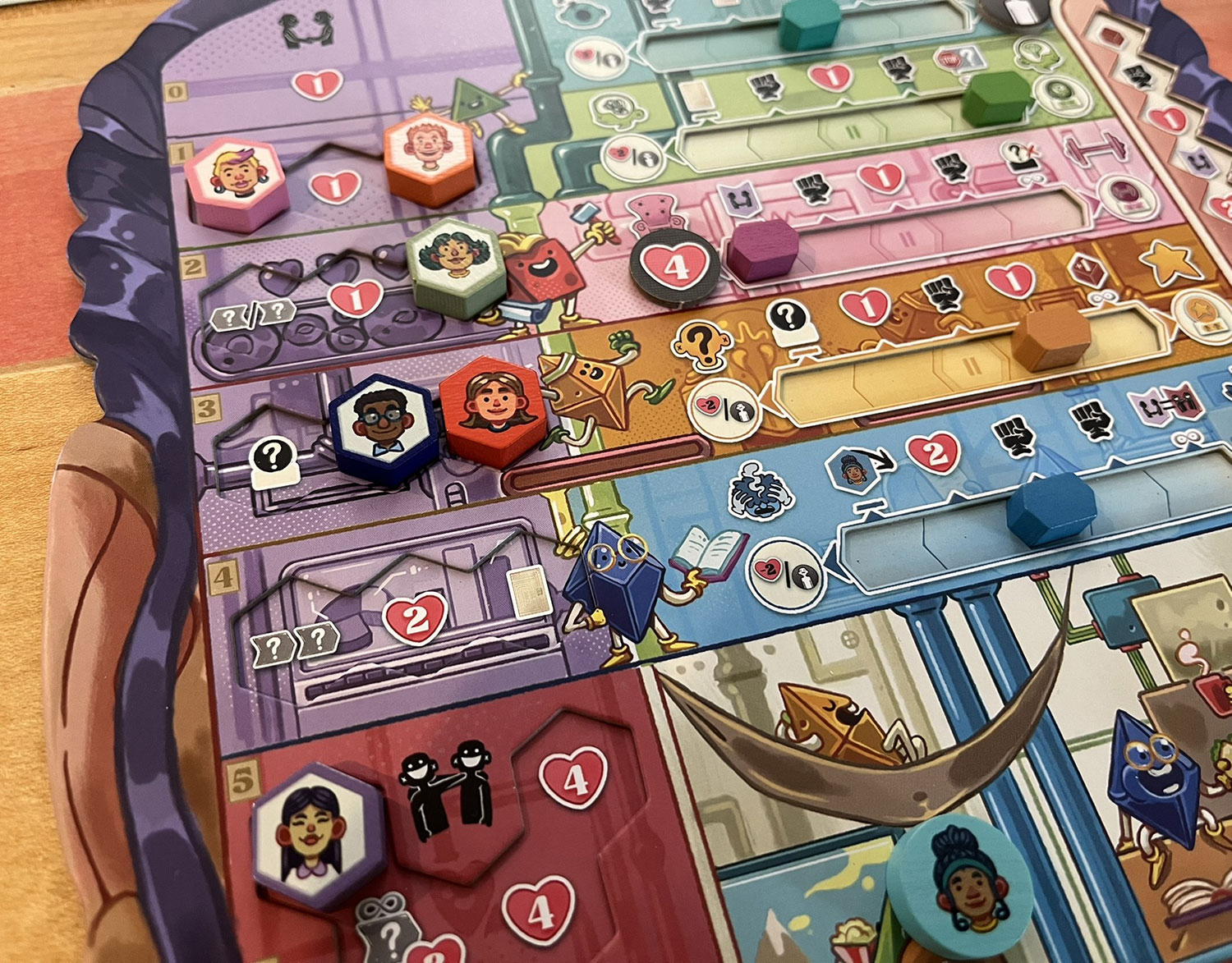
There’s also a friendship track/ladder on your playerboard where most of the rungs have 3 slots with unique bonuses. This track can theoretically be traversed by up to 8 different character tokens (five neutral friends and up to three friends for other players), but notably, no two characters can ever occupy the same exact slot at the same time. So if there’s a particular bonus you’d like to repeatedly exploit, it’s possible, but requires careful planning to move character tokens both into and out of that slot. There are also opportunities to score the trait goals belonging to other characters, but you need to be appropriately good friends for eligibility. Thus, you may be incentivized to move certain character tokens more quickly than others.
It’s a medium-heavy Eurogame that plays nearly simultaneously
Seriously, the game is mostly simultaneous. Granted, you’ll generally want to make sure everyone is done with a particular phase before moving on to the next, and the game can generate some serious AP, but for the most part, if everyone is comfortable with the rules, you really can think through your actions and execute them simultaneously, leaving minimal downtime. This is a rare crunchy medium-heavy Eurogame that can be set up and played in under an hour with experienced players, and I sincerely recommend it for all player counts. Creature Caravan and Terraforming Mars Ares Expedition are the only other games I can think of that come close to accomplishing the same thing.
 As for critiques, the big one is the rulebook. Grasping the unique gameplay becomes that much more difficult with a rulebook that insufficiently explains several key concepts. Fortunately, there are some excellent how-to-play videos at this point. Beyond that, a few of the personal goals are a bit more difficult than others, and I wish there were some luck mitigation when drawing new trait tiles.
Finally, not a critique, but a warning to those interested in this game purely for the theme; while the theme is definitely present in abundance, the gameplay is so thinky that you’ll more likely be thinking about the mechanics and, for example, the fact that you need a rightward bump on the pink track, rather than the fact that this means your character is becoming more athletic. To compare Coming of Age with Pursuit of Happiness, the latter is light enough to enjoy the theme more thoroughly, but Coming of Age is the crunchier, better, more balanced choice—and ultimately the title that is staying on this heavy gamer’s shelf.
Final Thoughts:
Coming of Age is a medium-heavy point salad Eurogame that is thematically akin to Inside Out, the board game, brilliantly incorporating several unique gameplay mechanics. The idea of bi-directional tracks with tantalizing rewards at each end presents a novel challenge as players must puzzle out how to trigger the best combination of bonuses in a timely manner. The fact that the crunchy gameplay occurs largely simultaneously means it plays great at all player counts, 1-4, and plays relatively quickly compared to other games of a similar weight.
Opinions seem to be divisive for this title, likely attributable to the somewhat confusing rulebook and the fact that it contains some unique mechanics that may not “click” with gamers during the first play. For gamers willing to give Coming of Age a fair chance, I think you’ll find your enthusiasm and maturity for the gameplay grow with successive plays, just like your character’s personality.
Final score: 4 stars — Employ Eurogame mechanics to recreate your childhood. Will you be the popular jock regularly attending concerts with friends, or the creative genius who relieves stress with solo mountain treks. This game contains multitudes.
 Hits:
Hits:
• Crunchy decisions with simultaneous play
• Unique track-based mechanics
• Fun and colorful thematic integration
Misses:
• Confusing rulebook
• Lack of choice in trait tiles